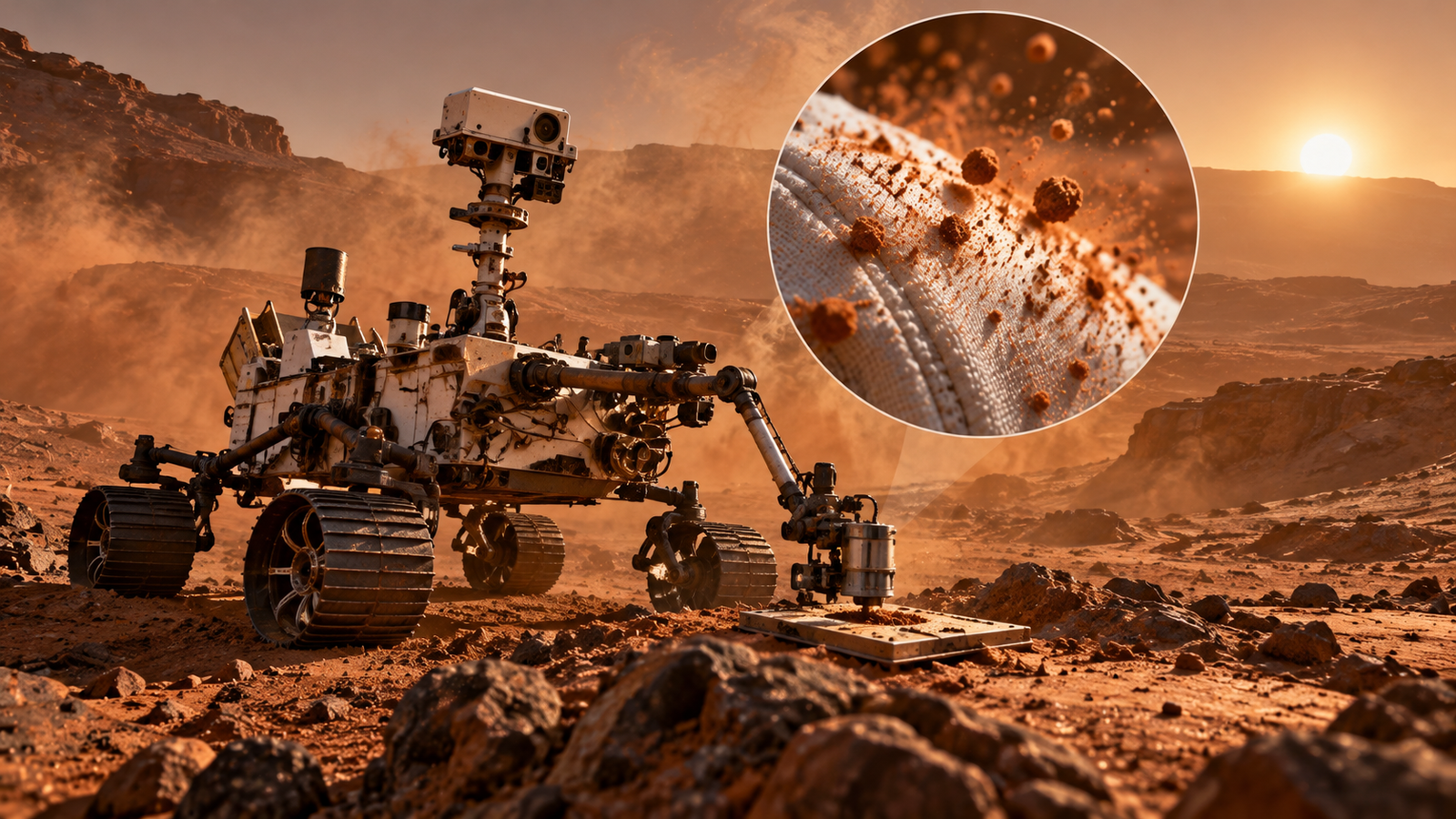
NASA’s Perseverance rover has directly measured exceptionally small dust particles on Mars, including grains around 100 nanometers across, in findings that could influence the design of future spacesuits and crew habitats. NASA announced the work on October 26, 2026, ahead of its planned October 27 publication in the Proceedings of the National Academy of Sciences, and Reuters reported on the findings on October 28. Using instruments and material samples already carried by Perseverance, researchers examined dust collected over 1,645 Martian days. The measurements offer new information about how particles adhere to surfaces and why preventing dust from entering living spaces will be important for astronauts. The study did not expose humans to Martian dust or establish a measured illness rate.
NASA Perseverance Mars Dust Discovery: Key Facts
Mission: NASA Mars 2020 Perseverance rover.
NASA news announcement: October 26, 2026.
Research publication announced: October 27, 2026 (PNAS).
Mukhbir article date: October 29, 2026.
Observation period: 1,645 Martian days, known as sols.
Smallest dust identified: Approximately 100 nanometers.
Fine particles: Below 2.5 micrometers.
Ultrafine samples: Roughly 100–300 nanometers in some measurements.
Previous directly resolved dust measurements: Down to about 3 micrometers.
Main instrument: PIXL, Planetary Instrument for X-ray Lithochemistry.
Additional material target: SHERLOC calibration swatches.
Test materials mentioned: Teflon, Vectran and basaltic glass.
Largest implication: Dust control, suit materials, airlocks and habitat safety.
Human exposure tested on Mars: No.
Confirmed astronaut illness: None; humans have not visited Mars.
Principal source: NASA Jet Propulsion Laboratory.
What Did NASA Discover on Mars?
Researchers measured tiny dust particles that had accumulated on exposed calibration targets and spacesuit-material samples aboard the rover. These measurements are important because earlier in-situ Martian observations resolved grains only down to roughly 3 micrometers. NASA reports fine particles smaller than 2.5 micrometers and ultrafine material around 100 nanometers. A nanometer is one-billionth of a meter; 100 nanometers is 0.1 micrometer. Unlike larger dust grains that can be inspected with many conventional methods, these exceptionally small particles are difficult to characterize directly on another planet. The result adds an important piece to the engineering picture of future Mars surface operations.
How Small Is 100 Nanometers?
NASA compares the ultrafine grains with a human hair about 70 micrometers wide. On that reference scale, a 100-nanometer particle is about 700 times smaller across than the hair’s diameter. The comparison describes width, not mass or volume. Fine particles under 2.5 micrometers are often called PM2.5 in air-quality discussions on Earth; ultrafine particles are smaller still. A tiny diameter does not automatically mean a particle will be inhaled, because actual exposure depends on whether it becomes airborne, how long it remains suspended, and the effectiveness of filtration and protective systems. Size nevertheless affects how particles behave and why they may be challenging to remove.
How Perseverance Collected the Measurements
NASA’s rover carries samples of spacesuit materials that were originally intended to help study how those materials endure the Martian environment. Five small swatches, about 20 millimeters square, are mounted on a calibration target associated with SHERLOC, the rover’s Raman and luminescence instrument. The PIXL X-ray instrument has its own calibration targets, including Teflon and basaltic glass. Scientists examined particle accumulation on these surfaces over multiple observations. Rather than collecting a breathable air sample inside a habitat, the team measured particles adhering to exposed materials. This is a valuable but specific type of evidence: it does not directly quantify an astronaut’s inhaled dose.
Why a Calibration Target Became a Dust Experiment
Instruments need calibration materials to test whether measurements remain accurate over time. Researchers realized that particles coating the surfaces could also provide useful information about Martian dust. PIXL’s X-ray measurements and the chosen target materials helped separate signals associated with collected dust from those produced by the target itself. The result is an example of extracting additional scientific value from equipment already on a mission. It also reflects a limitation: particles that stick to a specific surface may not represent all dust moving through the surrounding atmosphere. Investigators need to account for attraction, surface chemistry and sampling conditions when interpreting the data.
What Did the Scientists See on Different Materials?
NASA reports that dust on PIXL’s Teflon target and SHERLOC’s Vectran swatch averaged about 2 micrometers, while PIXL’s basaltic-glass target and SHERLOC’s Teflon swatch contained particle sizes down to approximately 100–300 nanometers. The differences suggest that surface properties affect which grains accumulate and remain attached. Some materials collected less dust by quantity but retained finer particles. This distinction matters when choosing fabrics or coatings for equipment: a surface that appears relatively clean may still carry microscopic material. The experiment does not establish one universally safest spacesuit fabric, because full durability, sealing, handling and cleaning performance also need to be evaluated.
Why Static Electricity Matters
Dust particles can become electrically charged when they collide and interact with surfaces. On Mars, where very dry conditions and frequent dust movement are common, electrostatic behavior may influence what remains attached to fabrics, tools and spacecraft equipment. NASA says static electricity appears to help determine which particle sizes adhere to particular calibration targets. Smaller grains can persist through years of rover activity, even when larger clumps are shaken loose. Such persistence makes cleaning more difficult because a surface may shed visible dust while retaining tiny particles. Engineers need to understand adhesion before deciding whether brushing, mechanical barriers, electrostatic removal or other techniques provide adequate protection.
What Chemicals Are Present in Martian Dust?
NASA describes Martian dust as rich in iron and sulfur, with chlorine and silica also important to its composition. PIXL reported enrichment in phosphorus and signs of calcium sulfate in the analyzed material. Scientists also recognize chemically reactive compounds, including perchlorates, as possible hazards in the broader Martian environment. The risk depends on the form and concentration of a substance as well as how it enters the body. Detection of a chemical on a planetary surface is not the same as proving harmful exposure inside a sealed astronaut habitat. Nevertheless, it informs the list of substances that future environmental control systems may need to monitor.
Could Mars Dust Harm Astronauts’ Lungs?
On Earth, small airborne particles are associated with health effects because they can penetrate deeply into the respiratory tract. Very fine particles may reach areas of the lungs where removal is difficult, and research on certain ultrafine particles shows routes through which they can influence other tissues. NASA identifies these mechanisms as reasons to study Martian dust carefully. However, the mission did not run human exposure experiments on Mars, and no astronaut has been diagnosed with an illness from breathing Martian dust. The actual risk will depend on dust concentration inside living spaces, exposure duration, mineral chemistry, filtration performance and the physical condition of the crew.
How Is Martian Dust Different From Moon Dust?
Lunar dust grains are often angular and abrasive because the Moon lacks wind-driven weathering comparable to Mars. Apollo astronauts encountered dust that scratched visors and affected equipment seals, and some reported irritation resembling hay fever. Mars has an atmosphere and winds that can repeatedly move particles, rounding their edges through collisions. That may make many Martian grains less mechanically abrasive than lunar dust, but their very small size and chemical content create different concerns. Dust that stays airborne or adheres to a suit can still be troublesome even if its edges are less sharp. These environments therefore require related but distinct protective strategies.
Why Mars Dust Storms Increase the Challenge
Dust activity on Mars ranges from local lifting to regional and occasionally global storms. Wind can redistribute fine material across large distances, while settled dust can cover equipment and instruments. The new study’s persistence findings suggest that once the smallest particles stick to certain surfaces, ordinary vibration or movement may not remove them easily. That affects both exploration outside a habitat and the process of returning inside. A single storm is not required for contamination; routine vehicle operation and footsteps may also disturb loose material. Future engineering plans must account for changing weather, predictable cleaning routines and emergency conditions without assuming all dust behaves the same way.
What Are Suitports and Why Might They Help?
A suitport is an arrangement that lets an astronaut access a spacesuit attached to the exterior of a habitat or vehicle, reducing the need to bring the entire dusty suit into the living area. NASA mentions suitports and dual-chamber airlocks as possible ways of limiting contamination. Such systems would not eliminate every particle or chemical hazard, but they could reduce how much exposed gear crosses into the interior environment. Their practical effectiveness depends on seals, materials, maintenance procedures and repeated use in realistic conditions. The Perseverance measurements can inform their design, yet the study did not demonstrate a finished Mars habitat operating one of these systems.
How Better Spacesuit Fabrics Could Help
Materials for space exploration must balance flexibility, strength, resistance to wear, thermal conditions and the ability to limit dust accumulation. Teflon and Vectran were among the samples examined by Perseverance. Their observed differences in particle adhesion could help engineers select coatings or fabric combinations, but a decision cannot be based on dust attraction alone. A material that collects less visible dust may retain especially fine grains or have unrelated mechanical weaknesses. NASA reports no clear material damage from this experiment, according to Reuters’ description of the results. Future laboratory testing and actual mission requirements will determine whether new fabrics or treatments are adopted.
NASA’s Dust-Removal Technology Research
NASA is studying techniques that might help keep hardware clean without relying entirely on manual brushing. In March 2025, an Electrodynamic Dust Shield experiment flew to the Moon aboard Firefly Aerospace’s Blue Ghost Mission 1 and used electric fields to move lunar material from surfaces. NASA also uses testing facilities on Earth to examine suit components and dust-mitigation tools with simulated extraterrestrial material. The Mars observations can make those studies more realistic by establishing the range of particle sizes and surface interactions that researchers should investigate. Lunar technology demonstrations are encouraging, but their results must be adapted and validated for Martian conditions.
Why the Discovery Matters for Human Mars Missions
Future Mars crews would need to operate outside for scientific tasks, vehicle maintenance, sampling and construction. Each excursion could transfer dust to tools, suits and potentially interior spaces. Over time, repeated exposure could create problems for human health and equipment. NASA’s new measurements provide engineers with size information that can improve assumptions in filtration, cleaning and materials testing. Planning for a possible crewed mission in the 2030s remains a goal, not a guaranteed launch schedule or evidence that all technological obstacles are solved. Protecting people from dust is one challenge among many, alongside radiation, life support, power, landing systems and the long journey.
What the Study Does Not Prove
The findings do not show that future astronauts will inevitably become sick, that toxic particles have already entered a human bloodstream on Mars or that NASA has found a new life form. They do not establish the full distribution of dust in every Martian region. The measurements come from material surfaces at one rover’s operating environment and are influenced by adhesion. They do provide the first direct on-site characterization of grains at a notably smaller scale than earlier measurements. Responsible scientific reporting should separate the discovery of small particles from the unmeasured probability of human illness. Overstating health effects would misrepresent an important but carefully limited study.
How the Finding Relates to Perseverance’s Main Mission
Perseverance has been exploring Jezero Crater and investigating evidence of ancient environmental conditions that may have been suitable for microbial life. The rover also carries technology and materials useful for planning human exploration. The new dust research comes from that second dimension of the mission. It illustrates how planetary science, engineering and human-health preparation can overlap, even when a rover’s main headline goal is searching for signs of past life. The presence of fine particles is not itself a biological finding. It helps researchers understand a physical environment that future explorers might have to navigate safely.
Why Pakistan and South Asian Readers Should Care
This discovery has global scientific significance and educational relevance for students studying physics, chemistry, materials science, robotics and medicine. Engineers in Pakistan and other South Asian countries can follow the research as an example of how a small calibration experiment can generate new engineering knowledge. It also provides an accessible illustration of particle size, static electricity and contamination control. No Pakistani space mission, research contract or direct national health threat was announced in NASA’s release. The local relevance is therefore scientific learning rather than an immediate government policy or public-health emergency. There is no reason to link this Martian finding to today’s air quality in Pakistani cities as if they were identical exposures.
What Will Scientists Investigate Next?
Researchers may use these measurements to refine laboratory simulants, study how materials retain different particle sizes and improve models of contamination inside potential Mars habitats. They may also examine the relationship between surface electrical properties and dust removal methods. Future mission studies can compare results across different locations and seasons, but no specific new experiment timeline was announced in NASA’s October 26 article. The next meaningful evidence will come from additional validated measurements and engineering tests, not from speculation about astronauts breathing dust on a mission that has not yet occurred. Understanding particle behavior is a prerequisite for deciding what mitigation approach works best.
Conclusion
NASA’s Perseverance mission has directly measured fine and ultrafine Martian dust, with particles as small as about 100 nanometers found attached to exposed materials. Observations across 1,645 Martian days show that different surfaces attract and retain different particle sizes, including grains that persist long after larger clumps have fallen away. The finding is relevant to spacesuit fabrics, airlocks, habitat filtration and the broader planning of eventual human exploration. It does not prove that astronauts will be harmed, but it gives researchers better information about a manageable hazard that must be addressed. The study is a concrete scientific result, not a warning of an immediate crisis.
Frequently Asked Questions
What did NASA’s Perseverance rover discover in October 2026?
The rover detected fine and ultrafine dust grains on Mars, including particles about 100 nanometers across, on exposed calibration and spacesuit-material samples.
When did NASA announce the Mars dust research?
NASA published its announcement on October 26, 2026, before the planned October 27 PNAS research publication.
How small is a 100-nanometer particle?
It is 0.1 micrometer wide, about 700 times smaller in diameter than NASA’s reference human hair of 70 micrometers.
What instruments were involved?
Researchers used the PIXL instrument and material calibration targets associated with SHERLOC on the Perseverance rover.
Which spacesuit materials were studied?
The sampled surfaces included Teflon and Vectran; a basaltic-glass calibration surface also provided useful measurements.
Does the discovery prove Mars dust has injured astronauts?
No. Humans have not visited Mars, and the rover study did not measure human inhalation or illness.
Why is ultrafine Mars dust a concern?
Its small size and chemistry could make contamination and potential inhalation difficult to manage if particles entered future crew living spaces.
How might NASA protect future Mars crews?
Possible measures include improved suit materials, cleaning technologies, filtration, suitports and airlock designs, subject to further testing.
About The Author