The Gujrat brother murder case 2026 has drawn attention after police arrested Muhammad Bilal, the elder brother of 24-year-old Muhammad Sufyan, whose body was found near Drekri Road in Punjab’s Gujrat district. Investigators say Bilal returned from Saudi Arabia without informing most relatives and allegedly arranged to meet Sufyan on the day he died. Police statements reported by Dawn and Dunya News, and detailed coverage of the FIR and investigation, describe CCTV evidence that challenged Bilal’s account of when he entered Pakistan. The case reportedly dates to October 17, 2026. Bilal is an arrested suspect, not a person whose guilt has been established by a final court judgment in the sources reviewed.
Gujrat Brother Murder Case 2026: Key Facts
Location: Near Drekri/Dharekri Road, Gujrat district, Punjab, Pakistan.
Reported incident and FIR date: October 17, 2026, according to FIR-based coverage.
Victim: Muhammad Sufyan, age 24.
Arrested suspect: Muhammad Bilal, the victim’s elder brother.
Father and FIR complainant: Khalid Mahmood.
Police jurisdiction: Daulat Nagar police station.
Suspect’s previous residence: Saudi Arabia, according to reports.
Reported evidence: CCTV and Safe City camera footage, other investigation and items submitted for forensic examination.
Missing items initially reported: Victim’s motorcycle and mobile phone.
First detailed newspaper coverage reviewed: Dawn and Dunya, October 21, 2026.
Subsequent detailed reporting: October 22–27, 2026.
Court proceedings: A three-day police remand was reported after an appearance before a judicial magistrate.
Final motive: Disputed or incompletely established in accessible reporting.
Conviction or final judicial verdict: Not verified as of this publication.
What Happened in Gujrat?
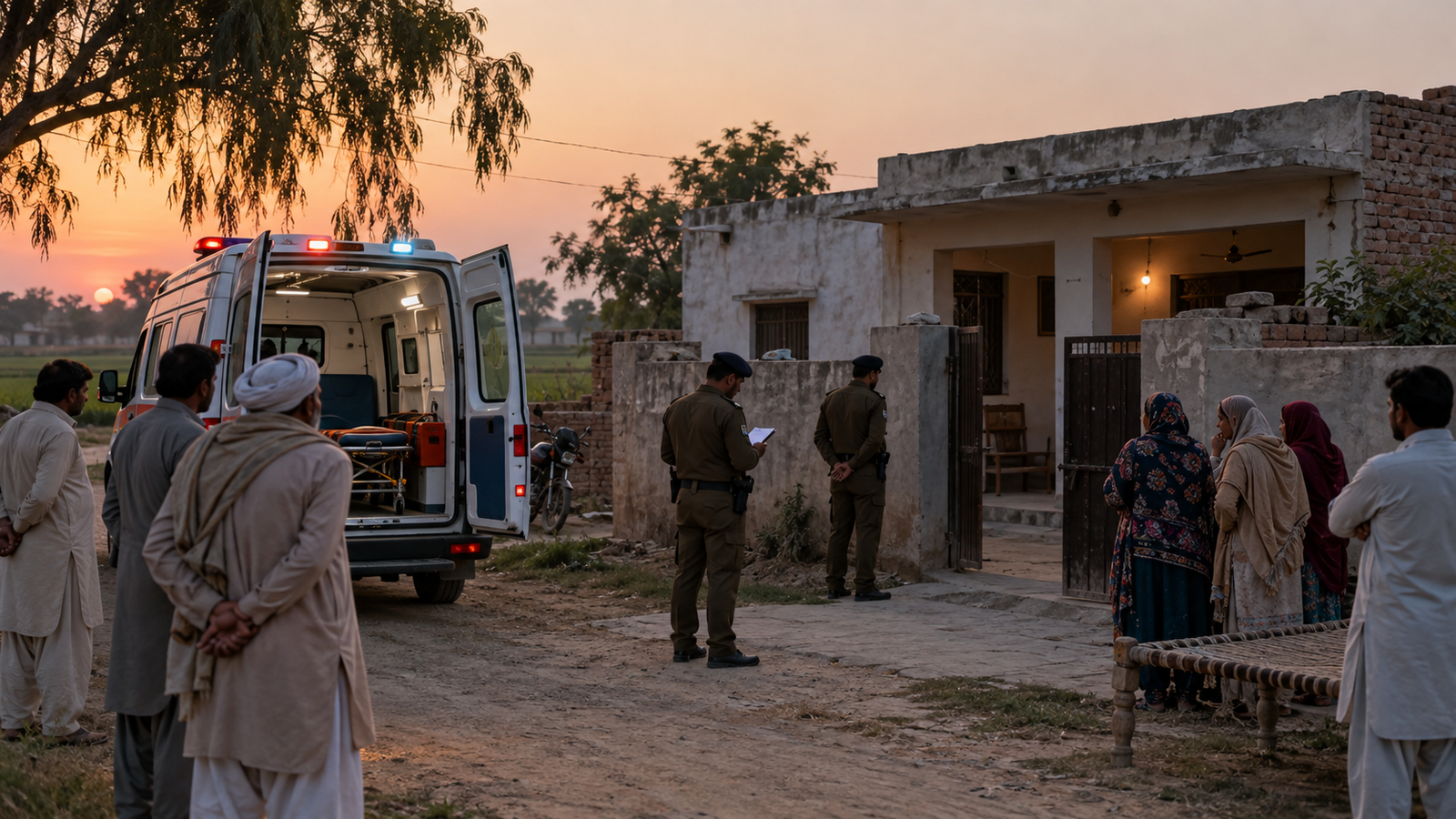
According to reporting based on the initial police complaint, Sufyan left his family’s home in Roperi village on a motorcycle on October 17 to travel toward Gujrat city. He did not return by evening. His father searched for him with others, and Sufyan’s body was found close to a road near the under-construction motorway bridge in the Daulat Nagar police area. The motorcycle and mobile phone were reportedly absent. Police registered a case against unidentified persons and began collecting evidence. These early circumstances prompted investigators to examine whether an apparent robbery was connected to the death, but the later investigation reportedly focused on someone close to the victim.
The Date Discrepancy: October 17 or October 19?
The date requires careful attribution. Dunya’s October 21 story and later FIR-based reports state that Sufyan’s body was found and the case registered on October 17. A Dawn report published October 21 describes the victim as leaving home on a Monday, which would point to a different date. Rather than silently combining these accounts, this article identifies October 17 as the FIR-based reported incident date and notes the inconsistency. The definitive original FIR and police case record should resolve any remaining discrepancy. October 29 is the publication date of this follow-up, not the date of a newly occurring murder or arrest.
Who Were Muhammad Sufyan and Muhammad Bilal?
Sufyan was 24 and was living near his parents in Gujrat district. Bilal, his older brother, had been living and working in Saudi Arabia. Detailed reporting based on interviews with their father says the family had four sons, with other brothers spending time abroad. The family’s personal circumstances have received considerable attention because investigators linked the suspect to the victim’s close relatives. However, the case should not become an invitation to speculate about private relationships or assign guilt to anyone not named by police. The central verified public-interest information concerns Sufyan’s death, Bilal’s arrest, the investigation and the judicial process.
Police Say a Surprise Meeting Was Arranged
According to the Gujrat police account reported in Dawn, Bilal told investigators that he returned from Saudi Arabia on October 17 without informing his relatives. Police say he contacted Sufyan and invited him to Gujrat city, presenting the meeting as a surprise and asking him not to reveal the return to family members. Dunya reported that the two brothers met and ate together before setting off on a motorcycle. Those details are attributed to investigators and media reports rather than presented as facts established through a trial. The alleged surprise is a part of the police reconstruction of the events preceding Sufyan’s death.
What the CCTV Footage Reportedly Showed
Investigators reportedly used local CCTV and Safe City cameras to reconstruct Sufyan’s movements. Detailed reporting citing investigating officer Ahsan Latif describes Sufyan waiting near Aziz Bhatti Shaheed Hospital before meeting a man whom investigators later identified as his elder brother. Cameras reportedly captured the brothers together around a restaurant and on a motorcycle. In later footage, police say Bilal was seen travelling alone, while Sufyan was no longer with him. The footage was reported through police accounts; Mukhbir has not independently authenticated or examined the original recordings. A video reconstruction can be significant evidence, but its interpretation remains subject to investigation and legal scrutiny.
How the Police Investigation Turned Toward the Elder Brother
The investigating team initially faced a case with an unidentified assailant and missing belongings. Police subsequently examined camera footage, the victim’s movements and the reported travel history of people close to him. A discrepancy emerged between Bilal’s apparent presence in Pakistan before the incident and the impression he later gave relatives that he had only returned after receiving news of his brother’s death. Gujrat police said the trail led to Bilal, and he was taken into custody. This describes the police case and the basis of the arrest. It does not substitute for testing the evidence through the courts.
Why the Funeral Became Part of the Investigation Story
News reports say Bilal asked the family to delay Sufyan’s burial until he could return from Saudi Arabia, despite police accounts placing him in Pakistan beforehand. He reportedly attended the funeral and took part in mourning with relatives. The family’s father described his confusion after learning of the arrest. Funeral attendance, emotional reactions or expressions of grief alone do not prove a person committed an offence, and they should not be treated as forensic evidence. In this case, the timing of the suspect’s claimed return became important because it could be compared against travel records and camera footage. Reports of grief are relevant context but should not be sensationalized.
What the Father Told Investigative Reporters
The father, Khalid Mahmood, was the complainant in the initial case against unknown persons. In a detailed interview published in Urdu reporting, he described believing that police initially wanted Bilal for questions or a statement. He later found that his son was being held as a suspect. His reported account conveys the effect of the case on a family that lost one son and saw another arrested. Such testimony is important but should remain clearly attributed to the speaker. It is not a replacement for a court record. The family deserves careful reporting that does not invent conversations or turn grief into unverified drama.
What Evidence Has Been Reported?
The available accounts refer to surveillance footage, the missing motorcycle and phone, the suspect’s reported movement, a knife and forensic examination. Dawn said a Punjab Forensic Science Agency team collected evidence at the scene. Other investigative reports mention an item reportedly sent for fingerprint comparison. The existence of a reported forensic submission is not equivalent to a completed certified laboratory result, and Mukhbir has not reviewed the laboratory report. Likewise, police descriptions of recoveries and alleged statements require proper documentation in court. Readers should distinguish between evidence collected, investigators’ claims about evidence and findings accepted by a judicial authority.
Police-Reported Confession and the Presumption of Innocence
Police sources quoted by Dawn and Dunya said the suspect admitted involvement during questioning. An account of a police-reported confession does not mean a court has determined its admissibility or that a criminal conviction has been obtained. Under the law, guilt must be established through the applicable judicial process, where the evidence and defence can be examined. Therefore, this article consistently uses language such as ‘police allege,’ ‘investigators say’ and ‘arrested suspect.’ It would be inaccurate to publish the case as definitively solved in a legal sense solely because police announced an arrest or attributed a statement to someone in custody.
Was the Alleged Motive a Property Dispute?
Accounts of motive are not fully consistent. Detailed reporting quoting the father described an earlier disagreement concerning the division of family property, including a house and an allocation of agricultural land. The father said he believed the issue had been settled, but he suspected tensions remained. This is an attributed family account, not an established court finding that a property dispute caused the killing. Other reports use the broader term ‘domestic dispute.’ Without verified judicial findings or a publicly reviewed evidence record, Mukhbir cannot responsibly assert property was the sole or proven motive.
Other Reports Give a Different Possible Motive
Dawn’s October 21 report attributed to police sources a separate allegation involving suspicion about a family relationship. That claim is disputed in the sense that other coverage emphasizes property-related tensions, and its underlying evidence has not been established in a final judicial ruling. Publishing intimate allegations as facts could unfairly harm people who are not accused of a crime. For this reason, this report does not repeat unverified personal accusations about other family members. The reliable formulation is that authorities have investigated possible family-related motives and accounts differ on the precise cause. Motive will require evidence, not speculation.
What Happened After the Arrest?
An October 22 detailed report describes Bilal being brought before a judicial magistrate, who granted a three-day physical remand for police investigation. This is a procedural development: remand allows specified custody for investigation and does not mean the magistrate has convicted the accused. Subsequent steps could include forensic results, a formal investigation report, prosecution and court hearings. The reporting reviewed for this article did not establish a final judgment or sentence. It is therefore important not to describe Bilal as serving a punishment or imply that the case had concluded simply because he was photographed or reportedly seen in handcuffs.
Why an Initial FIR Against Unknown Persons Matters
The father’s original complaint reportedly named no particular assailant. When a family discovers a relative’s body and does not know who caused the death, an initial complaint may reflect the facts available at that time. Police are then responsible for gathering evidence and identifying potential suspects. The later arrest of a relative does not mean the father intentionally misled investigators when filing the original report. The transition from an unknown-suspect case to an arrest is one aspect of the investigation timeline that can be explained without attributing hidden motives to the complainant.
The Role of CCTV and Forensic Techniques in Criminal Cases
Camera recordings can help investigators map movements, establish time windows and compare statements with observable events. They are most useful when original footage is preserved, timestamps are checked and the chain of custody can be examined. Forensic testing may provide additional evidence, but each finding must be interpreted within its limitations. Video showing two people travelling together does not automatically establish what happened outside camera coverage. A rigorous investigation may combine multiple independent sources of evidence, including records, witness testimony and laboratory results. This case illustrates why detailed evidence review is more reliable than speculation based on a viral narrative.
How the Case Spread on Social Media
The alleged surprise meeting, the funeral appearance and the subsequent arrest have made the case the subject of emotionally charged retellings. Some versions have reversed the names of the victim and suspect or changed the order of events. Verified reports identify Muhammad Sufyan as the deceased younger brother and Muhammad Bilal as the arrested older brother. Accounts using the opposite names should be corrected before publication. Readers should also be cautious about exact dialogue, durations and dramatic claims that cannot be traced to a police record, eyewitness interview or reliable reporting. Accuracy is particularly important when a real family is grieving.
Why Crime Reporting Must Avoid a Trial by Headlines
A serious allegation can have lasting consequences for relatives, witnesses and an arrested person who has not been convicted. Responsible crime reporting should include the victim’s verified identity, the location and date, the police investigation and the status of court proceedings, while avoiding unnecessary speculation about anyone’s character. It should not infer guilt from emotional behavior or repeat potentially defamatory allegations against uninvolved people. Where reports conflict, the disagreement should be identified. This standard protects readers from misinformation and allows later evidence or judicial decisions to update the story without having to correct an exaggerated earlier headline.
Is There Any Connection to Saudi Arabia Beyond Travel?
Saudi Arabia is relevant because Bilal reportedly lived and worked there and because his stated arrival timeline became part of the police investigation. The available sources do not establish wrongdoing by any Saudi institution or imply that a cross-border criminal network was involved. The alleged incident and investigation occurred in Punjab, Pakistan. References to Saudi Arabia should therefore remain about the suspect’s travel and residence, not be broadened into unsupported claims about overseas workers or international crime. Official travel documents, if relied on in court, would need to be described from verified records rather than inferred from headlines.
What Is Still Unknown or Unconfirmed?
The independently reviewed material does not establish a final criminal verdict, an unambiguous judicial finding of motive, or a complete forensic laboratory conclusion. It also contains a conflict concerning the original incident day in one early report versus the FIR-based date described elsewhere. Exact words said between the brothers, the suspect’s private intent and the legal admissibility of police-reported statements cannot be established simply from secondhand accounts. The responsible reporting approach is to note what police claim, what the complainant said and which matters await legal determination. No new arrest or court outcome is invented for October 29.
What Should Readers Watch Next?
The most meaningful future updates would be an official police investigation report, authenticated forensic findings, a prosecution filing and statements from the relevant court. These can help clarify the strength of the evidence and the legal status of the accused. If a later judicial ruling establishes responsibility or rejects an allegation, the headline and article should be revised accordingly. The story should not be republished repeatedly as breaking news unless a genuinely new development occurs. For now, it is best presented as an explanatory follow-up to a case that was already being reported between October 21 and October 27.
Conclusion
The Gujrat brother murder case concerns the death of 24-year-old Muhammad Sufyan and the subsequent arrest of his elder brother Muhammad Bilal. Reports based on the police investigation describe a secret return from Saudi Arabia, a meeting in Gujrat, CCTV footage and a later discrepancy in the suspect’s stated travel timeline. While these claims form the basis of an important criminal investigation, the motive has been described differently across sources and a final court judgment was not verified. Mukhbir’s coverage preserves that distinction, treats the family’s grief respectfully and avoids converting allegations into established guilt.
Frequently Asked Questions
Who was killed in the Gujrat brother murder case?
The victim was Muhammad Sufyan, a 24-year-old man from the Roperi area of Gujrat district.
Who was arrested in connection with Sufyan’s death?
Gujrat police arrested Muhammad Bilal, Sufyan’s elder brother, according to multiple news reports.
When did the reported incident occur?
FIR-based reporting places the incident on October 17, 2026, although one early newspaper account contains a different day reference.
Where was Sufyan’s body reportedly found?
Reports place the discovery near Drekri Road, close to an under-construction motorway bridge in Gujrat district.
What role did CCTV reportedly play?
Police said camera footage showed the brothers together and later appeared to show Bilal travelling alone, prompting further investigation.
Was the case linked to a property dispute?
The father described property-related tensions, while other reports cited a different suspected motive. The definitive motive has not been established by a verified final judicial finding.
Did the accused attend his brother’s funeral?
Multiple reports, citing police and family accounts, say Bilal attended the funeral and mourning after the death.
Has a court convicted Muhammad Bilal?
No final conviction was verified in the sources used for this October 29, 2026 article. Arrest and investigative custody are not a conviction.
About The Author