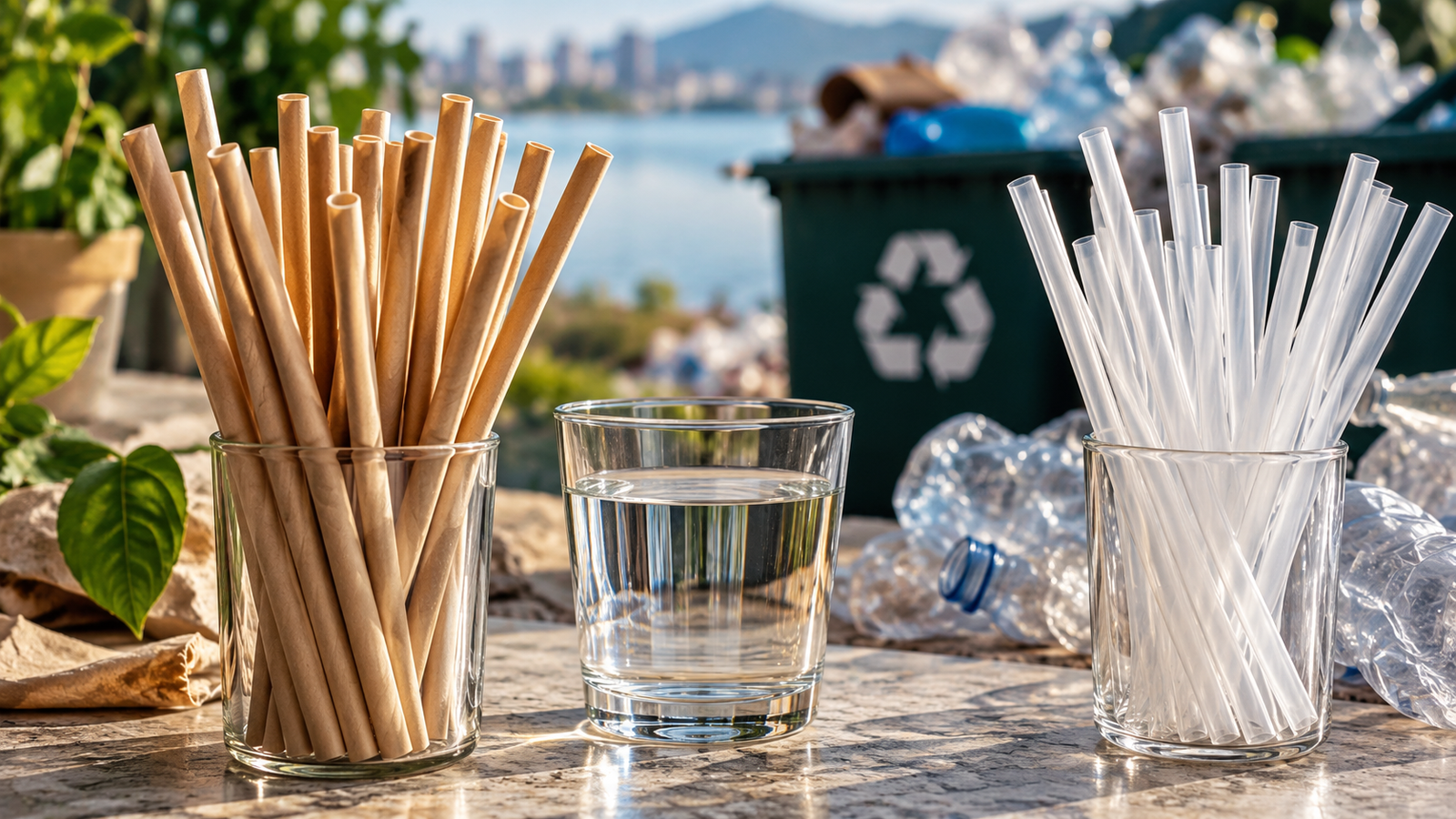
Paper straws vs plastic straws is back in the spotlight after a South Korean government-commissioned study found that paper and some bio-based alternatives performed worse than conventional plastic straws on several modelled environmental measures. The findings were disclosed by lawmaker Kim Wi-sang on October 21, 2026, and reported by The Korea Herald, SBS, South China Morning Post, Dawn and ProPakistani over the following days.
One of the most widely shared results says paper straws scored 6.33 times as high as conventional plastic straws in a life-cycle human carcinogenic impact category. Paper straws also registered approximately 2.04 times the acidification impact. These findings deserve attention, but they do not show that drinking through a paper straw makes a person 6.33 times more likely to develop cancer. The measure estimates potential effects linked to emissions across production and disposal, rather than diagnosing consumers.
The study compared conventional polypropylene plastic, paper, biodegradable plastic and bio-based polyethylene straws across 16 environmental categories. Its broader message is not that plastic litter is harmless. Instead, it challenges the assumption that changing a disposable product’s material automatically makes it sustainable. The strongest practical conclusion from the reported analysis is to reduce unnecessary single-use items in the first place.
What Did the 2026 South Korean Straw Study Find?
According to the October 22 Korea Herald report, the Comprehensive Study on Single-Use Straws was commissioned by South Korea’s Ministry of Climate, Energy and Environment and submitted to National Assembly member Kim Wi-sang. Researchers examined environmental impacts associated with the four straw types from raw-material production to end-of-life disposal.
Paper straws had a human carcinogenic life-cycle impact indicator 6.33 times that of ordinary plastic straws, along with an acidification impact 2.04 times as high. Biodegradable plastic recorded corresponding ratios of 3.34 and 1.98. Bio-based polyethylene scored 16.18 times higher for the carcinogenic indicator and 5.9 times higher for acidification.
Conventional plastic straws had the lowest impact among the compared options in 10 of the 16 categories, according to media summaries. Paper was highest in three categories, biodegradable plastic in two and bio-PE in 10. These counts describe categories, not an overall universal environmental score: impact categories are measured in different units and may receive different priorities in different assessments.
Study Facts and Verification
Country: South Korea.
Research: Comprehensive Study on Single-Use Straws, commissioned by the Ministry of Climate, Energy and Environment.
Disclosure: October 21, 2026, by lawmaker Kim Wi-sang.
Original English news coverage: SBS October 21 and The Korea Herald October 22.
International follow-up: South China Morning Post October 23; Dawn and ProPakistani October 26.
Straw materials: Conventional polypropylene plastic, paper, biodegradable plastic and bio-based polyethylene (bio-PE).
Number of impact categories: 16.
Paper relative carcinogenic life-cycle indicator: 6.33 times conventional plastic.
Paper relative acidification indicator: 2.04 times conventional plastic.
Bio-PE relative carcinogenic indicator: 16.18 times conventional plastic.
Disposal assumptions: 73.6% incinerated and 26.4% landfilled, based on Korean waste statistics in the reporting.
Critical limitation: The underlying commissioned report’s full original text was not independently retrieved for this article; detailed figures are attributed to named Korean reporting and subsequent independent republication.
What Is a Life-Cycle Assessment?
A life-cycle assessment, or LCA, attempts to measure environmental impacts associated with a product over defined stages of its existence. For a disposable straw, relevant stages can include obtaining raw materials, manufacturing, packaging, transport, use and disposal. The goal is to avoid moving pollution out of sight when one material is replaced with another.
Paper may appear harmless after disposal because it is associated with plant fibres, but turning fibres into a durable drinking straw can require energy, water, chemicals, adhesives and protective coatings. Plastic production has its own resource, emissions and pollution burdens. Even if a product is biodegradable in some conditions, manufacturing and waste-treatment effects do not disappear.
LCA results depend on the study’s boundaries and assumptions. The kind of electricity used in manufacturing, transportation distances, product weight, recycling rates and waste-treatment methods can change results. Therefore, the Korean findings should not be treated as a definitive ranking for every straw sold in every country.
Does 6.33 Times Higher Carcinogenic Impact Mean Paper Straws Cause Cancer?
No. This is the most important distinction in the story. The study used an environmental life-cycle indicator that models potential human carcinogenic impacts associated with emissions produced during the item’s life, including the manufacturing and disposal stages. It is not a clinical experiment in which researchers compared cancer incidence among people drinking through different straws.
A claim that a paper straw is ‘6.33 times more likely to give you cancer’ would be inaccurate and irresponsible. The Korea Herald explicitly distinguishes the modelled life-cycle figure from direct consumer health risk. The analysis cannot establish whether a particular person will become ill after using a straw.
Questions about chemicals migrating from food-contact materials into beverages are a separate area of research. Such safety questions require measurements of the actual substances, exposure and toxicological relevance. They cannot be answered directly using only a life-cycle impact score.
Why Could Paper Straws Have Higher Environmental Impacts?
The answer may involve production energy, the processing of paper fibres, chemical treatment and disposal assumptions. Paper straws often need to resist water long enough to function, and that may require processing or materials not evident from their appearance. A product’s final look does not reveal its total manufacturing footprint.
The Korean report considered multiple categories, including acidification, particulate matter, climate-change impacts and toxicological indicators. Reporting suggests the study found several alternative materials imposed a greater environmental burden than conventional polypropylene under its assumed conditions.
However, a newspaper summary does not provide all the inventory data or uncertainty analysis needed to attribute the numerical difference to one chemical or factory process. This article therefore does not claim that an identified adhesive or coating explains precisely 6.33 times higher impact.
How Were Disposal Conditions Modelled?
According to Dawn’s reproduction of Korean reporting, the assessment assumed that 73.6 percent of discarded straws would be incinerated, while 26.4 percent would go to landfill. This reflects a waste-management scenario relevant to South Korea. It is not necessarily representative of Pakistan, where collection and disposal systems differ across cities and neighbourhoods.
Incineration can produce air emissions and other environmental burdens; landfill disposal has different consequences. Collection and sorting also matter, especially for small objects that may be difficult to recover through conventional recycling. The value of a straw’s material depends partly on what actually happens to it after use.
If a country has different electricity sources, waste treatment or litter conditions, the relative outcome may change. The study is valuable evidence for a defined scenario, but it should not be mechanically copied into policy decisions elsewhere without testing local assumptions.
What About Bio-Based and Biodegradable Straws?
Bio-based material describes where some raw material originates, often plants instead of fossil feedstocks. Biodegradable material describes a capacity to break down under certain biological or environmental conditions. These terms are not identical. A plant-derived polymer may remain persistent under ordinary disposal conditions, while a certified compostable material may require controlled industrial composting to decompose as intended.
The study compared biodegradable plastic and bio-based polyethylene separately. Both performed worse than conventional plastic on several reported life-cycle measures. The bio-PE category had especially high reported values for carcinogenic and acidification indicators relative to conventional plastic.
These results do not prove that every bio-based item is harmful or that biodegradability has no environmental value. Instead, they demonstrate why manufacturers and regulators should define specific claims, test realistic disposal pathways and disclose trade-offs rather than relying on generic green labels.
What About Microplastics and Plastic Pollution?
Conventional plastic straws can persist in the environment and contribute to litter and plastic pollution. A life-cycle comparison of manufacturing and disposal emissions does not by itself capture every environmental consequence of leakage into rivers, coastal areas or ecosystems. Some impacts may be modelled differently or remain outside particular study boundaries.
That is why it would be misleading to declare ordinary plastic straws ‘good for the environment’ based solely on their lower results in 10 LCA categories. The comparison challenges a specific assumption about alternatives; it does not cancel established concerns about unmanaged plastic waste.
Environmental policy has to consider greenhouse gases, toxic emissions, physical litter, ecosystem effects, waste infrastructure and the practical availability of reusable alternatives. Reducing waste at source can address several dimensions at once.
What Did Previous Research Find About PFAS in Paper Straws?
A separate peer-reviewed study from 2023, published in Food Additives & Contaminants, investigated poly- and perfluoroalkyl substances, often called PFAS, in 39 brands of drinking straws sold in Belgium. Researchers tested paper, bamboo, glass, stainless steel and plastic varieties. They detected PFAS in several types, with more frequent findings among plant-based paper and bamboo materials; stainless steel was the one category without detected PFAS in that sample.
That study is relevant background because it shows that paper materials are not automatically free of persistent chemicals. But it is not the same project as the 2026 Korean life-cycle assessment and does not validate or explain its 6.33-times numerical result. The samples were drawn from the Belgian market, and detection alone does not quantify an individual user’s health risk.
The correct approach is to keep environmental life-cycle findings, migration testing and consumer exposure studies distinct. Each asks a different scientific question and may use different measurement methods.
How Might the Findings Affect Cafes and Restaurants?
The study raises practical questions for hospitality businesses that switched to paper straws partly to show environmental responsibility. Owners may need to evaluate whether a material-based purchasing policy genuinely reduces impacts under local conditions. A change in procurement should be supported by a credible product assessment rather than an assumption that ‘paper’ always means ‘green’.
One approach discussed in Korean coverage is offering straws only when customers ask for them. That can reduce consumption while preserving access for people who require a straw for practical or accessibility reasons. Businesses should also consider food-contact safety, customer needs, availability and local waste-processing capabilities.
The study does not require Pakistani restaurants to reverse any particular policy. It offers a reason to review evidence and avoid misleading sustainability marketing. Choices should respond to local regulations and realistic disposal outcomes.
Is Reducing Single-Use Consumption Better Than Material Switching?
Researchers and the Korean policy discussion emphasised reducing the unnecessary use of disposable straws. This aligns with an intuitive principle: an item that is not manufactured, transported and discarded does not create the associated one-time material demand. Nonetheless, consumers who need straws for disability access or other reasons should not be overlooked.
Reusable straws may lower per-use material demand if they are used repeatedly, cleaned appropriately and not replaced frequently, but their manufacturing and cleaning footprints need consideration. A heavy reusable item used only a few times may not outperform a lightweight disposable option in every environmental category.
For households and hospitality businesses, practical measures include not automatically distributing a straw with every drink, asking whether one is needed, maintaining sanitary reusable options where suitable and selecting products based on measured impacts instead of packaging claims.
What Does This Mean for Pakistan?
Pakistan faces its own waste collection, plastic pollution and recycling challenges. The Korean study has global news value because it tests assumptions behind consumer sustainability decisions, but its numerical findings should not be treated as locally measured Pakistani impacts. Energy mixes, manufacturing sources and end-of-life waste systems are different.
Pakistani manufacturers, retailers and policymakers can use the study as motivation to commission local lifecycle assessments of disposable food-service products. Such assessments should account for local production, imported materials, transport, landfill practices, recycling availability and litter that escapes collection.
A practical recommendation for Pakistani businesses is to avoid unsupported claims such as ‘100% environmentally friendly’ solely because a straw is paper-based. Better procurement information and reduced unnecessary consumption may prove more robust than a simple material swap.
How Should Consumers Interpret Green Product Labels?
Labels such as eco-friendly, biodegradable, plant-based and recyclable describe different qualities. Consumers should look for evidence showing what a claim covers. A product may be made from renewable raw materials yet require significant processing energy, or it may be technically recyclable while rarely being collected and sorted in practice.
Claims should clarify whether a product is home-compostable, industrially compostable, recyclable through common municipal systems or simply made partly from plants. Independent certification, clear disposal instructions and life-cycle information provide stronger evidence than a leaf-shaped logo or green-coloured packaging.
The broader lesson is that environmental performance is multidimensional. Material choice matters, but so do manufacturing, transport, use, waste management and how much of a product is consumed.
What Are the Limitations of the Korean Study?
The published reports describe a commissioned study with 16 environmental categories and a specific South Korean disposal scenario. Mukhbir could verify the core numerical findings across contemporaneous reporting by SBS, The Korea Herald, South China Morning Post and Dawn. However, the original government-commissioned report’s complete text and underlying modelling files were not independently accessible during preparation.
For that reason, this article does not independently certify its uncertainty ranges, raw inventory inputs, comparative weighting choices or methodological peer-review status. The study’s disclosure through a legislator and government commissioning is not equivalent to the full technical report being openly examined by every independent reader.
The findings are sufficiently corroborated to report with attribution, but they should be described as study results under stated assumptions. Absolute claims that paper straws are always worse than plastic in all circumstances would exceed the verified evidence.
What Happens Next for Sustainability Policy?
The results may encourage policymakers to reassess how single-use material restrictions are designed and evaluated. In South Korea, restrictions concerning plastic straws at cafes and restaurants had already faced changes in enforcement, with a grace period extended after implementation challenges and complaints. The new findings add evidence to public debate but do not by themselves enact a law.
A more comprehensive approach would consider reduction of unnecessary items, waste prevention, litter collection, product safety, accessibility and life-cycle emissions together. If governments require alternatives, the relevant performance standards and measurement assumptions should be disclosed.
Future research could compare materials under different waste-management scenarios, account more explicitly for litter and test whether alternative product designs improve results. Those questions remain open rather than settled by a single report.
Conclusion
The paper straws vs plastic straws debate has become more complicated following South Korea’s 2026 government-commissioned life-cycle assessment. Contemporary reporting says paper straws registered higher impacts than conventional polypropylene straws in several categories, including a 6.33-times higher modelled human carcinogenic impact indicator and 2.04-times higher acidification impact.
These are environmental modelling results, not a finding that drinking through paper straws multiplies a person’s cancer risk. The study also does not erase the harm of persistent plastic litter or establish one material as universally best. Its clearest practical implication is to reduce avoidable single-use products and evaluate alternatives using transparent, locally relevant evidence.
For Mukhbir readers, the lesson is scientific caution: sustainability depends on an entire product life cycle, and an attractive green label is not a substitute for measurement.
Frequently Asked Questions
Are paper straws worse than plastic straws?
In South Korea’s reported life-cycle assessment, paper straws performed worse in several environmental categories. It does not prove they are worse for every impact or disposal system worldwide.
Did the 2026 study find paper straws cause cancer?
No. The 6.33-times result is a modelled life-cycle human carcinogenic impact indicator for associated emissions, not a measured cancer risk from drinking through a straw.
Which straw types were compared?
Conventional polypropylene plastic, paper, biodegradable plastic and bio-based polyethylene (bio-PE) straws.
How many environmental categories were evaluated?
The report assessed 16 impact categories from raw-material sourcing through disposal.
Why does disposal method matter?
Incineration, landfill, recycling and escaped litter create different burdens. The Korean scenario reportedly assumed 73.6% incineration and 26.4% landfill.
Does this prove plastic straws are harmless?
No. Conventional plastics can contribute to litter and long-lived pollution; the study concerns specified life-cycle impact measurements.
What did earlier research find about PFAS in paper straws?
A separate 2023 Belgian peer-reviewed study detected PFAS in several straw materials, especially paper and bamboo. It did not directly test the Korean study’s 2026 life-cycle claim.
What is the most practical environmental takeaway?
Avoid unnecessary disposable straws, preserve access for those who need them, and assess material alternatives with credible local life-cycle and safety evidence.
About The Author