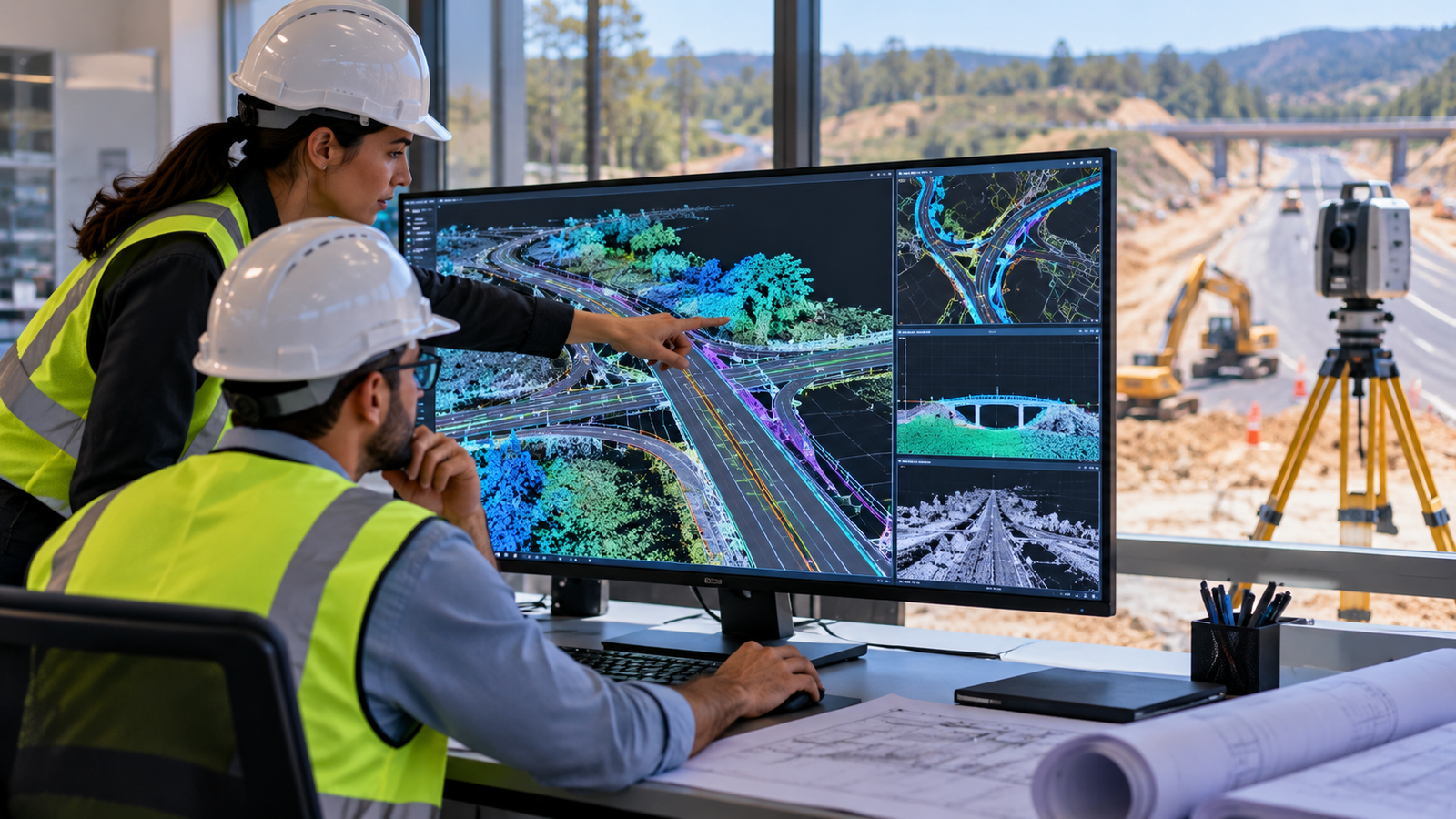
Mach9, a San Francisco-based construction technology startup, announced a $34 million Series A funding round on October 21, 2026, as it expands artificial intelligence software for civil engineering and surveying. First Round Capital and Bessemer Venture Partners co-led the financing, with participation from Prudence and existing investor Quiet Capital. The round brings Mach9’s total disclosed funding to $49 million, according to the company’s announcement, which was independently covered by TechCrunch.
The company’s software turns 3D laser scans, imagery and other survey data into computer-aided design (CAD) drawings used by engineers working on roads, utilities and related infrastructure. Mach9 says its technology can make some drafting workflows up to 10 times faster and operate at one-fifth the cost of conventional methods. Those efficiency figures are company claims and will depend on the project and independent validation; the confirmed news event is the financing and the stated business strategy.
Mach9’s $34 Million Series A: Key Details
Mach9’s October 21 announcement identified First Round Capital and Bessemer Venture Partners as co-lead investors. Prudence, a venture firm focused on sectors such as real estate and construction technology, also joined the round, while Quiet Capital continued as an investor. The company did not disclose a new valuation in the material reviewed. It would therefore be inaccurate to assign Mach9 a billion-dollar valuation or describe it as a confirmed unicorn.
Series A financing generally supports a startup that has moved beyond its earliest product-development stage, though the round label does not establish profitability. Mach9 says it will use its capital to improve the software, hire domain experts and grow the organisation to serve more customers. The company reported $49 million in cumulative funding after the deal, distinct from the $34 million raised in this particular round.
What Does Mach9’s AI CAD Software Do?
Civil engineering projects begin with information about existing ground conditions, road layouts, signs, utilities and other physical features. Surveying teams use tools such as LiDAR scanners and cameras to gather large collections of spatial information. Traditionally, technicians have had to convert much of that data into structured drawings through time-consuming manual work.
Mach9’s platform aims to shorten that step by identifying physical features inside the scans and drafting their geometry in a CAD environment. The system can recognise elements such as curbs, poles, pavement markings and wires. Engineers then review and modify the draft before approving it for use. This distinction matters: the product supports professional workflows rather than replacing the legal responsibility of qualified engineers and surveyors.
Why the Startup Pivoted Away From Robotics
Mach9 started in 2021 as Mach9 Robotics. Its founders originally developed technology to make physical surveying and inspection more efficient. According to founder and chief executive Alex Baikovitz’s interview with TechCrunch, customers eventually showed the team that collecting images and scans was often not the main bottleneck; interpreting the data and producing usable drawings took much longer.
The startup consequently dropped ‘Robotics’ from its name and focused on AI-powered CAD software. This shift illustrates a common startup challenge: the solution founders initially build may not address the most expensive part of a customer’s work. Mach9’s decision was driven by reported conversations with engineering customers rather than by a general claim that all surveying hardware is obsolete.
What Is LiDAR and Why Does It Matter?
LiDAR, short for light detection and ranging, uses laser measurements to create a detailed representation of surfaces and objects. Mobile surveying systems can collect extensive 3D point clouds along roads or across large construction sites. The resulting datasets help engineers understand the dimensions and positions of physical features before designing changes or repairs.
Raw point clouds are not automatically equivalent to ready-to-use construction drawings. Features must be classified, mapped and checked against project requirements. Mach9 is trying to automate this translation from captured reality into engineering CAD data. The quality of its output still depends on scan accuracy, visibility, data completeness and expert review.
How Fast Is the Software?
Mach9 says its AI CAD platform can help teams work up to 10 times faster at approximately one-fifth the cost of conventional drafting. The company also describes centimetre-level accuracy for extracting surveyed features. These figures appear in its official publicity materials and should be described as company-reported performance rather than universal results for every engineering task.
Different jobs have different complexity. A clear, well-scanned road may be easier to interpret than a site with occluded utilities, extensive construction or noisy data. Engineers still have to check outputs, adjust geometry and confirm that the final drawings meet contractual and professional standards. Independent benchmarks across varied project types would give a fuller picture of the technology’s performance.
How Many Customers and Projects Has Mach9 Reported?
TechCrunch reported that nearly 100 private-beta customers had used Mach9’s software on more than 2,500 projects. Mach9’s own announcement says its platform has been used on over 2,500 projects across all 50 US states and on more than 100,000 miles of infrastructure. These are company-supplied adoption metrics, not independently audited revenue figures.
Customer and project counts can indicate growing interest, but neither metric directly reveals annual sales, profit margins or the value of each deployment. For business reporting, it is important not to turn these figures into a claim that 2,500 separate companies bought the product. The customer count and number of projects measure different things.
Examples of Reported Real-World Use
Mach9 cited several projects to illustrate how the software is being used. California’s transportation agency Caltrans is described as applying the technology to inventory roadway rumble strips and other safety features on Interstate 8. In San Francisco, engineering firm Kier + Wright is reported to be using it in work related to pedestrian safety near schools.
The company also highlighted Fibersmith’s use of its software in a Louisiana broadband-connectivity project involving communities that lacked high-speed internet. These cases are presented in Mach9’s company announcement; they should not be taken as independent certification of every claimed benefit or as proof that a given project was completed solely because of the software.
Why Civil Engineering Needs More Efficient Drafting
A road or utility upgrade requires engineers to understand the existing site before proposing changes. The mapping and design process can take substantial time, particularly when datasets cover many kilometres or contain numerous physical objects. Firms may have enough scanning capacity to capture data but lack sufficient drafting staff to process it quickly.
AI-assisted drafting could let specialists spend less time tracing repetitive features and more time checking, refining and planning. However, greater automation may also change training needs and the mix of entry-level and expert work. Those effects deserve attention alongside productivity claims; the funding announcement itself does not prove a specific net increase or decrease in jobs.
How Could the Investment Change Mach9’s Business?
The company says it will spend the fresh capital on product improvement, hiring sector specialists and scaling its operations. Enterprise construction software requires more than a promising algorithm: customers need integration with established workflows, support for different file formats, dependable performance and clear responsibility when outputs contain errors.
Investors may see a market opportunity if engineering firms increasingly use AI tools to interpret physical-world data. Yet the size of an addressable market is not the same as confirmed sales. Mach9’s commercial outcome will depend on how consistently its product works and whether customers view the cost savings as worth adopting a new platform.
Who Are First Round Capital and Bessemer Venture Partners?
First Round Capital and Bessemer Venture Partners are venture-capital investors that back early-stage and growth-oriented technology businesses. Their participation gives Mach9 access to funding and industry networks. Bessemer published its own commentary on October 21 explaining why it views AI-assisted CAD as a significant opportunity within construction and infrastructure.
An investment firm’s perspective is useful for understanding its rationale, but it is not a neutral audit of the startup’s future performance. Financing by prominent investors does not guarantee a successful product, public listing or acquisition. Readers should evaluate the stated market need alongside adoption, competition and operational risks.
Competition in Construction and Engineering Software
Mach9 operates in a broader market that includes established CAD platforms, surveying specialists and newer construction AI startups. TechCrunch mentioned companies such as CivilGrid and Blueprints AI as other examples of businesses trying to modernise parts of the infrastructure planning process. Their products solve different problems and should not be described as identical replacements for Mach9.
Established engineering software vendors have years of customer relationships and mature workflows. A new entrant must prove it can deliver reliability, compatibility and measurable value. Even if AI makes some drafting tasks faster, procurement cycles, training costs and integration requirements may slow adoption.
Why Human Review Remains Essential
Engineering drawings guide decisions that can affect construction costs, public safety and the durability of infrastructure. Inaccurate placement of a utility line or roadside feature can carry consequences beyond an incorrect digital picture. Mach9’s described workflow therefore allows engineers to edit AI-generated geometry and assess its quality before producing final deliverables.
The company does not claim that every plan can be approved without professional review. This safeguard is especially important when underlying scans contain hidden features or incomplete information. AI should be evaluated as a tool that can expand professional capacity, not as proof that liability, licensing or quality-control requirements have disappeared.
Could This Technology Be Relevant to Pakistan?
Pakistan has infrastructure needs involving highways, urban development, drainage and utilities, making accurate surveying and efficient design a subject of genuine interest. Software that converts large scans into editable CAD information may eventually be relevant to engineering firms in South Asia, particularly those handling complex mapping projects.
However, the October 21 announcement did not confirm an investment in Pakistan, a local office or a government contract with Mach9. Mukhbir is covering this as a global startup and construction-technology story rather than inventing a domestic commercial partnership. Any future local relevance would depend on real deployments, available scanning equipment and professional requirements.
What Should Readers Watch Next?
The strongest follow-up indicators will be confirmed product expansion, customer adoption, project-level case studies and any financial disclosures the private company chooses to release. Independent evidence of quality, speed and cost would help engineers assess claims made in marketing materials. New integrations with familiar CAD tools would also shape the practical value of the platform.
For now, the verified milestone is the $34 million Series A and the accompanying description of Mach9’s software strategy. It would be premature to publish a market valuation, promised revenue target or specific global rollout plan without supporting documentation.
Conclusion
Mach9’s $34 million Series A funding brings its reported total capital raised to $49 million and provides resources to develop AI-assisted CAD tools for civil engineering. The round was co-led by First Round Capital and Bessemer Venture Partners, while TechCrunch and the company’s own release described growing use of the software among surveying and infrastructure teams.
The startup’s larger opportunity is to automate the laborious translation of LiDAR data into drawings that professionals can inspect and refine. Its reported speed and cost savings are promising but remain company claims rather than guaranteed results. The coming test will be reliable deployment across more projects, with engineering oversight and transparent evidence of value.
Frequently Asked Questions
How much funding did Mach9 raise in October 2026?
Mach9 announced a $34 million Series A funding round on October 21, 2026.
Who led the Mach9 funding round?
First Round Capital and Bessemer Venture Partners co-led the round, with Prudence and Quiet Capital participating.
How much total funding has Mach9 raised?
The company says its cumulative funding reached $49 million after the Series A.
What does Mach9’s software do?
It converts 3D survey scans and imagery into editable CAD drawings for roads, utilities and civil infrastructure.
What is LiDAR?
LiDAR uses laser measurements to capture detailed three-dimensional representations of physical environments.
How much faster is Mach9’s AI CAD platform?
Mach9 claims some workflows can be up to 10 times faster; results depend on project conditions and require verification.
Does Mach9 replace professional engineers?
Its described workflow produces drafts that engineers and surveyors review, adjust and approve.
Is Mach9 operating in Pakistan?
The cited funding announcement does not confirm a local office, investment or contract in Pakistan.
About The Author