The Orionid meteor shower reached its annual peak overnight on October 21-22, 2026, bringing a seasonal opportunity to see fast-moving streaks of light associated with debris from Halley’s Comet. NASA, the American Meteor Society and the Planetary Society all identify this period as the main viewing window. The shower remains active from October 2 through November 7, so a few Orionids may still be visible on nearby nights even after the precise peak has passed.
For skywatchers in Pakistan, the best general strategy is to look during the dark hours after midnight and before dawn, away from bright city lights. However, 2026 is not an ideal moonless year: a bright waxing gibbous Moon can obscure many faint meteors until it sets. The number visible on any particular night will also depend on cloud cover, pollution, local sky brightness and an observer’s patience. This guide explains what has been verified and how to improve the chances of seeing the display.
What Is the Orionid Meteor Shower?
The Orionids are a recurring annual meteor shower caused when Earth passes through a stream of tiny dust and rocky fragments left behind by Comet 1P/Halley. These particles enter the atmosphere at high speed and heat the surrounding air, creating the bright tracks popularly called shooting stars. They are not stars falling out of space, and most of the particles burn up far above Earth’s surface.
The shower gets its name from Orion, the well-known constellation whose bright stars include Betelgeuse and Rigel. From our viewpoint, the meteor paths appear to radiate outward from a region near Orion, even though individual meteors can cross many different portions of the sky. Knowing the radiant helps identify a shower, but looking directly at it is not necessary.
When Did the Orionids Peak in 2026?
NASA’s October 2026 skywatching guide lists the main peak as the night of October 21 into the morning of October 22. The American Meteor Society lists the same peak night and identifies the activity period as October 2 through November 7. This means that Thursday, October 22 is the morning immediately following the expected maximum, not the start of a shower that will only begin later.
Meteor showers do not operate like an eclipse with one guaranteed dramatic instant. The Orionids can have a broad maximum, so conditions on adjacent mornings may still offer some activity. For readers seeing this article after sunrise on October 22, the main predicted peak has already passed; observing on a subsequent pre-dawn morning remains possible but may produce fewer meteors.
Can You See the Orionids From Pakistan?
Yes, the Orionids can be observed from both the Northern and Southern Hemispheres, including Pakistan, provided the sky is sufficiently clear and dark. The constellation Orion becomes prominent during the late-night and early-morning hours at this time of year. People in Lahore, Karachi, Islamabad, Peshawar, Quetta and other locations may see the shower, but large-city light pollution makes faint meteors harder to detect.
This is an astronomy event visible across a large part of Earth, not something restricted to one particular Pakistani city. There is no need to travel to a formally designated viewing site. A safe open area with an unobstructed sky can be useful, while remote travel should always take local safety, weather and accessibility into account.
What Is the Best Time to Watch in Pakistan?
The most promising window is generally the latter half of the night through the hours before dawn, when Orion is higher in the sky. NASA recommends looking after moonset, when the sky becomes darker. The exact moonset time varies by city and date, so a clock time quoted for a US viewing location should not be reused as though it applies everywhere in Pakistan.
A practical approach is to check local moonset and sunrise times using a location-specific astronomy calendar, then choose a safe, clear interval before dawn. As the Moon moves closer to full later in the week, moonlight may continue limiting visibility. If clouds or haze obscure the sky, even the optimal astronomical timing will not guarantee a useful view.
How Many Meteors Per Hour Are Expected?
NASA and the American Meteor Society place typical Orionid rates at around 10 to 20 meteors per hour under very dark and otherwise favourable conditions. That is not a promise that a person on a city rooftop will count 20 shooting stars every hour. Actual counts can be far lower, particularly where moonlight and artificial light hide the faintest streaks.
NASA’s October 2026 observing guidance suggests observers in some suburban environments may see only a few meteors per hour. Meteor rates also fluctuate naturally over shorter periods, which means several quiet minutes may be followed by multiple streaks. Readers should understand the headline number as an idealised observing range rather than a fixed timetable.
Will Moonlight Affect the 2026 Shower?
Yes. A waxing gibbous Moon is one of the main complications for the 2026 Orionid peak. The American Meteor Society estimates substantial lunar illumination on peak night, while NASA explicitly warns that moonlight will wash out many faint meteors. This can make the display less striking than it appears in long-exposure astrophotography or promotional illustrations.
The Moon’s effect depends on whether it is above the local horizon, how bright the surrounding sky becomes and which meteors occur. Brighter Orionids can still be visible while the Moon is present, so moonlight does not make observation impossible. Looking after local moonset can improve contrast, although clear air and dark surroundings remain important.
Why Are the Orionids Linked to Halley’s Comet?
Halley’s Comet follows a long elliptical orbit around the Sun and sheds material as solar heating affects its icy and dusty surface. Some of that debris remains spread along the comet’s path. Earth crosses relevant debris streams at predictable times each year, producing the Orionids in October and the Eta Aquariids around May.
Halley’s Comet itself does not need to be visible in the night sky for the meteor shower to occur. The comet last visited the inner solar system in 1986 and is expected to return in 2061. The annual meteor showers are encounters with debris left along its orbit, not evidence that the comet has approached Earth again in 2026.
How Fast Are Orionid Meteors?
NASA lists the Orionids among the faster regular meteor showers, with particles entering Earth’s atmosphere at around 66 kilometres per second. Their speed helps explain why many Orionids appear as quick flashes rather than slow-moving objects. Some bright meteors may leave glowing trails that linger briefly after the original streak disappears.
These meteors are very different from aircraft, satellites or drones. Planes generally move more slowly across the sky and may show blinking navigation lights. Satellites can trace a relatively steady path for longer periods. A meteor typically flares and disappears in seconds, although a particularly bright event may last slightly longer or leave a temporary luminous train.
Where in the Sky Should You Look?
The Orionid radiant appears near the constellation Orion, not far from the bright reddish star Betelgeuse. However, viewers should not focus their gaze on that single point. Meteors may be seen across a broad section of the sky, and those appearing farther away from the radiant can leave longer visible tracks.
Choose a comfortable position that allows a wide view without straining your neck. Looking roughly 45 to 90 degrees away from the radiant is a useful general technique, according to meteor-observing guidance. A wide, unobstructed sky matters more than identifying every constellation precisely. If looking east is blocked by buildings, an open region of sky elsewhere may still allow meteors to be spotted.
Do You Need a Telescope or Binoculars?
No. Meteor showers are normally best enjoyed with unaided eyes because meteors can appear unexpectedly over a large area of sky. Telescopes and binoculars have narrow fields of view and can make it harder to follow fast streaks. A reclining chair, warm clothing and a little patience are more useful than specialised optical instruments.
Allow around 20 to 30 minutes for your eyes to adapt to darkness. Avoid looking repeatedly at a bright smartphone screen, and use a dim red light when practical to preserve night vision. A phone may help check a star map, weather or the time, but constant screen use will reduce your ability to notice faint events.
How to Photograph the Orionid Meteor Shower
Photography can be rewarding, but it requires different expectations from simply watching. A camera that allows manual exposure, a stable tripod and a wide-angle lens can capture the sky over repeated long exposures. Meteors appear unpredictably, so taking many photographs improves the chance of recording a bright streak. A dark sky and carefully focused stars are more important than adding dramatic effects later.
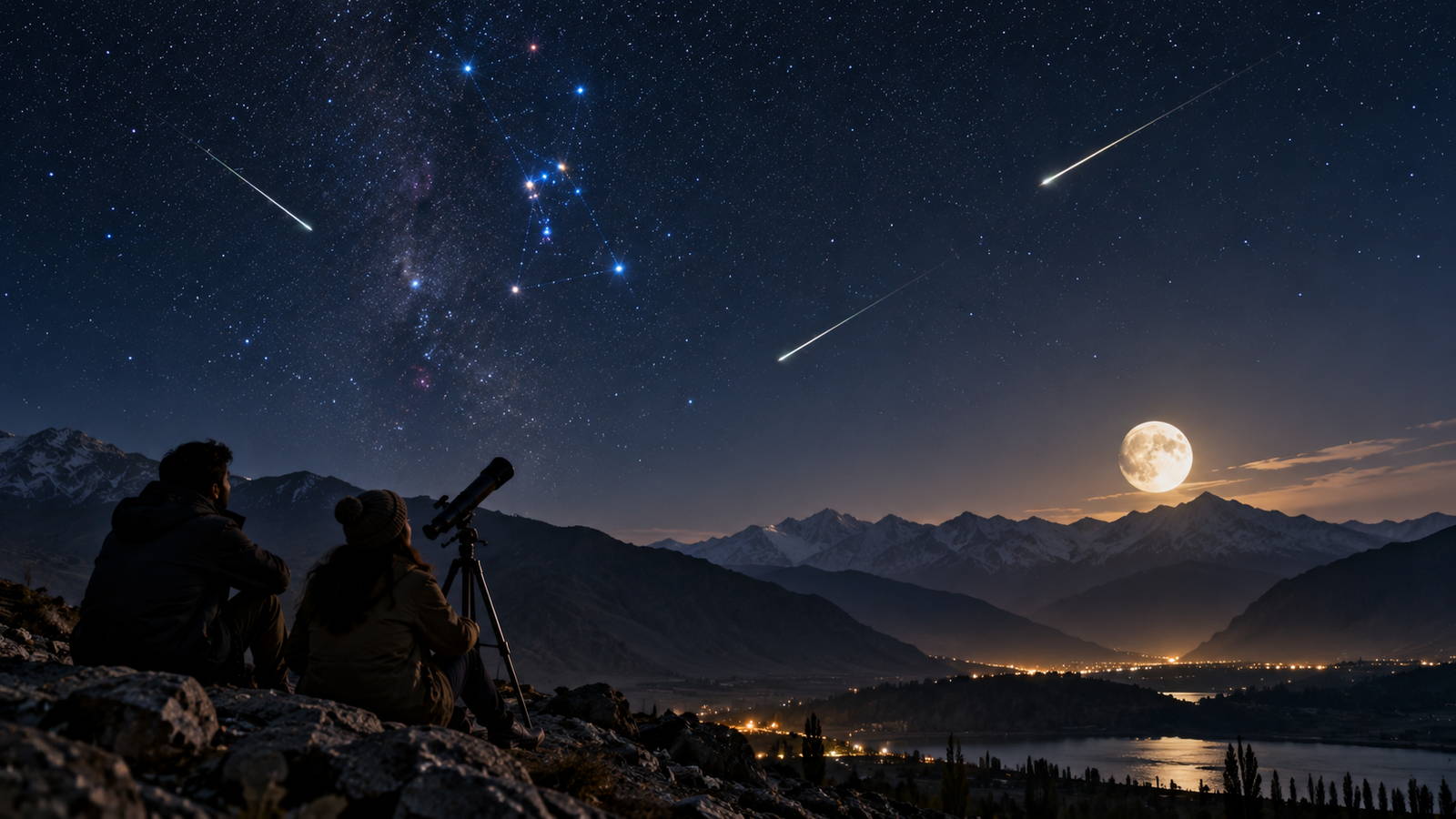
The result should still be honestly labelled. A composite made from several exposures is not the same as one single moment, and an AI-generated illustration must not be described as a real photograph from October 2026. Mukhbir’s featured visual for this article is conceptual, not documentary evidence of local sky conditions.
Can People Still Watch After October 22?
Yes. According to NASA and the American Meteor Society, the Orionids remain active into early November, although their strongest expected activity falls around October 21–22. The number of visible meteors typically declines away from the peak, and increasing lunar illumination near the late-October full Moon may further affect viewing opportunities.
Readers who missed the peak should avoid assuming that another identical maximum will occur on the next night. Instead, treat later observations as a chance to spot occasional shower members, with the possibility of other random meteors crossing the sky too. Local weather and moonlight may outweigh small differences in predicted activity.
Is the Meteor Shower Dangerous?
Ordinary Orionid meteors are small particles that burn in the atmosphere, and the shower is not a hazard to people standing outdoors to watch. There is no special radiation risk or need for protective eyewear. Looking at meteors is different from viewing the Sun, which requires proper solar filters.
The main practical risks are ordinary outdoor considerations: unsafe roads, isolated locations, extreme weather, cold temperatures and limited visibility while travelling. Choose a lawful, safe place to observe and avoid stepping into traffic or onto restricted property. Scientific curiosity does not require taking unnecessary personal risks.
Why the Orionids Matter for Astronomy
Meteor showers help scientists study the material released by comets and how dust moves through the inner solar system. Variations in observed activity can provide clues about the distribution of particles along an old cometary orbit. For students and amateur observers, the Orionids offer an accessible demonstration of Earth’s motion through space and the relationship between comets and meteors.
The 2026 shower also illustrates why observing conditions are as important as astronomical predictions. The expected peak and typical meteor rates can be well documented while individual experiences differ greatly because of weather, moonlight and sky brightness. This is one reason credible science reporting should explain uncertainties alongside attractive viewing possibilities.
Conclusion
The Orionid meteor shower peaked overnight on October 21–22, 2026, as Earth passed through dust associated with Halley’s Comet. NASA and the American Meteor Society identify the shower as active through November 7, with around 10 to 20 meteors per hour possible under favourable dark skies. In 2026, bright moonlight is likely to reduce the number seen from many locations.
For skywatchers in Pakistan, the sensible advice is to seek a safe, dark location, check local moonset and weather conditions, and watch with the naked eye in the hours before dawn. The event is a real annual astronomical phenomenon, but no location or viewing technique guarantees a particular number of meteors. Future nights may still offer occasional Orionids even though the peak has passed.
Frequently Asked Questions
When did the Orionid meteor shower peak in 2026?
Its main predicted peak was overnight from October 21 into October 22, 2026.
Can the Orionid meteor shower be seen in Pakistan?
Yes. The shower is visible from both hemispheres, including Pakistan, where weather and sky brightness permit.
What is the best time to see Orionids?
Generally after midnight and before dawn, ideally after local moonset and away from artificial lights.
How many Orionid meteors are visible per hour?
Typical ideal dark-sky rates are about 10 to 20 per hour, but many observers will see fewer due to moonlight and light pollution.
Is the 2026 Moon favourable for watching?
No. A bright waxing gibbous Moon during the peak can hide fainter meteors.
What causes the Orionid meteor shower?
Earth passes through dust and small debris left behind by Halley’s Comet.
Do I need binoculars or a telescope?
No. Use your unaided eyes for a wider view of the sky.
Can Orionids still be seen after October 22?
Yes. The shower remains active until November 7, although activity is usually lower after the peak.
About The Author