Japan has successfully launched a spacecraft toward Mars in an ambitious attempt to bring samples from the Martian moon Phobos back to Earth. The Martian Moons eXploration mission, known as MMX, lifted off aboard a Japanese H3 rocket from Tanegashima Space Center at 4:41 a.m. Japan Standard Time on October 20, 2026. The Japan Aerospace Exploration Agency (JAXA) confirmed that the spacecraft separated successfully from the rocket about 71 minutes after launch, beginning a journey that is planned to last roughly five years.
Unlike missions that focus on collecting material directly from the Martian surface, MMX targets Phobos, the larger of Mars’s two small moons. Scientists hope to bring home at least 10 grams of surface material in 2031, which could help explain how the moons formed and what the earliest solar system was like. The mission involves scientific contributions from NASA and European partners and represents a major new step in robotic planetary exploration.
What Is Japan’s MMX Mars Moon Mission?
MMX stands for Martian Moons eXploration. It is a JAXA-led robotic project designed to study both Martian moons, investigate their geology and gather samples from Phobos for laboratory analysis on Earth. Its scientific goal goes beyond obtaining photographs: researchers want detailed observations of surface materials, internal structure, gravity and composition, together with physical samples that sophisticated Earth-based laboratories can examine.
JAXA describes the mission as the first planned sample-return project from the Martian sphere. That distinction is important because the mission has only just launched. No samples have been collected or returned yet, and its major landing and recovery milestones remain ahead. Calling the flight a successful launch does not mean every subsequent stage has been accomplished.
When Did the MMX Spacecraft Launch?
JAXA’s official launch result states that the H3 Launch Vehicle Flight No. 10 departed Tanegashima Space Center on October 20, 2026 at precisely 04:41:03 Japan Standard Time. Agency officials confirmed that the rocket performed as planned and released MMX into its intended trajectory approximately one hour, 11 minutes and 13 seconds after liftoff. The European Space Agency also reported the successful launch and congratulated the Japanese mission team.
For international readers, the corresponding date was October 19 in some European time zones, which explains why a few news reports use that date. The locally stated launch date in Japan was October 20. This article uses the official Japan time to avoid confusion over the event chronology.
Where Is the Spacecraft Going?
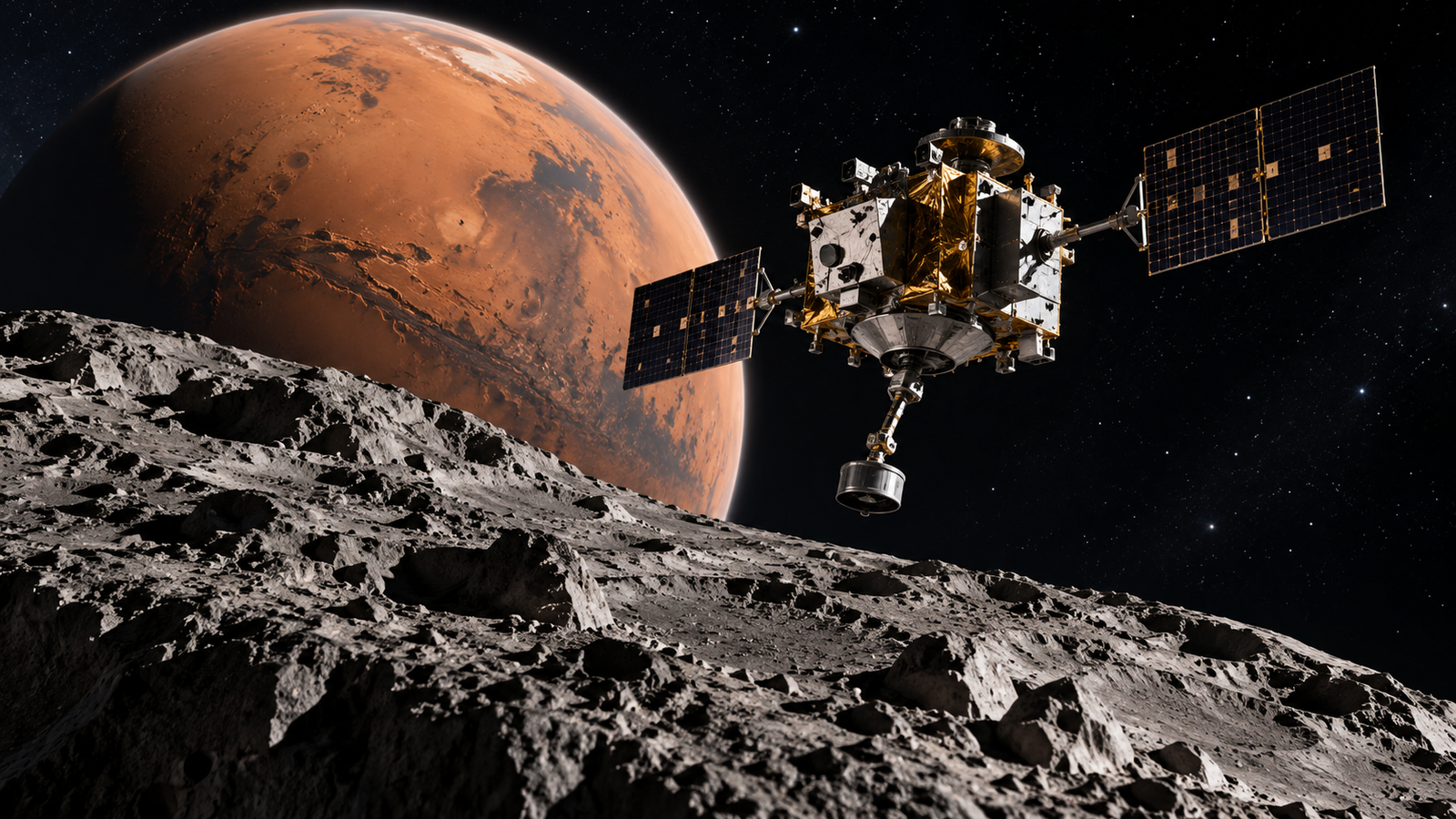
MMX is traveling to the Mars system, with an expected arrival in August 2027. After reaching the planet’s vicinity, the spacecraft is designed to approach Phobos and enter a special quasi-satellite orbit that follows the moon’s movement around Mars. From that vantage point, scientists will map its terrain, analyze candidate landing sites and select safe areas for surface work.
Although Phobos is the principal target, the mission will also observe Mars and its other moon, Deimos. These observations are important because scientists must distinguish materials native to the moons from those potentially deposited by impacts or transported from Mars. The sequence and timing of later maneuvers depend on the spacecraft’s performance and mission operations.
Why Is Phobos So Important to Scientists?
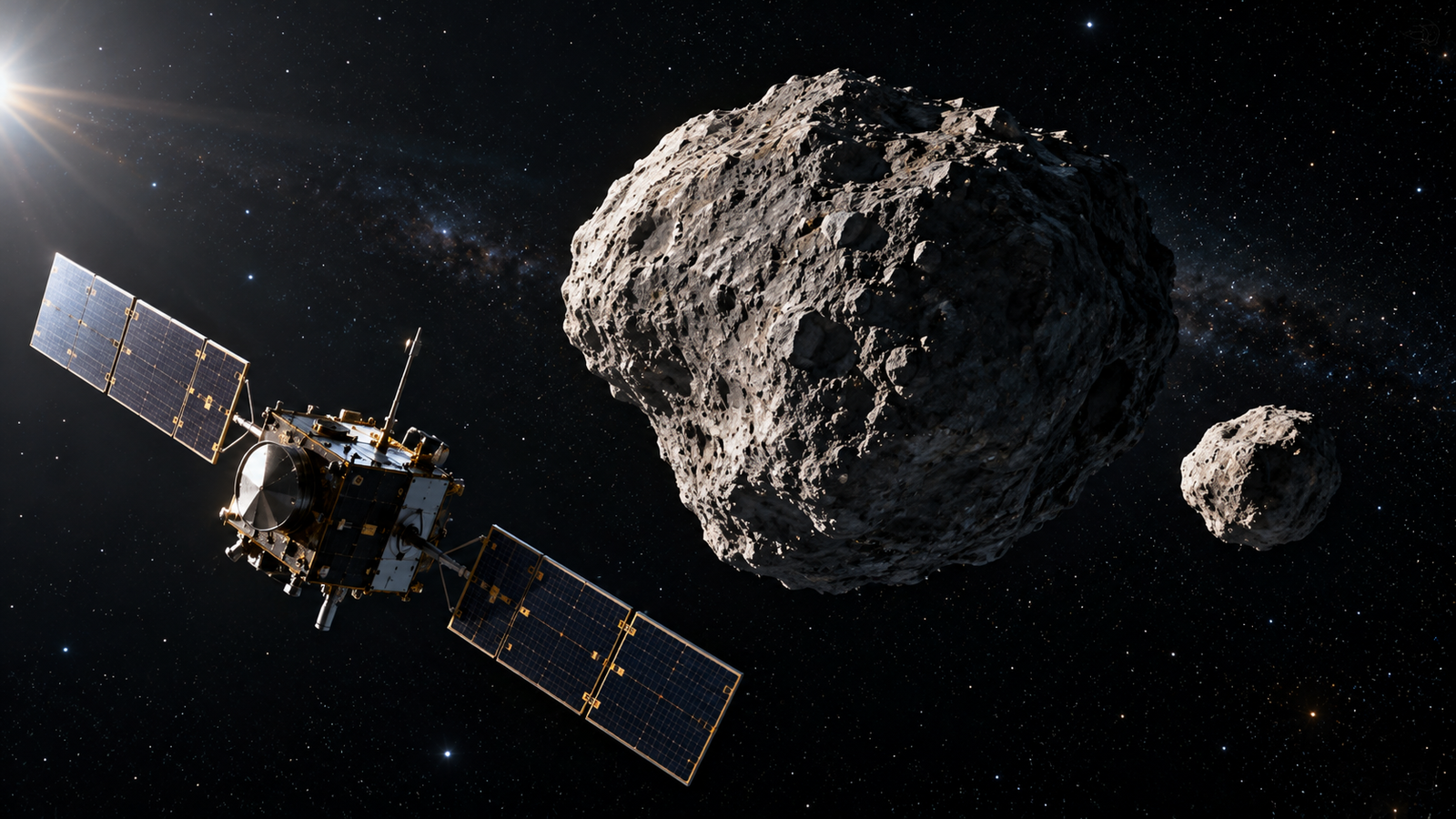
Phobos is a dark, irregular moon orbiting close to Mars, while its smaller companion Deimos travels farther away. Both are very different from Earth’s large, nearly spherical Moon. Their origins remain disputed: they may be captured objects resembling asteroids, or they may have formed from debris ejected after an ancient impact involving Mars.
Each explanation has different consequences for the history of the Red Planet. If the moons are captured asteroids, their materials could preserve evidence of other regions of the early solar system. If they grew from impact debris, their chemistry could reveal information about ancient Mars and violent events in its history. Measurements from MMX may help narrow these possibilities, though no single sample can guarantee a complete solution.
How Will MMX Collect Samples From Phobos?
The spacecraft is designed to investigate possible collection sites from orbit before conducting carefully controlled surface operations. JAXA’s mission plan targets the collection of at least 10 grams of rock and soil-like material from Phobos, potentially from more than one location. These samples will be placed into a return system designed to survive the journey back to Earth.
Phobos presents unusual engineering challenges. Its weak gravity, irregular shape and uncertain surface properties complicate navigation, descent and contact with the ground. A spacecraft cannot simply rely on techniques used for landing on the Moon or Mars, where gravity and terrain conditions differ. Engineers must limit contact forces and control trajectories with exceptional care. The sampling phase is scheduled for later in the mission and has not begun.
What Is the Idefix Rover’s Role?
A small rover named Idefix, developed through French and German cooperation, is expected to be deployed on Phobos to explore local terrain and study the surface environment. The European Space Agency has highlighted contributions from France’s CNES and Germany’s DLR, along with its own role in the international partnership. The rover’s measurements can complement remote observations by the main spacecraft.
Understanding surface texture, mechanical strength and the behavior of fine materials will help researchers interpret the larger spacecraft’s scientific measurements. It may also inform future operations on low-gravity planetary bodies. The rover is not yet conducting science on Phobos; its planned deployment depends on successful cruise, arrival and subsequent mission stages.
NASA’s Contribution to the Mission
NASA is supporting MMX with an instrument called MEGANE, short for Mars-moon Exploration with Gamma Rays and Neutrons. The device is designed to measure gamma rays and neutrons associated with Phobos’s surface and use those observations to identify important aspects of its elemental composition. Such information can be compared with findings from other instruments and eventually with laboratory analysis of returned material.
International scientific cooperation is a major feature of the mission. JAXA is leading the spacecraft and overall operations, while NASA, the European Space Agency, CNES and DLR contribute specialized capabilities. Collaboration spreads scientific expertise across agencies, but the goals and responsibilities of each contribution should be described accurately rather than calling MMX a NASA-led mission.
When Will Samples Return to Earth?
The current mission schedule aims for a return to Earth in 2031. JAXA’s public mission overview describes an approximately five-year journey that includes cruise to Mars, extensive observations of the moons, sampling and a return flight. The mission’s greatest scientific reward would come when researchers can study Phobos particles under laboratory instruments far more versatile than those that can fit aboard a spacecraft.
The 2031 date is a target, not a completed result or a guaranteed landing. Deep-space missions can face delays, technical challenges or revised plans. Similarly, the spacecraft’s expected arrival at Mars in August 2027 remains a scheduled milestone. Mukhbir will distinguish projected dates from events confirmed by JAXA as they happen.
What Can Returned Samples Reveal?
A returned sample would allow scientists to examine mineralogy, isotope ratios, microscopic textures and chemical composition in ways that are difficult to perform remotely. Laboratory results could test whether Phobos resembles primitive asteroids or material associated with Mars itself. Researchers could also search for clues about impact processes and how matter moved through the young solar system.
Such studies are relevant to understanding the ingredients and environments involved in planetary formation. However, the mission is not an announced discovery of life on Mars or on Phobos. References to habitability and life’s origins describe wider scientific questions, not evidence that organisms have been found. The strength of sample-return science is its capacity to test hypotheses with physical material and independent experiments.
How Does MMX Compare With Other Mars Missions?
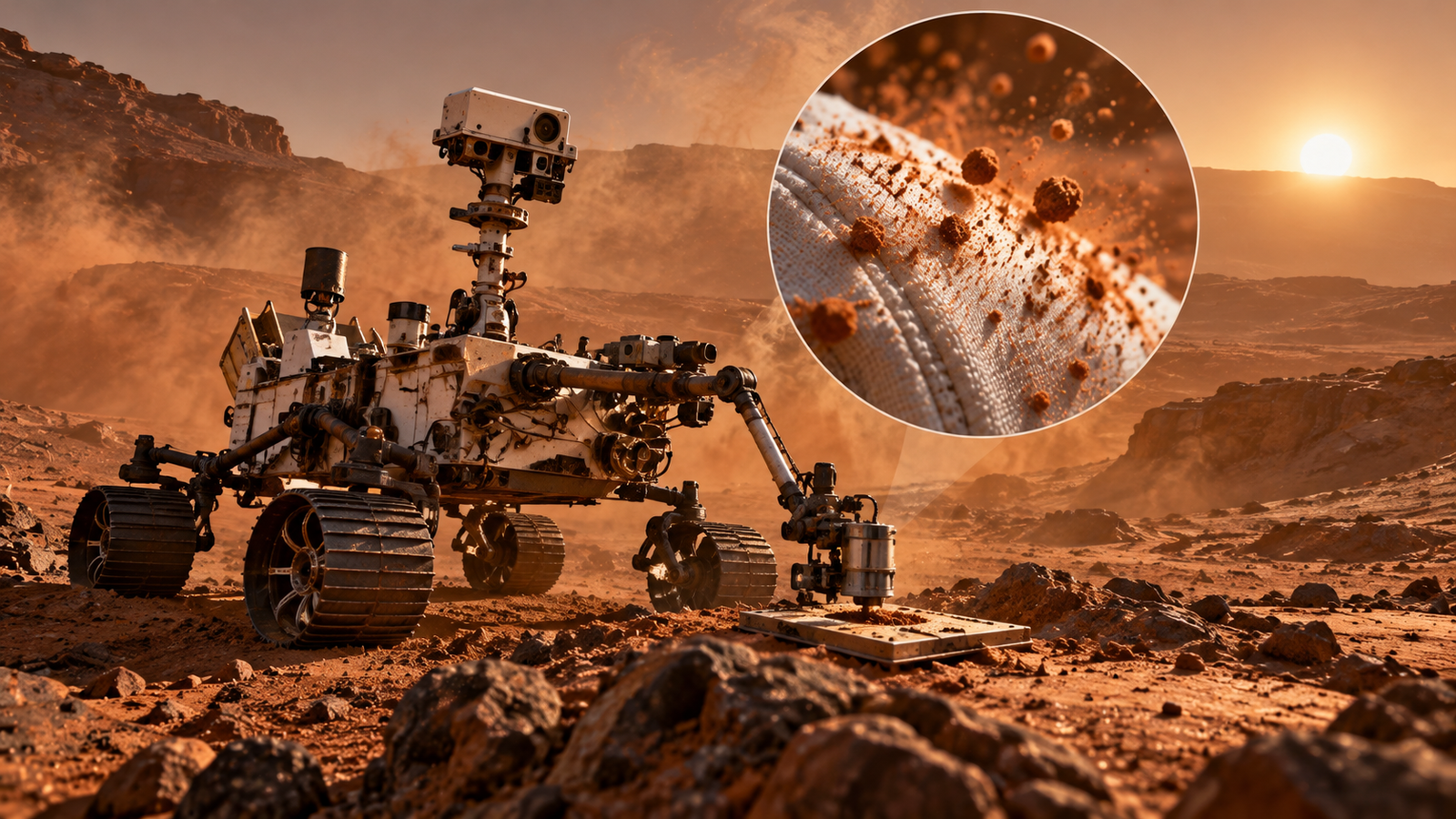
NASA’s Perseverance rover has been collecting and storing samples directly on Mars, while MMX is designed to retrieve material from a moon orbiting the planet. The two approaches investigate different geological histories. Mars surface samples may preserve evidence of ancient environments, whereas Phobos material may provide clues about the formation of Mars’s moons and interactions across the wider Martian system.
Japan has experience with sample-return missions through its Hayabusa and Hayabusa2 asteroid projects. MMX builds on some of that expertise while taking on new challenges posed by the distance to Mars and Phobos’s very weak gravity. Successful operation would extend humanity’s ability to examine worlds that have never before been sampled and returned to terrestrial laboratories.
The H3 Rocket and Japan’s Space Ambitions
MMX launched aboard Japan’s H3 rocket, developed as a central component of the country’s space transportation program. The successful dispatch of a large interplanetary spacecraft represents an important operational achievement for the launcher and JAXA. Reuters noted that the mission follows the rocket’s difficult initial development history, including a failed debut in 2023.
Japan’s space-science portfolio combines Earth observation, astronomical research, lunar exploration and sample-return missions. Rather than competing only for dramatic firsts, these efforts support engineering expertise and long-term scientific capability. MMX is particularly visible because success would allow Japan and its partners to address a planetary mystery using actual material recovered from beyond the Earth-Moon system.
Why This Story Matters Worldwide
The origin of Mars’s moons is not simply an isolated astronomy puzzle. Answers may improve understanding of how planets acquire satellites, how impacts redistribute material, and how the early solar system evolved. Research from one small moon can therefore inform broader models of planetary formation.
The mission also offers technological lessons in precise navigation, robotics, sample handling and autonomous operations far from Earth. These capabilities could eventually support more complex exploration of asteroids, moons and Mars. Countries around the world, including South Asian audiences following developments in space science, have a scientific interest in the findings; no direct Pakistani mission role should be asserted without evidence.
What Happens Next for MMX?
The next major phase is the spacecraft’s interplanetary cruise toward Mars. Mission controllers will monitor the probe’s health, conduct planned trajectory operations and prepare scientific systems before it approaches the Martian system. Detailed observations of Phobos are expected after arrival, followed by rover deployment, site selection and eventual sampling attempts.
A credible future update would cite JAXA’s tracking and mission-status announcements rather than assuming that a successful rocket launch means a spacecraft has arrived at its destination. Readers should also be cautious about dramatic social-media artwork that suggests samples have already been recovered. For now, the verified achievement is the launch and successful spacecraft separation.
Conclusion
Japan’s MMX mission has begun a journey intended to return samples from the Martian moon Phobos in 2031. JAXA confirmed the H3 rocket’s successful launch from Tanegashima on October 20, 2026, while partner agencies have outlined the scientific plan to investigate Mars’s moons and collect at least 10 grams of surface material. The launch marks the start of a challenging international exploration effort, not the completion of its sample-return goal.
If the spacecraft reaches Mars, performs its investigations and brings samples home, scientists could gain important evidence about the origin of Phobos, Deimos and the broader Mars system. The most important next step is simply to follow the mission’s confirmed milestones as its five-year journey unfolds.
Frequently Asked Questions
What is Japan’s MMX mission?
Martian Moons eXploration (MMX) is a JAXA-led spacecraft mission to study Phobos and Deimos and return samples from Phobos to Earth.
When was the MMX spacecraft launched?
JAXA confirmed the launch on October 20, 2026 at 04:41:03 Japan Standard Time from Tanegashima Space Center.
Which rocket launched MMX?
The spacecraft launched on Japan’s H3 Launch Vehicle Flight No. 10.
Which Mars moon will MMX collect samples from?
Phobos, the larger of Mars’s two moons, is the primary sample-collection target.
How much material will MMX bring back?
JAXA aims to return at least 10 grams of material from Phobos if the sampling and return phases succeed.
When will the spacecraft arrive at Mars?
Current mission plans target arrival in August 2027, subject to successful operations.
When will MMX return to Earth?
The sample-return target is 2031. No samples have been returned yet.
What will scientists learn from Phobos samples?
They hope to test competing theories about how Mars’s moons formed and learn more about the early solar system.
About The Author