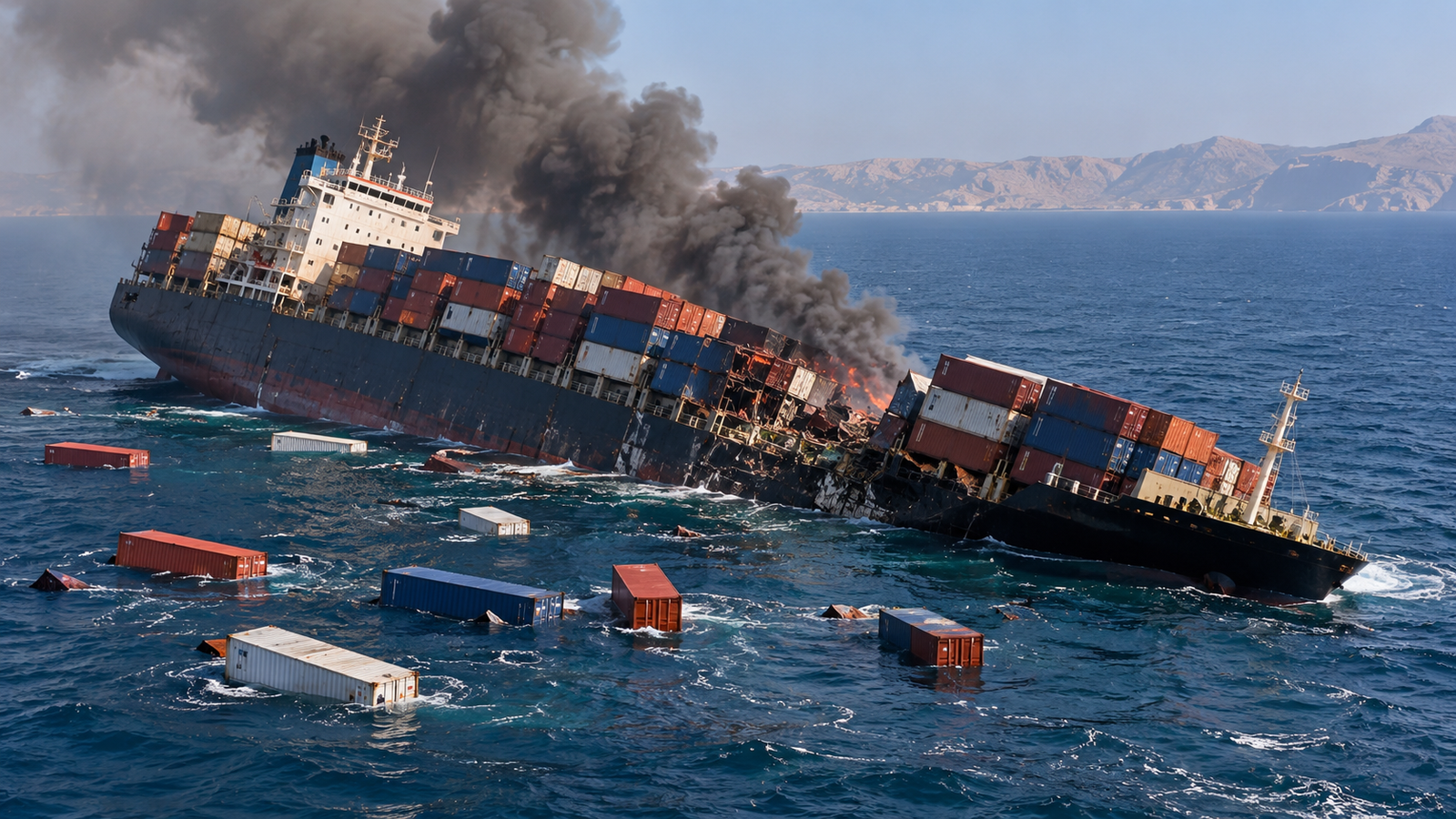
The sinking of the Singapore-flagged container vessel GFS Pride in the Strait of Hormuz has heightened concern about the safety of commercial shipping in one of the world’s most important trade routes. Singapore’s Maritime and Port Authority said the ship was struck by an unidentified projectile on October 13, 2026, suffered damage and a fire, and subsequently sank. All 21 people on board were evacuated safely, with no injuries reported.
The incident also became the centre of a separate wave of online claims about cargo containers spilling tens of thousands of iPhones and luxury perfumes into the sea. Dramatic clips purporting to show people collecting expensive goods went viral, but an Al Jazeera open-source investigation traced prominent videos to an account producing AI-generated fictional scenes. There is no reliable confirmation for widely repeated claims of 50,000 iPhones or a cargo loss exceeding $100 million.
What Happened to GFS Pride on October 13?
GFS Pride was navigating the Strait of Hormuz when an incident damaged the ship and caused a fire. Singapore’s Maritime and Port Authority (MPA) reported the event the following day as part of a statement on two Singapore-registered container ships struck in the area. The authority described the objects that hit the ships as unidentified projectiles rather than assigning a definitive weapon type or attacker in its initial account.
The fire and structural damage were serious enough that GFS Pride later sank. Reuters and other major international outlets reported the loss of the ship amid a broader series of incidents affecting merchant vessels near the strait. The exact moment of sinking and full damage assessment were not documented in enough detail in the initial official release to support elaborate reconstructions circulated online.
All 21 Crew Members Were Rescued
One of the most important verified details is that all 21 crew members from GFS Pride were safely evacuated and no injuries were reported. MPA also confirmed that no Singaporean nationals were among the crews of the two Singapore-registered vessels involved in the incidents. Successful evacuation meant the loss of the ship did not produce reported fatalities among its own crew.
Another vessel, GFS Giselle, was struck on October 14. It sustained hull damage but managed to reach a safe anchorage under its own propulsion, and its 22 crew members were also reported safe. These are separate vessels and events. Their details should not be combined or confused with reports of another ship, Cape Dao, that also sank in the region.
Did Iran Attack the Ship? What the Reports Actually Establish
Iran’s Islamic Revolutionary Guard Corps said a ship using what it described as an unauthorized route struck a naval mine. Associated Press reported that account alongside Singapore’s statement that its vessels had been struck by unidentified projectiles. Reuters also placed the incident in the context of heightened military tensions and attacks on commercial vessels in the waterway.
These accounts are not identical. An official statement about an unidentified projectile does not conclusively establish whether the ship was struck by a mine, missile, drone or another weapon. Nor does it settle all questions of legal responsibility. Mukhbir therefore attributes claims about a naval mine to Iranian authorities and uses the wording of Singapore’s maritime regulator when describing the independently documented damage.
Did GFS Pride Leave Dubai or Karachi?
Social-media posts have offered differing accounts of the ship’s departure point, including claims that it sailed from Dubai. An October 17 Al Jazeera investigation examined MarineTraffic vessel-tracking records and reported that GFS Pride left Karachi port in Pakistan on October 2, 2026, and that its declared destination was Fujairah in the United Arab Emirates. Al Jazeera also reported that the vessel later switched off its tracking signal.
A declared destination in vessel data is not equivalent to a verified arrival, and the data described in that report does not justify stating that the ship departed Dubai with a particular cargo of phones. The Karachi connection is significant for Pakistani readers but should be described precisely as a reported departure based on tracking records.
Why Did Viral Videos Show iPhones and Perfumes Floating at Sea?
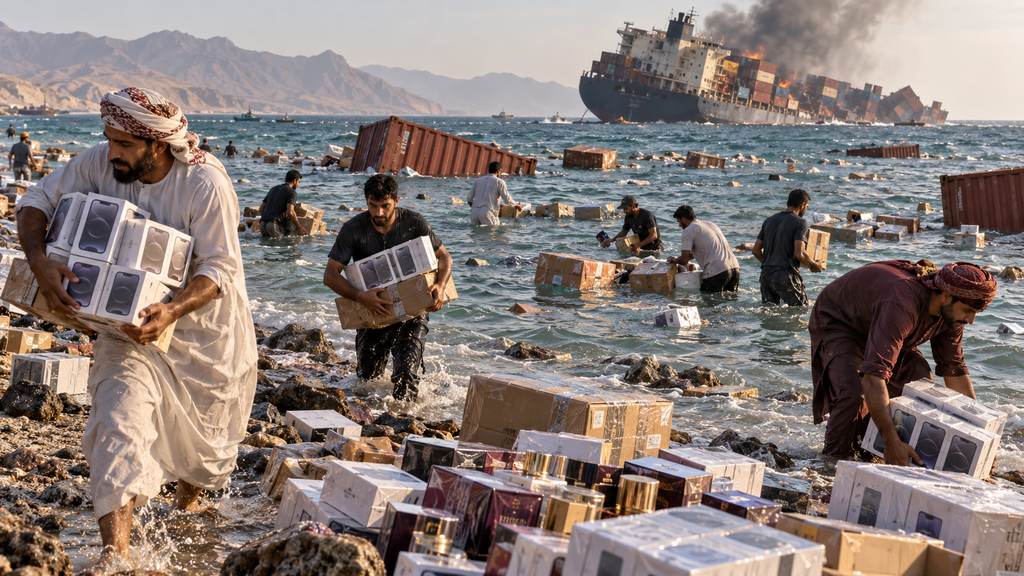
Soon after news of the sinking spread, social-media clips claimed to show people recovering boxes of iPhones, expensive perfumes and other consumer goods from seawater. The images appeared attractive and dramatic because the supposed cargo was valuable and easy for online audiences to recognize. Posts accumulated huge view counts and were reshared as though they documented the aftermath of the GFS Pride incident.
Al Jazeera’s open-source investigation published on October 17 traced the clips to an Instagram account called Nativora, which describes its content as cinematic fictional stories produced with artificial intelligence. Investigators identified visual inconsistencies, including distorted phone packaging, unnatural depictions of floating devices and inconsistent details in people shown in the clips. They calculated approximately 80 million cumulative views for related material. The videos cannot be relied upon as authentic footage of cargo escaping the vessel.
Were 50,000 iPhones Really on Board?
No verified cargo manifest has been produced in the reporting reviewed to support the claim that GFS Pride carried more than 50,000 iPhones. Similar posts also listed premium perfumes and luxury products but did not establish reliable shipping documentation showing the contents of specific containers. Merchandise appearing in AI-generated footage is not proof that the merchandise was on the real vessel.
It would be inaccurate to replace an unverified figure with another invented estimate. Commercial ships frequently transport diverse cargo, and determining the contents of a lost container requires records from shippers, freight forwarders, customs authorities or insurers. Until these become publicly available and credible, the correct position is that the precise nature and value of the lost consumer goods remain unconfirmed.
What About Claims of 24 Containers and $100 Million in Losses?
Other circulating reports have presented incompatible container counts, including an assertion that the ship carried just 24 containers. A marine casualty note by WK Webster referred to the vessel as carrying approximately 2,500 containers, but a large estimated quantity on board should not be confused with the number physically lost or recovered. The complete condition and contents of the cargo were not yet independently established.
The often repeated claim of more than $100 million in lost iPhones and perfumes has likewise not been supported by a published official cargo valuation. An accurate financial calculation would distinguish the vessel’s own value, insured merchandise, salvage costs, pollution response and interruption to transport services. Without those records, describing an exact total loss would mislead readers.
Why the Strait of Hormuz Matters to Global Shipping
The Strait of Hormuz connects the Persian Gulf with the Gulf of Oman and the wider Indian Ocean. It is a strategic corridor for tankers, container carriers and other merchant ships serving Gulf ports and international markets. Before the current conflict, the waterway was associated with roughly one-fifth of global oil and liquefied natural gas shipments, which explains why shipping incidents in the area receive intense international attention.
A strike on a commercial vessel threatens more than the cargo on a single ship. Owners and operators may reconsider routes, increase security spending or face difficult insurance conditions. Disruptions can also create congestion or delays at regional ports. These are potential consequences of insecurity; they are not proof that a particular shipment suffered a specific price increase or that every cargo service has been halted.
How the Incident Fits Into Wider Regional Tensions
Reuters and Associated Press reported the GFS Pride sinking against a backdrop of escalating conflict involving Iran and military activity affecting the strait. Commercial vessels have faced growing hazards from attacks, disputed transit restrictions and warnings about navigation. Singapore’s MPA condemned attacks on commercial shipping and said it remained in contact with the vessels’ management company while monitoring developments.
For a news outlet, accurate attribution is particularly important when reporting military incidents. Statements issued by governments, maritime authorities and armed groups may contain different accounts of responsibility or methods. Reporting those differences faithfully enables readers to understand both what is known and what remains under investigation.
Potential Impact on Pakistan and South Asia
Al Jazeera’s report that GFS Pride departed Karachi on October 2 gives the case a concrete Pakistan connection. Pakistan relies on seaborne trade for imports and exports, and its merchants operate within shipping networks that connect South Asian ports to the Gulf, Europe and other markets. Security problems in Hormuz can therefore matter for businesses even when the immediate vessel is registered in another country.
Possible effects include shipping delays, increased marine insurance expenses and uncertainty for importers and exporters using nearby routes. However, available reporting does not establish that Pakistani businesses lost a specified shipment aboard GFS Pride or that domestic prices rose because of this particular sinking. Any direct financial impact on Pakistan should be supported by cargo records, carriers or trade data rather than inferred from proximity alone.
Environmental and Salvage Concerns
The sinking of a container ship can create navigational and environmental complications. Fuel, floating cargo, container debris and damaged equipment may need to be assessed by maritime authorities and specialist salvage companies. Shipping containers can drift or sink and may pose dangers to vessels or coastal environments depending on their contents and position.
The actual extent of pollution from GFS Pride had not been comprehensively established in the source material reviewed. It would therefore be premature to claim a confirmed major toxic spill or make an exact prediction about ecological damage. Maritime authorities and salvage specialists are the appropriate sources for later updates on debris, hazardous cargo and recovery operations.
How to Verify Maritime Disaster Videos
A convincing-looking clip is not the same as authenticated evidence. Viewers can begin by identifying the original uploader and asking whether the footage appeared before or after the reported incident. A reverse search can reveal an earlier source, while details such as inconsistent branding, impossible physical movement, warped lettering and unusual human figures may signal synthetic media.
Location matters as well. A clip filmed at another coast or generated without a real-world location should not be presented as depicting the Strait of Hormuz. Video evidence should be compared with independent images from reputable agencies, maritime notices and vessel-tracking information. In this case, the viral iPhone recovery clips failed those verification checks.
What Still Needs Confirmation?
Several questions remain open in the public record: the precise weapon or mechanism responsible for the damage, the independently verified cargo manifest, the amount of insured loss, the quantity of merchandise recovered and the eventual outcomes of salvage or environmental assessment. It is also important to monitor for any updated Singapore maritime authority findings or company statements.
Those uncertainties do not undermine the confirmed central event. GFS Pride was damaged, caught fire and sank, and its 21 crew members were rescued. The existence of a genuine tragedy at sea, however, does not validate every subsequent social-media claim about the cargo.
Conclusion
The Singapore-flagged GFS Pride sank after a damaging incident in the Strait of Hormuz on October 13, 2026, according to Singapore’s maritime authority and major international news agencies. All 21 crew members were evacuated without reported injuries. Iran described a naval-mine incident, while Singapore referred to unidentified projectiles, leaving the precise attack mechanism subject to differing accounts.
The viral narrative about tens of thousands of iPhones and luxury perfumes floating into the sea is a different matter. Al Jazeera established that prominent circulating videos were generated with artificial intelligence, and neither the claimed cargo volume nor the widely shared $100 million loss estimate has been independently verified. The responsible news angle is therefore both a maritime-security report and a fact-check of misleading visual content.
Frequently Asked Questions
When did GFS Pride sink?
Singapore’s Maritime and Port Authority said the vessel was struck on October 13, 2026, and subsequently sank after damage and a fire.
Was GFS Pride registered in Singapore?
Yes. The ship was Singapore-registered, according to MPA.
Were crew members injured?
All 21 crew members were safely evacuated, with no injuries reported.
Did Iran sink GFS Pride with a mine?
Iranian authorities described a naval-mine incident, while Singapore reported unidentified projectiles. The precise mechanism remains disputed in the cited reports.
Were 50,000 iPhones on board?
There is no independently verified cargo manifest in the reporting reviewed confirming that number.
Are videos of people collecting iPhones from the sea authentic?
Al Jazeera identified prominent viral clips as AI-generated fabrications, not authentic footage of the ship’s cargo.
Did the ship leave Dubai?
Al Jazeera cited vessel-tracking data showing departure from Karachi on October 2 and a declared destination of Fujairah.
Did the sinking cause more than $100 million in losses?
The exact value of the lost cargo and total financial damage has not been independently confirmed.
About The Author