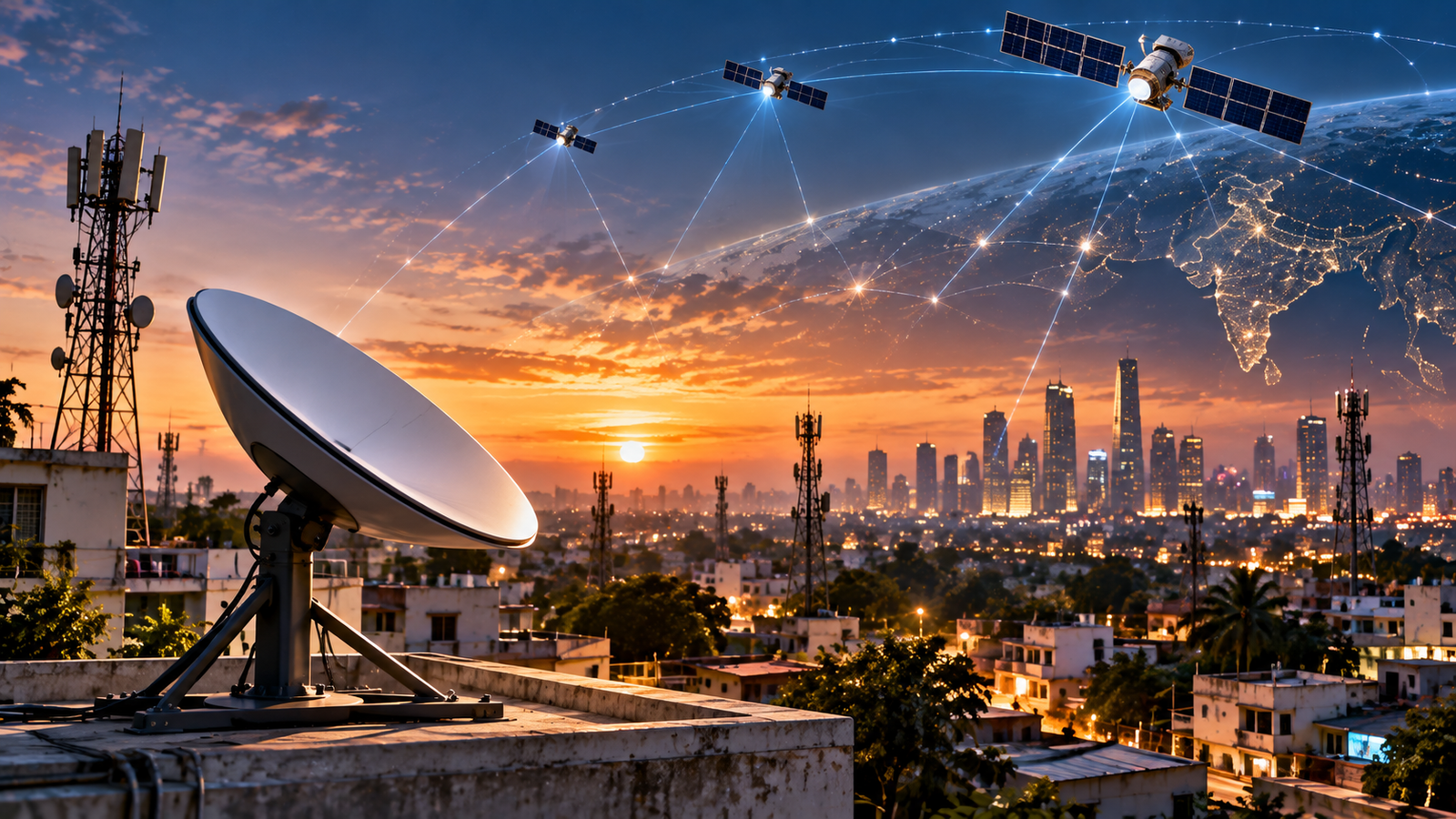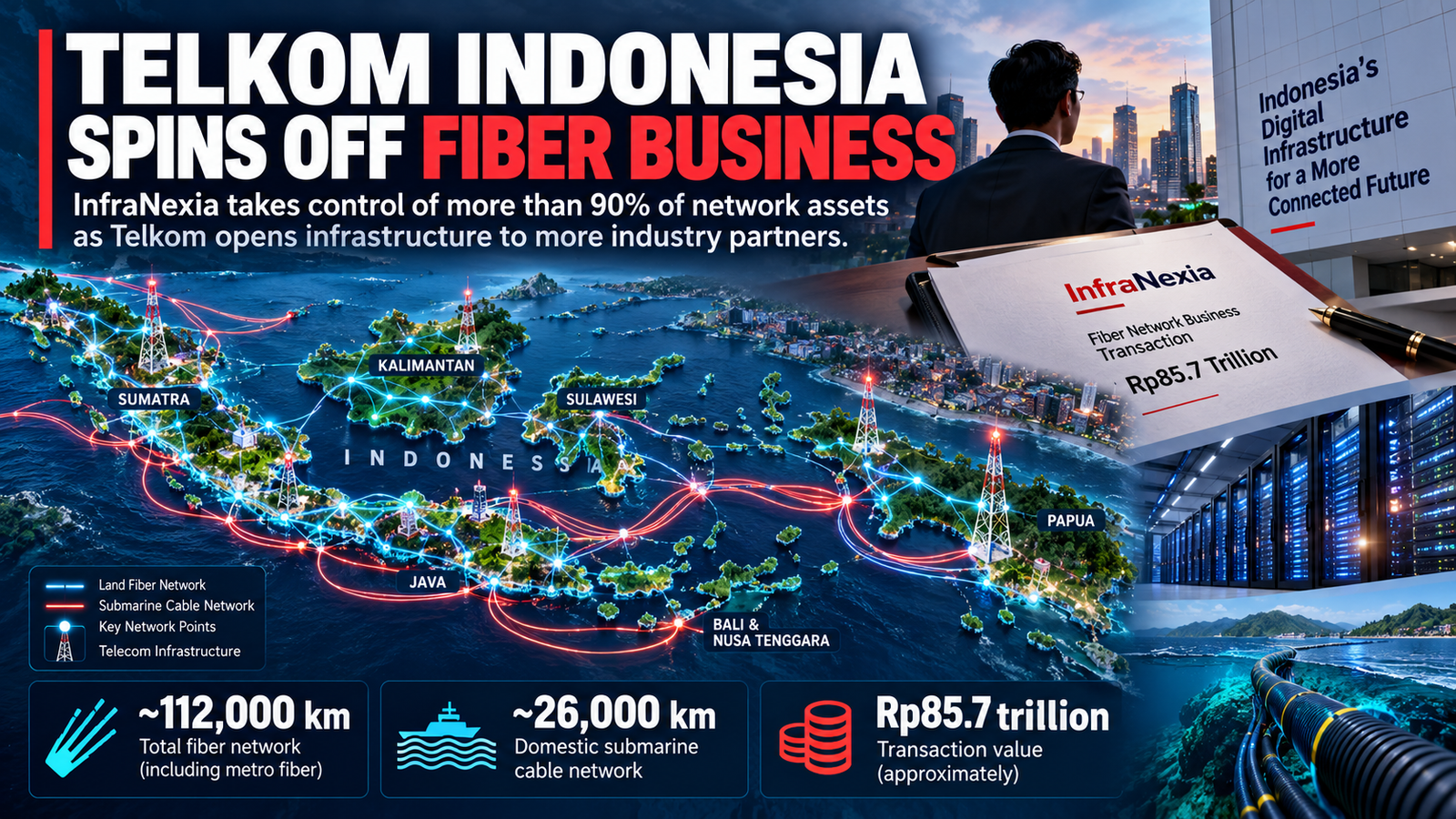
Telkom Indonesia has moved more than 90% of its network infrastructure assets into PT Telkom Infrastruktur Indonesia, known as InfraNexia, as the state-controlled telecom group restructures its wholesale fiber business and opens more of its network to external industry customers.
The company said independent shareholders approved the second phase of the spin-off at an extraordinary general meeting on September 30, 2026. Telkom and InfraNexia signed the deed of spin-off the same day.
The transaction covers network infrastructure valued at about Rp85.7 trillion and gives InfraNexia control of roughly 112,000 kilometers of fiber network, including around 26,000 kilometers of domestic submarine cable.
Telkom says the move is part of its broader TLKM 30 transformation strategy, which aims to separate major operating businesses, improve asset monetisation and turn Telkom from an operating holding company into a more strategic holding structure.
For Indonesia’s telecom market, the most important change is that InfraNexia is being positioned as a wholesale infrastructure company serving both TelkomGroup and outside operators, internet service providers, cloud companies, data-center operators and other businesses.
What Telkom Indonesia Approved
Telkom’s independent shareholders approved the spin-off of its wholesale fiber connectivity assets and business into InfraNexia.
The transaction is an affiliated corporate action and was handled under Indonesian financial-market rules governing affiliated transactions and conflicts of interest.
After the shareholder vote, Telkom and InfraNexia signed the formal deed of spin-off.
That step marked a major milestone in the second phase of the InfraCo restructuring.
Telkom had already completed an earlier phase of the transaction, but the latest transfer significantly expands InfraNexia’s scale and operational importance.
More Than 90% of Network Assets Move to InfraNexia
Telkom says more than 90% of its network infrastructure assets are now consolidated under InfraNexia.
That gives the company one of the largest digital infrastructure footprints in Indonesia.
The network includes:
– around 112,000 km of fiber optic infrastructure
– about 26,000 km of domestic submarine cable
– terrestrial backbone and access infrastructure
– supporting network assets across multiple regions
The company said the transaction value is about Rp85.7 trillion.
Why the 112,000 km Network Matters
Indonesia is one of the world’s largest archipelagic countries.
Connecting its major islands requires both terrestrial fiber and submarine cable systems.
That makes fixed infrastructure especially important.
A large national fiber footprint can support:
– mobile operators
– fixed broadband providers
– data centers
– cloud platforms
– enterprises
– government services
– AI workloads
InfraNexia’s role is therefore broader than traditional telecom connectivity.
The company is being positioned as a backbone provider for Indonesia’s wider digital economy.
What InfraNexia Is Supposed to Become
Telkom wants InfraNexia to operate as a neutral wholesale infrastructure provider.
That means the company is expected to sell connectivity not only to Telkom-affiliated businesses but also to external customers.
This is strategically important.
A network used by multiple operators can generate more revenue from the same physical assets.
It can also reduce duplication if companies do not need to build parallel infrastructure in every market.
Telkom says this model can improve asset utilization and create new growth outside the group’s traditional retail businesses.
Why Telkom Is Separating the Fiber Business
Large telecom companies often own valuable infrastructure that is difficult for investors to value clearly when it sits inside a broader group.
Separating infrastructure can make its economics more visible.
Telkom says the spin-off is intended to unlock value from network assets and make them easier to manage commercially.
The company is also trying to create a structure that can support strategic partnerships.
That could eventually include cooperation with operators, cloud providers, data-center companies or infrastructure investors.
The move fits a wider global telecom trend in which operators separate towers, fiber networks and data centers from retail service businesses.
TLKM 30 and the Shift to a Strategic Holding Model
Telkom describes the transaction as part of its TLKM 30 transformation.
The strategy is intended to move the group from an operating holding company toward a strategic holding model.
In practical terms, that means specialized operating companies manage specific businesses while the parent company focuses more on capital allocation, portfolio strategy and long-term value creation.
InfraNexia is the operating company for wholesale fiber connectivity.
Other parts of Telkom’s portfolio are being reorganized around similar principles.
Why Wholesale Fiber Can Be a Different Business
Retail telecom and wholesale infrastructure have different economics.
Retail businesses compete for individual consumers and enterprise customers.
Wholesale infrastructure businesses focus more on long-term contracts, network utilization and large-scale capacity.
Keeping those activities separate can make management decisions clearer.
It can also make financial performance easier for investors to analyze.
This is one reason infrastructure carve-outs have become common across global telecom markets.
InfraNexia’s Regional Footprint
After the asset transfer, Telkom says InfraNexia will operate through four areas, 12 regional structures and 61 districts across Indonesia.
The network spans both land and submarine infrastructure.
That scale is important because demand for data is growing across many parts of the country, not only in Jakarta.
More regional connectivity can support cloud adoption, digital services and data-center expansion outside the largest urban centers.
The AI-Ready Infrastructure Strategy
InfraNexia is also framing its network as “AI-ready infrastructure.”
The phrase reflects a broader change in telecom demand.
AI applications require large amounts of computing power and data movement.
That creates demand for:
– high-capacity fiber
– low-latency connections
– data-center interconnection
– cloud connectivity
– reliable backbone networks
InfraNexia says its infrastructure is designed to support AI, cloud and data-center growth.
That gives the company a role in Indonesia’s technology strategy beyond basic broadband.
How Data Centers Fit Into the Plan
Data centers depend heavily on fiber connectivity.
Large computing facilities need multiple high-capacity network routes for redundancy and performance.
As Indonesia attracts more cloud and AI investment, demand for data-center interconnection is likely to rise.
InfraNexia’s large fiber footprint could make it an important supplier to that market.
This is especially relevant as global technology companies and local operators expand infrastructure in Southeast Asia.
Why Open Access Matters
InfraNexia says it wants to provide infrastructure that can be used by multiple industry participants.
Open-access wholesale networks can help smaller operators expand without building every section of fiber themselves.
That can reduce capital requirements and speed up service launches.
The model can also improve competition if access is offered on transparent commercial terms.
However, the long-term market impact will depend on pricing, service quality and how neutral InfraNexia is in practice when dealing with Telkom competitors.
Competition Questions
Telkom remains a powerful player in Indonesia’s telecom market.
That means the independence and neutrality of InfraNexia will be closely watched.
External customers will want confidence that wholesale terms are fair and that Telkom-affiliated businesses do not receive inappropriate advantages.
Regulators may also monitor how the new structure affects competition.
The company’s success as a neutral carrier will depend partly on whether outside operators see it as a reliable partner rather than simply another arm of Telkom.
Why Investors Are Watching
Wall Street Journal market commentary said Telkom’s fiber spin-off could support strategic investment and asset monetisation, although restructuring can also create short-term execution risks.
The attraction for investors is straightforward.
Dedicated infrastructure businesses often generate long-term contracted revenue and can be valued differently from traditional telecom operations.
If InfraNexia attracts more external customers, Telkom may be able to show clearer returns from assets that previously sat inside the group.
The potential risk is that large reorganizations can create operational complexity during the transition.
Transaction Value and Asset Monetisation
Telkom values the transferred assets and business at about Rp85.7 trillion.
That figure shows how important fiber infrastructure is to the group’s balance sheet.
Asset monetisation does not necessarily mean selling the network outright.
It can also mean generating more commercial value from infrastructure through wholesale access, partnerships and better utilization.
Telkom’s stated strategy is to increase the productivity of those assets rather than simply hold them inside the parent company.
Why Submarine Cables Matter
About 26,000 km of the network consists of domestic submarine cable.
For Indonesia, submarine connectivity is essential because the country is spread across thousands of islands.
These cable systems connect major population centers and support national internet traffic.
They are also important for redundancy.
If one route fails, alternative routes can help keep services running.
As cloud usage and data traffic grow, maintaining resilient submarine infrastructure becomes increasingly important.
Business Impact
The spin-off could create opportunities for operators, cloud providers, data-center companies and enterprise customers that need large amounts of network capacity.
A more commercially focused wholesale provider may be able to offer new products and expand partnerships more quickly.
For Telkom, success will depend on whether InfraNexia can attract meaningful external revenue.
If most traffic continues to come from TelkomGroup, the benefits of neutrality may be limited.
If outside demand grows, the company could become a major independent infrastructure platform in Southeast Asia.
Technology Impact
The move strengthens the physical layer needed for Indonesia’s digital economy.
Cloud computing, AI services, streaming, enterprise software and mobile networks all depend on reliable fiber.
As data-center capacity increases, network quality becomes even more important.
The InfraNexia strategy therefore sits at the intersection of telecom, cloud infrastructure and AI investment.
Southeast Asia Relevance
Indonesia is one of Southeast Asia’s largest digital markets.
Its infrastructure decisions can influence regional investment.
A strong wholesale fiber platform could make Indonesia more attractive to cloud providers, data-center developers and international telecom partners.
It could also encourage similar infrastructure restructuring among operators elsewhere in the region.
Pakistan Relevance
There is no direct Pakistan connection to the Telkom transaction.
However, the model is relevant to Pakistan’s telecom sector because infrastructure sharing can reduce duplication and improve the economics of network expansion.
Pakistan’s operators also face rising data demand, expensive capital requirements and growing need for fiber backhaul.
Indonesia’s approach offers a useful example of how a large telecom group can separate infrastructure from retail operations and open the network to outside customers.
What Happens Next?
The next phase will be judged by execution.
Key things to watch include:
– growth in external wholesale customers
– partnerships with mobile and internet operators
– data-center and cloud connectivity deals
– capital investment in network expansion
– pricing and access terms
– regulatory treatment of InfraNexia
– possible strategic investment in the business
The spin-off itself is a major structural change, but the long-term value will depend on how successfully InfraNexia turns the transferred assets into a broader wholesale platform.
Why This Story Matters
Telkom Indonesia’s fiber spin-off is one of the largest telecom infrastructure restructurings in the region.
More than 90% of Telkom’s network infrastructure assets are now being managed by a specialized wholesale company.
That gives InfraNexia control of a network stretching roughly 112,000 km, including 26,000 km of domestic submarine cable.
The strategy is designed to make those assets more open, more commercially productive and more useful to Indonesia’s fast-growing cloud, data-center and AI ecosystem.
If the model works, InfraNexia could become one of the most important digital-infrastructure platforms in Southeast Asia.
Frequently Asked Questions
What is InfraNexia?
InfraNexia is PT Telkom Infrastruktur Indonesia, the TelkomGroup company responsible for wholesale network infrastructure.
How much fiber does InfraNexia manage?
Telkom says the company manages about 112,000 km of fiber network.
How much submarine cable is included?
About 26,000 km of domestic submarine cable is included in the infrastructure footprint.
How much is the transaction worth?
Telkom says the transaction value is about Rp85.7 trillion.
How much of Telkom’s network infrastructure moved to InfraNexia?
More than 90% of Telkom’s network infrastructure assets are now consolidated under InfraNexia.
Why did Telkom spin off the fiber business?
Telkom says the goal is to improve asset utilization, support strategic partnerships and create a neutral wholesale infrastructure business.
Will InfraNexia serve companies outside TelkomGroup?
Yes. Telkom says InfraNexia will serve external operators, internet providers, cloud companies, data-center businesses and other customers.
Why is this important for AI and cloud services?
AI and cloud services require high-capacity, low-latency fiber links between users, data centers and computing infrastructure.
Does the deal directly involve Pakistan?
No, but it offers a relevant infrastructure-sharing model for telecom markets such as Pakistan that need more fiber investment.
About The Author