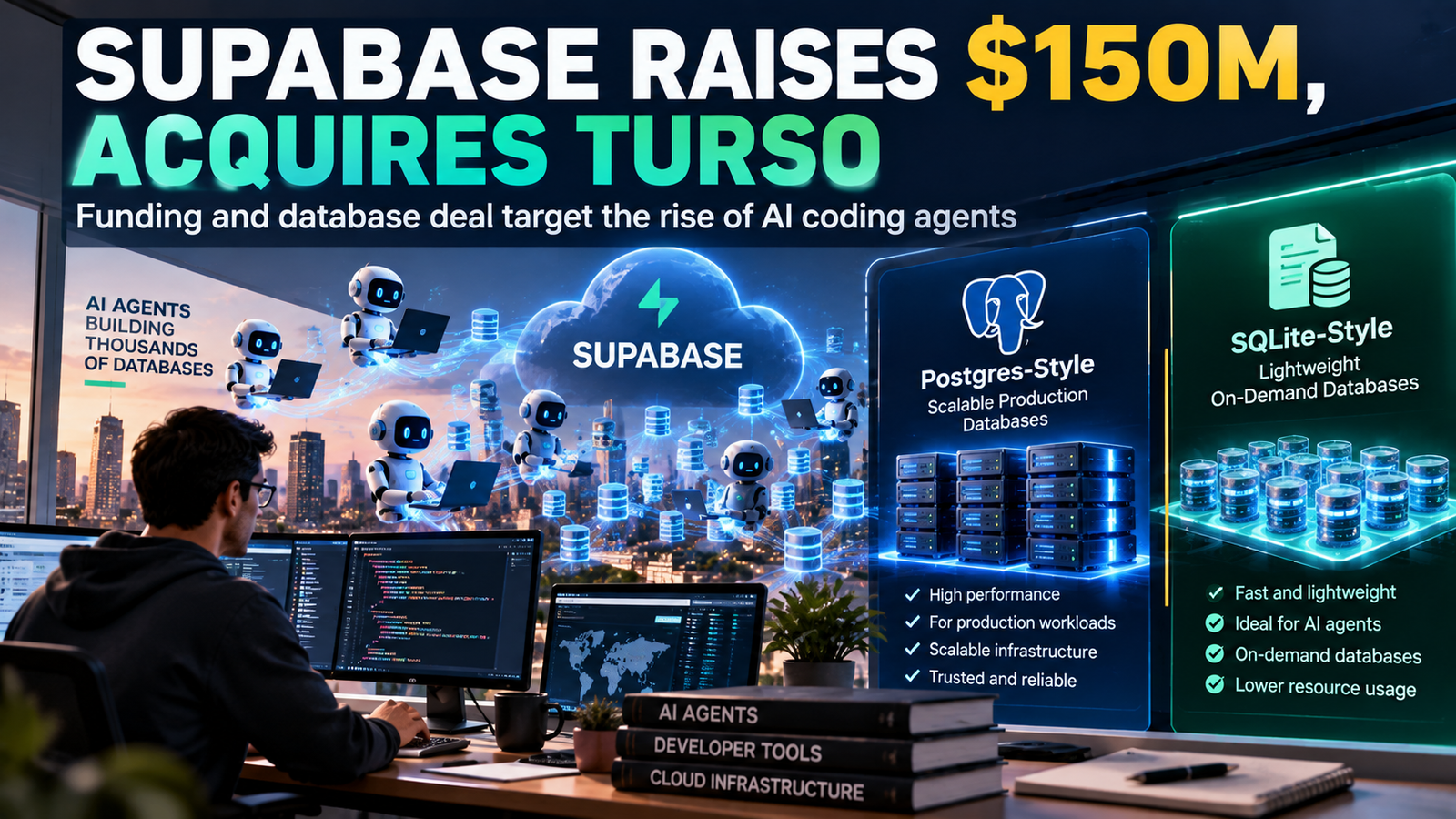
Supabase has raised $150 million in new funding led by Singapore’s sovereign wealth fund GIC and agreed to acquire database startup Turso, as the company expands its infrastructure for software increasingly created and operated by AI coding agents.
CapitalG, IronArc and Square Peg also participated in the funding round, according to the company’s October 2 announcement.
Supabase did not disclose a valuation for the new financing, and the purchase price for Turso was also not made public.
The deal brings together two different database approaches. Supabase is built around PostgreSQL, a widely used relational database suited to production applications. Turso has focused on lightweight SQLite-based databases that can be created quickly and cheaply for smaller, temporary or isolated workloads.
Supabase says that combination is increasingly important because AI agents are generating software, prototypes and database workloads at a scale that traditional infrastructure was not designed to handle.
What Supabase Announced
Supabase announced two major moves on the same day.
First, it raised $150 million in new funding.
Second, it agreed to acquire Turso.
The company says the acquisition will help it build database infrastructure better suited to a world where AI agents can create large numbers of applications and supporting databases automatically.
Supabase says it is already launching more than one million databases every week.
That figure helps explain why the company sees database creation itself becoming a scaling problem.
Why the $150 Million Funding Round Matters
The latest financing gives Supabase additional capital to expand products, infrastructure and developer tools.
The round was led by GIC.
CapitalG, Alphabet’s independent growth fund, also participated, alongside IronArc and Square Peg.
The financing follows Supabase’s $500 million Series F in June 2026, which the company said valued it at $10 billion on a pre-money basis.
Supabase has not disclosed a new valuation for the October round.
That distinction is important because the $150 million funding announcement should not be treated as evidence of a new company valuation unless one is formally disclosed.
Why Supabase Is Buying Turso
The acquisition is directly tied to the rise of AI coding agents.
Traditional applications may rely on one or a small number of databases.
AI agents can create many small applications, tasks, experiments and workflows, each of which may need its own isolated data store.
Supabase argues that this changes the economics of backend infrastructure.
If millions of databases are created frequently, each one cannot require the same amount of infrastructure or operational overhead as a large production database.
Turso has built technology aimed at that problem.
What Turso Brings to Supabase
Turso is built around SQLite, one of the world’s most widely used embedded databases.
The company has developed architecture designed to run very large numbers of lightweight databases.
Supabase said Turso can support a model where databases are created on demand, loaded when needed and suspended when they are inactive.
That approach is useful for smaller workloads where running a dedicated database server for every task would be unnecessarily expensive.
Turso’s founders Glauber Costa and Pekka Enberg are joining Supabase with the rest of the team.
Costa will lead the company’s agent-focused infrastructure effort as Head of Agentic Services.
Postgres and SQLite Serve Different Needs
The acquisition does not mean Supabase is replacing PostgreSQL.
Supabase says it will continue building around Postgres while Turso continues developing its SQLite-based technology.
The company sees the two systems as serving different stages of an application’s lifecycle.
SQLite for Lightweight Workloads
SQLite works well for small, local or short-lived applications.
It can start quickly and does not require the same infrastructure as a full database server.
That makes it well suited to temporary AI-agent tasks, prototypes and isolated workloads.
Postgres for Production Scale
PostgreSQL is better suited to many larger production applications.
It supports advanced queries, large datasets, multi-user workloads and complex application requirements.
Supabase wants developers and AI agents to start with lightweight infrastructure and move into Postgres as applications grow.
Why AI Agents Are Changing Database Demand
AI coding tools are reducing the time required to create software.
An agent can generate code, test an idea, create a prototype and deploy an application far faster than a traditional development process.
That means developers may build more applications than before.
Agents can also create temporary software for a single user, task or workflow.
Each of those applications may need data storage.
Supabase believes the number of databases needed in this environment could grow much faster than the number of human developers.
The One-Agent, One-Database Model
Turso describes the emerging pattern as one agent, one task, one user and one isolated database.
The idea is not that every AI agent must always have a separate database.
Instead, the architecture makes it economically practical to create isolated databases when needed.
Isolation can improve security and simplify management because one task does not have to share the same database with many unrelated workloads.
For AI systems that repeatedly create and discard temporary applications, that model can be useful.
What Existing Turso Users Should Expect
Turso says its existing platform will continue operating.
Customer databases, APIs and workflows are expected to remain available.
The company also says its open-source database will continue to be developed openly.
Over time, customers will gain a clearer path into the wider Supabase ecosystem when their workloads require more scale.
That means the acquisition is being positioned as an expansion rather than an immediate shutdown or forced migration.
Why Open Source Matters to Both Companies
Supabase and Turso have both built businesses around open-source technology.
Supabase’s platform is closely associated with PostgreSQL.
Turso has also emphasized open development around its database technology.
Open source is important in developer infrastructure because customers often want transparency, portability and the ability to run software themselves.
It can also help startups build communities quickly.
The challenge is turning a large open-source user base into a sustainable commercial business.
Supabase’s strategy combines open tools with managed cloud services.
Why Developer Experience Is a Major Competitive Advantage
Database technology can be technically powerful and still fail if it is difficult to use.
Supabase has grown partly because it packages database, authentication, storage and other backend functions into tools that are easier for developers to start with.
AI coding agents make ease of use even more important.
An agent needs predictable APIs, clear documentation and infrastructure that can be created programmatically.
The company’s Turso acquisition fits that strategy because lightweight databases can be provisioned automatically without requiring a human administrator for every workload.
Supabase Says Agents Are Already Driving Growth
Supabase’s leadership says AI-driven tools are already responsible for a large share of new database creation.
CEO Paul Copplestone said in announcing the funding that the company is adding more than one million users and nearly five million databases per month, with around 70% of new databases being created by agents or AI-driven tools.
Those figures come from the company and have not been independently audited in the public material reviewed for this article.
Even so, they illustrate the scale of the shift Supabase is trying to address.
The Bigger Race for AI Infrastructure
The funding round also reflects a wider investment trend.
Large amounts of capital are flowing into the infrastructure beneath AI applications.
That includes:
– chips
– data centres
– cloud computing
– developer tools
– databases
– model monitoring
– cybersecurity
– networking
As AI coding becomes more common, investors are looking beyond model developers and toward the software layers needed to run large numbers of AI-generated applications.
Supabase is positioning itself in that infrastructure layer.
Why Databases Matter for AI Coding Agents
AI agents can write code, but useful software still needs reliable data.
Applications may need to store user accounts, transactions, preferences, files, logs or application state.
A coding agent that can build an application but cannot safely create and manage its backend is still dependent on human setup.
Supabase wants to reduce that gap.
Its broader product direction is to let agents work with backend infrastructure through code rather than relying on manual dashboard actions.
The Turso acquisition adds another piece to that strategy.
Competition in the Database Market
Supabase operates in a highly competitive market.
Developers can choose from major cloud providers, managed Postgres services, serverless databases and specialized platforms.
The company competes partly by offering a developer-friendly alternative to assembling multiple backend services independently.
Turso adds a different kind of database capability rather than simply expanding Supabase’s existing Postgres offering.
That could help the company serve workloads that would otherwise be too small or too numerous for traditional infrastructure.
What the Deal Does Not Tell Us
Several important financial details have not been disclosed.
Supabase has not announced:
– the purchase price for Turso
– a new valuation for the $150 million round
– the exact terms of the acquisition
– Turso’s revenue
– Turso’s current customer count
Those gaps matter.
The $150 million financing and the Turso acquisition were announced together, but the funding amount should not be interpreted as Turso’s purchase price.
They are separate transactions unless the companies disclose otherwise.
Business Impact
The combination could strengthen Supabase’s position with developers building AI applications.
If AI agents continue creating large numbers of small databases, infrastructure costs and provisioning speed will become more important.
Supabase could benefit by serving developers from the earliest prototype through larger production workloads.
The company also gains Turso’s team and database architecture rather than building an equivalent system from scratch.
For competitors, the deal raises the pressure to make database infrastructure cheaper and easier to automate.
Investment Impact
The round shows that investors remain willing to put large amounts of capital into developer infrastructure tied to AI adoption.
That is notable because many AI startups are competing for funding at the application layer.
Infrastructure companies can offer investors a different thesis: rather than betting on one AI application, they provide tools used by many of them.
GIC’s participation also gives the round a high-profile institutional backer.
CapitalG’s involvement adds another major technology-focused investor.
Pakistan Relevance
The direct Pakistan connection is limited, but the development is relevant to Pakistan’s software and startup ecosystem.
Pakistani developers increasingly use global cloud and open-source tools to build products for local and international customers.
Cheaper on-demand database infrastructure can reduce the cost of testing new applications, especially for small teams.
The rise of coding agents could also allow Pakistani software firms to build and deploy more prototypes with fewer manual backend tasks.
The main opportunity is productivity rather than a Pakistan-specific commercial expansion by Supabase.
What This Means for Startup Founders
The deal highlights an important shift in software infrastructure.
Founders using AI coding tools may no longer think in terms of a small number of long-lived applications.
They may create many temporary products, internal tools and experiments.
Infrastructure providers are adapting to that behavior.
For founders, this could mean lower setup costs and faster experimentation.
It could also create new challenges around security, database sprawl and monitoring.
More databases are useful only if teams can manage them safely.
What Happens Next?
The most important next step will be product integration.
Supabase says Turso will continue operating while the companies work on bringing the two systems closer together.
Developers should watch for:
– deeper Turso integration inside Supabase
– tools that automatically provision databases for AI agents
– clearer migration paths from SQLite to Postgres
– changes to Turso pricing or packaging
– new enterprise controls for large numbers of databases
– further AI-agent infrastructure products
The companies have not announced a detailed integration timetable.
Why This Story Matters
Supabase’s funding and Turso acquisition show how quickly AI coding is changing the infrastructure market.
The important shift is not only that AI can write more code.
It is that software creation itself can become much more frequent.
If agents generate millions of applications and experiments, the systems underneath them need to become cheaper, faster and easier to create automatically.
Supabase is betting that databases will be one of the most important bottlenecks in that transition.
The $150 million round gives it more capital to pursue that strategy, while Turso gives it technology designed for the large number of lightweight databases that AI agents may require.
Frequently Asked Questions
How much did Supabase raise?
Supabase announced $150 million in new funding on October 2, 2026.
Who led the funding round?
Singapore sovereign wealth fund GIC led the round.
Which other investors participated?
CapitalG, IronArc and Square Peg participated.
What company is Supabase acquiring?
Supabase is acquiring Turso, a database company focused on lightweight SQLite-based infrastructure.
How much is Supabase paying for Turso?
The purchase price has not been disclosed.
What is Supabase’s new valuation?
The company did not disclose a new valuation for the October funding round.
Why does Supabase want Turso?
Supabase says AI coding agents are creating large numbers of small databases, and Turso’s architecture is designed to provision lightweight databases quickly and cheaply.
Will Supabase stop using Postgres?
No. Supabase says it will continue building around PostgreSQL while Turso continues its SQLite-based work.
Will Turso continue operating?
Yes. Turso says its platform and open-source database will continue operating and developing.
Why is this relevant to Pakistan?
Pakistani developers and startups may benefit from cheaper, more automated backend infrastructure as AI-assisted software development expands.
About The Author