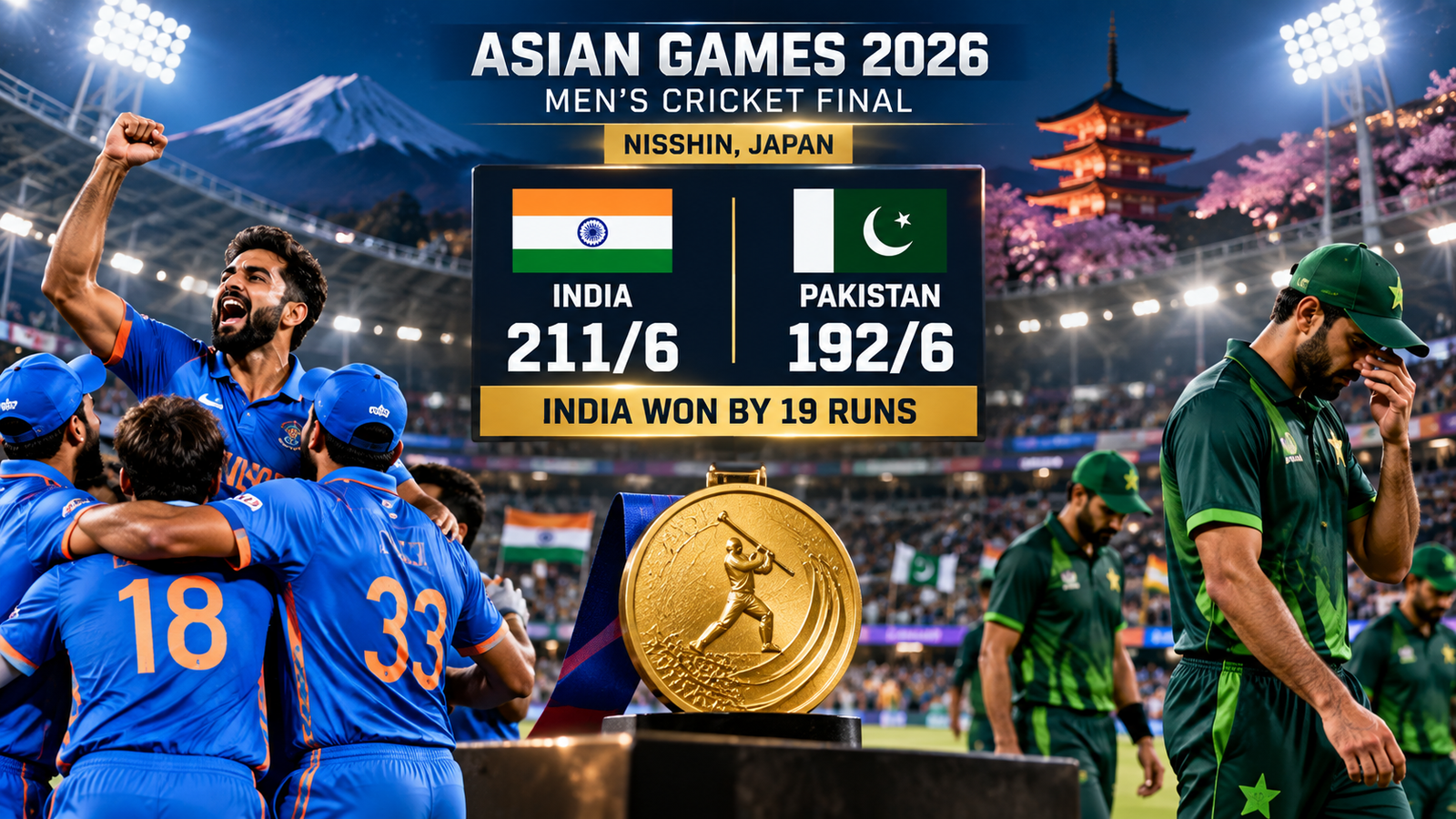
India defeated Pakistan by 19 runs in the men’s cricket final at the 2026 Asian Games in Nisshin, Japan, successfully defending their title and completing a cricket double after India’s women also won gold.
India scored 211 for six after captain Shreyas Iyer won the toss and chose to bat first. Pakistan replied with 192 for six in 20 overs.
Hasan Nawaz produced Pakistan’s standout performance with 96 from 51 balls, but his innings was not enough to overhaul India’s highest total of the men’s competition.
The result gave India gold and Pakistan silver, while Sri Lanka took bronze.
What Happened in the Final?
India set the tone with aggressive batting from the start.
Abhishek Sharma scored 61 from 28 balls, hitting three fours and seven sixes. His innings gave India the early momentum needed in a high-pressure final.
Tilak Varma then finished the innings strongly with an unbeaten 51 from 22 balls.
Pakistan’s bowlers did take wickets, but India maintained enough scoring pressure throughout the innings to reach 211 for six.
A target of 212 meant Pakistan needed to score at more than 10 runs per over from the beginning.
Pakistan’s Chase Started Badly
Pakistan lost early wickets and slipped to 39 for three in the seventh over.
That put the chasing side under immediate pressure because the required run rate was already high.
Hasan Nawaz and Saim Ayub then rebuilt the innings.
The pair added 87 runs for the fourth wicket and gave Pakistan a realistic chance of taking the match deep.
Saim scored 29 from 22 balls before India broke the partnership.
Hasan Nawaz Nearly Took Pakistan Home
Hasan Nawaz kept Pakistan alive with one of the best innings of the final.
He scored 96 from 51 balls, including five fours and seven sixes.
His half-century came from 28 deliveries.
Hasan continued attacking even as the required rate climbed, taking Pakistan’s chase into the final over.
He was dismissed from the last ball of the innings, four runs short of a century.
That meant his 96 ended as a standout performance in defeat.
Why Hasan’s Innings Mattered
Pakistan had already lost three wickets before the chase had properly settled.
Hasan therefore had to do two jobs at once: rebuild the innings and maintain a scoring rate high enough to stay in touch with the target.
That balance is difficult in T20 cricket.
His ability to keep scoring boundaries while batting under scoreboard pressure was the main reason Pakistan remained competitive so late in the match.
Saim Ayub’s Role in the Recovery
Saim Ayub scored 29 from 22 balls and played an important supporting role during the fourth-wicket partnership.
His contribution gave Hasan room to attack and helped Pakistan recover from the early collapse.
Once Saim was dismissed, the burden shifted even more heavily toward Hasan.
Maaz Sadaqat added 23, while debutant Saad Masood remained unbeaten on 12 from five balls.
India’s Batting Built the Winning Total
India’s total was shaped by two very different phases.
Abhishek Sharma controlled the early innings with power hitting.
Tilak Varma then handled the late overs and ensured India finished above 200.
That combination was decisive.
A score around 180 or 190 may have given Pakistan more freedom in the chase.
At 212, the margin for error became much smaller.
Abhishek Sharma’s 61 Set the Tone
Abhishek’s 61 from 28 balls came at a strike rate above 200.
He attacked early and prevented Pakistan’s bowlers from settling.
His seven sixes were especially important because they allowed India to score quickly without needing a long accumulation phase.
His innings gave India a strong platform before the middle and death overs.
Tilak Varma Finished the Job
Tilak Varma’s unbeaten 51 from 22 deliveries was equally important.
His role came later in the innings, when India needed to turn a good total into a match-winning one.
He kept the scoring rate high and ensured the innings did not slow down after wickets fell.
The late acceleration pushed India past the 200 mark and created the pressure that shaped Pakistan’s chase.
Pakistan’s Bowlers Had Good Moments
Despite conceding 211, Pakistan’s bowlers produced several useful spells.
Arafat Minhas took 2 for 25 and was Pakistan’s most economical wicket-taking bowler.
Ahmed Daniyal also took two wickets.
Abrar Ahmed conceded only 29 runs in four overs and picked up one wicket.
Saim Ayub also took a wicket.
The problem was not that Pakistan failed to create chances.
It was that India scored heavily enough in other overs to keep the total above 200.
India’s Bowlers Shared the Wickets
India did not rely on one bowler.
Axar Patel took 2 for 29.
Washington Sundar also returned 2 for 29.
Shivam Dube took 2 for 33.
That distribution mattered because Pakistan could not simply target one weak link in the attack.
India kept taking wickets at intervals while defending a large total.
Why the Early Wickets Changed the Match
Pakistan needed 212 to win.
Losing three wickets for 39 made that task significantly harder.
A high chase usually requires one of two things: a very strong powerplay or a large partnership with wickets in hand.
Pakistan got neither early.
Hasan and Saim repaired some of the damage, but the required rate remained high throughout.
That meant even a strong partnership was not enough to fully reset the chase.
Shreyas Iyer’s Decision to Bat First Paid Off
India captain Shreyas Iyer chose to bat after winning the toss.
In a final, putting a large total on the board can create extra pressure because the chasing side always knows the asking rate.
India used that advantage well.
Pakistan had to attack from the beginning and could not afford many quiet overs.
Once early wickets fell, the scoreboard pressure became even stronger.
India Completed a Cricket Double
The men’s gold completed a successful Asian Games cricket campaign for India.
India’s women had already won gold earlier in the competition.
That gave India both men’s and women’s cricket titles at the Games.
The double also underlined the depth of Indian cricket across different squads.
Pakistan Leave With Silver
Pakistan will be disappointed to miss gold, especially after keeping the match alive until the final over.
But there were positives.
Hasan Nawaz produced a high-quality innings under pressure.
Arafat Minhas bowled economically in a high-scoring game.
Young players also gained experience in a major final against a strong Indian team.
Pakistan coach Mike Hesson said the tournament had provided useful experience for the younger bowlers.
Why India-Pakistan Matches Carry Extra Pressure
India-Pakistan cricket attracts more attention than most international fixtures.
A gold-medal final increases that pressure even further.
Players are not only competing for a tournament result.
They are also playing under intense public attention across South Asia and from large overseas audiences.
That can affect decision-making, temperament and execution.
India handled that pressure more effectively on the day.
The Biggest Turning Points
India’s Early Acceleration
Abhishek Sharma’s rapid 61 meant Pakistan were under pressure before the middle overs even began.
Tilak Varma’s Late Surge
Tilak’s unbeaten 51 lifted India to 211 for six and turned a strong total into a difficult target.
Pakistan’s Early Collapse
At 39 for three, Pakistan lost the freedom to build the chase gradually.
Hasan-Saim Partnership
Their 87-run stand brought Pakistan back into the contest and kept the final alive.
India’s Wickets in the Middle and Late Overs
India broke partnerships often enough to stop Pakistan from gaining full control of the chase.
Match Summary
India: 211/6 in 20 overs
Abhishek Sharma: 61 off 28
Tilak Varma: 51 not out off 22
Arafat Minhas: 2/25
Ahmed Daniyal: 2/43
Pakistan: 192/6 in 20 overs
Hasan Nawaz: 96 off 51
Saim Ayub: 29 off 22
Maaz Sadaqat: 23
Saad Masood: 12 not out
Axar Patel: 2/29
Washington Sundar: 2/29
Shivam Dube: 2/33
Result: India won by 19 runs.
Pakistan Relevance
This is a major Pakistan sports story because the national men’s cricket side finished with the silver medal after facing India in the final.
Hasan Nawaz’s 96 will be the biggest positive for Pakistan from the match.
The defeat will also bring discussion around the early batting collapse, bowling plans and how Pakistan handles pressure in major T20 games.
South Asia Relevance
India-Pakistan cricket remains one of the biggest sporting rivalries in South Asia.
A gold-medal final gives the rivalry an added dimension because it connects bilateral sporting interest with a major multi-sport event.
The match also shows how cricket is becoming more important within the Asian Games programme.
Business and Media Impact
India-Pakistan matches attract large television and digital audiences.
That creates strong commercial value for broadcasters, sponsors and sports platforms.
The final also generated strong social-media engagement because of the rivalry, the medal stakes and Hasan Nawaz’s near-century.
For tournament organizers, high-interest matches such as this can help increase the visibility of cricket within the Asian Games.
What Happens Next?
Attention will now move to how both teams use the tournament experience.
For India, performances from Abhishek Sharma and Tilak Varma will strengthen confidence in the depth of the batting group.
For Pakistan, Hasan Nawaz’s innings is likely to receive attention from selectors and fans.
Pakistan may also review the top-order collapse and how the bowling unit handled India’s late acceleration.
The medal result itself will remain part of the wider discussion around both teams’ development in T20 cricket.
Why This Story Matters
The result matters for more than the medal table.
India successfully defended its Asian Games men’s cricket title.
Pakistan still finished with silver and produced one of the best individual batting performances of the final through Hasan Nawaz.
The match also delivered exactly what high-profile India-Pakistan contests often produce: pressure, momentum swings and intense public interest.
Frequently Asked Questions
Who won the Asian Games 2026 men’s cricket final?
India beat Pakistan by 19 runs.
What score did India make?
India scored 211 for six in 20 overs.
What score did Pakistan make?
Pakistan finished on 192 for six.
Who was Pakistan’s top scorer?
Hasan Nawaz scored 96 from 51 balls.
Who was India’s top scorer?
Abhishek Sharma scored 61 from 28 balls.
Who won the gold medal?
India won gold.
Which medal did Pakistan win?
Pakistan won silver.
Where was the final played?
The match was played at Korogi Sports Park in Nisshin, Japan.
Who bowled well for Pakistan?
Arafat Minhas took 2 for 25, while Abrar Ahmed conceded 29 runs in four overs and took one wicket.
Who took wickets for India?
Axar Patel, Washington Sundar and Shivam Dube each took two wickets.
About The Author