ISLAMABAD, October 14, 2026 – Pakistan’s textile and clothing exporters have requested structural reforms and temporary financial support from the government, warning that rising production costs and global competition are making it harder for manufacturers to sustain export orders. The concerns were examined at a meeting chaired by Commerce Secretary Jawad Paul on October 13, according to reporting published the next day by Dawn and Business Recorder.
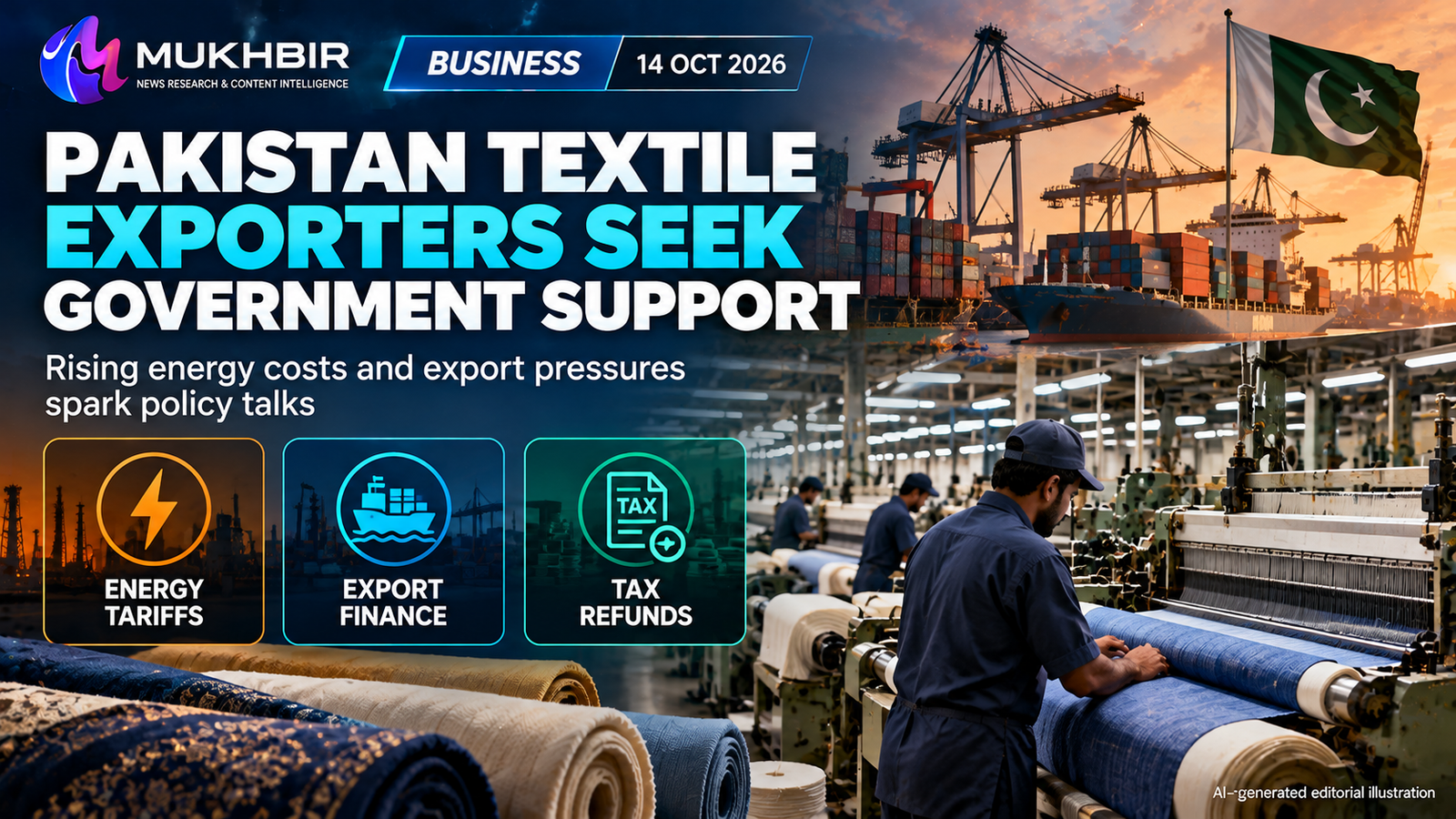
The Pakistan textile exporters 2026 discussions covered industrial electricity tariffs, gas pricing, export financing, delayed tax refunds and costs of employment. Officials established issue-specific subcommittees expected to prepare recommendations within 15 days. No broad new subsidy or tariff reduction was confirmed as approved at the meeting.
The development matters because textiles and clothing are major contributors to Pakistan’s merchandise exports and industrial employment. Higher costs can weaken pricing competitiveness against producers in other countries, although individual claims about the scale of losses require evidence and should remain attributed to the exporters making them.
What Happened at the Commerce Ministry Meeting?
Dawn reported that a high-level meeting led by Commerce Secretary Jawad Paul reviewed problems identified by textile and clothing exporters. Representatives asked for near-term measures to manage financial pressure as well as more durable changes to energy pricing and export procedures.
Participants agreed that issue-based subcommittees would examine the matters raised and submit recommendations within 15 days. This is a process for reviewing proposals, not a government commitment that every demand will be accepted.
The discussions follow concerns about shrinking export competitiveness and uncertainty around the costs of production. Business Recorder separately reported that the Pakistan Textile Exporters Association had proposed temporary Drawback of Local Taxes and Levies (DLTL) support linked to performance targets.
Textile Exporters’ Demands at a Glance
Meeting: October 13, 2026, chaired by Commerce Secretary Jawad Paul. Main demands: energy-cost relief, financing corrections, faster tax refunds and structural reforms. Committee timeline: recommendations in 15 days. Electricity-tariff issue: industry representatives cited Rs56 billion in calculation discrepancies; according to Dawn, PPMC acknowledged Rs26 billion of that amount. Proposed support discussed in separate PTEA reporting: DLTL relief of 6–8%, conditional on a 10% rise in exports. These are proposals and attributed industry figures, not verified payouts.
Why Electricity Prices Are a Central Concern
Textile manufacturers use electricity across spinning, weaving, dyeing, finishing and garment production. Higher power tariffs may increase the cost of each unit produced, making it harder to compete internationally when overseas buyers compare suppliers largely on price, quality and delivery time.
At the meeting, industry representatives raised the impact of cross-subsidies and calculations used in determining industrial electricity tariffs. Dawn reported that exporters alleged discrepancies amounting to Rs56 billion, while the Power Planning and Monitoring Company acknowledged Rs26 billion in the calculations.
The difference between those amounts had not been reconciled publicly in the sources reviewed. Officials planned to raise the issue with the Power Division at a meeting scheduled for Friday, October 16, with recommendations then to be submitted to the prime minister.
That means the issue remains under official consideration. Mukhbir should not publish a headline suggesting that the full Rs56 billion had been refunded or that the government had approved an industrial power discount.
Gas Tariff Calculations Also Questioned
Exporters also challenged aspects of gas pricing, particularly the treatment of unaccounted-for-gas losses. They argued that the calculation method raises energy expenses for manufacturing businesses.
Gas can be important for thermal processes used in textile processing, including some dyeing and finishing operations. Variations in energy prices can therefore affect the overall cost of producing export-quality fabric.
The meeting report does not establish that the exporters’ proposed methodology is legally or technically correct. That would require further assessment by the responsible energy authorities and access to the full tariff records.
Export Finance Scheme: What Needs to Change?
Another concern was the Export Finance Scheme, designed to support qualifying export-related borrowing. Industry representatives said differences in financing rates, inadequate allocations and uneven bank implementation were affecting access to working capital.
Dawn reported complaints that some commercial banks were not consistently applying the prescribed fixed financing rate of 4.5%. The meeting addressed that alleged gap, but the available report did not identify individual banks or establish final regulatory violations.
Affordable working capital can help businesses buy raw materials, pay workers and cover operating costs while waiting for overseas customers to settle invoices. However, financing support must be implemented through clear eligibility conditions and supervision.
Why Delayed Tax Refunds Matter
Textile businesses told officials that delays in tax refunds were tightening liquidity and limiting their ability to finance export orders. They raised taxation issues involving the Federal Board of Revenue as a further obstacle.
A refund claim represents money a business expects to recover under the tax framework, subject to legal eligibility and verification. Where significant amounts remain pending, exporters may need additional short-term borrowing to meet operational expenses.
The meeting report did not publish a comprehensive verified total of unpaid refunds or a government-approved settlement date. Any such numbers should be confirmed with the FBR and relevant official documents before being added to the article.
PTEA Calls for Temporary DLTL Support
Business Recorder reported that the Pakistan Textile Exporters Association sought Drawback of Local Taxes and Levies support at a proposed rate of 6–8%. The association linked its request to a targeted 10% improvement in exports.
The proposed mechanism is intended to offset some domestic costs faced by exporters. Nevertheless, the effectiveness and fiscal implications of such support would depend on policy design, eligibility rules, oversight and public financing.
It is important to distinguish an industry demand from an enacted government scheme. The reviewed reporting does not establish that an across-the-board 6–8% benefit has already begun or that every textile exporter would qualify.
What Did Exporters Say About Labour Costs?
Industry representatives told the meeting that overall human-resource expenses had reached approximately $270 per worker, according to Dawn. This was presented as an industry estimate of employer costs, not as a verified average take-home salary for all textile workers.
Labour cost comparisons can be complicated by wages, benefits, skill levels, output per worker and exchange rates. A higher nominal employer cost does not by itself establish weaker competitiveness without productivity and other costs being considered.
Policy discussions therefore need to balance manufacturers’ financial sustainability with decent working conditions and the interests of employees who depend on the sector.
Pakistan’s Textile Exports and Global Competition
Pakistan’s textile and clothing sector competes for orders against producers across South Asia and other manufacturing regions. International buyers consider prices alongside delivery reliability, quality standards, trade preferences, environmental compliance and logistical risk.
Rising domestic energy costs may make winning orders more difficult, but international demand and competing countries’ pricing also influence outcomes. The October 13 meeting does not establish how many specific export orders Pakistan lost or which buyer transferred production elsewhere.
Pakistan’s position in global supply chains will depend on investment in technology, productivity, stable energy supply and dependable trade policies as well as any temporary financial measures.
What Does the Government Plan to Do Next?
The immediate official step is the formation of subcommittees to examine the matters raised by exporters and return recommendations within 15 days. The electricity-tariff dispute was also due for discussion with the Power Division on October 16.
Commerce authorities may then consider which measures can be pursued through administrative changes, financial arrangements or further policy decisions. Any new concession would require a separate official announcement specifying its scope.
The availability of budget resources, the impact on other electricity users and wider fiscal objectives may influence whether proposed support is approved, revised or rejected.
Why This Story Matters for Businesses and Workers
Textile exporters support networks of suppliers, transport operators, logistics providers, service companies and workers. Financial stress at one stage of production may affect orders and purchases throughout those networks.
Temporary relief might ease cash-flow pressure, but structural competitiveness will also depend on efficient production, modern machinery, training and access to stable markets. Those longer-term challenges cannot be solved through one meeting.
The news is important to manufacturers, employees, banks and overseas buyers because it signals potential trade-policy changes. It does not justify predicting a fixed number of job losses or export gains before measures have been approved and their results measured.
Public Finance and Policy Trade-Offs
A financial support programme can create fiscal costs, while energy tariff adjustments may shift the burden among consumer categories or affect utilities. Policymakers must consider whether the proposed assistance is targeted, affordable and likely to improve exports.
Performance-linked support could encourage measurable results, but eligibility and monitoring standards would be needed to ensure transparency. Similar concerns apply to credit schemes and tax refunds, where straightforward procedures can be as important as headline rates.
The current story is a discussion of requests and proposals. No published evidence in the cited reports demonstrates the final economic impact of measures that are still being debated.
Pakistan and Global Business Relevance
This story has strong direct Pakistan relevance because it concerns export earnings, industrial costs and employment. It is also internationally relevant to brands and purchasing companies that source products through Pakistan’s textile manufacturing chain.
Global buyers may watch whether authorities produce a predictable operating environment. However, an immediate change in retail clothing prices overseas or global textile market share has not been established by this announcement.
For Mukhbir readers, the most useful angle is the relationship between energy policy, working capital and export competitiveness rather than an unsupported claim that an economic crisis or recovery has already been decided.
What Happens Next?
The next milestones are the October 16 discussion with the Power Division, recommendations from the issue-based subcommittees and any formal decision by the government on tariff calculations, financing conditions or DLTL proposals.
Future coverage should clarify whether measures are approved, when they take effect, which businesses qualify and what documented results they produce. Requests by associations and preliminary discussions should continue to be described accurately until those outcomes are known.
As of October 14, 2026, the central verified development is that textile exporters have formally sought support and structural reforms, while the government has established a process to examine their concerns.
Frequently Asked Questions
Why are Pakistan’s textile exporters seeking government support?
They cite higher production and energy costs, export financing issues, delayed tax refunds and pressure from international competitors.
When did the government meeting take place?
The meeting chaired by Commerce Secretary Jawad Paul took place on October 13, 2026, and was reported on October 14.
What electricity-tariff issue was raised?
Industry representatives cited a Rs56 billion discrepancy; Dawn reported that PPMC acknowledged Rs26 billion of that amount. Further official examination is pending.
What is the proposed DLTL support?
PTEA sought 6–8% temporary support linked to a targeted 10% export increase, according to Business Recorder. It remains a proposal.
What financing-rate concern was discussed?
Exporters complained that some banks were not applying the prescribed 4.5% rate under the Export Finance Scheme consistently.
Has the government approved the requested concessions?
The reviewed reports described committees and discussions, not a final comprehensive approval of the exporters’ demands.
When will the subcommittees report?
Officials established a 15-day timeline for recommendations on the issues discussed.
Why does this matter beyond Pakistan?
International brands and buyers rely on Pakistani textile production, so competitiveness and reliability matter for cross-border supply chains.
About The Author