KARACHI, October 14, 2026 – Pakistan’s benchmark KSE-100 Index remained under pressure on Wednesday morning after closing below the 165,000-point level in the previous session, as investors responded to domestic uncertainty, energy-market risks and selling across several major sectors.
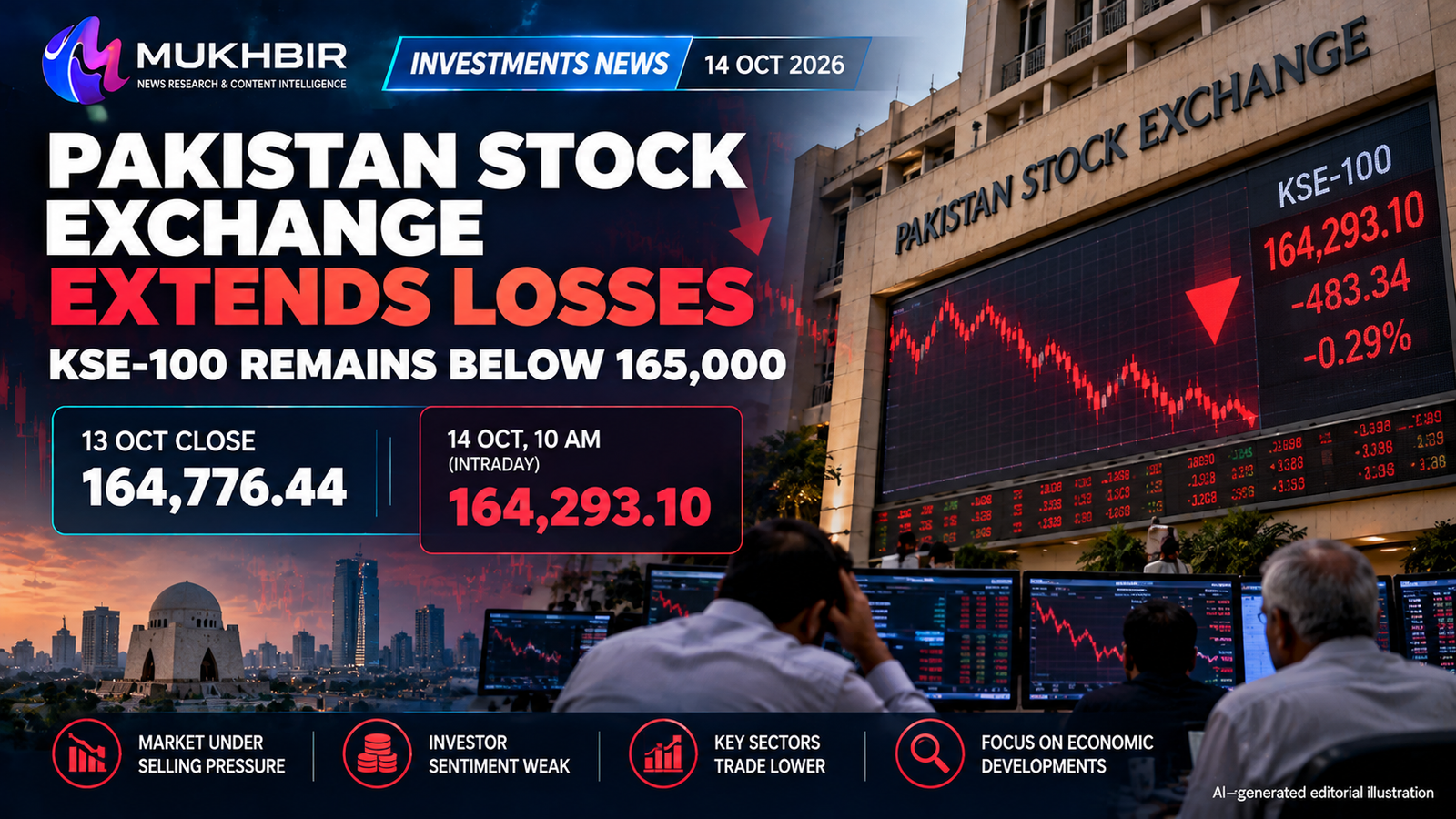
The Pakistan Stock Exchange October 2026 market decline has been documented in fresh reporting by Dawn and Business Recorder, with independent figures available on the official Pakistan Stock Exchange data portal. The benchmark ended Tuesday, October 13, at 164,776.44 points, down 347.97 points, or 0.21%, according to Topline Securities figures cited by Dawn.
Selling continued on Wednesday. Business Recorder reported the KSE-100 at 164,293.10 points around 10 a.m. on October 14, a loss of 483.34 points, or 0.29%, from the previous close. The figure is a timestamped intraday snapshot and should not be mistaken for the final Wednesday closing level.
The market’s latest weakness follows several unsettled sessions in which political developments, geopolitical tensions and changing expectations about the economy have influenced risk appetite.
Pakistan Stock Exchange: Key Market Figures
Previous close, October 13: 164,776.44 KSE-100 points.
October 13 point change: minus 347.97 points.
October 13 percentage change: minus 0.21%.
October 13 intraday high: approximately 166,070.48 points.
October 13 intraday low: approximately 164,773.67 points.
October 14 around 10 a.m.: 164,293.10 points.
October 14 change at 10 a.m.: minus 483.34 points, approximately minus 0.29%.
October 13 regular-market traded volume: approximately 384 million shares.
October 13 traded value: approximately Rs13.1 billion.
All market figures are historical readings attributed to their reporting times. They should not be treated as live quotes or investment recommendations.
What Happened to the KSE-100 Index on October 13?
The benchmark initially recovered during Tuesday’s trading session and climbed above 166,000 points, according to Dawn, Business Recorder and Mettis Global. Its intraday high approached 166,070 points before profit-taking erased the early advance.
By the closing bell, selling in heavyweight stocks had pushed the index to 164,776.44 points. The result marked a fall of 347.97 points, extending a weak period for local equities.
Business Recorder reported that the market lacked a fresh catalyst strong enough to reverse earlier losses. Analysts described cautious positioning as traders monitored political developments and wider financial conditions.
The late-session retreat illustrates the difference between an intraday rally and a sustained recovery. A market can briefly move higher while closing lower if sellers dominate the remainder of the session.
What Changed on October 14?
Wednesday opened with further selling pressure. In a report updated at 10:23 a.m., Business Recorder said the benchmark had fallen nearly 500 points, reaching 164,293.10 around 10 a.m.
The official PSX data portal also displayed a negative morning reading, although its precise value varied by timestamp. These observations corroborate the broad direction of the morning session rather than establish one immutable market level.
The latest reported weakness was seen across automobile assemblers, cement, banks, oil and gas producers, oil marketing companies, power generation and refining.
Because the trading day was still underway at the time of those observations, reporting must avoid stating that the index had finished Wednesday at any morning figure. Later prices could recover or fall further.
Why Are Investors Selling Pakistani Shares?
Dawn linked Tuesday’s unsettled trading to political uncertainty following the imposition of emergency and governor’s rule in Khyber Pakhtunkhwa. The report also described concern around economic pressures despite official optimism about fiscal-year growth.
This is a market-reaction explanation attributed to analysts and reporting, not proof that one government decision caused every individual share-price movement.
Investors evaluate potential corporate earnings, economic policy, interest rates, exchange-rate expectations and geopolitical developments when pricing listed companies. Uncertainty can make participants more cautious, especially after a period of losses.
Trading positions also matter. An investor who bought shares at a lower price may sell during a temporary rebound to realize profits or reduce exposure. Such selling can weaken a rally even without a new adverse announcement.
Which Stocks Weighed on the Index?
Dawn identified Pakistan Telecommunication Company, United Bank, Habib Bank, Lucky Cement and Mari Energies as major negative contributors on October 13. The newspaper said the group collectively removed about 343 index points.
A stock can exert a substantial influence on an index because of its market weight. Therefore, a small number of large companies may cause a decline even when numerous smaller shares move differently.
Wednesday morning trading showed additional selling across banking, energy and other cyclical sectors. Business Recorder mentioned companies including ARL, HUBCO, MARI, OGDC, PPL, POL, HBL, MCB and UBL in its early market report.
These are market observations, not allegations of wrongdoing by the companies. Daily share-price declines do not establish deteriorating financial condition for every issuer.
Trading Volume and Market Participation
Dawn reported that October 13 trading volume rose by about 5.72% to nearly 384 million shares while traded value fell about 9.67% to Rs13.1 billion.
The difference between volume and value is important. More shares can change hands even when the total rupee amount falls, depending on which securities were actively traded and at what prices.
A higher volume figure does not automatically indicate that buyers are optimistic. Every completed stock-market transaction has a buyer and seller, and the prevailing price reflects the terms at which they meet.
When assessing market pressure, turnover should be interpreted alongside index performance, sector contributions, order flow and broader investor positioning.
What Does Falling Below 165,000 Mean?
The 165,000-point area is a psychologically noticeable round number for the KSE-100. Market commentary often uses such thresholds to help readers understand broad movements.
However, a round-number crossing is not itself proof of a permanent change in a company’s underlying value. Technical levels are interpreted differently by analysts, and prices can move above and below them multiple times.
Readers should distinguish a benchmark index level from the aggregate value of all listed companies, and from the performance of their individual holdings.
A person whose portfolio includes different stocks may experience a gain or loss that diverges significantly from the headline KSE-100 movement.
Political Risk and Investor Sentiment
Changes in the political environment can increase uncertainty about policy, public spending and business confidence. Dawn’s October 14 market report discussed the situation in Khyber Pakhtunkhwa as a factor weighing on investor sentiment.
That interpretation should be attributed to market reporting rather than presented as an official statistical finding of causation.
Political developments can also affect different sectors in different ways. Companies with primarily domestic operations may be sensitive to expectations about local demand, while export-oriented firms may respond more directly to international prices or exchange rates.
A balanced report does not assign responsibility for the stock market’s movement to any individual without evidence. The central market fact is the observed selloff and analysts’ assessment of possible influences.
How Do Oil Prices Affect the Pakistan Market?
Pakistan’s economy is exposed to international oil and energy prices through imports, transportation and production costs. Changes in global prices can affect expectations about inflation, the current account and corporate earnings.
Business Recorder’s October 14 global-market coverage noted that energy prices remained elevated amid concerns about oil supplies in the Middle East.
Higher energy costs do not affect every Pakistani listed company in the same direction. Producers, refiners, distributors, manufacturers and consumers have distinct business models, and the net effect depends on policy, contracts and demand.
Claims that a particular change in international oil prices directly caused a specific number of KSE-100 points to be lost would require more detailed evidence.
The Role of Banks, Cement and Energy Stocks
Commercial banks are influential in the benchmark because of their size and their connection to interest rates, deposits, lending and economic activity.
Cement companies are watched for construction demand and energy costs, while exploration and production firms respond to commodity economics as well as local operational and payment conditions.
A broad selloff across these groups can signal caution about economic conditions, but sector-level movement should not be mistaken for identical underlying risks.
Investors and journalists should look at company disclosures and financial statements rather than extrapolating a company’s future profits from a single trading session.
How Does Pakistan Compare With Asian Markets?
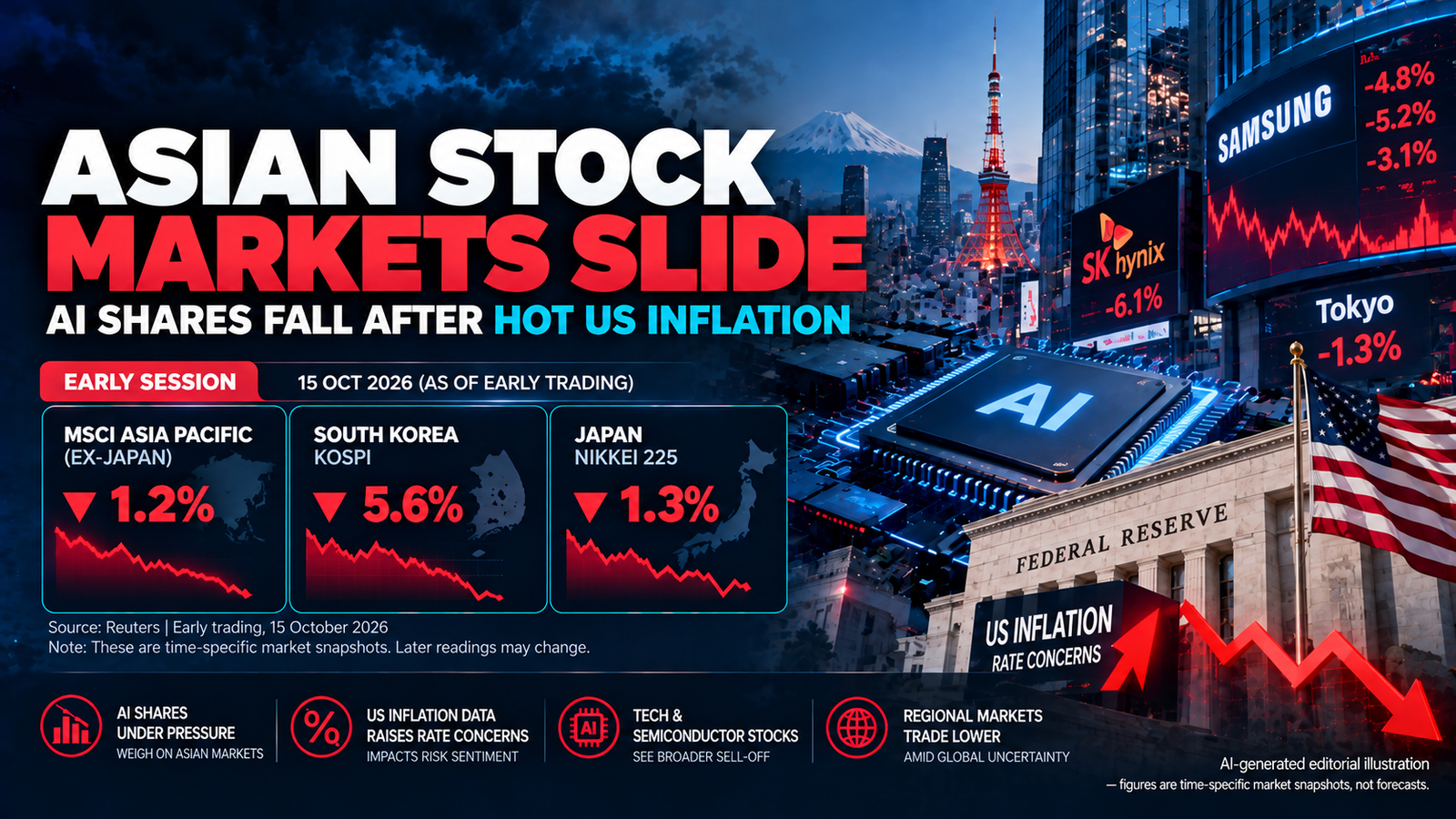
Business Recorder reported that Asian shares moved modestly higher on Wednesday after semiconductor stocks recovered some of the previous day’s losses. The rebound contrasted with ongoing pressure in Pakistani equities.
This divergence shows why global stock markets do not always move together. Local politics, currency conditions, sector composition and financial policies can outweigh external trends on a particular day.
The index decline in Pakistan is therefore not adequately explained by a generalized statement that all Asian markets were falling.
International developments remain relevant context, but the strongest explanation of local trading is built from actual PSX figures and reporting by analysts familiar with the domestic market.
What Should Investors Watch Next?
Potential influences include new official economic statistics, company earnings releases, political and legal developments, foreign portfolio activity, commodity prices and monetary-policy expectations.
Analysts quoted by Dawn expect volatility to remain possible while uncertainty persists. That is an outlook, not an assurance that the index will fall or rise by any specific amount.
Investors should consider diversification, risk tolerance, liquidity needs and company fundamentals before acting on a headline. A temporary dip is not automatically a buying opportunity, just as a red trading session does not prove that every asset should be sold.
Mukhbir presents market information for public understanding, not as personalized financial advice.
What Is the Broader Business Impact?
Persistent equity-market uncertainty can influence how businesses think about raising capital, issuing shares and financing investment. It can also shape investor confidence toward listed companies.
Nevertheless, the October 13–14 index readings alone do not establish that major projects have been canceled or that national economic growth has been reduced by a particular amount.
Pakistan’s real economy includes activities that extend far beyond the companies listed on the exchange. Stock-market performance is one useful indicator, but not a complete measure of household income, employment or national welfare.
The strongest economic reporting combines market information with business results, fiscal indicators and real-world data rather than relying on a single benchmark.
Conclusion
The Pakistan Stock Exchange remained under selling pressure on October 14 after the KSE-100 closed at 164,776.44 a day earlier. Business Recorder’s Wednesday morning update showed the index falling further to 164,293.10 around 10 a.m.
Dawn, Business Recorder and Mettis Global linked recent volatility to caution among investors, political uncertainty, profit-taking and weakness in major index constituents.
The key distinction is timing: Tuesday’s reading is a completed closing figure, while Wednesday’s morning number is an intraday snapshot that may change before the session ends.
As new market figures emerge, readers should consult dated exchange data and avoid treating short-term volatility as a reliable prediction of future investment returns.
Frequently Asked Questions
What happened to the Pakistan Stock Exchange on October 14?
The KSE-100 remained under selling pressure and was reported at 164,293.10 around 10 a.m., below the previous close.
Where did the KSE-100 close on October 13?
It closed at 164,776.44 points, down 347.97 points or 0.21%.
Is 164,293.10 the closing price for October 14?
No. It was a morning intraday reading, not a verified end-of-day closing value.
Why did Pakistan’s stock market fall?
Analysts discussed profit-taking, political uncertainty and risk aversion. No single factor has been conclusively established as the cause of every price movement.
Which companies contributed to Tuesday’s decline?
Dawn identified PTCL, UBL, HBL, Lucky Cement and Mari Energies as major negative contributors.
How much trading took place on October 13?
Regular-market volume was reported at approximately 384 million shares, with traded value around Rs13.1 billion.
Does a fall below 165,000 mean the market will keep falling?
No. The threshold is a market level, not a reliable guarantee of future direction.
Where can readers check updated PSX figures?
The official Pakistan Stock Exchange data portal provides market readings and trading information, with timestamps.
About The Author