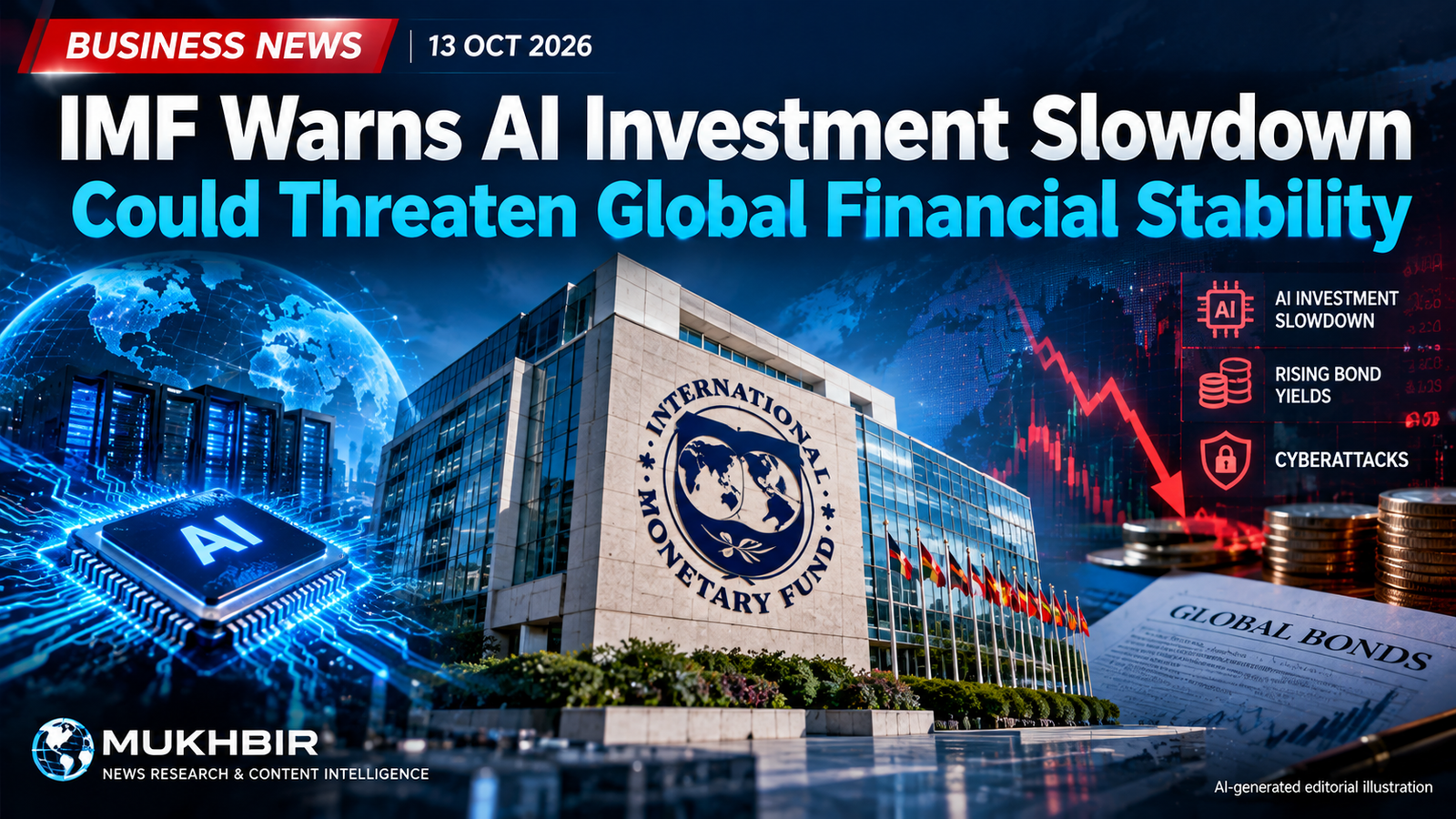
The International Monetary Fund has warned that a sharp slowdown in artificial intelligence investment could trigger losses in technology-related assets and spread stress through the wider financial system. In its Global Financial Stability Report released on October 13, 2026, the IMF also identified rising sovereign bond yields and major cyberattacks as potential shocks that could expose existing weaknesses in international markets.
The IMF AI investment risks 2026 assessment arrives as technology companies commit large sums to chips, data centers, electricity supply and software infrastructure. Those investments have supported growth and investor confidence, but expectations about future profits have also become central to market valuations.
The IMF did not say a global financial crash has occurred or is inevitable. Its report examines scenarios in which weaker investment returns, more expensive government borrowing or a serious cyber incident combine with leverage and other vulnerabilities to create broader instability.
Reuters, Associated Press and The Guardian reported on the warning on October 13, making this a verified and widely covered international business story rather than an unconfirmed market rumour.
What Did the IMF Warn About on October 13?
The IMF’s Global Financial Stability Report argues that apparently resilient markets should not encourage complacency. Financial conditions can deteriorate rapidly when heavily priced assets encounter disappointing earnings, unexpected financing costs or an operational disruption.
Its warning centers on three potential catalysts: a correction linked to AI investment or earnings, a sharp rise in government bond yields, and a significant cyberattack against critical financial or economic infrastructure.
Each scenario could be manageable on its own. The greater danger is that the shock may interact with high debt, crowded investments, concentrated market exposures and borrowing arrangements that force investors to sell assets at unfavorable prices.
The IMF therefore urges policymakers, banks and nonbank financial institutions to build resilience rather than assume the recent strength in growth and markets will automatically continue.
Why Artificial Intelligence Investment Matters to the World Economy
Demand for AI systems has encouraged companies to buy advanced semiconductors, expand cloud capacity, build new data centers and upgrade electricity and networking infrastructure.
This expenditure supports more than software businesses. Semiconductor manufacturers, utilities, construction companies, industrial equipment suppliers and countries that export technology components can all benefit from the investment cycle.
A separate IMF World Economic Outlook update released on October 13 estimates global economic growth at 3.1% for 2026, up slightly from its previous 3.0% projection. The fund acknowledged that AI-related spending helped offset some economic pressure from high energy prices.
That combination creates an unusual situation: the same investment boom that is supporting economic activity may also become a source of market instability if earnings, demand or productivity gains fall short of expectations.
The IMF’s analysis is therefore not an argument that AI investment is inherently harmful. It is a warning against assuming a powerful growth trend will continue without interruption.
How Could an AI Investment Slowdown Trigger a Market Selloff?
Many AI-related businesses are valued partly on expectations of future revenue and profit. If investors conclude that demand is expanding more slowly than expected, they may reduce what they are willing to pay for those companies.
A drop in technology shares can directly affect pension portfolios, mutual funds, exchange-traded funds and other investors that hold large positions in major technology companies.
Pressure can spread further if companies, investment funds or financial intermediaries have borrowed money against assets that are losing value. Forced selling may then amplify an initial market decline.
The IMF warns that growing connections among asset classes and financial institutions create channels through which a localized shock could reach broader markets.
Such a scenario is not a prediction of a guaranteed crash. It describes a mechanism that regulators should understand and prepare to manage.
Big Tech Spending and the Concentration of Market Risk
AI infrastructure has become a substantial part of capital expenditure for major technology companies. Investors are watching whether spending on data centers and computing power leads to sustainable commercial returns.
Reuters reported that large cloud and technology firms have become significant participants in investment-grade bond markets, accounting for roughly 10% of new global issuance in a relevant recent measure cited in IMF coverage.
Heavy investment may strengthen future productivity, but it can also increase exposure when many businesses and investors depend on a similar set of optimistic assumptions.
Market concentration adds another concern. A relatively small group of large companies can carry considerable weight in widely held stock indexes, causing changes in their valuations to affect diversified portfolios.
Financial stability risks are therefore shaped not only by the technology itself, but also by how its expansion is financed and distributed across global investors.
Why Rising Government Bond Yields Are a Separate Threat
The IMF also highlighted the possibility of a sudden rise in sovereign borrowing costs. Government bond yields can increase when investors demand more compensation for inflation, debt levels or fiscal uncertainty.
Higher yields make new government borrowing more expensive and may put pressure on public budgets. They also affect private financing rates because government bonds often serve as reference points for loans and other financial products.
Countries with high debt burdens can become more vulnerable if debt-service costs rise faster than government revenue. A prolonged increase in borrowing rates may also cause the prices of existing bonds to fall.
For banks, insurers, pensions and funds that hold substantial government securities, sharp market movements can create valuation or liquidity challenges.
The IMF’s concern is amplified when an AI-related market correction and bond-market stress occur together, narrowing the options available to borrowers and investors.
Cyberattacks Add Another Source of Financial Instability
A third issue in the report is the potential effect of a major cybersecurity incident. Banks, payment networks, exchanges and other institutions depend on interconnected digital systems.
A cyberattack that disrupts essential services could damage confidence and create operational problems even without immediately producing a large conventional financial loss.
The IMF warns that cyber threats are changing as attackers exploit vulnerabilities and automation. Rapid exploitation can leave institutions with less time to deploy protective software patches.
The report does not suggest that a major cyber event has already caused a current global financial collapse. It presents cyber resilience as an important defense against a plausible future shock.
Effective responses may include stronger security testing, incident reporting, backup systems and coordination among financial regulators and technology providers.
What Does the IMF Say About Banks and Nonbank Financial Firms?
Traditional banks are not the only institutions relevant to financial stability. Hedge funds, investment funds, pension providers, insurers and other nonbank intermediaries also connect borrowers and investors.
These organizations may provide useful market liquidity and financing, but they can create vulnerabilities when their investment strategies rely on significant borrowing or assets that cannot be sold quickly.
Reuters reported IMF stress-test findings indicating that institutions representing around 22% of global banking assets showed weak capital positions under modeled pressure, compared with roughly 18% in a comparable 2025 measure.
Stress-test results are not the same as current bank insolvencies. They illustrate how particular assumptions could reveal weaknesses that regulators need to address before a crisis.
The IMF’s recommendations emphasize supervision, capital strength, transparency and careful monitoring of links between banks and nonbank institutions.
How Is the Global Growth Outlook Connected?
The IMF’s October 13 World Economic Outlook presents a mixed economic picture. Global growth is projected at 3.1% in 2026 and 3.4% in 2027, according to Associated Press and Reuters coverage.
These forecasts suggest that the world economy has been more resilient than some earlier expectations. However, elevated energy costs, debt burdens and uneven participation in AI-driven growth remain important concerns.
Some countries benefit directly from supplying semiconductors, servers or other AI infrastructure. Others face higher import costs without experiencing equivalent investment gains.
This unequal distribution matters because financial shocks can affect economies differently. An AI-related slowdown might reduce export demand in technology-producing economies while rising financing costs pressure heavily indebted countries.
The forecasts are estimates and scenarios, not confirmed future outcomes. Realized growth can change as economic conditions evolve.
How Could Asian Markets Be Affected?
Asian economies have important roles in the global technology supply chain, including semiconductor production, memory chips, electronics manufacturing and assembly.
When AI infrastructure spending rises, demand can strengthen for suppliers of the components required to build servers and networking equipment. Conversely, a pullback may affect orders and valuations across these industries.
That is why financial markets in South Korea and other technology-exporting economies are sensitive to changing expectations about AI demand and competition.
The IMF’s report places these connections within a broader framework of international financial stability rather than treating the risk as confined to Silicon Valley or the United States.
Any country-specific impact will depend on its export mix, financial exposure and domestic economic conditions.
What Does the Warning Mean for Pakistan and South Asia?
The IMF’s warning is global rather than a new Pakistan-specific policy announcement. Pakistan’s potential exposure comes primarily through international financing conditions, commodity prices, investor sentiment and broader economic growth.
If government borrowing costs rise internationally, countries with external financing needs could face a more difficult environment. Similarly, slower demand from major economies may influence exports and investment.
South Asian technology and outsourcing industries could also be affected by changes in corporate AI spending, but the report does not establish an immediate, measurable impact on every regional firm or worker.
It would be inaccurate to claim that the IMF’s October 13 report caused an immediate change in Pakistan’s interest rates, currency value or economic programme without separate local evidence.
For Mukhbir readers, the practical relevance is understanding how events in global technology markets can interact with financing conditions across the international economy.
Are AI Stocks in a Bubble?
The IMF’s language is more cautious than a blanket declaration that all AI-related companies are overvalued. It identifies possible corrections if investment and profit expectations weaken.
Some AI businesses may achieve substantial productivity gains and durable earnings, while others may face difficult competition or disappointing demand. Financial outcomes depend on individual companies and broader market conditions.
A company can operate within a promising industry yet still have a share price that proves vulnerable to changing expectations.
The IMF’s emphasis is on systemic risk: what happens if a concentrated group of market exposures moves sharply at the same time, especially in the presence of debt and limited liquidity.
Readers should therefore distinguish between the long-term usefulness of AI technology and the price investors currently pay for particular financial assets.
What Should Businesses and Investors Watch Next?
One important indicator is whether large technology companies continue increasing AI-related spending and whether reported revenue growth supports those commitments.
Another is the direction of government bond yields, particularly in large economies whose debt markets influence global financing costs.
Investors may also monitor bank capital, credit spreads, fund leverage and cybersecurity incidents affecting major services.
Businesses that rely on technology financing should consider how sensitive planned projects are to borrowing costs and changes in customer demand.
None of these observations amounts to a guarantee about future market direction. The purpose of the IMF’s warning is to encourage preparation for a range of outcomes.
What Could Policymakers Do?
The IMF has called for credible strategies to make public debt sustainable and reduce vulnerabilities that could intensify shocks.
Regulators may review borrowing practices, improve transparency around financial exposures and assess how market participants would respond to sudden price changes.
Financial institutions can strengthen liquidity planning and cyber defenses, while governments can improve cooperation on operational resilience and systemic oversight.
The appropriate actions vary by country and institution. The report offers risk analysis rather than a single uniform policy prescription for all economies.
The broader message is that resilience built during relatively stable periods may be essential when investment assumptions or financing conditions shift.
Conclusion
The IMF’s October 13, 2026 warning highlights the growing relationship between artificial intelligence investment and global financial stability.
AI infrastructure spending has supported growth and created opportunities across technology supply chains, but concentrated valuations, borrowing and uncertain returns can increase the impact of a sudden change in market expectations.
Higher sovereign bond yields and major cyberattacks present additional potential shocks. The IMF’s concern is that these forces could become more dangerous when combined with existing weaknesses.
The report does not announce an inevitable financial crisis. Instead, it urges policymakers and investors to recognize the risks before a downturn or disruption exposes them.
Frequently Asked Questions
What did the IMF warn about on October 13, 2026?
The IMF warned that an AI investment slowdown, rising government bond yields or a serious cyberattack could expose vulnerabilities in global financial markets.
Did the IMF predict a global financial crash?
No. The report described potential risk scenarios and the conditions under which they could become more serious.
Why does AI investment affect financial markets?
AI spending influences technology company valuations, infrastructure demand, credit markets and investments held by major financial institutions.
What happens if companies reduce AI spending?
A significant slowdown could weaken demand for technology-related businesses and lead investors to reconsider valuations. The scale of any consequences would depend on broader financial conditions.
What are sovereign bond yields?
They represent the return investors demand for lending money to governments. Rising yields generally make new borrowing more expensive.
How do cyberattacks threaten financial stability?
A major attack on essential systems could interrupt payments or services, increase operational losses and damage confidence in financial institutions.
Is there an immediate effect on Pakistan?
The IMF report does not establish an immediate Pakistan-specific market impact. Potential indirect exposure includes international financing and economic conditions.
What is the IMF’s global growth forecast for 2026?
The IMF projects 3.1% global growth for 2026 in its October World Economic Outlook, according to Reuters and Associated Press reporting.
About The Author