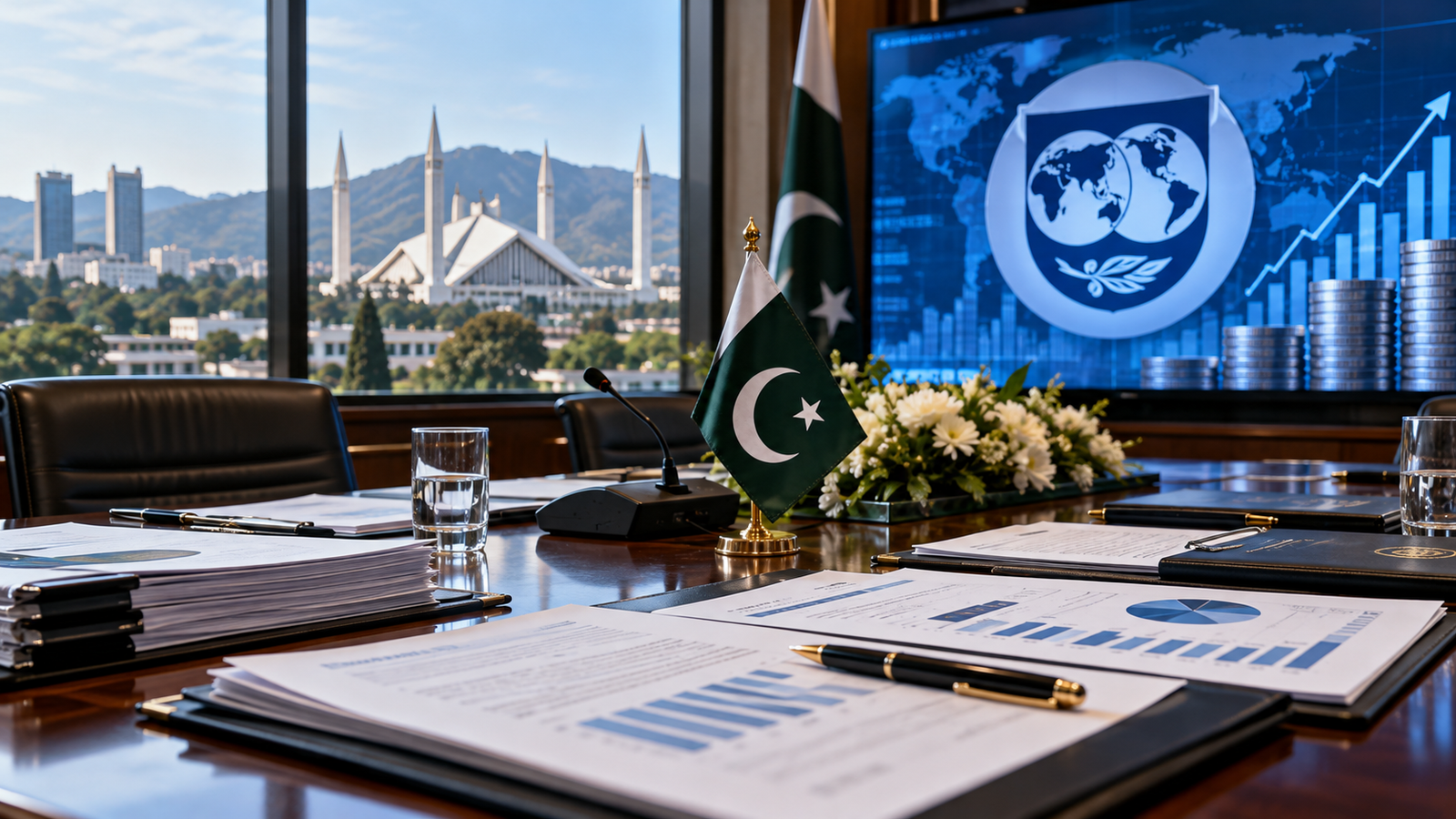
Pakistan and the International Monetary Fund have reached a staff-level agreement on the fourth review of the country’s 37-month Extended Fund Facility and the third review of its Resilience and Sustainability Facility, a development that could unlock roughly $1.2 billion in financing if the IMF Executive Board gives its approval.
The agreement follows talks between IMF staff and Pakistani authorities in Karachi and Islamabad from September 23 to October 7, 2026. According to reporting based on the IMF statement, Pakistan would gain access to about $1.0 billion under the Extended Fund Facility and about $210 million under the climate-focused Resilience and Sustainability Facility once the reviews are approved by the Fund’s Executive Board.
The distinction between a staff-level agreement and a final disbursement is important. The financing has not yet been released. The reviews must still pass through the IMF’s internal process and receive Executive Board approval before Pakistan can draw the funds.
The agreement is significant because it gives Pakistan another important checkpoint in its ongoing economic programme with the IMF. It also comes at a time when the government is trying to maintain macroeconomic stability while managing pressures from energy costs, external financing needs, public-sector reform and the effects of regional geopolitical uncertainty.
What the staff-level agreement covers
The latest agreement relates to two separate but connected IMF arrangements. The first is the Extended Fund Facility, or EFF, a 37-month programme originally approved in September 2024. The EFF is designed to support macroeconomic stabilisation, fiscal reform, improved public finances and wider structural reforms across the economy.
The second is the 28-month Resilience and Sustainability Facility, or RSF, which focuses more directly on reforms intended to reduce long-term economic risks linked to climate change and strengthen Pakistan’s resilience to climate-related shocks.
Under the fourth EFF review, Pakistan could access around SDR 760 million, equivalent to roughly $1.0 billion. Under the third RSF review, the country could receive around SDR 154 million, or about $210 million. Combined, the two disbursements would amount to approximately $1.21 billion, subject to Board approval.
Why this matters for Pakistan’s economy
IMF programme reviews matter for Pakistan because successful completion can strengthen confidence among international lenders, development partners and investors. A positive review signals that the government has broadly met agreed targets or has reached understandings with the IMF on how to address any deviations from the programme.
For Pakistan, continued access to IMF financing can also support foreign-exchange reserves and provide reassurance to other creditors that the country remains within a multilateral reform framework. That can be especially important when external financing requirements remain high and global borrowing conditions are difficult.
The direct dollar amount is only one part of the story. IMF approval can also influence how markets assess Pakistan’s ability to manage its external obligations, fiscal pressures and reform commitments. In previous programme reviews, progress with the Fund has often been closely watched by rating agencies, bond investors and bilateral partners.
What the IMF has said about Pakistan’s recent performance
Recent IMF assessments have highlighted progress in preserving macroeconomic stability while also stressing the need to continue reforms. In May 2026, when the IMF Executive Board completed the previous EFF and RSF reviews, the Fund said Pakistan’s policy efforts had helped stabilise the economy and improve financing and external conditions despite a difficult global environment.
The IMF also continued to emphasise priorities including stronger public finances, improved competition, better productivity, reform of state-owned enterprises, stronger social protection, greater energy-sector viability and institutional improvements.
The latest staff-level agreement indicates that IMF staff and the Pakistani authorities have again reached sufficient common ground to move the review process forward. However, final confirmation will only come when the Executive Board considers the case.
How much funding could Pakistan receive?
If the IMF Executive Board approves the reviews, Pakistan would be able to draw about $1.0 billion under the EFF and around $210 million under the RSF. Together, that would be about $1.2 billion in additional financing.
Based on public reporting, approval of the latest reviews would bring cumulative disbursements under the two arrangements to roughly $5.7 billion. The exact timing of the release will depend on when the IMF schedules the Executive Board meeting and formally completes the review process.
Pakistani officials have indicated that Board consideration could follow within several weeks, although the timing remains subject to the IMF’s own procedures. Until that approval is granted, the funds should be described as expected or potentially available rather than already disbursed.
The difference between the EFF and RSF
The EFF is the main macroeconomic programme. It supports policies intended to improve fiscal discipline, strengthen the external position, reform public institutions and create conditions for more sustainable growth. Reviews under the EFF typically assess performance against quantitative targets, structural benchmarks and policy commitments agreed between the IMF and the government.
The RSF has a different purpose. It supports longer-term reforms that can improve resilience to climate-related risks and other structural challenges. For Pakistan, this area is especially relevant because climate shocks, floods, water stress and energy vulnerabilities can have major fiscal and economic consequences.
Keeping the two programmes on track therefore serves different but complementary objectives: short- to medium-term macroeconomic stability through the EFF, and longer-term resilience through the RSF.
Energy reforms remain an important issue
Energy-sector reform continues to be one of the most difficult parts of Pakistan’s economic programme. High circular debt, tariff design, subsidies and the financial health of power and gas-sector entities remain major challenges.
Reporting around the latest review showed that some energy-policy proposals were still under discussion, including a proposed time-of-use electricity tariff for industry. The IMF reportedly sought additional data before clearing that proposal, highlighting how energy reforms remain closely scrutinised within the broader programme.
The government has also committed to moving toward more targeted support for lower-income electricity consumers rather than relying heavily on broad cross-subsidies. Such reforms can be politically and socially sensitive because changes in energy pricing can directly affect households and businesses.
What it could mean for markets and businesses
For businesses, the immediate impact of the staff-level agreement is mainly about confidence rather than a sudden change in operating conditions. A successful IMF review can reduce uncertainty around the country’s external financing outlook and may support broader market sentiment.
Businesses will still be watching the policy conditions attached to the programme. Tax changes, energy pricing, import rules, state-owned enterprise reforms and financial-sector policy can all influence costs and investment decisions.
For financial markets, the next major milestone will be Executive Board approval. Investors will also monitor foreign-exchange reserves, inflation, interest rates, the rupee, energy prices and the government’s ability to sustain the reform programme without creating excessive pressure on growth.
What it means for ordinary Pakistanis
For households, IMF agreements can feel distant, but the policy choices connected to them can affect everyday life. Changes in taxes, utility tariffs, subsidies and social-protection spending can influence household budgets directly.
The IMF has repeatedly stressed the importance of protecting vulnerable groups while strengthening public finances. That means the quality of implementation matters as much as the headline funding amount. Reforms that improve efficiency without weakening basic protections are likely to be central to how the programme is judged domestically.
At the same time, stronger reserves and improved macroeconomic stability can help reduce the risk of severe balance-of-payments pressure, which in previous periods has contributed to currency weakness, inflation and import constraints.
Business impact
From a business perspective, the agreement is important because it can improve visibility around Pakistan’s near-term financing position. Companies that depend on imported machinery, raw materials or external credit are particularly sensitive to the country’s access to foreign exchange and the stability of the rupee.
However, firms will also remain focused on reforms that affect their costs. Energy prices, taxation and regulatory changes may remain challenging even if the IMF agreement improves confidence at the macro level. The business impact is therefore mixed: greater stability can support planning and investment, while reform measures may continue to create adjustment costs in the short term.
Investment and market relevance
For investors, a staff-level agreement reduces one source of uncertainty but does not remove all risk. Executive Board approval remains necessary, and Pakistan still faces structural challenges that will require sustained policy implementation.
International investors will likely focus on whether the government maintains fiscal discipline, continues reserve accumulation and advances reforms in the energy sector and state-owned enterprises. Domestic investors may also watch for changes in interest-rate expectations and the exchange-rate outlook as programme implementation progresses.
Pakistan and regional relevance
The development is most directly relevant to Pakistan, but it also matters within South Asia because IMF-supported adjustment programmes can affect trade, investment and confidence across the region. Pakistan is a major regional economy, and changes in its macroeconomic stability can influence cross-border business sentiment and financing conditions.
The agreement also reflects a wider challenge facing many emerging markets: maintaining growth while controlling debt, improving public finances and managing climate-related vulnerabilities at the same time.
What happens next?
The immediate next step is for IMF staff to prepare the review documentation for consideration by the Executive Board. Subject to management and Board approval, Pakistan would then gain access to the financing associated with the fourth EFF review and third RSF review.
After that, attention will shift back to implementation. The programme is reviewed regularly, so the government will need to continue meeting policy commitments and performance targets ahead of future reviews.
The key point for readers is simple: the staff-level agreement is a major positive step in the process, but it is not the final approval and it does not mean the $1.2 billion has already been transferred.
FAQs
How much funding could Pakistan receive from the latest IMF agreement?
Pakistan could receive about $1.2 billion in total: roughly $1.0 billion under the Extended Fund Facility and about $210 million under the Resilience and Sustainability Facility, subject to IMF Executive Board approval.
Has the IMF already released the $1.2 billion?
No. The latest development is a staff-level agreement. The funds can only be released after the IMF Executive Board approves the reviews.
Which IMF reviews are covered by the agreement?
The agreement covers the fourth review of Pakistan’s 37-month EFF and the third review of its 28-month RSF arrangement.
What is the EFF?
The Extended Fund Facility is an IMF programme designed to support macroeconomic stabilisation and structural reforms over a multi-year period.
What is the RSF?
The Resilience and Sustainability Facility provides financing linked to longer-term reforms that improve resilience, including climate-related reforms.
When could the funds be released?
The timing depends on when the IMF Executive Board considers and approves the reviews. Public reporting suggests the process could take several weeks.
Why is the agreement important for Pakistan?
It can support foreign-exchange reserves, strengthen confidence in the country’s financing outlook and signal continued progress under the IMF-backed reform programme.
What should businesses watch next?
Businesses should watch Executive Board approval, energy-sector reforms, tax policy, foreign-exchange conditions, interest rates and the government’s implementation of future IMF commitments.
About The Author