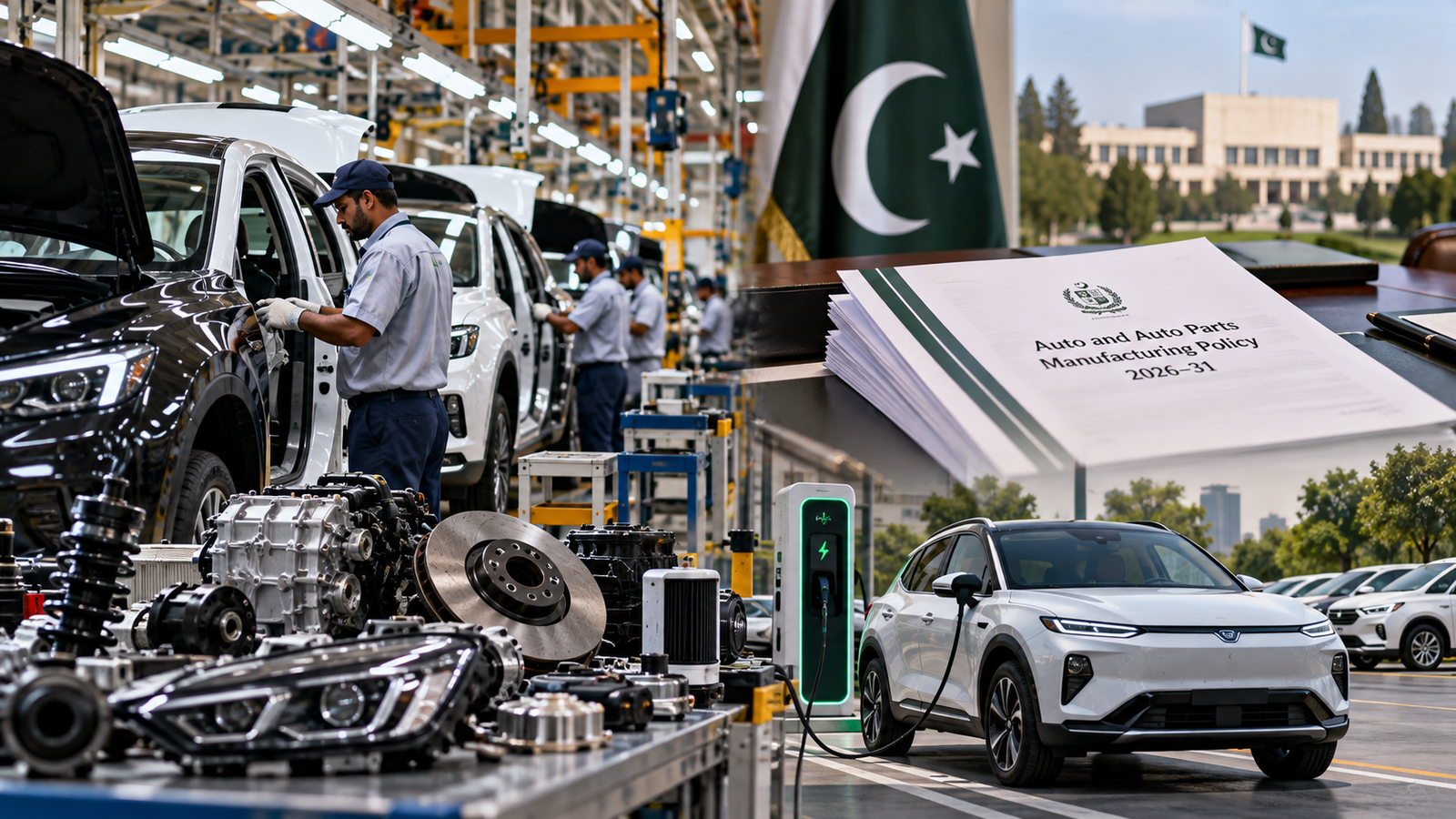
Pakistan’s proposed five-year Auto and Auto Parts Manufacturing Policy 2026-31 is moving closer to federal cabinet approval, with the government preparing a broad package of reforms covering vehicle affordability, local manufacturing, imports, electric vehicles, exports, safety standards and consumer protection. Prime Minister’s Adviser on Industries and Production Haroon Akhtar Khan told a Senate committee that the policy could reach the cabinet within the next two weeks, although final implementation still depends on the completion of consultations and formal approvals.
The draft policy is intended to replace the previous automobile framework and shape the industry through 2031. It arrives at a sensitive time for Pakistan’s auto sector, which is balancing pressure for lower vehicle prices with the need to protect domestic manufacturing, jobs and investment. The government is also trying to align the policy with broader tariff reforms, international commitments and its ongoing discussions with the International Monetary Fund.
The latest briefing suggests that the government has completed much of the internal policy work. A committee headed by the federal law minister has been reviewing the draft clause by clause, while the Ministry of Industries and Production has said consultations are continuing with relevant ministries, regulators and industry stakeholders. The draft is expected to move through the remaining approval process before being presented to the cabinet.
What the New Auto Policy Is Trying to Achieve
The central challenge for policymakers is to reduce costs for consumers without weakening Pakistan’s domestic auto industry. Haroon Akhtar Khan told the Senate Standing Committee on Industries and Production that aggressive tariff reductions could make imported completely built-up vehicles more attractive, but could also put pressure on local assemblers, parts manufacturers and employment.
The government’s stated approach is therefore to encourage local manufacturing while improving competition, quality and affordability. The draft includes measures aimed at increasing localization, supporting exports, strengthening vehicle safety rules and promoting new-energy vehicles. It also seeks to improve the treatment of consumers in areas such as vehicle booking, pricing and delivery practices.
Cabinet Approval Could Come Within Two Weeks
According to the latest parliamentary briefing, the federal cabinet may consider the new policy within the next two weeks. That timetable is not a final approval date, but it indicates that the policy has reached an advanced stage after months of delays and negotiations.
The policy has already gone through repeated reviews. In September, the government formed a committee under Federal Minister for Law and Justice Azam Nazeer Tarar to examine the draft from legal, financial and administrative perspectives. The committee reviewed concerns raised by ministries and other institutions and continued consultations to bring the policy in line with the prime minister’s directives.
The government has also indicated that the draft will be shared with the IMF as part of the wider policy and tariff consultation process. That means the final structure may still be adjusted before cabinet approval, especially in areas involving taxation, tariffs and incentives.
Localization Is a Major Priority
A key objective of the proposed policy is to increase the share of locally manufactured components in vehicles assembled in Pakistan. Policymakers have argued that stronger localization can reduce reliance on imported parts, support domestic suppliers, create jobs and help the industry build a more competitive export base.
However, localization targets can also be difficult to achieve when raw materials, technology and specialized components remain expensive or unavailable locally. Auto-parts manufacturers have repeatedly argued that high taxes and input costs reduce their ability to compete internationally.
The government is therefore considering a combination of localization requirements and export incentives. One proposal discussed in the policy process is the use of duty drawback mechanisms to support exports of locally manufactured vehicles and parts. The aim is to make Pakistani manufacturers more competitive in foreign markets while encouraging them to increase domestic value addition.
EVs and New-Energy Vehicles Remain Central to the Draft
Electric vehicles and other new-energy vehicles are expected to play a major role in the 2026-31 framework. Earlier draft measures have included tax and financing incentives designed to encourage adoption of battery electric vehicles, plug-in hybrids and other lower-emission technologies.
The government’s challenge is to promote EV growth without creating a policy structure that becomes financially unsustainable or unfair to existing manufacturers. That is one reason why proposed tax concessions have been closely scrutinized during the policy process and in discussions linked to Pakistan’s IMF programme.
The final policy is expected to address not only vehicle incentives but also charging infrastructure, local assembly, components and broader investment in the EV ecosystem. For consumers, the most important issue will be whether these measures ultimately lower the cost of ownership and improve access to financing.
Used Vehicle Imports Are Under Review
The policy process has also focused heavily on used vehicle imports. The government has been reviewing the rules governing personal baggage, gift schemes and commercial imports as it tries to balance consumer choice with the interests of local assemblers and parts manufacturers.
Officials have said the personal baggage scheme was abolished because of misuse, while the gift scheme would continue under tighter conditions. Under the proposed arrangement, a vehicle imported through the gift scheme would need to remain registered in the recipient’s name for one year and could not be transferred during that period. Officials have also indicated that one vehicle could be gifted once every three years.
Industry representatives have warned that a sharp increase in used vehicle imports could hurt local production and employment. The government, however, has also clarified that commercial vehicle imports have not been completely banned. The final policy will need to define how imported vehicles are regulated, taxed and inspected while maintaining a competitive domestic market.
New Safety and Environmental Rules Are Planned
Vehicle safety is another major component of the proposed policy. The government is preparing tighter quality, environmental and fitness requirements for imported vehicles, with the Pakistan Standards and Quality Control Authority expected to play an important role in certification and enforcement.
Haroon Akhtar Khan said additional clauses had been added to the relevant legal framework and stressed that safety and environmental standards would not be compromised. Pakistan has also been working to expand the adoption of international vehicle safety regulations under the United Nations WP.29 framework.
For consumers, stronger safety rules could improve vehicle quality and reduce the number of substandard vehicles entering the market. For manufacturers and importers, however, new compliance requirements could increase costs. The effectiveness of the policy will therefore depend heavily on how standards are implemented and enforced.
Consumer Protection Is Part of the Reform Agenda
The draft auto policy is also expected to include measures aimed directly at vehicle buyers. One proposal reported during the policy process would cap booking advances at 20 percent and protect the price agreed at the time of booking. The government is also seeking to address the long-running “on-money” problem, in which buyers pay unofficial premiums to obtain vehicles quickly.
If adopted and effectively enforced, such measures could improve transparency in vehicle sales and reduce uncertainty for consumers. They could also place greater pressure on manufacturers and dealers to improve delivery timelines and pricing practices.
The policy’s consumer-protection provisions may become one of its most visible elements because vehicle affordability and delivery delays remain major concerns in Pakistan’s auto market.
Exports Are Becoming More Important
Pakistan’s auto industry has traditionally focused on domestic demand, but the new policy places greater emphasis on exports. Policymakers want manufacturers to increase exports of vehicles and auto parts as a way to earn foreign exchange, improve scale and encourage higher production standards.
The draft has included proposals for incentives linked to export performance and domestic value addition. At the same time, the government is under pressure to ensure that incentives do not simply protect inefficient production or raise costs for consumers.
A successful export strategy would require more than tax incentives. Manufacturers would need competitive production costs, reliable energy, strong logistics, internationally accepted safety standards and access to regional markets. The policy could provide direction, but execution will determine whether Pakistan can meaningfully expand its automotive exports.
Why the Policy Matters for Jobs and Investment
The auto industry supports a large network of assemblers, parts suppliers, dealerships, logistics companies and service businesses. Industry representatives have warned that abrupt policy changes could affect employment and investment across this supply chain.
Senate committee members have also raised concerns about the potential employment impact of increased vehicle imports. The government’s response has been to argue that the new policy is designed to protect local manufacturing while still making vehicles more affordable and encouraging competition.
For investors, the most important factor will be policy predictability. A clear five-year framework could help companies make decisions about new assembly plants, localization, EV production, charging infrastructure and supplier development. Repeated delays or frequent rule changes, on the other hand, could weaken confidence.
What This Could Mean for Car Buyers
For consumers, the policy could affect vehicle prices, financing, availability and the range of models offered in Pakistan. If localization increases and competition improves, some production costs could fall over time. EV incentives could also make electric and hybrid vehicles more accessible to buyers.
However, the final impact will depend on the tax and tariff structure approved by the government. Lower import duties could increase competition but also put pressure on local manufacturers. Stronger safety and environmental requirements could improve quality but may add compliance costs. The final policy will therefore need to balance affordability with long-term industrial development.
Pakistan Relevance and Business Impact
The new auto policy has direct relevance for millions of Pakistani consumers because it will influence the price and availability of cars, EVs and imported vehicles. It also has wider business implications for local manufacturers, parts suppliers, banks, leasing companies, charging-network providers and technology firms entering the mobility sector.
The policy could also affect Pakistan’s trade balance. Higher vehicle and parts imports increase demand for foreign exchange, while stronger localization and exports could reduce that pressure. This makes the auto policy not only an industry issue but also part of the country’s broader economic and industrial strategy.
What Happens Next
The immediate next step is the completion of remaining consultations and review of the draft. The government has indicated that the policy will be shared with the IMF, after which the law minister is expected to brief Prime Minister Shehbaz Sharif. The proposal would then move to the federal cabinet for approval and may subsequently be discussed by relevant parliamentary standing committees.
Until that process is completed, the policy remains a draft. Specific incentives, tax rates, import rules and localization requirements should therefore be treated as proposed measures rather than final law.
Key Questions Still Unanswered
Several important details remain unresolved. It is not yet clear which tax and tariff proposals will survive the final approval process, how aggressively localization targets will be enforced, or what final incentives will be offered for EVs and exports. The treatment of used vehicle imports will also remain closely watched by both consumers and industry players.
Another major question is implementation. Pakistan has introduced auto policies before, but industry groups and policymakers have often disagreed over whether previous targets were fully achieved. The success of the 2026-31 policy will depend on whether its rules are clear, stable and enforceable over the full five-year period.
FAQs
What is Pakistan’s new Auto Policy 2026-31?
The proposed Auto and Auto Parts Manufacturing Policy 2026-31 is a five-year framework covering vehicle manufacturing, imports, localization, EVs, exports, safety standards and consumer protection.
Has the new auto policy been approved?
No. The policy is still in the approval process. The government has indicated that it could reach the federal cabinet within the next two weeks, but final approval has not yet been announced.
Will the new policy reduce car prices?
The government says affordability is one of its goals, but the final effect on prices will depend on taxes, tariffs, localization, imports and competition after the policy is approved.
Does the policy support electric vehicles?
Yes. EVs and other new-energy vehicles are a major part of the proposed framework, with incentives, financing and infrastructure measures under consideration.
What changes are planned for used car imports?
The government is reviewing import schemes, transfer restrictions, inspection rules and other requirements. Final details remain subject to approval.
Will vehicle safety rules become stricter?
Yes. The draft includes stronger quality, environmental and fitness standards, with PSQCA expected to play a larger role in certification and enforcement.
Why is the IMF involved in the policy process?
Pakistan’s auto policy intersects with tariff, taxation and economic reform commitments. The government has said the draft will be shared with the IMF during the consultation process.
When will the policy take effect?
No final implementation date has been announced. It will first need to complete consultations and receive formal government approval.
About The Author