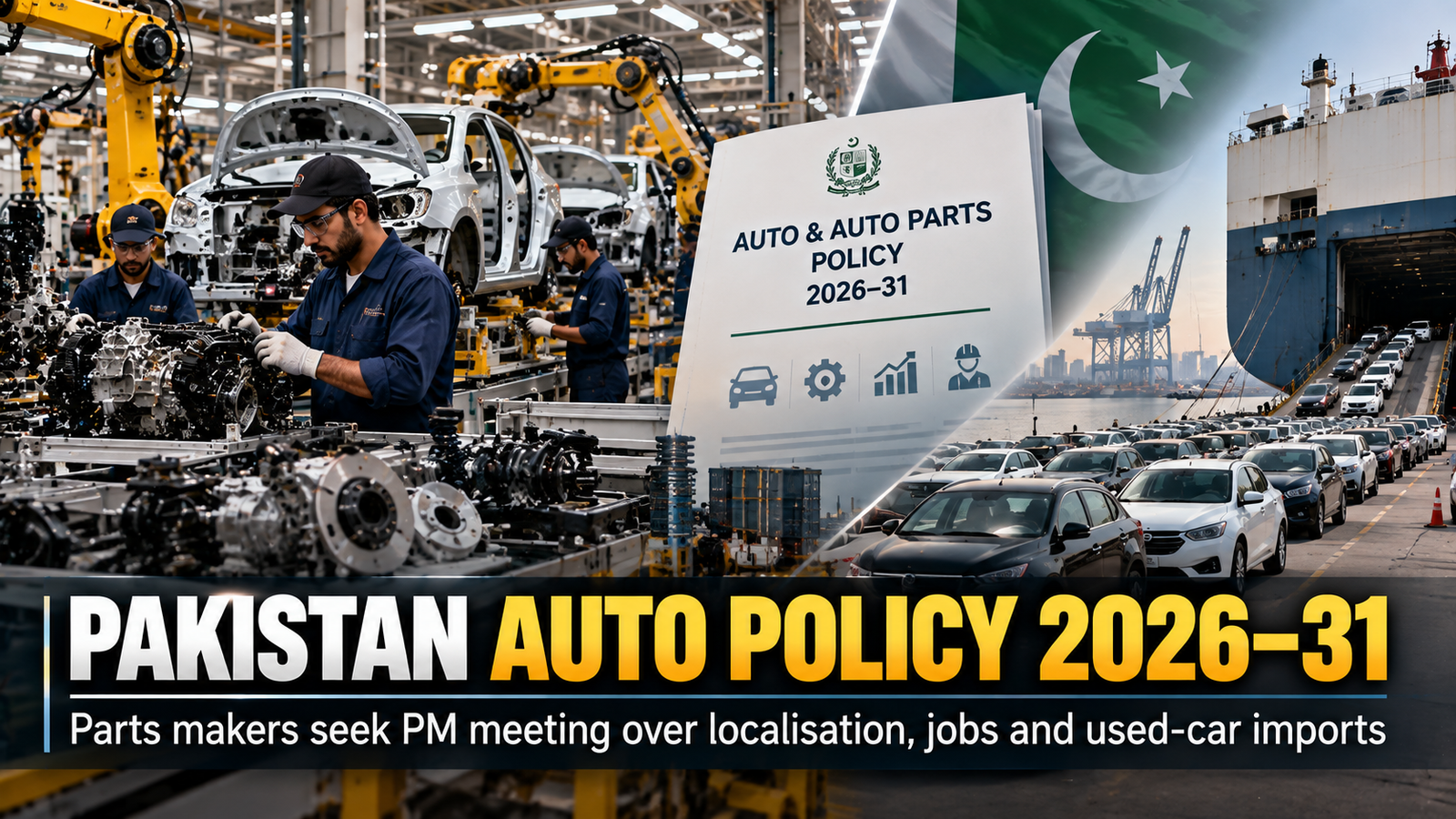
Pakistan’s auto parts manufacturers have asked Prime Minister Shehbaz Sharif for an urgent meeting as the government reviews the draft Auto & Auto Parts Policy 2026-31.
The Pakistan Association of Automotive Parts & Accessories Manufacturers, or PAAPAM, said it wants industry concerns and proposals considered before the policy is finalised.
According to Dawn, the association welcomed the prime minister’s decision to have a high-level committee conduct a clause-by-clause review of the draft. At the same time, PAAPAM warned that approving the policy without meaningful consultation could hurt domestic manufacturing, employment, localisation and long-term industrial capacity.
The dispute comes as Pakistan is also easing rules around used-car imports, adding another layer to an already sensitive debate over competition, consumer choice and protection of local industry.
What PAAPAM Is Asking From the Government
PAAPAM wants a direct meeting with Prime Minister Shehbaz Sharif before the new auto policy moves to its final stages.
The association says manufacturers and parts suppliers should be given a chance to review the revised draft and provide technical feedback.
PAAPAM has specifically argued that the reviewed policy should be shared with industry stakeholders before it is submitted to the cabinet and the International Monetary Fund.
That request reflects a broader concern within the local auto industry that tariff changes and import rules could reshape the sector for years.
Why the Draft Auto Policy Matters
Pakistan’s auto policy influences far more than vehicle prices.
It affects local assembly, parts manufacturing, investment decisions, import duties, technology transfer and employment.
A policy that makes imported vehicles cheaper can improve consumer choice and increase competition.
At the same time, local manufacturers argue that aggressive tariff reductions can weaken domestic production if imported vehicles become significantly cheaper than locally assembled alternatives.
The central policy challenge is therefore balance: keeping the market competitive without discouraging local manufacturing.
Localisation Is at the Centre of the Debate
Localisation refers to the share of a vehicle or its components that is manufactured inside Pakistan.
Parts manufacturers see localisation as one of the most important measures of whether the auto industry is creating domestic economic value.
The more components that are produced locally, the more demand is created for Pakistani suppliers, workers, engineering firms and industrial services.
PAAPAM says the next policy should protect and deepen localisation rather than make imported alternatives structurally more attractive.
Why Local Parts Matter
A locally assembled vehicle can support a network of suppliers producing items such as:
– seats and interior components
– electrical systems
– batteries
– tyres and rubber parts
– plastic components
– metal parts
– glass
– wiring
– suspension and mechanical components
That supplier network can create jobs outside the main assembly plants.
It also helps build engineering skills and production capacity that can eventually support other industries.
Used-Car Imports Are Adding Pressure
The policy debate is happening while Pakistan has also relaxed some rules around commercial imports of used vehicles.
Dawn reported that an Engineering Development Board notification dated September 30 removed a previous minimum-capital condition for commercial used-car importers.
Under the revised arrangement described by Dawn, a tax-registered individual or firm can commercially import used vehicles even if it is not registered with the Securities and Exchange Commission of Pakistan.
Importers have welcomed the change as a way to improve competition and expand consumer choice.
Local assemblers and parts manufacturers have raised concerns about the effect on domestic production.
Used-Car Imports Rose Sharply in September
Commerce Ministry figures reported by Dawn show a notable rise in used-vehicle imports during 2026.
In May, only 48 used vehicles were imported.
That rose to 843 in June and 1,938 in July.
Imports then reached 1,445 in August.
In September, 2,276 vehicles were imported under the Gift Scheme, according to the figures cited by Dawn.
The increase has strengthened calls from local manufacturers for the government to consider how import liberalisation interacts with the new auto policy.
PAAPAM’s Estimate of the Local Industry Impact
PAAPAM Chairman Abdul Rehman Aizaz told Dawn that locally produced cars can contain up to 60% local parts by value.
He said this can amount to an average of around Rs1.5 million in locally produced parts per vehicle.
Based on that estimate, he argued that the import of 2,276 used vehicles represented roughly Rs3.4 billion in potential local parts production that did not take place.
This is an industry estimate rather than an independently verified measure of economy-wide loss.
It nevertheless shows why auto-parts manufacturers view used-car imports as a major policy issue.
The Consumer Argument for More Imports
Used-car dealers and importers present a different case.
They argue that more imports can increase choice and force local assemblers to compete harder on price, quality and features.
Pakistan’s auto market has often faced criticism over high prices, long delivery times and limited competition.
From that perspective, easier imports can benefit buyers.
The policy debate is therefore not simply local manufacturers versus the government.
It is also a debate over how to divide the benefits and costs between consumers, importers, assemblers, parts makers and workers.
Competition Versus Industrial Development
A healthy auto market needs competition.
But governments also use industrial policy to build local production and employment.
If import barriers are too high, consumers may face expensive vehicles and weak competition.
If they are reduced too quickly, domestic suppliers may struggle to compete with established foreign production networks.
The Auto & Auto Parts Policy 2026-31 will need to manage both risks.
That is why consultation with multiple stakeholders is important.
What the Government Has Said So Far
The government has indicated that a new auto policy is being prepared and reviewed.
In September, Adviser to the Prime Minister on Industries and Production Haroon Akhtar Khan said the policy would be unveiled soon and would aim to support stakeholders including auto-parts makers.
He also said the government wanted to build a more competitive manufacturing economy and strengthen industrial value chains.
PAAPAM’s latest request suggests parts makers want those broad commitments reflected clearly in the final policy text.
Why the IMF Is Mentioned in the Auto Policy Debate
PAAPAM said the revised draft should be shared with industry before submission to the IMF and cabinet.
Pakistan’s economic reform programme has included tariff rationalisation and measures aimed at making trade more competitive.
That creates a direct connection between industrial policy and the country’s wider economic programme.
Auto manufacturers are concerned that tariff reforms designed at a macroeconomic level could have unintended effects on specific local industries.
The government, on the other hand, has to balance industry protection with wider reform commitments.
Jobs Are a Key Concern
Auto manufacturing is labour-intensive beyond the assembly line.
Parts suppliers employ workers in machining, plastics, electronics, metal fabrication and other industrial activities.
PAAPAM says policy changes that reduce local production could therefore affect employment.
The exact job impact of the draft policy cannot be known until the final rules are published.
That is another reason industry groups are asking for consultation before approval.
Investment Decisions Depend on Policy Stability
Automotive investment requires long planning cycles.
Companies decide whether to build plants, expand production or introduce new models based partly on expected tariffs and market rules.
Frequent changes can make those decisions harder.
A five-year auto policy can provide greater certainty if its rules are clear and predictable.
For new entrants, policy stability can also determine whether Pakistan is attractive as a manufacturing base rather than only a sales market.
Technology and EV Transition
Pakistan’s auto sector is also undergoing a technology shift.
Hybrid, plug-in hybrid and fully electric vehicles are becoming more important.
Chinese automakers have expanded their presence in the market, increasing pressure on established Japanese assemblers.
The next auto policy therefore has to deal with two transitions at once: more competition from imports and a move toward newer powertrain technologies.
Local parts manufacturers will need incentives and scale to adapt to batteries, electronics, motors and other components used in electrified vehicles.
What Could Happen to Car Prices?
The effect on prices will depend on the final policy.
Lower duties on imported vehicles or parts can reduce costs in some cases.
Greater competition can also pressure manufacturers to lower prices or improve specifications.
However, exchange rates, taxes, financing costs and production volumes also have a major influence on vehicle prices.
It would therefore be premature to say that the draft policy will automatically make cars cheaper or more expensive.
The final tariff structure will matter.
What the Industry Wants Changed
PAAPAM has not publicly released every proposed amendment to the draft policy in the reporting reviewed for this article.
Its public position is broader.
The association wants meaningful industry consultation, protection of localisation, support for employment and a policy that strengthens domestic manufacturing.
It has also raised concerns about a market becoming increasingly dependent on imported new and used vehicles.
Until the final draft is released, detailed claims about individual clauses should be treated cautiously.
Why the Used-Car Debate Is Likely to Continue
Used vehicles remain popular because they often offer features or models not available locally.
Many buyers also see imported Japanese vehicles as attractive alternatives to locally assembled cars.
At the same time, local manufacturers argue that imported vehicles do not create the same domestic industrial activity.
That conflict is unlikely to disappear.
The government will have to decide how much competition it wants from imports while setting rules that encourage investment inside Pakistan.
Business Impact
The final Auto & Auto Parts Policy 2026-31 could influence decisions across the entire sector.
Assemblers may change investment plans.
Parts suppliers may alter capacity expansion.
Importers could increase volumes if rules remain liberal.
Banks and leasing companies may also see changes in vehicle demand and financing.
For consumers, the most visible effects will be model availability, prices and delivery times.
Pakistan Relevance
This is directly relevant to Pakistan because the policy will shape one of the country’s major manufacturing sectors.
It could affect vehicle prices, industrial jobs, local parts production, imports and future investment.
The key issue is whether the government can increase competition while keeping enough incentive for companies to manufacture and source parts locally.
What Happens Next?
The government’s high-level committee is reviewing the draft policy.
PAAPAM wants the revised document shared with industry stakeholders before it is sent onward for approval.
The next important development will be publication of the final policy or a detailed draft.
Once that happens, the market will be able to judge the actual tariff changes, localisation rules and treatment of imports.
Until then, many claims about the policy’s final impact remain provisional.
Frequently Asked Questions
What is Pakistan’s Auto & Auto Parts Policy 2026-31?
It is the government’s upcoming policy framework for the automotive sector, covering areas such as manufacturing, imports, tariffs, localisation and investment.
Why does PAAPAM want a meeting with the prime minister?
PAAPAM says it wants the concerns and technical proposals of local parts manufacturers considered before the draft policy is finalised.
What is PAAPAM worried about?
The association has raised concerns about localisation, jobs, domestic manufacturing and the impact of more liberal vehicle imports.
Are used-car imports increasing?
Yes. Commerce Ministry figures cited by Dawn show 2,276 used vehicles were imported under the Gift Scheme in September 2026, up sharply from earlier in the year.
Will the new auto policy reduce car prices?
That cannot be confirmed yet. The effect will depend on the final tariff structure, import rules, taxes, exchange rates and competition.
Has the final Auto Policy 2026-31 been approved?
The reporting reviewed for this article describes the policy as a draft under review. The final policy details had not yet been published.
What is the main keyword for this article?
Pakistan Auto Policy 2026-31.
About The Author