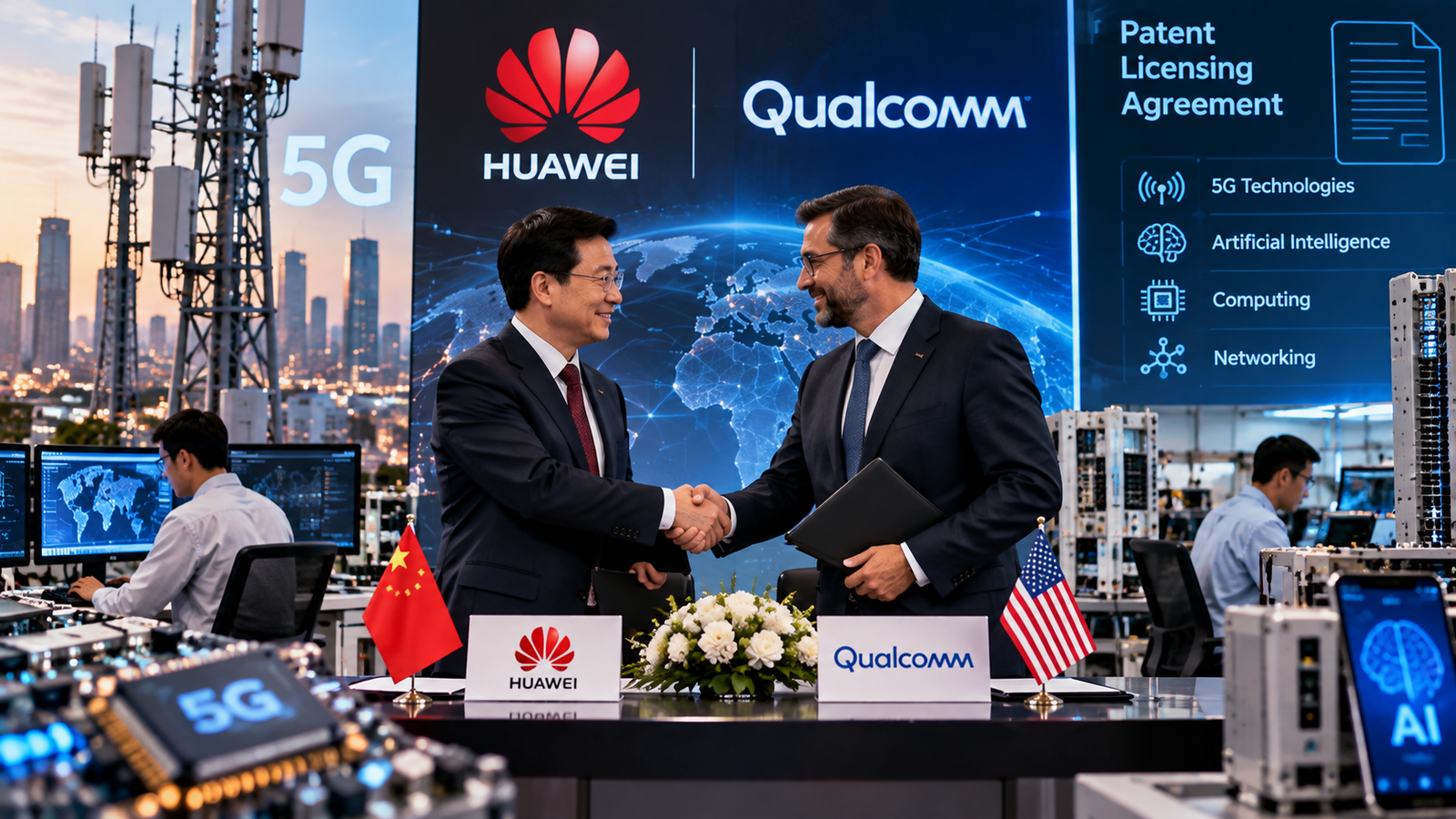
Huawei and Qualcomm announced a broad, multi-year patent licensing agreement on October 5, 2026, covering 5G, artificial intelligence, computing and networking technologies, in a deal that also includes Qualcomm’s purchase of certain Huawei patents in the United States.
The companies said the agreement includes cross-licences to parts of their respective patent portfolios. Huawei said the patent-sale component covers U.S. patents related to compute, AI, networking and other technologies and will close after the necessary regulatory approvals are received.
Reuters reported that this is Huawei’s first patent licensing agreement with Qualcomm that covers 5G technology. Huawei also said completion of the transaction is expected to push the total value of its patent licensing agreements to more than $6.9 billion.
The agreement is notable because Huawei and Qualcomm are major contributors to global wireless technology while operating on opposite sides of a difficult U.S.-China technology relationship. The deal shows that patent licensing and standards cooperation can continue even when commercial access to chips, software and equipment remains politically sensitive.
What Is in the Huawei Qualcomm Patent Deal?
The agreement has two main parts.
First, Huawei and Qualcomm will cross-license patents across several technology areas, including 5G, compute, AI and networking. Cross-licensing allows each company to use covered intellectual property owned by the other under agreed terms.
Second, Qualcomm will purchase certain Huawei U.S. patents in areas including computing, AI and networking. Huawei said that part of the transaction still requires regulatory approvals before it closes.
The companies did not publicly disclose the duration of the multi-year agreement, the royalty rates, the value of the patent purchase or the exact patents included.
Why the 5G Element Is Especially Important
Reuters reported that the agreement is the first Huawei-Qualcomm patent licensing deal to include 5G.
That matters because both companies own substantial intellectual property tied to cellular standards. Technologies used in 5G networks and devices are built from contributions made by many companies over years of research and standardisation.
Some of those inventions become standard-essential patents, often called SEPs, because implementing a communications standard can require use of the patented technology.
Licensing agreements reduce the risk of disputes between major patent holders and give device makers and technology companies clearer rights to use technologies that underpin global mobile communications.
What Cross-Licensing Means in Telecom
A patent cross-licence is an agreement in which companies allow each other to use specified patents under negotiated terms.
In telecom, this is common because a single smartphone, modem, base station or connected device can depend on thousands of patented technologies owned by different companies.
Rather than negotiating every individual invention separately, major patent holders often establish broad portfolio agreements.
The Huawei-Qualcomm agreement extends beyond cellular connectivity into computing, networking and AI, reflecting how modern telecom technology increasingly overlaps with processors, cloud infrastructure and intelligent devices.
Qualcomm Is Also Buying Huawei U.S. Patents
The patent acquisition is a separate but connected part of the transaction.
Huawei’s official announcement says Qualcomm will purchase certain Huawei U.S. patents related to compute, AI, networking and other technologies.
The companies have not identified the individual patents or disclosed a purchase price.
Because Huawei says the transaction will close after necessary regulatory approvals, the patent sale should not be described as fully completed yet. The licensing agreement has been announced, while the asset-transfer component remains subject to approvals.
Huawei Says Licensing Agreements Could Exceed $6.9 Billion
Huawei told Reuters that the new transaction is expected to take the total value of its patent licensing agreements above $6.9 billion once completed.
That figure refers to the value of Huawei’s patent licensing agreements, not the value of the Huawei-Qualcomm deal alone.
This distinction is important because the companies have not disclosed a standalone price for the new agreement.
Huawei also said its intellectual-property licensing business has generated positive revenue since 2021, reflecting a strategy of monetising technology developed through years of research and development.
Huawei Has Built One of the Industry’s Largest Patent Portfolios
Huawei says it held more than 165,000 active granted patents by the end of 2025.
The company also says it has signed more than 260 patent licence agreements with major ICT companies across the United States, Europe, Japan and South Korea.
Patent ownership has become increasingly important for Huawei as the company has invested heavily in communications technology, computing and networking while facing restrictions on access to some U.S.-origin technologies.
Licensing allows Huawei to earn revenue from inventions even when it is not the company manufacturing or selling the final device that uses them.
Qualcomm’s Business Also Depends Heavily on Licensing
Qualcomm is both a semiconductor company and one of the world’s largest wireless patent licensors.
Its Qualcomm Technology Licensing business manages a large portfolio of cellular and other technology patents.
Qualcomm says it has more than 200 5G licensing agreements and more than 200,000 granted and pending patents across over 100 countries and jurisdictions.
The company also says more than 23 billion devices have benefited from technologies covered by its licensing agreements.
That makes patent licensing a core part of Qualcomm’s business model rather than a secondary legal function.
What FRAND Licensing Means
Huawei and Qualcomm said the agreement reflects licensing practices consistent with fair, reasonable and non-discriminatory, or FRAND, principles.
FRAND commitments are particularly important for standard-essential patents. Companies that contribute patented technology to an industry standard may commit to making licences available on fair and non-discriminatory terms.
The concept is designed to balance two goals: patent owners should receive compensation for their inventions, while companies implementing global standards should be able to access essential technology.
Disagreements over what counts as a fair royalty can still lead to major litigation, which is why negotiated portfolio agreements between large patent holders can reduce uncertainty.
Why Huawei and Qualcomm Still Need Each Other
Huawei and Qualcomm compete in important technology markets, but their patent portfolios are also deeply connected to the same global standards.
Qualcomm develops modem, smartphone, automotive, PC, data-centre and AI technologies. Huawei develops telecom infrastructure, devices, networking systems, computing products and other ICT technologies.
When companies contribute inventions to the same technical ecosystems, competition does not remove the need for licensing.
The new agreement therefore reflects a common reality of global technology: companies can be commercial competitors while simultaneously being patent licensees, suppliers, standards contributors or technology partners.
The Deal Comes Despite U.S.-China Technology Tensions
The agreement is particularly notable because Huawei has faced U.S. trade restrictions since 2019.
Those restrictions have limited the company’s access to certain advanced chips and software and reshaped its supply chain.
Qualcomm is a U.S. company and has historically supplied mobile technology across the global handset industry.
The patent agreement does not remove export restrictions or change U.S. trade policy toward Huawei. Patent licensing and the sale of intellectual property operate under different legal and regulatory frameworks from unrestricted semiconductor supply.
What the Deal Means for 5G Devices and Networks
For consumers, the agreement is unlikely to create an immediate visible change in a smartphone or mobile network.
Its importance is more structural. Clearer licensing relationships can reduce legal uncertainty around technologies used in devices, network equipment and connected products.
That can make it easier for companies to develop products around common standards without facing unresolved disputes between major patent owners.
The direct commercial impact will depend on which patents are covered, how the licences are structured and which products or businesses rely on those technologies.
AI Is Now Part of Telecom Patent Strategy
The inclusion of artificial intelligence shows how telecom intellectual property is expanding beyond radio technology.
AI increasingly runs on smartphones, PCs, network infrastructure, edge devices and data centres. It can also be used for network optimisation, signal processing, device intelligence and automated operations.
Qualcomm has been expanding its positioning around on-device and infrastructure AI, while Huawei has been investing in computing and AI systems alongside its communications business.
A broad licence covering AI and compute therefore reflects the convergence of telecom, semiconductors and intelligent computing.
Networking and Compute Are Becoming Closely Linked
Modern telecom networks depend increasingly on general-purpose and specialised computing infrastructure.
5G core networks, edge computing, cloud platforms and AI workloads require processors, accelerators, networking technologies and software to operate as integrated systems.
That makes patents in networking and compute commercially important well beyond smartphones.
The Huawei-Qualcomm agreement therefore has potential relevance to a wider technology ecosystem that includes connected vehicles, industrial devices, PCs, data centres and Internet of Things products.
Why the Agreement Matters for Qualcomm’s Licensing Business
Qualcomm has built one of the industry’s most extensive patent-licensing programs.
The Huawei agreement adds another major technology company to its 5G licensing ecosystem and reinforces Qualcomm’s position that its patented inventions remain foundational to modern wireless standards.
Qualcomm executive John Han said the agreement reflects industry recognition of Qualcomm’s 5G technology leadership and its SEP licensing program.
That statement represents Qualcomm’s view of the transaction. The commercial significance will ultimately depend on the undisclosed financial terms and the scope of the licences.
Why the Agreement Matters for Huawei’s IP Strategy
For Huawei, the deal provides additional validation of a strategy that increasingly treats intellectual property as a business asset.
Huawei chief intellectual property officer Alan Fan said the agreement demonstrates the value of Huawei’s innovation and recognises Qualcomm’s foundational contributions to communications technology.
Huawei has also been signing patent agreements outside mobile connectivity. In August 2026, it announced a multi-year global patent cross-licensing agreement with HP that included certain Wi-Fi patents.
Earlier in 2026, Huawei published a Wi-Fi 7 licensing rate of $0.50 per compliant device and continues to publish royalty caps for parts of its mobile-handset patent program.
Could the Patent Deal Affect Smartphone Costs?
The companies have not disclosed enough financial detail to calculate any direct effect on smartphone prices.
Patent royalties are one component of a device maker’s overall costs, alongside chips, displays, memory, cameras, software, manufacturing, logistics and marketing.
Large portfolio agreements can increase predictability because companies know what rights they have and can reduce the risk of litigation.
However, without the royalty terms, it would be speculative to claim that the Huawei-Qualcomm agreement will raise or lower consumer prices.
Business Impact for the Telecom Industry
The agreement may reduce legal and commercial uncertainty between two of the telecom industry’s largest patent holders.
That matters because prolonged patent disputes can create financial liabilities, sales restrictions or uncertainty for partners and customers.
Cross-licensing can also allow both companies to focus more resources on product development rather than litigation over overlapping portfolios.
The broader business signal is that intellectual property remains a major source of value in telecom even as the industry’s attention shifts toward AI and computing.
Pakistan and South Asia Relevance
There is no direct Pakistan-specific component in the Huawei-Qualcomm agreement.
Its relevance to Pakistan and South Asia is indirect because telecom operators, smartphone makers and technology suppliers across the region rely on global 4G and 5G standards built from intellectual property owned by international companies.
Patent licensing relationships between major standards contributors can influence the wider device and network ecosystem over time.
However, the agreement does not itself announce a new Pakistan network project, 5G rollout, device launch or local licensing arrangement, so those connections should not be implied.
What Happens Next?
The main near-term step is regulatory approval for Qualcomm’s purchase of the identified Huawei U.S. patents.
The companies have not disclosed a timetable for those approvals or identified the agencies involved.
Industry attention will also focus on whether Huawei signs additional cross-licensing agreements with other major technology companies as it continues to monetise its patent portfolio.
For Qualcomm, the agreement adds to a licensing business that remains central to the company’s financial and technology strategy.
Important Questions Still Unanswered
The companies have not disclosed the financial value of the Huawei-Qualcomm agreement itself.
They have also not published the exact duration, patent lists, royalty rates or detailed product coverage.
It is unclear how many U.S. patents Qualcomm will purchase from Huawei and what price will be paid for those assets.
Those details will determine the full commercial significance of the transaction beyond its broader strategic importance.
FAQs
What did Huawei and Qualcomm agree to?
Huawei and Qualcomm announced a multi-year patent licensing agreement covering 5G, AI, computing and networking. The deal includes cross-licences to patent portfolios and Qualcomm’s planned purchase of certain Huawei U.S. patents.
Is this Huawei’s first 5G patent deal with Qualcomm?
Reuters reported that it is Huawei’s first patent licensing agreement with Qualcomm that covers 5G technology.
How much is the Huawei Qualcomm patent deal worth?
The companies have not disclosed the value of this specific deal. Huawei said completion is expected to push the total value of its patent licensing agreements above $6.9 billion.
Has Qualcomm already completed the Huawei patent purchase?
No. Huawei said Qualcomm’s purchase of certain U.S. patents will close after the necessary regulatory approvals are received.
What technologies are covered?
The agreement covers patent portfolios across 5G, artificial intelligence, computing and networking technologies.
Why do Huawei and Qualcomm cross-license patents?
Telecom and computing products can rely on patented inventions owned by many companies. Cross-licensing gives each company agreed rights to use covered technology and can reduce legal uncertainty.
What does FRAND mean?
FRAND stands for fair, reasonable and non-discriminatory. It is a licensing principle commonly associated with standard-essential patents used in technologies such as cellular communications.
Does this agreement directly affect 5G in Pakistan?
No direct Pakistan-specific rollout or licensing arrangement was announced. Any regional impact would be indirect through the global telecom and device ecosystem.
About The Author