Pakistan’s shift toward digital payments accelerated sharply in fiscal year 2025-26, with digital channels accounting for 92% of all retail payment transactions processed through formal banking channels. According to the State Bank of Pakistan’s Annual Payment Systems Review, the country recorded 14.3 billion retail transactions worth about Rs673 trillion during FY26, while 13.2 billion of those transactions were completed digitally.
The growth was driven primarily by mobile phone-based payments, which crossed 11.1 billion transactions and rose 79% year on year. That means the overwhelming majority of everyday digital payments in Pakistan are now being initiated through smartphones, including bank apps, branchless banking apps and e-money wallets.
The numbers show a major change in how consumers and businesses move money, but they also reveal an important gap. Digital channels dominated transaction volume, yet they accounted for only about 38% of retail payment value. In other words, Pakistan is digitising small and frequent payments much faster than large-value transactions.
That distinction is important for businesses, banks, fintech companies and policymakers. The volume data points to rapid consumer adoption, while the lower share by value suggests there is still significant room to digitise business-to-business payments, government payments and other higher-value transactions.
Digital Payments Reach 13.2 Billion Transactions
The State Bank’s annual review shows that retail payment volumes through formal banking channels rose 58% during FY26 to 14.3 billion transactions. The total value of those payments increased 10% to about Rs673 trillion.
Digital channels processed 13.2 billion transactions, representing 65% year-on-year growth. Their share of total retail payment volume rose to 92%, up from 88% in FY25 and 85% in FY24, showing that the trend is not a one-year spike but part of a broader structural shift.
Digital channels include mobile banking applications, branchless banking apps and wallets, internet banking, e-money wallets, point-of-sale terminals, e-commerce payment systems, ATMs and other electronic payment methods.
Mobile Payments Are Driving the Shift
Mobile phone-based payments were the strongest growth engine in FY26. More than 11.1 billion mobile transactions were processed during the year, a 79% increase compared with the previous fiscal year.
The user base also expanded significantly. Branchless banking mobile app users reached 99.1 million, while users of banks’ mobile apps rose to 30.4 million. E-money wallet users also increased, highlighting the widening use of app-based financial services beyond traditional bank accounts.
This growth matters because mobile apps are increasingly being used for routine financial activity such as person-to-person transfers, utility bill payments, merchant purchases, mobile top-ups and e-commerce transactions. For many users, the smartphone is becoming the primary banking interface.
Digital Share by Value Remains Much Lower
Despite the rapid growth in digital transaction volume, the value picture is more mixed. Digital payments represented around 38% of total retail payment value in FY26, up from about 29% a year earlier.
Digital payment value rose to roughly Rs257 trillion from around Rs179 trillion, but over-the-counter and branch-based channels still handled a larger share of high-value payments. That indicates that large corporate, government and institutional payments have not migrated online at the same pace as consumer transactions.
The State Bank has highlighted the need for continued efforts to digitise higher-value payments across businesses, government entities and financial institutions. Closing this gap could be one of the next major phases of Pakistan’s digital payments transition.
QR Payments and Merchant Acceptance Expand
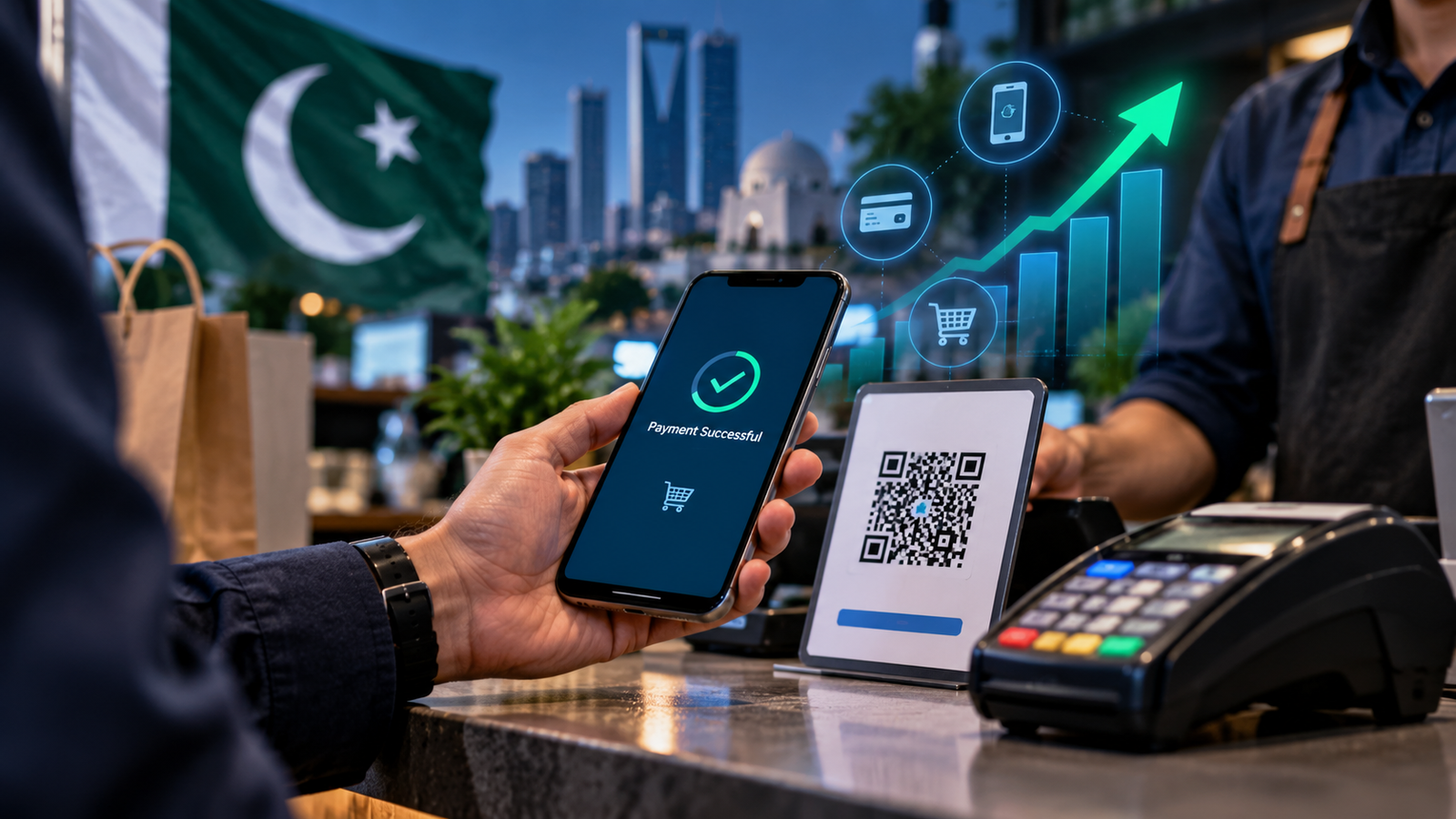
Pakistan’s merchant acceptance network also grew rapidly during FY26. The number of QR-enabled merchants more than tripled to around 3.8 million by the end of June 2026, compared with roughly 1.1 million a year earlier.
The expansion of QR payments is especially important for small retailers and informal businesses because QR systems can be cheaper and easier to deploy than traditional card terminals. A merchant can accept digital payments using a printed code or app without installing expensive hardware.
For Pakistan, where millions of small businesses operate outside large retail chains, QR-based acceptance could play a major role in increasing digital payment usage and reducing dependence on cash.
POS Network Grows Across Pakistan
Card acceptance also expanded. The number of point-of-sale terminals rose to 337,791 across 295,367 merchant locations during FY26. Daily card payments at POS outlets reached nearly 1.5 million, compared with around one million per day in the previous fiscal year.
The expansion was supported in part by newer acceptance methods such as Soft-POS, which allows compatible smartphones or devices to function as payment terminals. This can reduce hardware costs and make card acceptance easier for smaller merchants.
For banks and payment companies, a larger acceptance network can increase transaction volumes and reduce the friction that has historically limited card usage outside major urban retail outlets.
E-Commerce Payments Continue to Grow
Pakistan’s e-commerce payment ecosystem also expanded. The number of e-commerce merchants registered with banks rose to 23,356, while account- and wallet-based payments represented nearly 96% of e-commerce transactions processed through banking channels.
This is significant because it shows that online payments are moving beyond traditional debit and credit cards. Consumers are increasingly paying directly from accounts or wallets, which can reduce payment friction and broaden access for users who do not regularly use cards.
For online retailers, this shift creates opportunities to integrate more local payment options and potentially reduce failed transactions at checkout.
Why the Growth Matters for Businesses
The rise in digital payments has direct implications for retailers, banks, fintech firms and technology companies. More transactions moving online can lower cash-handling costs, improve transaction records and make payment reconciliation easier for businesses.
Digital payments can also provide merchants with better data on customer behaviour, sales patterns and cash flow. For small businesses, digital transaction histories may eventually help improve access to formal credit if lenders are able to use verified payment data in underwriting.
At the same time, businesses need reliable payment infrastructure, strong fraud controls and affordable merchant fees. Rapid adoption can create problems if customer support, dispute resolution or cybersecurity systems do not scale at the same pace.
Fintech and Banking Competition Is Intensifying
The growth of branchless banking apps, bank apps and e-money wallets shows that competition for digital customers is broadening. Traditional banks are no longer competing only with each other; they are also competing with wallet providers, payment companies and digital financial platforms.
This can encourage better app experiences, faster transfers and new payment products, but it also raises questions about interoperability, data protection and consumer trust. Users increasingly expect instant payments to work reliably across providers.
Pakistan’s Raast instant payment infrastructure and wider QR ecosystem are likely to remain central to this competition because they can make transfers and merchant payments easier across institutions.
PRISM+ Modernises Core Payment Infrastructure
The Annual Payment Systems Review also highlighted the introduction of PRISM+ in August 2025 as a major infrastructure development. The upgraded real-time gross settlement platform moved Pakistan’s wholesale payment system to the ISO 20022 messaging standard.
ISO 20022 is increasingly used internationally because it allows richer and more structured payment data. For financial institutions, this can improve processing efficiency, transparency and compatibility with modern payment systems.
The State Bank has described the upgrade as part of a broader effort to modernise both retail and high-value payments.
Pakistan Express Clearing System Adds Another Digital Layer
In a separate development announced in October 2026, the State Bank launched the Pakistan Express Clearing System, or PECS, which will begin implementation on a pilot basis from October 15. The system is designed to move cheque clearing toward image-based processing instead of relying on physical movement of paper cheques.
PECS is not part of the FY26 payment statistics, but it reflects the same policy direction: reducing manual processing and moving more of the country’s payment infrastructure onto digital rails.
Nationwide implementation is scheduled to be completed by April 30, 2027, subject to the central bank’s rollout plan.
Cash Still Matters
The strong digital numbers should not be interpreted as evidence that Pakistan has become a cashless economy. The State Bank’s review covers retail payments conducted through formal banking channels and does not capture all cash transactions taking place outside the banking system.
Cash remains widely used in retail trade, informal commerce and person-to-person transactions. Large parts of the economy continue to depend on physical currency, especially in areas where internet access, smartphone usage or formal financial inclusion is limited.
The 92% figure therefore means that digital channels dominate formal retail payment transaction volume, not that 92% of all economic transactions in Pakistan are digital.
Financial Inclusion Remains a Key Question
Digital payment growth can support financial inclusion, but access remains uneven. Smartphone ownership, digital literacy, reliable mobile internet and trust in financial services vary significantly across income groups and regions.
Women, rural users and lower-income households may face additional barriers to formal financial services. Expanding mobile wallets and low-cost merchant payments can help, but technology alone does not remove all access gaps.
For policymakers, the challenge is to turn payment adoption into broader financial inclusion rather than simply increasing transaction counts among already-connected users.
Cybersecurity and Fraud Risks Grow With Adoption
As more financial activity moves online, cybersecurity becomes more important. Larger digital ecosystems can attract phishing, account takeover, identity theft and social-engineering scams.
Banks, fintech companies and regulators will need to strengthen authentication, fraud monitoring and consumer education. Users also need clearer mechanisms for reporting suspicious transactions and resolving disputes.
A successful digital payments ecosystem depends not only on speed and convenience but also on trust. A major rise in fraud could slow adoption if consumers begin to see digital channels as unsafe.
What the Numbers Mean for Pakistan’s Economy
The expansion of digital payments can improve economic efficiency by reducing cash handling, improving transaction visibility and speeding up the movement of money between consumers and businesses.
More digital records can also improve transparency and potentially support better tax documentation, although the effect depends on how payment data is used and how businesses are brought into the formal economy.
For the technology sector, the trend increases demand for payment gateways, cybersecurity services, cloud infrastructure, fraud detection and financial software. For banks, it creates pressure to invest more in digital channels even as physical branches remain important for certain services.
What Happens Next
The next phase of Pakistan’s payment transition is likely to focus on increasing the value of transactions conducted digitally, not only the number of transactions. The State Bank has already indicated that higher-value business, government and institutional payments remain an important area for further digitisation.
Merchant acceptance will also be crucial. Continued expansion of QR payments, Soft-POS and e-commerce systems could make digital payments available to more small businesses and consumers.
At the same time, regulators and financial institutions will need to manage cybersecurity, fraud, interoperability and inclusion risks. The FY26 numbers show that adoption is accelerating quickly; the bigger challenge is ensuring the system remains secure, accessible and useful as it grows.
FAQs
What share of Pakistan’s retail payments were digital in FY26?
Digital channels accounted for 92% of retail payment transactions by volume through formal banking channels in FY26.
How many digital transactions were processed in Pakistan in FY26?
Pakistan processed about 13.2 billion digital retail payment transactions during FY26.
What was the total value of retail payments?
Total retail payments through formal banking channels reached about Rs673 trillion during the fiscal year.
How important were mobile payments?
Mobile phone-based payments exceeded 11.1 billion transactions and grew about 79% year on year.
Did digital payments also dominate by value?
No. Digital channels accounted for about 38% of retail payment value, showing that many large-value transactions still use branch or over-the-counter channels.
How large is Pakistan’s POS network?
The POS network expanded to 337,791 terminals across 295,367 merchant locations in FY26.
How many QR-enabled merchants are there?
QR-enabled merchants rose to roughly 3.8 million by the end of June 2026.
Does the 92% figure mean Pakistan is almost cashless?
No. The figure refers to retail payments processed through formal banking channels and does not include all cash activity outside the banking system.
About The Author