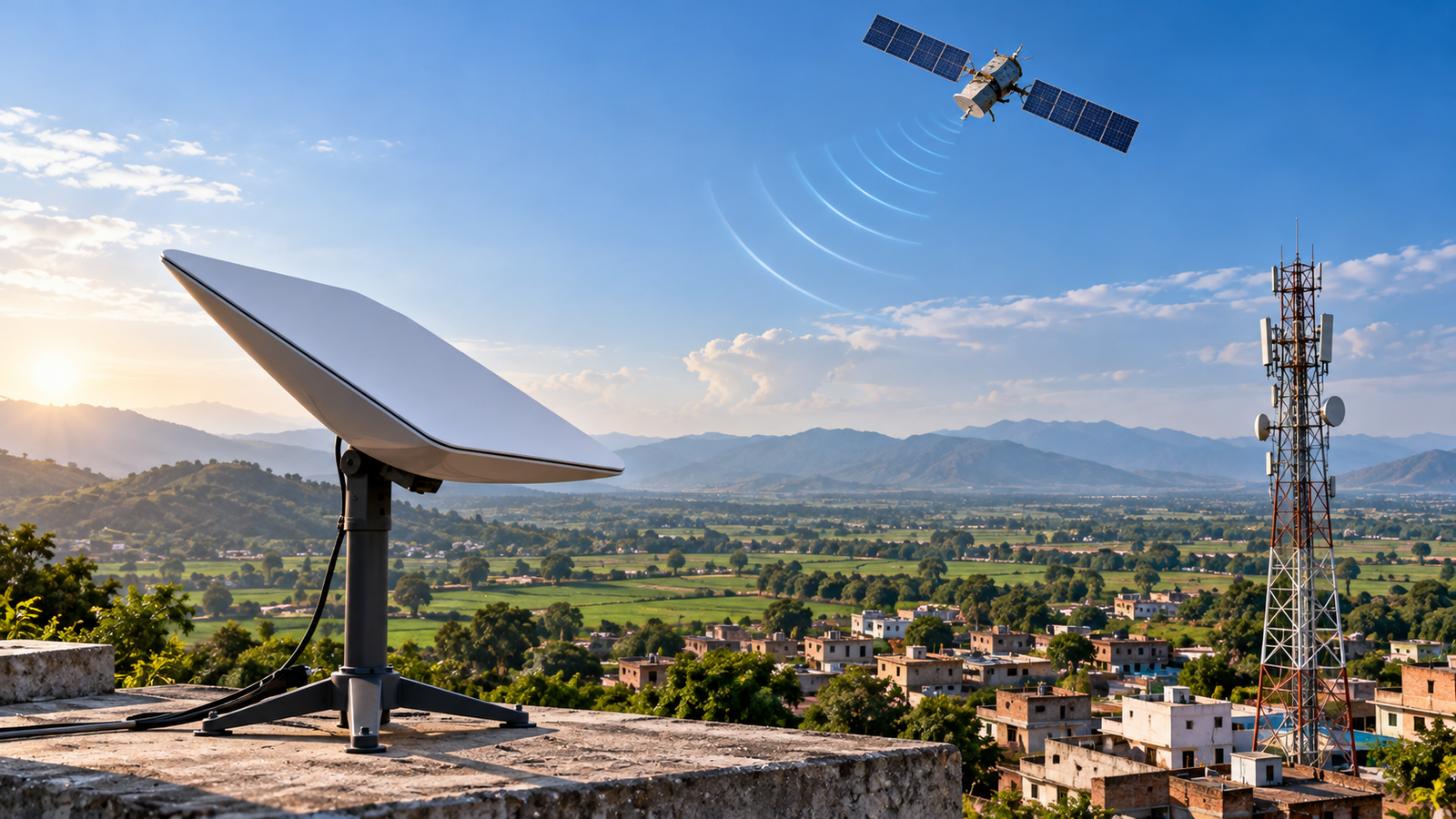
NEW DELHI, October 17, 2026 – Reliance Industries says its Jio satellite internet business is still waiting for Indian government clearances, just as Elon Musk’s Starlink works toward launching commercial services in the country. Reliance welcomed competition from Starlink in a statement on October 16 and said every provider must follow India’s laws and regulations.
The latest Jio Starlink India satellite internet debate gained fresh attention on October 17 after Starlink said it had built dedicated infrastructure in India with required approvals and was ready to provide high-speed connectivity. Reuters, Dawn, Business Standard, The Economic Times and Financial Express reported the developments.
The statements do not mean either company has confirmed a nationwide commercial launch date. India still has security and spectrum-allocation procedures, and different levels of approval should not be confused with a fully operational consumer service.
Jio Starlink India Satellite Internet: Key Facts
Reliance statement: October 16, 2026. Starlink response: Reported October 17. Market: India. Jio status: Says it is awaiting satellite service clearances. Starlink status: Says its infrastructure is ready and has required approvals for that infrastructure; commercial launch is not confirmed. Main regulators and rules: India’s telecom and security approval process, including spectrum assignment. Other significant operator: Eutelsat OneWeb, backed by Bharti interests.
Jio’s existing mobile network and its proposed satellite service are not the same product. Jio already provides mobile connectivity, but approval for its satellite offering is a separate issue.
What Did Reliance Industries Say?
Reliance said it welcomes competition in satellite communications, including from Starlink. It argued that competition helps customers as long as every company follows India’s legal and regulatory requirements.
The statement came after Elon Musk made allegations that powerful business interests were delaying Starlink’s entry into India. Reliance rejected the suggestion that it was trying to stop competition and pointed out that its own satellite project remains in the approval process.
Reuters reported that this was Reliance’s first direct response to those accusations. The allegations should be attributed to Musk, rather than presented as a proven finding about Reliance or government officials.
What Has Starlink Said About Its India Launch?
Starlink responded by saying it had worked with Indian regulators, telecom companies and other industry partners for more than five years. It said dedicated infrastructure had been established with the necessary government approvals.
The company also said it was ready to connect people across India with high-speed internet, particularly where existing networks are limited.
That readiness is the company’s own description of its progress. It does not independently establish that all final regulatory steps are complete or that ordinary customers can immediately order a fully activated nationwide service.
Business Standard and The Economic Times reported Starlink’s statement on October 17, offering a direct follow-up to Reliance’s remarks the previous day.
Why Are Final Approvals Taking Time?
Satellite internet services use signals travelling between terminals on the ground and satellites in space. Operating such a system involves different technical and security requirements from running an ordinary mobile network.
India’s telecom authorities have said operators must satisfy relevant security checks and obtain spectrum assignments before commercial services can be fully launched. Reuters previously reported that Starlink, Jio and other applicants had reached broadly comparable regulatory stages.
Spectrum refers to the radio frequencies used to carry wireless signals. Authorities need to manage these frequencies so that different users and systems can operate safely and with limited interference.
A company can receive certain permissions for infrastructure or equipment while still awaiting other decisions required to begin widespread commercial operations.
Is India Blocking Starlink to Protect Jio?
Elon Musk has criticised delays and suggested that influential business interests were protecting their positions in India’s telecom market. Those are allegations and political or business claims, not established findings.
India’s government has denied bias in the approval process. Reliance has also rejected the suggestion that it fears competition, saying its own satellite services are awaiting permission.
The public record therefore includes competing statements. A neutral news report should describe each position and examine independently verifiable regulatory steps instead of declaring either side guilty of misconduct without evidence.
The next official decisions on security clearances and spectrum will provide a stronger basis for assessing the actual pace of approval.
How Is Satellite Internet Different From Regular Mobile Internet?
Most mobile phones connect to nearby ground towers. Those towers are connected to other parts of the network through cables or wireless links.
Satellite internet can deliver a connection through equipment that communicates with satellites orbiting Earth. This can help in places where fibre cables and mobile towers are expensive or difficult to install.
For many home customers, satellite broadband usually requires a dedicated terminal and a clear view of the sky. Speeds, service quality and costs depend on the equipment, network capacity, location and service plan.
Satellite internet can complement mobile and fibre networks, but it does not automatically replace them for every household or every densely populated city.
Why Rural Communities Could Benefit
India has towns, villages, mountain communities and remote areas where internet service can be difficult to extend. Satellite broadband offers a possible way to provide connectivity without building a continuous cable connection to every location.
Better access could help schools use online material, local businesses communicate with customers and families stay connected. But actual benefits depend on affordability, power supply, reliable equipment and customer support.
Neither the statements from Reliance nor Starlink confirm a final consumer price for every location or a definite service activation schedule across rural India.
New competition could increase choice over time, but lower prices should not be promised before the companies publish official plans.
What Is Jio Satellite Communications?
Jio Satellite Communications is part of Reliance’s wider digital and telecom business. It is working toward satellite connectivity that would add to the group’s large existing mobile and broadband operations.
Reliance says its mobile business grew from no subscribers when it entered the market in 2016 to more than 530 million users. The figure is a company-reported measure for its mobile business, not the number of people already using Jio satellite broadband.
A nationwide mobile network brings experience in distribution, payments and customer support. However, satellite services still need suitable infrastructure, approvals and pricing before customers can judge them.
What Is Starlink?
Starlink is a satellite broadband service operated by SpaceX, the aerospace company associated with Elon Musk. It uses a network of satellites in low Earth orbit to deliver internet access through compatible equipment.
Low Earth orbit means satellites travel closer to Earth than traditional high-altitude communications satellites. This can help reduce signal delay compared with some older satellite systems, although real-world performance varies.
Starlink already operates in multiple countries, but a launch in India must follow Indian national laws and approval procedures. Its experience elsewhere does not replace local permission.
What Role Does Airtel and OneWeb Play?
Jio and Starlink are not the only companies interested in India’s satellite broadband market. Bharti-backed Eutelsat OneWeb has also pursued commercial satellite services.
Bharti Enterprises chairman Sunil Bharti Mittal recently said his group had been waiting for final satellite communication approvals for years and considered itself ahead in parts of the process.
That means competition could involve more than two brands. Customers may ultimately compare different technologies, equipment requirements, coverage areas and subscription plans.
For now, officials and companies continue discussing approvals rather than announcing a completed, nationwide launch by all operators.
Are Jio and Starlink Working Together or Competing?
The two companies have business interests that can overlap. Earlier reports described an arrangement exploring the distribution of Starlink services through Jio’s retail network.
A distribution arrangement does not erase competition in satellite communications or imply that the companies share all technology, pricing or regulatory rights.
Companies can cooperate in one area while competing in another. The details of any retail offering will only be clear once commercial services, eligibility and prices are formally announced.
Consumers should be careful about websites or messages that claim to sell already approved plans without an official operator announcement.
Why Satellite Internet Rules Matter
Telecom networks carry important business and personal communications. Governments therefore regulate areas such as spectrum, security, lawful operation and technical reliability.
New satellite networks create extra questions because signals cross large areas and the technology involves space-based equipment as well as ground installations.
The goal of a fair approval system should be to apply clear requirements consistently while allowing safe and useful services to reach customers.
Whether a particular delay is justified needs evidence about the missing requirements, not just claims from a company or one of its competitors.
Does Jio’s Upcoming IPO Change This News?
Reliance’s comments came shortly before the planned public offering of Jio Platforms. Reuters reported that the IPO could value the business at around $108 billion.
The IPO concerns an investment transaction, whereas the satellite internet story concerns approvals, infrastructure and competition. They are connected through the wider Jio group but are separate developments.
The proposed fundraising does not mean the satellite business has received its remaining permissions. Likewise, satellite approvals do not guarantee that Jio shares will perform well after a listing.
Investors should review each development separately rather than treating one as proof of success in the other.
What This Could Mean for Pakistan and South Asia
Pakistan also faces challenges bringing reliable internet to some remote or underserved communities. For that reason, India’s satellite broadband debate has wider South Asian relevance.
Still, a decision by Indian regulators does not change Pakistan’s telecom laws. Companies wanting to operate in Pakistan must follow the approvals and spectrum arrangements required by Pakistani authorities.
There is no verified announcement in the reviewed India reports that Jio is launching satellite internet in Pakistan or that Pakistani consumers can subscribe to these Indian offerings.
The regional lesson is that satellite broadband requires not only equipment and investment but also workable licensing, security oversight and prices customers can afford.
What Should Customers Watch Next?
The most important next step will be official confirmation of the remaining clearances and spectrum arrangements. After that, customers can look for service launch dates, package prices, equipment costs and coverage maps.
Advertisements and social posts can appear before services are actually available. Customers should check the company and regulator’s official channels before paying a deposit.
For businesses, commercial partnerships and infrastructure announcements are worth following, but they should not be mistaken for evidence that nationwide service has started.
Conclusion
Reliance Industries says it welcomes Starlink’s entry into India’s satellite internet market and maintains that Jio is also awaiting regulatory clearances. Starlink says it has built approved infrastructure and is ready to deliver high-speed connectivity.
The dispute has drawn attention to how India regulates satellite broadband, how companies compete and when customers may receive new options.
As of October 17, the most accurate conclusion is that both companies are moving toward service while key regulatory and commercial details remain unsettled. There is no confirmed nationwide launch date in the reviewed reports.
Frequently Asked Questions
Has Jio satellite internet been fully approved in India?
Reliance says its satellite service is still awaiting required government clearances.
Is Starlink available nationwide in India now?
A nationwide commercial launch is not confirmed by the October 17 reports, despite Starlink saying its infrastructure is ready.
What is the Jio Starlink India satellite internet dispute about?
It concerns launch delays, allegations about competition and the regulatory steps required before satellite broadband services can begin.
Does Reliance support Starlink entering India?
Reliance publicly says it welcomes competition, provided every company follows Indian laws.
Why is spectrum approval important?
Satellite networks use radio frequencies that must be managed and assigned under national rules.
Will satellite internet be cheaper than mobile data?
There is no confirmed price comparison for the new Indian commercial services in the reviewed reports.
Can satellite internet help rural areas?
It may offer connectivity where cables and towers are difficult to install, depending on affordability and coverage.
Does this announcement apply to Pakistan?
No. Indian regulatory developments do not automatically change Pakistan’s licensing or spectrum rules.
About The Author