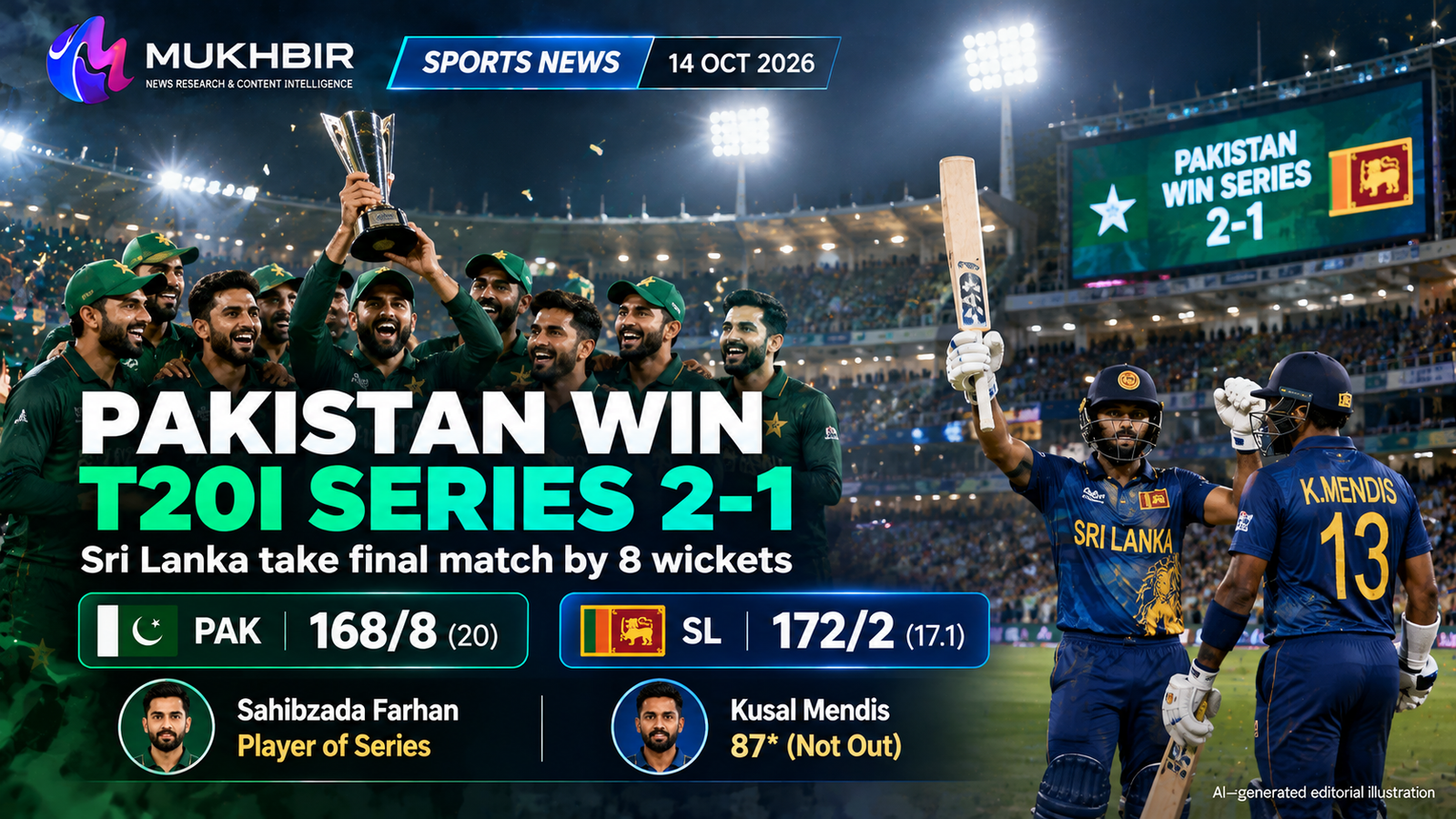
RAWALPINDI, October 14, 2026 – Pakistan have won their three-match Twenty20 International series against Sri Lanka 2–1 despite suffering an eight-wicket defeat in the third and final game at Rawalpindi Cricket Stadium on Tuesday evening. Sri Lanka chased Pakistan’s 168 for eight in 17.1 overs, reaching 172 for two as captain Kusal Mendis struck an unbeaten 87.
The Pakistan Sri Lanka T20I series 2026 result was confirmed by the Pakistan Cricket Board (PCB) in its October 13 match report and independently covered by Geo News, Express Tribune and AFP reporting published by The Daily Star on October 14. Pakistan had already secured the series by winning the first two matches on October 9 and October 11.
The final match provided two contrasting outcomes: a convincing consolation victory for Sri Lanka, and an overall series triumph for Pakistan under captain Sahibzada Farhan. The result was decided on October 13, while this article forms part of Mukhbir’s October 14 daily sports coverage.
Final T20I Scorecard: Pakistan vs Sri Lanka
Venue: Rawalpindi Cricket Stadium, Rawalpindi.
Match date: Tuesday, October 13, 2026.
Pakistan: 168 for 8 in 20 overs.
Sri Lanka: 172 for 2 in 17.1 overs.
Match result: Sri Lanka won by eight wickets, with 17 balls remaining.
Series result: Pakistan won 2–1.
Pakistan top scorer: Sahibzada Farhan, 76 from 47 balls.
Sri Lanka top scorer: Kusal Mendis, 87 not out from 48 balls.
Player of the Match: Kusal Mendis.
Player of the Series: Sahibzada Farhan.
The figures are drawn from the PCB’s official final-match report. The distinction between the match result and the series result is essential: Sri Lanka won the third T20I, but Pakistan finished ahead across the three games.
What Happened in the Third T20I?
Sri Lanka won the toss and chose to field, putting Pakistan in to bat. The hosts reached 168 for eight in their allocated 20 overs, led by Farhan’s composed 76 and an unbeaten 34 from Arafat Minhas.
Sri Lankan bowlers kept taking wickets at intervals, preventing Pakistan from turning a solid platform into a substantially larger total. Dasun Shanaka was the leading wicket-taker with three for 21, while Nuwan Thushara and Eshan Malinga each took two wickets for 38 runs.
Chasing 169 to win, Sri Lanka reached the target with eight wickets and almost three overs to spare. Kusal Mendis anchored the innings and put together decisive partnerships after the visitors lost early wickets.
The eight-wicket margin reflected the strength of Sri Lanka’s chase rather than an overturned series outcome, since Pakistan’s previous victories had already settled the trophy.
Sahibzada Farhan Scores 76 for Pakistan
Pakistan captain Sahibzada Farhan continued his productive series with 76 from 47 deliveries. His innings included seven boundaries and three sixes, according to the PCB.
Farhan held the innings together while wickets fell at the other end. His contribution helped Pakistan post a competitive total despite Sri Lanka’s ability to interrupt the hosts’ batting momentum.
Arafat Minhas added an important unbeaten 34. His late runs ensured the side reached 168, although the total ultimately proved insufficient to defend against a well-managed Sri Lankan chase.
Farhan’s performance in the final match also supported his selection as Player of the Series. The honor reflected his impact across the three-match contest, including major contributions to Pakistan’s wins in the first two games.
Kusal Mendis Leads Sri Lanka’s Eight-Wicket Win
Sri Lanka captain Kusal Mendis produced the decisive batting performance of the third game, finishing 87 not out from 48 deliveries. His innings featured nine fours and four sixes.
Following the loss of an early wicket, Mendis helped rebuild the chase alongside Sineth Jayawardena. The pair put on 59 runs for the second wicket, with Jayawardena making 38 from 26 balls.
Arafat Minhas dismissed Jayawardena, but Pakistan could not create the series of breakthroughs needed to regain control. Mendis then combined with Kamindu Mendis for an unbeaten 98-run third-wicket partnership.
Kamindu finished on 40 not out from 27 balls. The partnership carried Sri Lanka to 172 for two in 17.1 overs, leaving Pakistan without enough wickets or scoreboard pressure to turn the chase around.
How Sri Lanka’s Bowlers Restricted Pakistan
Pakistan’s innings contained an individual standout performance from Farhan, but Sri Lanka’s attack ensured the hosts were unable to build an unbroken sequence of large partnerships.
Dasun Shanaka returned figures of three wickets for 21 runs, making him the leading wicket-taker in the innings. Nuwan Thushara took two for 38, as did Eshan Malinga.
Those breakthroughs were significant because they limited how many recognized batters could bat through the final overs. Pakistan still reached 168, but that score gave Sri Lanka a chase its top order ultimately handled comfortably.
The result showed how an effective bowling effort can create manageable conditions for batters even when a captain makes a half-century.
Pakistan Had Already Won the Series
The series was decided before Tuesday’s finale. Pakistan won the opening match on October 9 by four wickets and followed that with an 82-run victory on October 11, both at Rawalpindi Cricket Stadium.
Those two wins gave Pakistan an unassailable 2–0 lead. Sri Lanka could therefore win the last match but could not claim the three-match series.
Pakistan’s ability to secure the trophy early matters when analyzing the campaign as a whole. The team produced match-winning batting and bowling performances before Sri Lanka adjusted and finished with a strong consolation result.
The final record of two wins and one defeat captures both Pakistan’s success and the need to review its performance in the closing fixture.
First T20I: Farhan’s 89 Sets Up a Four-Wicket Win
In the opening match on October 9, Sri Lanka posted 182 for eight, setting Pakistan a target of 183. Pakistan completed the chase in 18.5 overs with six wickets down, winning by four wickets.
Sahibzada Farhan, leading Pakistan in a bilateral T20I series for the first time, scored 89 in a Player-of-the-Match performance. Maaz Sadaqat added an important half-century, according to the PCB’s official report.
The victory gave Pakistan an early advantage and established the attacking batting approach that would carry into the following game.
The match also showed the importance of Farhan’s contributions across the series. His performance was not limited to the final defeat, making the Player-of-the-Series award understandable in the wider context.
Second T20I: Maaz Sadaqat and Imran Deliver Series Win
Pakistan’s most emphatic victory came in the second T20I on October 11. The hosts amassed 215 for three before restricting Sri Lanka to 133 for seven, winning by 82 runs.
Maaz Sadaqat scored 96 from 51 balls, narrowly missing a century. Farhan contributed 73, while Muhammad Imran bowled a highly effective spell, taking three wickets for 11 runs.
The International Cricket Council reported that Pakistan’s 215 for three was their highest men’s T20I total on home soil and their second-highest overall at that point.
The convincing victory clinched the series with one game remaining. It also demonstrated the role of newer players in the side’s batting and bowling performances.
Why the Final-Match Loss Still Matters
A bilateral series victory is the principal result, but the final match can still offer important information about how a team performs under different match conditions.
Pakistan’s inability to defend 168 showed that a strong individual innings does not necessarily lead to a winning total. Bowling discipline and the ability to take wickets during a chase remain essential.
Sri Lanka, meanwhile, demonstrated that it could recover from earlier defeats and execute a more complete performance. The visitors restricted the hosts and then chased efficiently with major support from their leading batters.
A single defeat does not erase Pakistan’s earlier wins, just as one consolation victory does not change Sri Lanka’s series loss. A balanced assessment recognizes both developments.
Farhan Named Player of the Series
The PCB confirmed Sahibzada Farhan as Player of the Series after a campaign featuring substantial runs across all three encounters. He scored 89 in the first match, 73 in the second and 76 in the final.
Those innings total 238 runs across the series, illustrating his consistency at the top of Pakistan’s batting order. His leadership was also prominent as the team won the trophy in Rawalpindi.
The Player-of-the-Series award should be distinguished from the Player-of-the-Match award for the third T20I, which went to Sri Lanka captain Kusal Mendis.
Individual honors recognize performance at different levels: one outstanding match, or sustained contribution across the full contest.
What Comes Next for Pakistan and Sri Lanka?
According to the PCB’s October 13 announcement, Pakistan and Sri Lanka are scheduled to join England in an ODI tri-series beginning on Sunday, October 18, in Rawalpindi.
The PCB said the final is scheduled to take place at Lahore’s Gaddafi Stadium on October 31. Match logistics remain subject to subsequent official updates.
The next competition will involve the 50-over format, which requires different batting pacing and bowling strategies from a 20-over contest. This makes it a new challenge even for players who performed well during the T20I series.
The scheduled tri-series is a future event, not a completed tournament. Any match results or squad changes should be reported only after verified official updates.
Why This Result Matters for Pakistan Cricket
The win provides a positive result for Pakistan’s T20I side and showcases contributions from both the captain and emerging players. The strong second-game performance was especially significant because it secured the trophy without relying on the third result.
Pakistan’s batting totals and the performances of Maaz Sadaqat and Muhammad Imran offer talking points for selectors and supporters. However, claims about future national-team selections or changes in squad roles would require official confirmation.
Sri Lanka’s win likewise highlights the competitiveness of international cricket. The touring side ended the series by registering its strongest result, even though the larger contest had already been lost.
For Mukhbir’s readers in Pakistan and South Asia, the confirmed match figures and the difference between match and series outcomes are the most useful points to retain.
Conclusion
Pakistan concluded the October 2026 T20I series against Sri Lanka as 2–1 winners, despite an eight-wicket loss in Tuesday’s final match at Rawalpindi Cricket Stadium.
Sri Lanka’s Kusal Mendis led the winning chase with an unbeaten 87, while Sahibzada Farhan made 76 for Pakistan and was subsequently recognized as Player of the Series.
The result gives Pakistan a series trophy and Sri Lanka a consolation victory. Attention now turns to the scheduled ODI tri-series involving Pakistan, Sri Lanka and England.
Frequently Asked Questions
Who won the Pakistan vs Sri Lanka T20I series in October 2026?
Pakistan won the three-match series 2–1 after victories in the first two games.
Who won the third and final T20I?
Sri Lanka won by eight wickets on October 13 at Rawalpindi Cricket Stadium.
What were the scores in the final T20I?
Pakistan scored 168 for eight in 20 overs. Sri Lanka replied with 172 for two in 17.1 overs.
Who was Player of the Match?
Sri Lanka captain Kusal Mendis, who scored an unbeaten 87 from 48 balls.
Who was Player of the Series?
Pakistan captain Sahibzada Farhan, following major batting contributions across all three matches.
How did Pakistan win the first two matches?
Pakistan won the first T20I by four wickets on October 9 and the second by 82 runs on October 11.
What did Maaz Sadaqat score in the second T20I?
He scored 96 from 51 balls and was named Player of the Match.
What tournament is scheduled next?
The PCB announced an ODI tri-series featuring Pakistan, Sri Lanka and England beginning October 18, with the final scheduled for October 31.
About The Author