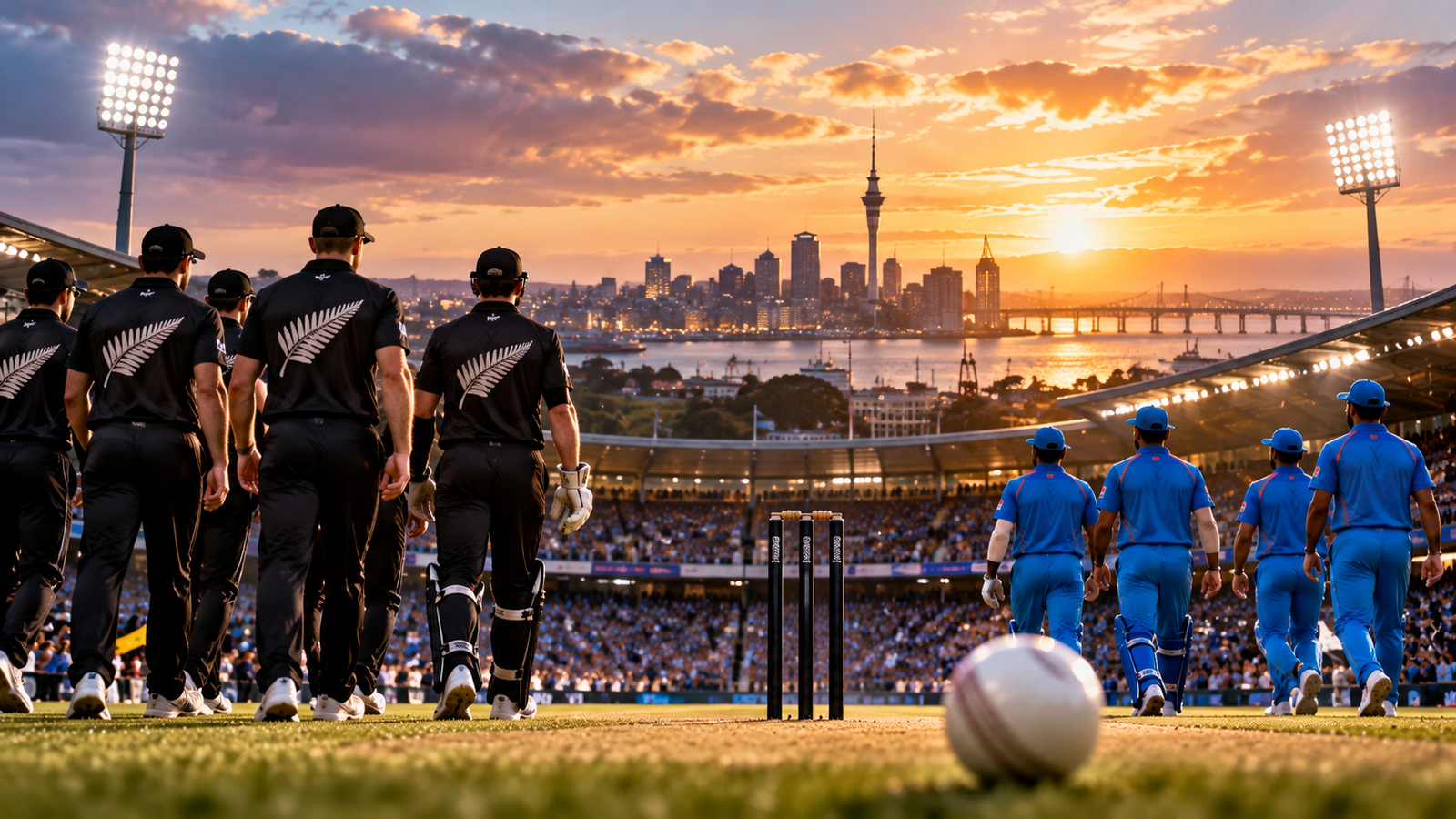
New Zealand have announced separate squads for the opening three and final two one-day internationals against India, with Rachin Ravindra returning from a shoulder injury and Finn Allen, Lockie Ferguson and Tim Seifert set for ODI comebacks. The five-match series begins at Eden Park in Auckland on November 4, 2026, with Mitchell Santner captaining both groups.
New Zealand Cricket announced the selections on October 10, while the International Cricket Council reported them on October 11. The move is designed to balance competition against India with player workload management ahead of the two-Test series that follows the one-day matches.
Ravindra has been selected for the first three ODIs. Allen, Ferguson and Seifert will join for the last two, giving New Zealand different combinations during the five-game contest. The selections also offer valuable opportunities for players hoping to strengthen their cases before the 2027 ICC Men’s Cricket World Cup.
The announcement is a squad selection, not a match result. India’s ODI and Test squads had not yet been announced in the BCCI’s October 6 update, which confirmed only its T20I and India A selections for the tour.
Why New Zealand have picked two ODI squads
The split reflects a packed international schedule. New Zealand and India will contest five T20 internationals, five ODIs and two Tests across October and November. Some players involved in the opening ODIs will move to Test preparation after the third match, while seven others will enter the one-day squad for the concluding fixtures.
Managing workloads is particularly important for players who operate across formats. Fast bowlers must handle different physical demands in limited-overs and Test cricket, while batters and all-rounders may need time to adjust preparation for longer innings and changing conditions. The squad split lets New Zealand preserve options rather than forcing one group to play every fixture.
Head coach Rob Walter has described the series as an important opportunity to assess depth and build toward the next World Cup. The selectors have retained established performers while using the last two ODIs to bring back experienced white-ball specialists.
That approach also means fans should check which group a player belongs to before assuming that a familiar name will appear in a particular match. Inclusion in an announced squad does not guarantee a place in the playing eleven.
Rachin Ravindra returns for opening ODIs
Rachin Ravindra’s availability is a prominent boost. The left-handed all-rounder was ruled out of the earlier T20 series against India because of a shoulder injury. New Zealand’s latest selection indicates that he is expected to be available for the opening ODI segment, subject to normal match readiness assessments.
Ravindra offers flexibility through top-order batting and spin bowling. In 50-over cricket, that combination allows New Zealand to adjust their balance between specialist batters, seamers and spin options depending on the pitch and opposition.
His return could be especially valuable against India, whose batting strength and bowling variety often reward teams that can change tempo throughout an innings. New Zealand will nevertheless need to determine his final role according to conditions and the makeup of each playing eleven.
He is named only in the first squad, not across all five ODIs. That distinction is central to the selection announcement and should not be overlooked when discussing his return.
Finn Allen, Lockie Ferguson and Tim Seifert recalled
Finn Allen and Lockie Ferguson last appeared in ODIs in 2023, according to New Zealand Cricket. Ferguson’s previous appearance in the format came in the World Cup semifinal against India in Mumbai. Their inclusion for the final two games creates a chance for both players to re-establish themselves in the 50-over side.
Allen is known for aggressive batting at the top of the order. His inclusion can provide an alternative to a more measured opening approach, though selectors will decide the combination based on match circumstances and current form. In one-day cricket, an attacking start can change the powerplay but also increases the risk of early wickets.
Ferguson provides experience and pace. Fast bowling resources remain important in New Zealand conditions, where movement with the new ball and changing weather can alter tactics. His return broadens the team’s bowling options without guaranteeing that he will feature in both matches.
Tim Seifert, whose previous ODI appearance was against Pakistan about 18 months earlier, is also included in the final segment. His selection adds another wicketkeeping and batting option alongside other members of that squad.
Who is in New Zealand’s first three ODI squad?
For ODIs one through three, the ICC lists Mitchell Santner as captain alongside Michael Bracewell, Mark Chapman, Devon Conway, Jacob Duffy, Matt Henry, Kyle Jamieson, Tom Latham, Daryl Mitchell, Glenn Phillips, Rachin Ravindra, Nathan Smith, Blair Tickner and Will Young.
That selection combines established batting experience, wicketkeeping cover, all-round options and a varied pace attack. Santner’s captaincy provides continuity, while Conway, Latham, Mitchell and Young offer different batting roles. Henry, Jamieson, Duffy, Smith and Tickner give the selectors options to suit conditions.
The first squad also provides a transition toward Test preparation. Players required for the longer format can leave after the third ODI without interrupting the series because replacements have already been named.
Who is in New Zealand’s final two ODI squad?
For ODIs four and five, New Zealand have listed Mitchell Santner as captain, Finn Allen, Michael Bracewell, Mark Chapman, Kristian Clarke, Jacob Duffy, Matt Fisher, Lockie Ferguson, Mitch Hay, Nick Kelly, Tim Seifert, Blair Tickner and Will Young.
The changes bring in Allen, Ferguson and Seifert as well as players who can gain experience in a high-profile series. The smaller second group differs substantially from the opening squad, which makes the selectors’ workload-management priorities especially clear.
The continuity between both groups comes through Santner, Bracewell, Chapman, Duffy, Tickner and Young. Their presence may help maintain tactical consistency even as several players move away to prepare for Test cricket.
India tour schedule and timing
The India tour begins with a five-match T20I series. The BCCI’s official schedule puts the opening T20 international in Christchurch on October 22, followed by another in Christchurch on October 24, Wellington on October 27, Auckland on October 30 and Hamilton on November 1.
The five-match ODI series is scheduled to begin on November 4 at Auckland’s Eden Park, according to New Zealand Cricket and the ICC. Two Test matches are also part of the wider tour. Readers should consult official board updates for venue and scheduling changes rather than relying on unverified social posts.
India had already announced a T20I squad led by Shreyas Iyer, with Tilak Varma named vice-captain, in its October 6 media release. The governing body explicitly said ODI and Test selections would be announced later. It would therefore be inaccurate to present an India ODI team as confirmed on the basis of the T20I list.
Why the series matters before the 2027 World Cup
The 2027 Men’s Cricket World Cup gives teams a major long-term selection target. New Zealand must identify combinations capable of scoring consistently, taking wickets in the middle overs and adapting to different conditions. A five-match series against a strong opponent provides competitive evidence that training sessions alone cannot offer.
The structure of the two squads means the coaching staff can assess more than one combination. Performances from returning players and less-established selections may influence future selection decisions, but no single match should determine an entire World Cup plan.
New Zealand also enter the series after a notable ODI achievement. The Black Caps won a bilateral ODI series in India 2–1 in January 2026, a result highlighted by New Zealand Cricket in announcing the squads. That history adds context to the rivalry, though it does not predict the result of the new home series.
For India, overseas white-ball matches offer an opportunity to assess adaptability to New Zealand conditions. India will have its own preparation priorities, and the final ODI selections will become clearer once the BCCI makes its formal announcement.
What the squad announcement means for cricket fans
The biggest immediate takeaway is that the player list changes after the third ODI. Anyone following Ravindra, Allen, Ferguson or Seifert should pay attention to their assigned matches rather than assuming availability across the full series.
The second takeaway is that the tour spans all three international formats. Players can be rested, moved into Test preparations or selected for specific white-ball roles. Such decisions are not necessarily signs of poor performance or injury.
For South Asian fans, the India-New Zealand fixture has broad appeal due to the teams’ recent high-profile meetings. There is no direct Pakistan team involvement in this bilateral series, although the selection of Seifert and the earlier references to Pakistan form part of players’ ODI histories.
What happens next?
New Zealand will prepare first for the T20I fixtures starting October 22. The ODI leg then opens November 4 with a reshaped squad strategy, followed by Test preparation and the longer-format series. Team management will confirm playing elevens closer to each match.
India’s ODI and Test squads remain a key upcoming announcement. Injury updates and any late replacements could also change availability. For now, the confirmed story is New Zealand’s split selection, Ravindra’s return and the planned comebacks of Allen, Ferguson and Seifert.
Frequently Asked Questions
Who will captain New Zealand against India in the 2026 ODI series?
Mitchell Santner is named captain in both New Zealand squads for the five-match ODI series.
When does the New Zealand vs India ODI series start?
The five-match ODI series is scheduled to begin on November 4, 2026, at Eden Park in Auckland.
Is Rachin Ravindra back in New Zealand’s ODI squad?
Yes. Ravindra has been selected for the first three ODIs after recovering from a shoulder injury that kept him out of the preceding T20I series.
Which New Zealand players are returning for the final two ODIs?
Finn Allen, Lockie Ferguson and Tim Seifert are among the notable returning players named for ODIs four and five.
Why did New Zealand announce separate squads?
The selectors are managing workloads before the subsequent Test matches and using the series to assess the depth of the ODI player pool.
Has India announced its ODI squad for this tour?
The BCCI’s October 6 announcement confirmed the T20I and India A squads, saying the ODI and Test squads would be announced later.
How many matches are in India’s tour of New Zealand?
The tour includes five T20 internationals, five one-day internationals and two Test matches.
Why is the 2026 ODI series important for New Zealand?
It offers competitive preparation and squad evaluation ahead of the 2027 ICC Men’s Cricket World Cup.
About The Author