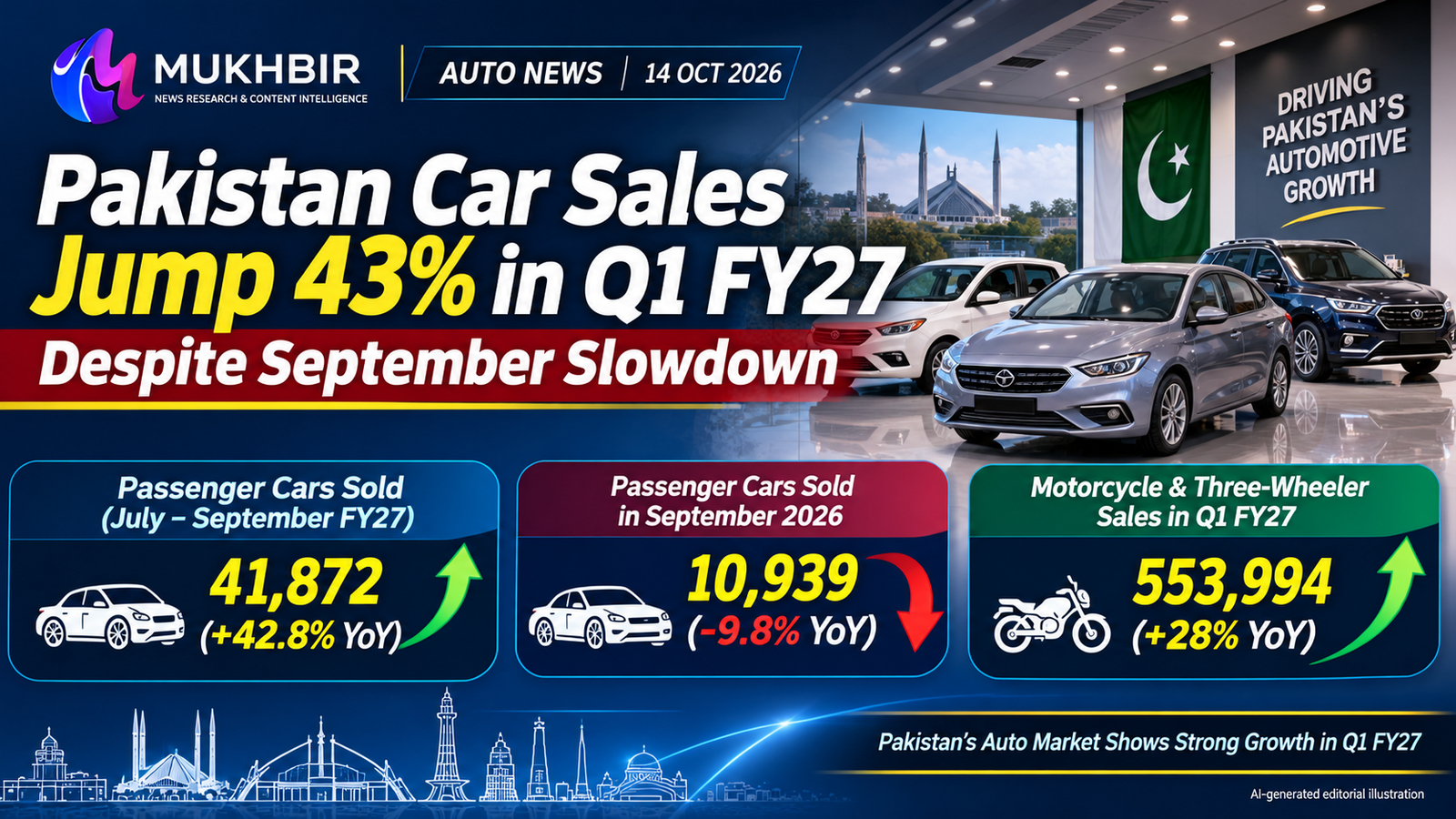
KARACHI, October 14, 2026 – Pakistan’s passenger-car market recorded a strong year-on-year recovery during the first quarter of fiscal year 2026–27, although September brought a decline in sales. The Pakistan Automotive Manufacturers Association (PAMA) reported 41,872 passenger cars sold from July through September 2026, up approximately 42.8% from 29,318 a year earlier.
The Pakistan car sales Q1 FY27 increase contrasted sharply with September, when passenger-car deliveries fell to 10,939 units, down 9.8% from September 2025 and 20.3% from August 2026. Figures released by PAMA on October 13 were covered by Business Recorder and PakWheels that day, followed by Dawn and The News on October 14.
The market’s mixed performance reflects improving demand over the quarter, uncertainty over vehicle taxes and policy, and divergent results among manufacturers. Different news reports also use different market definitions: passenger cars alone are not the same as passenger cars plus SUVs, jeeps, pickups and vans.
Quarterly Sales: What the Numbers Show
PAMA’s passenger-car category reached 41,872 sales in July–September FY27, compared with 29,318 in the year-earlier quarter. Mettis Global reported a 42.8% increase based on this category. The combined category of cars, SUVs, pickups and vans was reported by Dawn at 50,480 in the quarter, representing a 19% annual increase.
These figures are not competing estimates of the same set of vehicles. They cover different categories. Mukhbir’s main headline refers specifically to the approximately 43% rise in passenger cars, while the broader figure is provided separately for context.
The available data principally represents PAMA reporting manufacturers, not every vehicle brand or independently imported car sold in Pakistan. Manufacturers such as some non-member Chinese brands may not appear in those totals.
Why September Car Sales Fell
September passenger-car sales were 10,939, compared with 12,126 one year earlier and 13,717 in August. This represents a 9.8% annual decline and a 20.3% monthly reduction, according to PAMA figures reported by Mettis Global.
Demand did not fall equally across brands. Toyota’s Corolla, Yaris and Corolla Cross group performed better, while popular Suzuki models experienced lower monthly sales. Industry analysts highlighted uncertainty about hybrid and plug-in hybrid sales-tax treatment and delayed invoicing as factors affecting the broader automotive market.
The one-month fall should not be described as a collapse of the entire quarter, because July and August sales were sufficiently strong to keep the three-month total well above last year.
Toyota Sales Show Relative Strength
Indus Motor Company sold 4,142 vehicles in September across its reported model lines, a 31% increase from a year earlier and approximately 3% higher than August, Dawn reported. Corolla, Yaris and Corolla Cross together contributed 3,563 sales, rising 34% year on year.
Fortuner and IMV models contributed 579 deliveries during September. Indus Motor’s first-quarter volume reached 13,260 units, up around 34% year on year according to the cited report.
Toyota’s strong figures indicate a better performance than many competitors during the period. Nevertheless, these numbers alone do not establish a future market-share trend or predict how October sales will develop.
Suzuki’s September Drop Despite Quarterly Gains
Pakistan Suzuki Motor Company reported 4,862 vehicles sold in September across the models counted by Dawn, down 46% year on year and 36% month on month. The Alto recorded 3,354 sales, a 29% annual fall.
The Cultus recorded 138 sales, reflecting a much steeper annual decline of around 68%. Other models also faced softer demand, highlighting the uneven nature of September’s results.
Even so, Suzuki’s first-quarter volume increased 14% to 22,615 vehicles, showing why a weak monthly comparison should not be confused with the complete quarter’s performance.
Honda, Hyundai and Other Manufacturers
Honda Atlas Cars reported 2,128 vehicle sales in September, down about 8% year on year and 19% from August, Dawn reported. Combined City and Civic sales reached 2,021, while BR-V and HR-V accounted for 107.
The company’s first-quarter total rose considerably from a year earlier, illustrating that accumulated quarterly growth can coexist with a weak September. Hyundai Nishat, meanwhile, registered 884 September sales and experienced a 35% decline in its first-quarter tally to 2,336.
PAMA also reported Sazgar’s Haval and Tank sales with an unusual August reporting pattern. Some September tabulations include vehicles covering earlier reporting gaps, so month-on-month interpretations for that category require extra caution.
Passenger-Car Production Grew Faster Than Sales
PAMA member companies produced approximately 17,040 passenger cars in September, compared with 10,939 sales. Production increased about 24.7% from September 2025 even as reported sales declined.
A higher production figure than sales in one month can reflect changes in inventories, supply-chain scheduling, invoicing or deliveries. It is not proof, without inventory-level data, that a precise number of unsold cars is available at each dealership.
For the quarter, passenger-car production totaled 47,614, compared with 36,114 a year earlier, representing growth of about 31.8%. That also indicates manufacturing activity improved over the prior-year period.
Motorcycles and Three-Wheelers Hit New Highs
The two- and three-wheeler segment was an especially strong part of the broader automotive picture. PAMA reported 202,502 sales in September, an all-time monthly high and roughly 27% above September 2025.
For July through September, two- and three-wheeler sales rose to 553,994 from 431,542 a year earlier, an increase of approximately 28%. Atlas Honda alone recorded 167,100 motorcycle sales in September, surpassing its earlier record from April 2026.
These numbers should not be incorporated into the 41,872 passenger-car figure. Motorcycles and rickshaws form a separate market segment with different consumer demand, affordability and usage patterns.
Tractors, Trucks and Buses
Tractor sales reached 1,815 units in September, about 130% higher year on year, while the quarter’s volume reached 4,109. Truck and bus sales combined were reported at 933 in September and 2,727 for the three-month period.
These categories reflect different activities, including agricultural purchasing, commercial transport and infrastructure investment. A rise in tractor sales does not necessarily have the same economic explanation as improved passenger-car demand.
The overall picture is therefore a mixed but broadly improving market, with pronounced differences among vehicle types and manufacturers.
Why Automakers Are Waiting for Policy Clarity
PAMA Director-General Razi ur Rahman said improved macroeconomic conditions and easing inflationary pressures had contributed to renewed consumer interest. However, he also warned that both companies and buyers remained hesitant to make investment decisions amid uncertainty surrounding the government’s new auto policy.
Manufacturers need to plan assembly investments, sourcing and product launches over several years. Buyers may delay purchases when vehicle prices or tax treatment appear likely to change. Those behaviors can create temporary fluctuations in invoicing and delivery figures.
The association also raised concerns about imports of fully built-up vehicles and their possible implications for domestic manufacturing and the balance of payments. These are industry positions and risks, not established findings that a specific new policy has already caused economic damage.
Are Hybrids Driving the Recovery?
Hybrid and plug-in hybrid vehicles have become part of the market debate because tax treatment and invoicing policies affect their affordability. PakWheels linked some September model-level strength to improved clarity around hybrid tax treatment, while Dawn’s analyst attributed the broader decline to delayed clarity that had restricted some invoicing.
Those explanations reflect reporting and analyst interpretations, rather than a definitive government evaluation of why every vehicle category rose or fell. Consumer demand also depends on financing, exchange rates, income and competing model launches.
Readers should check current dealership prices and the official tax position before interpreting the sales trend as evidence that hybrid prices will rise or fall next month.
What the Data Means for Consumers
For buyers, the data shows that vehicle availability and popularity can vary significantly between brands and months. Strong quarterly sales do not automatically mean every model is in short supply, and a monthly decline does not guarantee discounts.
Consumers comparing new cars should verify the current official retail price, delivery timetable, warranty, financing terms and any applicable tax changes. A booking contract and written price conditions are more reliable than unconfirmed social-media claims about imminent changes.
PAMA data is best used as evidence of market direction, not as individualized purchasing advice. Vehicle choice depends on use, budget, operating costs and availability of after-sales support.
Implications for Pakistan’s Economy
A stronger auto market can benefit local assembly, component suppliers, distribution, services and associated employment. At the same time, imported inputs and completed vehicles can affect foreign-exchange demand.
The scale of those effects requires separate economic evidence. The 43% passenger-car sales increase is not an estimate of GDP growth, additional employment or government revenue.
A durable recovery will depend on stable policy, competitive pricing, access to financing, consumer confidence and broader economic conditions, not only on a favorable comparison with last year’s first quarter.
What Comes Next for the Auto Industry?
Industry watchers will examine October PAMA data to see whether September weakness was temporary. They will also follow announcements about sales tax treatment, the Auto Policy 2026–31 and imports of used or fully built-up vehicles.
A reliable next update should distinguish passenger cars from SUVs and light commercial vehicles and give the exact date on which each set of sales figures became available.
As of October 14, the main verified development is a 42.8% increase in quarterly passenger-car sales, despite a 9.8% annual fall in September. Motorcycle and three-wheeler demand also reached record levels, while policy uncertainty continues to cloud manufacturers’ decisions.
Frequently Asked Questions
How many passenger cars were sold in Q1 FY27?
PAMA reported 41,872 passenger-car sales in July–September 2026, up about 42.8% from 29,318 in the year-earlier quarter.
How many passenger cars were sold in September 2026?
10,939 units, down 9.8% year on year and 20.3% compared with August.
Why does Dawn report 50,480 vehicles for the quarter?
That figure covers a broader set of categories, including cars, SUVs, pickups and vans, rather than passenger cars alone.
Which Toyota models drove September growth?
Corolla, Yaris and Corolla Cross together contributed 3,563 sales, up approximately 34% year on year.
How did the Suzuki Alto perform?
Alto sales reached 3,354 units in September, approximately 29% below the prior-year month.
What happened to motorcycle sales?
Two- and three-wheeler sales totaled 202,502 in September and 553,994 during the quarter, both strong results.
What is affecting car industry confidence?
PAMA and analysts cited uncertainty over the coming auto policy, tax treatment and investment decisions, despite better underlying demand.
Does PAMA data cover every car brand in Pakistan?
No. Its published member-company data does not necessarily include all importers, assemblers or brands active in the market.
About The Author