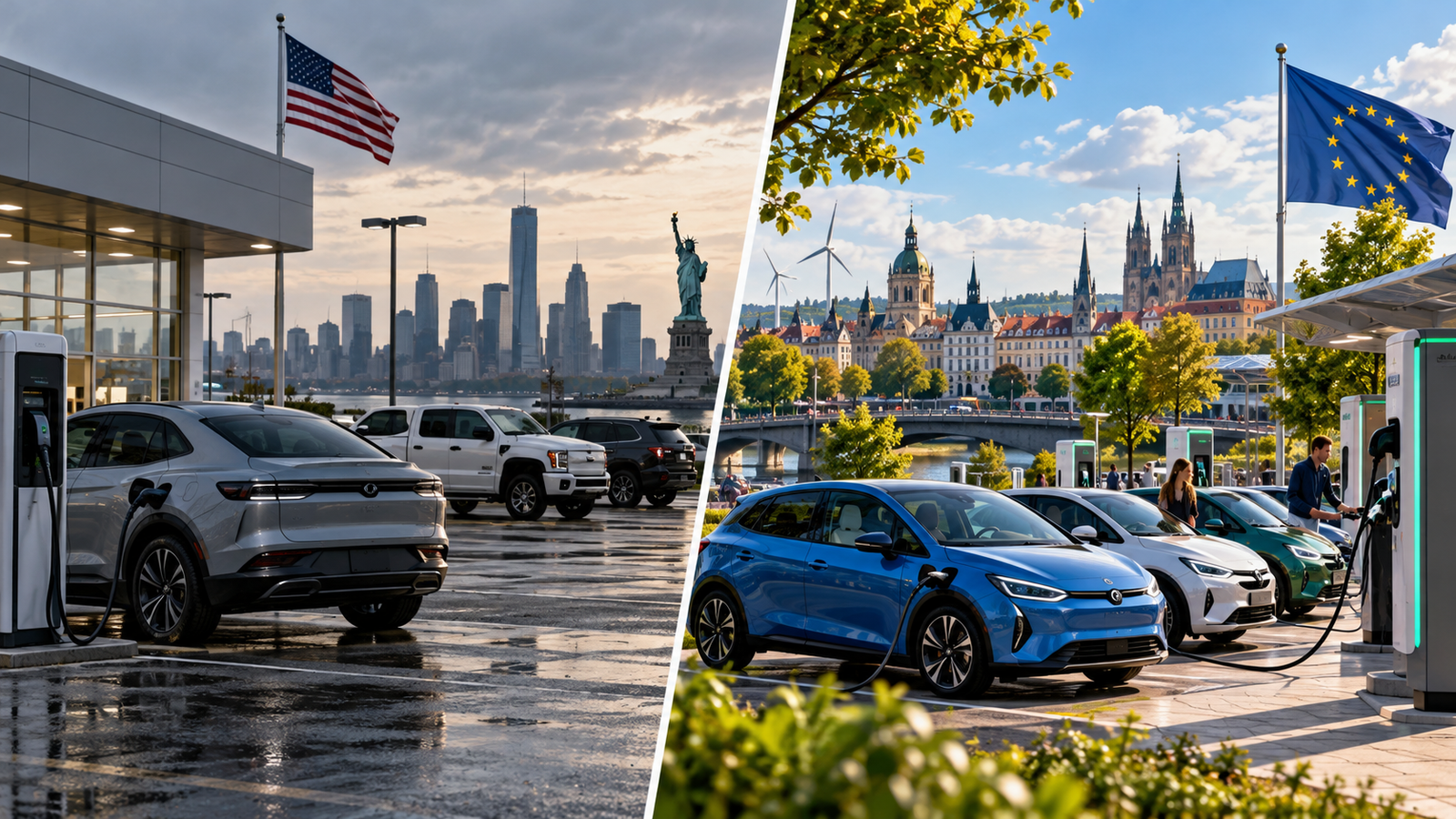
Electric vehicle markets are taking sharply different paths in 2026. New EV demand in the United States has weakened as buyer incentives disappear and automakers reassess investment plans. Across Europe, battery-powered cars are gaining market share, supported by higher fuel costs, policy measures and a growing range of affordable models. The divergence is becoming one of the defining stories of the global auto industry this year.
An October 8 Reuters analysis reported that U.S. electric-vehicle sales had fallen 30.7% year to date, while their share of overall car sales had dropped to around 6%, from 8.5% a year earlier. The same report put Europe’s EV share at 23.2%. These figures illustrate contrasting momentum, although different underlying market definitions and reporting periods mean they should not be treated as perfectly like-for-like measures.
Official data provides a clearer benchmark for the European Union. The European Automobile Manufacturers’ Association (ACEA) reported on September 24 that battery-electric vehicles accounted for 21.7% of new EU car registrations during January–August 2026, up from 15.8% a year earlier. Hybrids were still the EU’s leading powertrain, with 36.6% market share. The figures show that electrification is widening, but consumers are choosing different technologies.
A widening gap in EV adoption
The gap reflects more than a difference in consumer tastes. It reveals how purchase incentives, emissions regulations, energy prices, model selection and financing costs shape adoption. An EV with an attractive total cost of ownership can still be difficult to sell if its initial price is too high or charging feels inconvenient. Conversely, expensive gasoline and a broad choice of small electric cars can accelerate adoption even in a cautious economy.
Reuters linked the U.S. slowdown to the expiration of a federal tax credit of up to $7,500 and to a shift toward less supportive EV policies. It also reported that traditional automakers have scaled back some electric-vehicle programs. That does not mean electrification has stopped in America: hybrid demand has increased, used EV sales have strengthened and individual EV manufacturers have posted divergent results.
In Europe, regulations and market support measures continue to give manufacturers reasons to expand electric offerings. Consumers have more choice at lower price points, including compact models designed for urban use. At the same time, Europe faces its own challenges: charging access is uneven, trade tensions affect imports, and an uncertain economic outlook can still discourage major purchases.
Why the U.S. EV market cooled
Incentives and sticker-price pressure
The loss of a federal purchase incentive can materially change the monthly cost of buying an electric car. Many shoppers compare monthly payments rather than lifetime fuel savings, especially when borrowing costs are high. Without a tax credit, an EV that looked financially competitive may suddenly cost considerably more than a gasoline or hybrid alternative. This effect is especially important for buyers who do not have flexibility in their household budgets.
The U.S. market also favors larger pickups and SUVs. Electrifying a heavy, high-range vehicle may require a more expensive battery, raising the price hurdle. Some drivers can charge conveniently at home, while others depend on public networks whose coverage and reliability vary. Longer-distance travel and towing requirements may increase hesitation among particular customer groups, even though EV technology has improved substantially.
Policy uncertainty changes business strategy
Automakers make platform, factory and battery investment decisions years in advance. When emissions rules, subsidies or trade policies change, companies may delay planned expansions or redirect spending toward powertrains with more predictable near-term demand. That can reduce consumer choice, which in turn affects adoption. The industry’s decision-making loop is therefore closely tied to long-term regulatory certainty.
None of these factors establishes that American drivers have rejected electric cars permanently. Instead, they help explain why demand can be vulnerable when the financial case weakens. Lower vehicle prices, better charging access and additional used EV inventory could still bring new buyers into the market.
Hybrids gain ground as a middle option
Reuters reported that U.S. hybrid sales rose 23% and represented 15.6% of the market. A hybrid offers lower fuel consumption than a comparable conventional gasoline vehicle without requiring regular plug-in charging. For consumers uneasy about full EV ownership, that can be an appealing compromise. Hybrids also allow manufacturers to offer electrified vehicles while responding to immediate customer demand.
Europe’s pattern is different in degree, not completely in kind. ACEA reported hybrid-electric cars were the EU’s biggest powertrain segment in the first eight months of 2026, representing 36.6% of registrations. Battery-electric cars reached 21.7%, while plug-in hybrids held 10%. The combined petrol and diesel share fell to 29%, from 37.5% in the corresponding 2025 period. That shift shows conventional combustion vehicles losing ground even as multiple electrified technologies coexist.
Why Europe is adopting EVs faster
Fuel prices and regulations
Higher fuel prices make potential savings from electric driving more visible. European drivers facing rising petrol and diesel expenses may be more willing to assess a car’s full cost over several years. At the same time, emissions standards and market-support policies encourage manufacturers to supply vehicles capable of meeting stricter environmental targets. The combination can reinforce consumer demand and industrial investment.
More affordable models
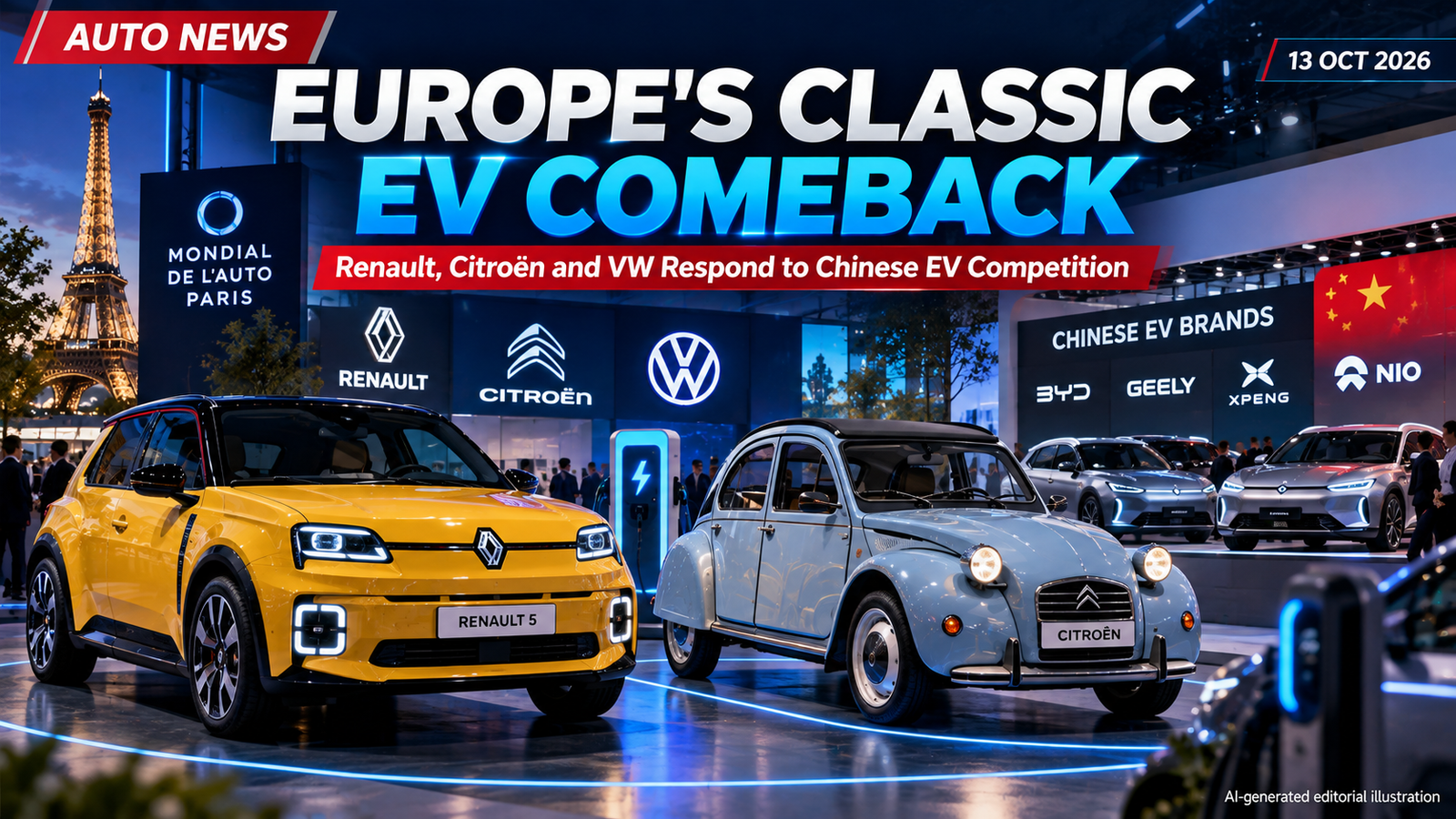
The expansion of affordable electric models is another major driver. Reuters reported growing EV choice in Europe, including a significant contribution from Chinese manufacturers. Competition can pressure established brands to improve value through lower prices, improved equipment and more efficient batteries. Compact EVs are particularly relevant for European city driving, where vehicle size and parking convenience influence buying decisions.
European success should not be exaggerated as a uniform boom across every country. National subsidies, electricity prices, charging networks and household incomes differ. Growth in one market can coexist with slower adoption in another, and future policy adjustments could change the trajectory. Nonetheless, the wider EU registration data supports the conclusion that battery-electric vehicles are gaining share.
Used EV sales reveal a different U.S. story
Although new EV sales have faced pressure, the secondhand market is showing demand. On October 7, Cox Automotive said U.S. used retail EV sales reached approximately 124,000 vehicles in the third quarter of 2026, the highest quarterly total on record and 11.4% above the same period a year earlier. Used EVs still accounted for only about 2.8% of all used retail vehicle sales, leaving room for growth.
The firm also said electric vehicles represented 4.9% of transactions at Manheim wholesale auctions in Q3, compared with 3.9% in the previous quarter. Wholesale EV sales increased 45% from a year earlier. Growing off-lease supply could broaden choice and create lower-priced entry points for buyers previously priced out of the new-car EV market.
These figures qualify any sweeping claim that Americans no longer want EVs. Rather, the market may be dividing between buyers seeking inexpensive electric transport, shoppers choosing hybrids and those able to afford new premium EVs. Used EV growth is worth tracking alongside new registrations to understand the overall transition.
Impact on automakers, batteries and competition
For global automakers, the regional split complicates product strategy. A vehicle optimized for European city buyers may not meet the needs of an American pickup customer. Brands with flexible production and a range of hybrid, plug-in hybrid and battery-electric products may find it easier to adjust to uneven demand. Others face greater risks from unused production capacity or delayed returns on investment.
Battery manufacturers and their suppliers are exposed to these changes. EV production forecasts influence demand for cells, critical minerals, charging equipment and factory machinery. If demand shifts between countries, suppliers may need to redirect orders or adapt investment timelines. Battery technology improvements could eventually narrow the EV price gap, but commercial adoption depends on costs, manufacturing scale and vehicle design, not just technical advances.
Trade policy is a further variable. Chinese companies have expanded their presence in international EV markets, including Europe, while facing tariff and regulatory challenges. European automakers must compete on quality, price and technology while meeting domestic rules. Investors should distinguish announced capacity, actual sales, margins and policy-dependent forecasts rather than assuming every EV-related company will benefit equally.
What it means for Pakistan and South Asia
The American and European experiences offer policy lessons for emerging markets, including Pakistan. Fuel-import exposure makes transport electrification potentially attractive, but consumer affordability and infrastructure are essential. Import duties, financing, electricity availability, home-charging access and after-sales service can determine whether a vehicle is practical for ordinary households.
Pakistan should not be assumed to follow either market’s trajectory. Its income levels, electricity network, vehicle mix and charging needs are distinct. For policymakers and industry participants across South Asia, the takeaway is that a coherent mix of reliable rules, affordable products and charging options matters more than ambitious adoption targets alone. Two- and three-wheelers, buses and commercial fleets may also require different approaches from private passenger cars.
What happens next in 2026 and beyond?
The central question for the U.S. is whether a weaker new-EV market represents a temporary correction or a prolonged shift toward hybrids. Watch vehicle prices, the availability of affordable models, financing conditions, public charging performance and automakers’ revised investment plans. Used EV sales could offer an early indication of demand that is constrained more by price than by the technology itself.
In Europe, watch whether battery-electric market share continues to climb while governments reconsider incentives and automakers navigate competition from Chinese entrants. Consumers will be sensitive to energy prices and charging reliability, while manufacturers must manage production costs and emissions compliance. For the wider auto sector, 2026 is a reminder that the move to electric transport is real but not synchronized across the world.
FAQs
Why are U.S. EV sales slowing in 2026?
A loss of key purchase incentives, affordability concerns, high financing costs and uneven charging convenience have weakened new-EV demand, according to Reuters reporting.
Is Europe selling more EVs than before?
Yes. ACEA reported that battery-electric vehicles reached 21.7% of new EU registrations from January through August 2026, compared with 15.8% in the same period of 2025.
Are U.S. buyers moving to hybrids?
Hybrid demand has strengthened. Reuters reported a 23% rise in U.S. hybrid sales and a 15.6% market share in 2026.
Why are affordable electric cars important in Europe?
Lower-priced models reduce the upfront affordability barrier and expand EV ownership beyond premium buyers, increasing the number of consumers who can consider switching.
Are electric vehicles disappearing from the U.S. market?
No. New EV demand has slowed, but Cox Automotive reported record U.S. used retail EV sales in the third quarter of 2026.
Does Europe have the same EV market share in every country?
No. The EU figure is a regional aggregate. National incentives, energy costs, consumer incomes and infrastructure differ across member states.
What does this mean for carmakers?
Manufacturers may have to adjust pricing, model plans and factory investments by region instead of assuming EV adoption will rise at the same pace everywhere.
Why is this story relevant to Pakistan?
It shows that EV adoption depends on affordability, policy stability and infrastructure. Pakistan can assess these factors against its own energy system and transport needs.
About The Author