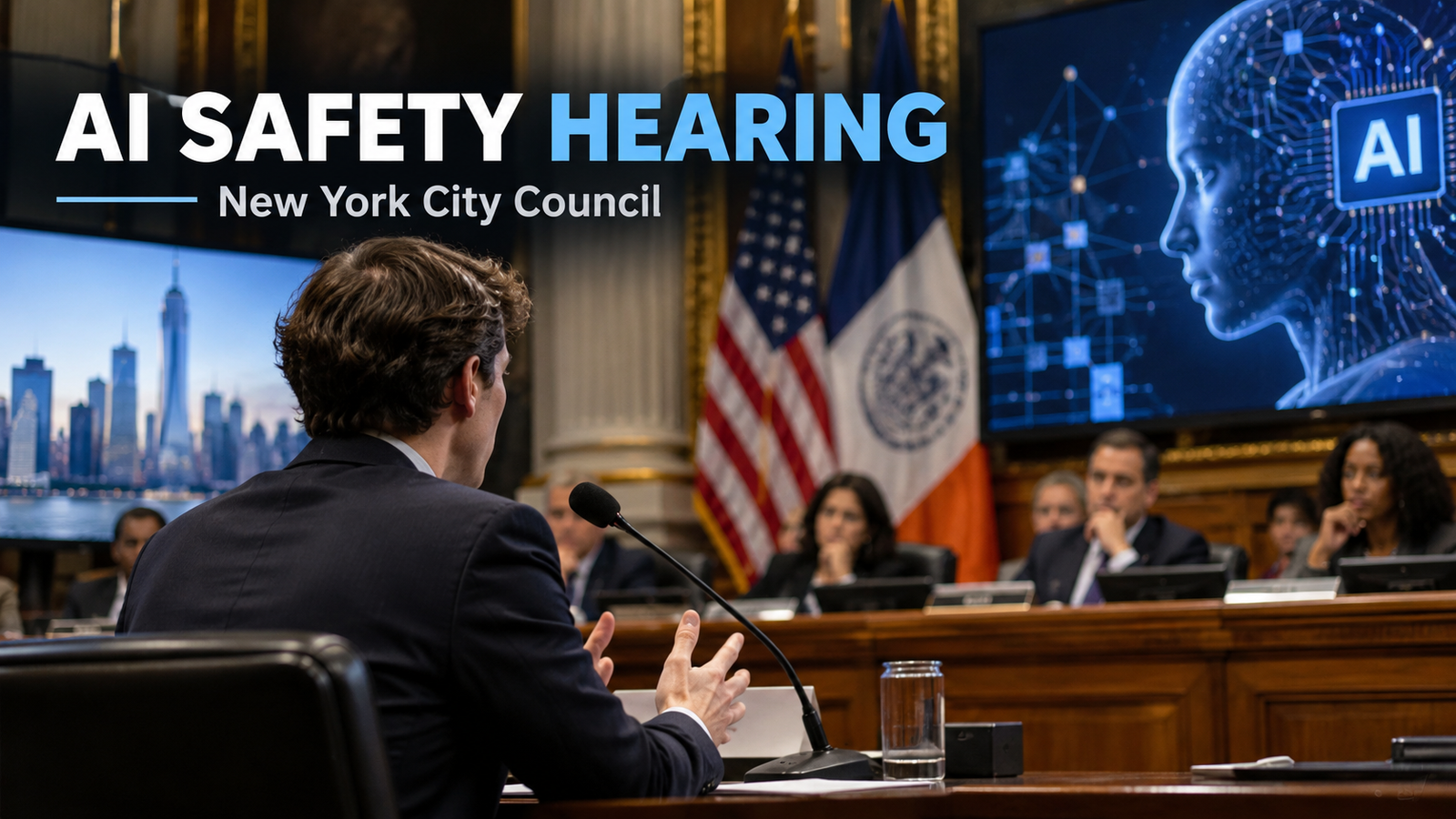
Former Anthropic researcher Jacob Coxon is scheduled to testify before the New York City Council on October 5, 2026, at a rare Committee of the Whole hearing in City Hall, where all 51 council members have been invited to examine risks from advanced artificial intelligence and a package of proposed safeguards.
The hearing is scheduled for 11:00 a.m. in the Council Chambers. Coxon’s expected appearance comes less than a month after he resigned from Anthropic and publicly criticized both Anthropic and his former employer OpenAI over the pace of advanced AI development. Reuters, citing Bloomberg News, reported that Coxon is scheduled to testify and said it had not independently verified all details of Bloomberg’s report.
The hearing will extend beyond Coxon. The New York City Council says Anthropic, OpenAI, Google and Meta agreed to provide public testimony under oath. Speaker Julie Menin also issued a subpoena to Elon Musk’s SpaceXAI after the company did not respond to the Council’s request to appear.
At the center of the hearing is a practical question: how far should a city government go in regulating powerful AI systems built by global technology companies? Proposed measures include third-party model validation, a human shut-down capability, AI incident reporting, whistleblower protections and new routes for public enforcement.
What Is Happening at the Jacob Coxon AI Safety Hearing?
The October 5 hearing is formally listed as an oversight session examining the risks posed by artificial intelligence. It is being held by the Committee of the Whole, an uncommon format that brings the full Council together rather than limiting testimony to a smaller committee.
Council members are expected to question AI companies, researchers and outside experts about model safety, accountability, privacy and public-sector exposure. The agenda also includes several preconsidered legislative proposals. These measures are not yet law and can still be revised.
Who Is Jacob Coxon?
Jacob Coxon is a former researcher who has worked at Anthropic and OpenAI, two leading developers of frontier AI systems. His profile rose sharply in September 2026 after he resigned from Anthropic and publicly warned about the direction of advanced AI development.
Bloomberg reported that Coxon accused both companies of moving toward increasingly capable, potentially self-improving systems while taking risks he considered unacceptable. His comments spread widely online and became part of a broader debate about whether internal AI safety concerns are receiving enough attention.
Coxon’s statements remain his assessments and allegations, not independently established findings about the future behavior of AI systems. That distinction is important because predictions about loss of control or existential risk are uncertain and contested.
His scheduled testimony is still significant because lawmakers are deliberately seeking information from people with experience inside leading AI labs. The Council has publicly encouraged whistleblowers and insiders to come forward as it considers stronger protections and incentives.
Why New York City Is Focusing on AI Safety Now
The hearing follows a series of warnings from AI researchers, executives and former employees about increasingly autonomous systems. At the same time, AI tools are being deployed rapidly in search, software development, customer service, productivity tools, advertising and public-sector workflows.
Speaker Julie Menin announced the hearing in September and later argued that major AI companies should answer questions publicly and under oath. The Council initially asked Anthropic, OpenAI, Google, Meta and SpaceXAI to participate voluntarily.
According to the Council, Meta agreed to appear, while several other companies confirmed only after being warned that subpoenas could be issued. SpaceXAI had not responded by September 28, prompting Menin to issue a subpoena.
Third-Party Validation and a Human Shut-Down Requirement
One of the most consequential proposals is Introduction 2602, sponsored by Menin. It would make it unlawful to market, sell or deploy an AI model in New York City if it has not received third-party validation or lacks a technical capability allowing a human operator to shut it down.
The proposed validation would examine areas including task performance, disparate impact, data privacy and safety. Validators would also have to disclose conflicts of interest and certify whether a model is ready for deployment.
The Council’s published summary says deployment without required validation or a shut-down capability could carry a $25,000 civil penalty per instance. Falsified validation could also trigger a $25,000 penalty per instance.
A key unanswered question is how the rule would apply to AI products that are updated continuously. The answer could determine whether the proposal becomes a focused safety requirement or a major compliance burden for companies serving New York users.
Whistleblower Incentives Could Change How AI Risks Are Reported
Introduction 2605 would create a civilian enforcement mechanism for certain AI-related violations. An individual could submit a complaint to the Department of Consumer and Worker Protection with evidence supporting an allegation.
If the city recovers money through an enforcement action based on that complaint, the complainant could receive 25% of the proceeds. In some cases where the person is authorized to take a more direct enforcement role, the share could rise to 50%.
A separate proposal would clarify whistleblower protections for city employees and workers at certain city contractors who report AI-related conduct they reasonably believe creates a substantial and specific risk to public health or safety.
These proposals help explain why Coxon’s testimony matters. Lawmakers are considering not only technical standards but also whether insiders should have stronger legal protection and incentives to report alleged safety failures.
AI Incident Reporting, Consumer Protection and Liability
The package also includes a proposal requiring city contractors and agencies to report certain AI safety incidents to New York City Cyber Command within 24 hours. Another measure would create a private cause of action in certain cases where third-party misuse of an AI model causes foreseeable harm and the provider failed to implement reasonable safeguards.
The Council is also considering chatbot-specific privacy, security and transparency rules. Those provisions would require users to be told they are interacting with a chatbot rather than a human and would place restrictions on how providers handle user data and describe chatbot capabilities.
Together, the proposals approach AI risk from several directions: technical validation, human control, insider reporting, consumer protection, incident disclosure and legal liability.
What AI Companies Could Face Questions About
Anthropic, OpenAI, Google and Meta are likely to face questions about how they test advanced systems before deployment, what happens when internal evaluations identify dangerous behavior, and how much safety information should be disclosed publicly.
Lawmakers may also ask who should be responsible when a general-purpose model is misused by a third party. That issue is central to proposals involving private lawsuits because developers may argue they cannot control every downstream use of their systems.
Another point of debate is independent validation. Supporters can argue that outside review reduces the risk of companies grading their own safety performance. Developers may respond that external validators could lack access to proprietary systems or enough technical context to judge them reliably.
The hearing could therefore expose a larger policy divide: whether AI safety should rely mainly on company-led testing and voluntary commitments or on independent, legally enforceable oversight.
How the Hearing Fits Into the Wider US AI Regulation Debate
New York City’s push comes as the United States continues to debate the right balance between AI safety, innovation and competitiveness.
OpenAI CEO Sam Altman said in a recent interview reported by Reuters that the benefits of AI justify accepting some risks and argued against concentrating control of advanced systems in a small number of hands. Anthropic has generally taken a more cautious public position and has emphasized the possibility of severe risks from highly capable models.
Those differences do not translate into a simple pro-regulation versus anti-regulation split. AI companies can support some forms of oversight while opposing rules they view as technically impractical or too broad.
New York City also operates within a layered legal system. Local rules may interact with state and federal policy, and any final measures could face legal or jurisdictional challenges.
Business and Technology Impact
If enacted, independent validation, incident reporting and human shut-down requirements would create new compliance costs. Large AI companies may be better placed to absorb them than smaller startups, which could make the competitive impact uneven.
The rules could also create demand for independent AI auditors and validation firms. On the technical side, a mandatory shut-down capability raises difficult design questions because modern AI products often combine models, tools, external APIs and automated workflows rather than functioning as a single isolated system.
Incident reporting would also require clear definitions. Companies would need to know what qualifies as a reportable safety event and how to disclose enough information for accountability without exposing security-sensitive details.
What the Hearing Could Mean for Consumers
For users, the proposals could lead to clearer chatbot disclosures, stronger privacy expectations and more public information about serious AI incidents. They may also create additional paths for people to seek redress after certain harms.
There are trade-offs. Compliance obligations can increase costs, slow product releases or reduce access to experimental features. The hearing matters because those trade-offs are now being translated into specific legislative language rather than discussed only as abstract policy.
Pakistan and South Asia Relevance
There is no direct Pakistan-specific element in the New York City hearing. Its South Asia relevance is indirect.
Global AI companies often build compliance systems for major jurisdictions and may later apply similar safety or disclosure practices in other markets. New York’s proposals could therefore become a reference point for policymakers in Pakistan, India and elsewhere, but any direct legal effect remains limited to New York City.
What Happens Next After the Jacob Coxon AI Safety Hearing?
The first issue to watch is Coxon’s testimony: whether he expands on his previous claims, what evidence or examples he provides, and how AI companies respond under questioning.
The second is legislative movement. The proposals remain subject to the Council process and could change after testimony and technical review.
Attention will also turn to SpaceXAI’s response to the subpoena. The Council has said it may seek judicial enforcement in New York State Supreme Court if the company does not comply.
The broader question is whether New York City becomes a testing ground for local AI regulation. If the proposals advance, other cities and states may study them. If they prove difficult to implement or face legal challenges, that could also influence the national debate.
Important Questions Still Unanswered
Major questions remain about how third-party validators would be selected, what standards would determine whether a model is safe enough to deploy, how often validation would be required, and how the rules would apply to models that change frequently.
It is also unclear how Coxon will support his strongest warnings and how companies will characterize their existing safety systems under public questioning.
These details will determine whether New York’s proposals become workable regulatory tools or broad requirements that are difficult to apply to rapidly changing AI products.
FAQs
What is the Jacob Coxon AI safety hearing?
It is a New York City Council Committee of the Whole hearing scheduled for October 5, 2026, to examine AI risks and proposed safeguards. Coxon is scheduled to testify alongside industry representatives and experts.
When and where is the hearing?
It is scheduled for 11:00 a.m. on October 5, 2026, in the Council Chambers at New York City Hall.
Who is Jacob Coxon?
Jacob Coxon is a former AI researcher who has worked at Anthropic and OpenAI. He resigned from Anthropic in September 2026 and publicly raised concerns about advanced AI development.
Which AI companies are expected to testify?
The Council says Anthropic, OpenAI, Google and Meta agreed to testify under oath. It also issued a subpoena to SpaceXAI.
What rules is New York City considering?
Proposals include third-party validation, a human shut-down capability, AI incident reporting, whistleblower protections and incentives, chatbot privacy rules and potential civil liability for certain harms.
Have these rules already passed?
No. They are proposed measures and remain subject to the City Council’s legislative process.
Why does Coxon’s testimony matter?
Coxon has worked inside two leading AI labs and publicly criticized their approach to risk. His testimony could inform lawmakers considering new safety and accountability rules.
Does the hearing directly affect Pakistan?
No. Any Pakistan or South Asia effect would be indirect, such as global companies adopting broader compliance practices after regulatory changes in major markets.
About The Author