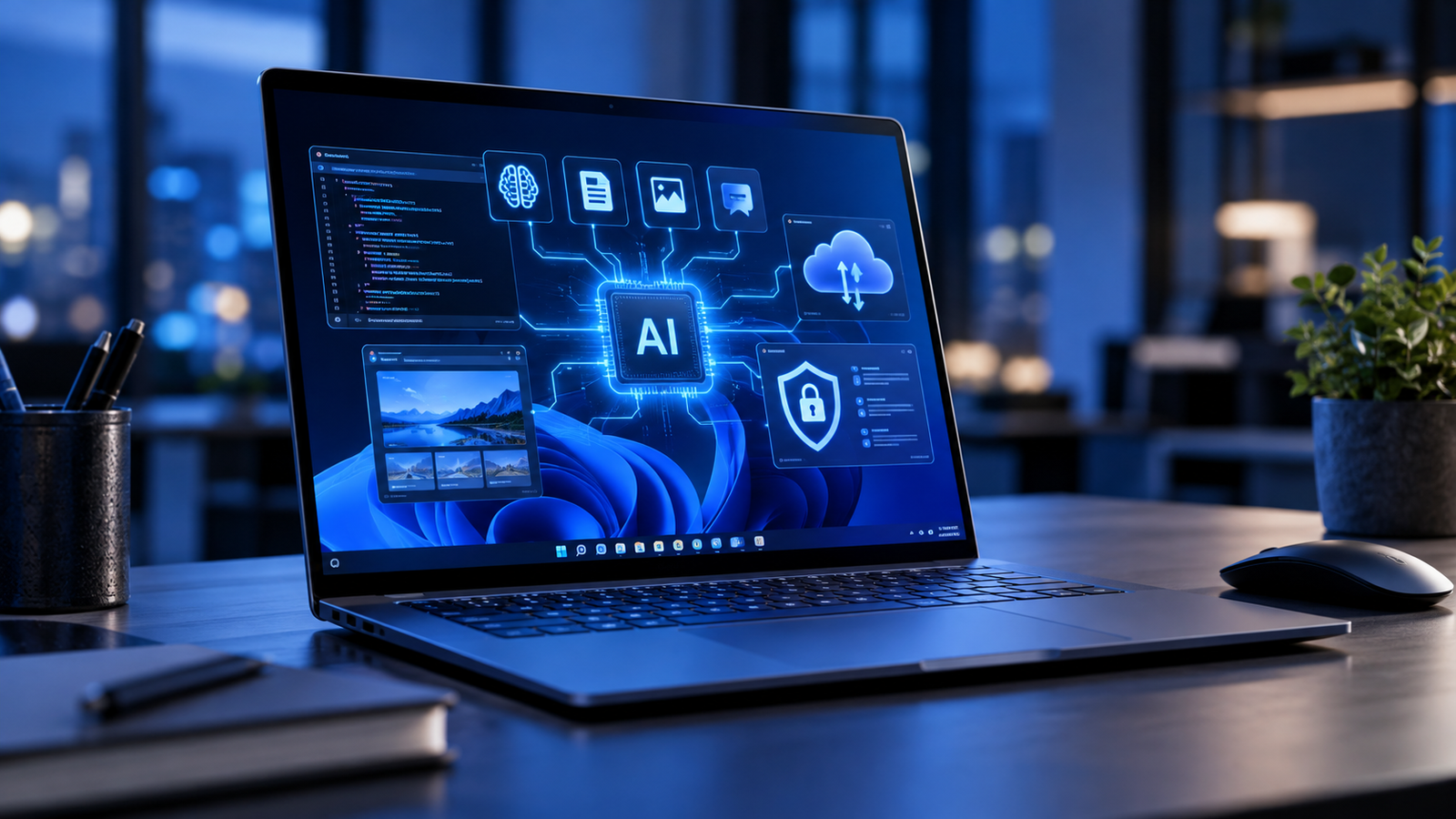
Microsoft has unveiled a broader push to make artificial intelligence run directly on Windows PCs, introducing new hardware, local AI capabilities and security controls aimed at moving more AI work from the cloud onto personal computers. At a San Francisco event on October 7, the company presented what it calls a “hybrid intelligence” approach, where AI tasks can be handled locally on a device when that is faster, cheaper or more private, while other workloads can still be sent to the cloud.
The strategy includes the new Surface Laptop Ultra, powered by Nvidia RTX Spark hardware, as well as Microsoft Execution Containers, or MXC, a security layer designed to isolate AI agents and control what data they can access. Microsoft also said higher-performance Windows systems can now run advanced AI models locally, including models from Nvidia and DeepSeek, while Copilot can route tasks between local and cloud computing depending on the job.
Reuters reported that the announcements are part of Microsoft’s effort to challenge Apple’s growing emphasis on on-device AI while reducing reliance on expensive cloud processing. The company is betting that more powerful PC hardware and tighter operating-system integration can make local AI practical for developers, businesses and advanced users, although price remains a major barrier.
What Microsoft Announced
The central idea is that Windows should become a platform for “hybrid intelligence.” Instead of forcing every AI request through remote data centers, Microsoft wants Windows devices to decide where a task should run. Some jobs may be processed on the PC, while more demanding tasks can still use cloud infrastructure.
Microsoft says this approach can improve responsiveness, help reduce cloud costs and give users more control over sensitive data. For businesses, local processing can also reduce the amount of proprietary information that needs to leave an employee’s device. The company is positioning this as a practical way to bring AI agents into everyday computing without making the cloud the only option.
Surface Laptop Ultra Leads the Hardware Push
One of the biggest hardware announcements was the Surface Laptop Ultra, which Microsoft says is powered by Nvidia RTX Spark technology. The machine is designed for demanding local AI workloads and is intended to sit above mainstream consumer laptops in performance.
Reuters reported that the Surface Laptop Ultra starts at $2,599, putting it firmly in the premium segment. That price underlines one of the biggest questions around local AI: powerful hardware is still expensive, and mass adoption may depend on whether similar capabilities become available on lower-cost devices over time.
For professionals, developers and companies that already spend heavily on cloud AI, the economics may still be attractive. Running certain workloads locally can reduce repeated cloud charges, and organizations may value the privacy benefits enough to justify higher hardware costs.
AI Models Can Run Directly on Windows
Microsoft also demonstrated how advanced AI models can run locally on sufficiently powerful Windows PCs. Reuters said models including Nvidia’s Nemotron and DeepSeek’s V4 can operate on high-end Windows machines, showing how quickly desktop hardware is catching up with workloads that recently required remote servers.
This shift matters because local AI changes the relationship between users and models. Instead of every request traveling to a data center, some prompts, files and workflows can remain on the machine. That can reduce latency and give users more direct control over data, especially in areas such as coding, document analysis, design and enterprise automation.
Microsoft Execution Containers Aim to Secure AI Agents
The rise of AI agents has created a new security problem. Unlike simple chatbots, agents may be allowed to open files, use apps, browse data or take actions on a user’s behalf. Microsoft is addressing that risk with Microsoft Execution Containers, a system designed to isolate agent activity and restrict what agents can access.
The company says MXC is now generally available on Windows. The idea is to make agent actions more controllable and auditable, giving organizations a way to separate AI processes from the rest of the system. Microsoft has said companies including OpenAI and Anthropic are adopting or integrating with these new Windows agent-security tools.
This security layer could become one of the most important parts of Microsoft’s strategy. If AI agents become common on personal computers, businesses will need confidence that an agent cannot freely access sensitive files or perform actions outside its approved scope.
Copilot Moves Toward Hybrid Processing
Microsoft’s Copilot is also being adapted for this hybrid model. The company says Copilot will be able to use local context from a user’s PC, perform certain actions on the device and tap into local models when appropriate. For more complex tasks, it can still use cloud-based AI systems.
That architecture could help Microsoft improve performance while managing compute costs. Cloud AI is powerful but expensive to operate at scale. By shifting some work onto user devices, Microsoft can potentially reduce infrastructure demand while also offering faster experiences for simple tasks.
Why Local AI Matters
Local AI has several potential advantages. The first is speed. A task processed on a laptop does not need to travel to a remote server and back, which can make some interactions feel more immediate. The second is privacy, because sensitive information can remain on the device instead of being uploaded.
The third advantage is cost. Businesses that run large volumes of AI workloads may be able to reduce cloud usage if part of that work moves to local hardware. The fourth is resilience: some AI features may continue to work even when internet access is limited or unavailable.
However, local AI also has limitations. Powerful models require significant computing resources, which can increase device cost, power consumption and heat. Many consumer laptops may not be able to run the largest models efficiently, meaning cloud AI will remain important for more demanding tasks.
Microsoft Versus Apple in the AI PC Race
The announcements also sharpen competition between Microsoft and Apple. Apple has emphasized privacy and on-device intelligence across its ecosystem, while Microsoft is trying to make Windows the leading platform for a wider range of local AI models, developers and hardware partners.
Microsoft’s advantage is the scale and diversity of the Windows ecosystem. PC makers can build machines at many price points and for different use cases. But that diversity can also make the platform more complex, because AI features may behave differently depending on hardware.
Apple, by contrast, controls both hardware and software more tightly. The next phase of the AI PC market may therefore come down to whether Microsoft can use its broader ecosystem to move faster without sacrificing consistency or security.
Business and Technology Impact
For the technology industry, Microsoft’s shift reinforces a broader move toward edge and on-device AI. Chipmakers such as Nvidia, AMD, Intel and Qualcomm all stand to benefit if PCs need more capable processors to run AI locally.
For software companies, the opportunity is equally significant. Developers can build applications that use local models for coding, document processing, creative tools and personal assistants. At the same time, businesses will need new policies for security, access control and data governance as AI agents gain more autonomy.
The economic impact could also extend to cloud providers. If a meaningful share of AI workloads shifts to user devices, cloud demand may grow more slowly in some categories. But the more likely near-term outcome is a hybrid market in which local and cloud AI expand together.
Pakistan and South Asia Relevance
The development is relevant to Pakistan and South Asia because the region has a large and growing base of Windows users, software developers and IT service companies. Local AI could help developers and businesses perform more work on-device, which may be useful in markets where bandwidth costs, latency and data-privacy concerns are important.
The biggest obstacle will be affordability. A premium AI laptop costing more than $2,500 is out of reach for most consumers in Pakistan. Wider regional adoption will therefore depend on whether similar local-AI capabilities appear in mid-range machines over the next few years.
What Happens Next
Microsoft’s next challenge is turning the hybrid-AI concept into a consistent user experience across Windows devices. The company will need to show that local AI delivers clear benefits in speed, privacy and cost without creating new security risks.
Developers will also play a major role. If software makers adopt Microsoft’s local-AI frameworks and agent-security tools, Windows could become a major platform for AI applications that run partly or entirely on-device.
For consumers, the key question is whether these features become available beyond expensive flagship machines. If hardware prices fall and local models become more efficient, the AI PC could move from a premium niche into the mainstream.
FAQs
What is Microsoft’s hybrid intelligence strategy?
It is Microsoft’s approach of combining local AI processing on Windows PCs with cloud AI, allowing tasks to run where they make the most sense.
What is the Surface Laptop Ultra?
It is a new high-end Microsoft Surface laptop designed for demanding AI workloads and powered by Nvidia RTX Spark technology.
How much does the Surface Laptop Ultra cost?
Reuters reported a starting price of $2,599.
What are Microsoft Execution Containers?
They are a Windows security technology designed to isolate AI agents and limit what data and system resources they can access.
Can AI models run directly on Windows PCs?
Yes. Microsoft says sufficiently powerful Windows systems can run advanced AI models locally, including models from Nvidia and DeepSeek.
Why is local AI useful?
It can improve speed, reduce cloud costs, keep more data on-device and allow some AI features to work with less dependence on an internet connection.
What is the biggest challenge for local AI PCs?
Cost is a major barrier because high-performance hardware capable of running advanced models locally remains expensive.
Why does this matter for Pakistan?
Pakistan has a large Windows and developer ecosystem, but widespread adoption will depend on lower-cost AI-capable hardware becoming available.
About The Author