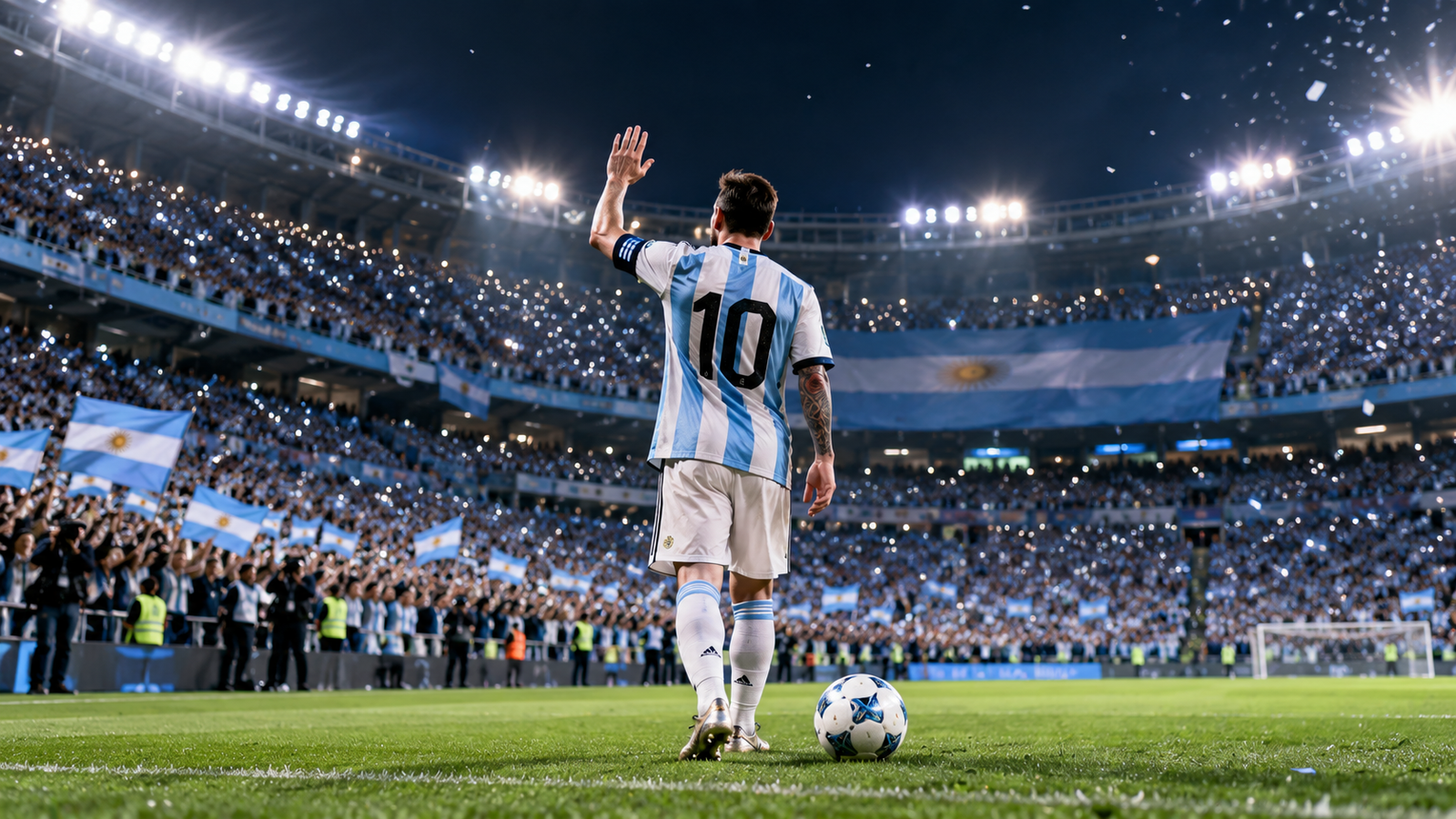
Lionel Messi brought the curtain down on his Argentina international career with a decisive performance in a 3-0 friendly win over Benin at Buenos Aires’ Monumental stadium on October 6, 2026. Reuters reported that the 39-year-old scored once and created two more goals as more than 85,000 supporters packed the stadium for a night built around his farewell. The match was staged as a celebration of Messi’s two decades with the national team, but he still delivered the kind of match-defining contribution that shaped his international career.
Argentina’s football association said the national team ended the international window with a 3-0 victory over Benin, with Nicolas Otamendi opening the scoring, Nicolas Paz adding the second and Messi scoring late to close the night. The AFA described the event as Messi’s final appearance for Argentina in front of the home crowd and said the Monumental was full for the occasion.
The farewell was emotional before the first whistle. Messi was visibly moved during the national anthem, with Argentina coach Lionel Scaloni also emotional on the touchline. His family was present, former World Cup winners attended, and the stadium programme included music, lights, fireworks and a drone show after the match.
The result itself mattered less than the symbolism. Argentina won comfortably, but the bigger story was the end of a 21-year international chapter that carried Messi from a difficult debut to World Cup triumph and national-team immortality.
A Farewell Built Around Football and Emotion
Reuters described the night as a national celebration rather than simply another friendly. Buenos Aires landmarks were lit in Argentina’s colours, fans filled the Monumental and the atmosphere became increasingly emotional as the match approached. Messi’s final appearance came with a sense of closure that had been building for years, especially after he led Argentina to major international trophies late in his career.
The AFA’s official account of the event reflected the same mood. The federation said the stadium followed every moment of the captain’s farewell and that the day was marked by emotion from start to finish. The pre-match anthem became one of the defining images of the night as Messi struggled to contain his tears.
After the match, celebrations continued with a specially prepared show involving drones, lights, pyrotechnics and live music. That combination of football and ceremony turned the fixture into something closer to a public tribute than a conventional international match.
How Argentina Beat Benin 3-0
The first half ended goalless, with Benin resisting Argentina’s pressure and preventing the hosts from converting possession into a breakthrough. Argentina eventually found more space after the interval and began to take control of the match.
Nicolas Otamendi opened the scoring in the second half. The veteran defender’s goal had extra emotional weight because he was also making his final appearance for Argentina. Otamendi later said that scoring in his last match, with Messi involved in the move, was a memory he would carry with him.
Nicolas Paz then doubled the lead as Argentina’s younger generation took a more visible role. The goal was symbolically important in a match that was simultaneously about saying goodbye to one era and preparing for the next. Messi completed the scoring late on, providing the final footballing moment of his Argentina career with a goal in front of the home crowd.
Reuters reported that Messi finished with one goal and two assists, meaning his influence was present across all three Argentina goals. That performance ensured the farewell was not just ceremonial. He remained central to the result.
Why the Match Was More Than a Friendly
For Argentina, Messi’s final match represented the end of the most successful period of his international career. After years of criticism over whether his club brilliance could be reproduced with the national team, he eventually captained Argentina to the Copa America, the Finalissima and the 2022 FIFA World Cup.
The farewell therefore carried a different tone from the frustration that surrounded earlier stages of his international career. By the time he stepped onto the Monumental pitch for the final time, the argument over his national-team legacy had effectively disappeared. He was leaving as the central figure in one of the most celebrated eras in Argentine football.
The timing also gives Argentina a clear transition point. Scaloni now has to build a team without the player who shaped Argentina’s attacking identity for two decades. That is a tactical challenge, but also a psychological one. Several teammates acknowledged after the match that Messi’s absence would be difficult to process.
Scaloni Faces the Challenge of Life After Messi
Argentina coach Lionel Scaloni said after the match that he had never imagined he would coach what he called the best footballer in history. In comments published by the AFA, Scaloni said Messi leaves an “incredible legacy” and admitted that replacing the influence he brought to matches will be impossible on an individual basis.
Scaloni’s most important point was that Argentina will have to compensate collectively. Without Messi, the team loses a player capable of changing a poor match with one moment of brilliance. The coach suggested the only realistic answer is to build a stronger collective in which every player contributes.
That process has already started. Argentina has continued to introduce younger players around an experienced core, and Nicolas Paz’s goal in Messi’s farewell match offered a neat image of the transition. The challenge now is to turn that symbolism into a sustainable post-Messi team.
What Messi’s International Career Leaves Behind
Messi’s Argentina career began in August 2005 and lasted more than two decades. The early years included major tournament defeats and periods of intense scrutiny. At one stage, after the 2016 Copa America final defeat, Messi briefly announced his retirement from international football before returning.
The story changed dramatically in the final years. Argentina won the 2021 Copa America, then the 2022 Finalissima and the 2022 World Cup in Qatar. Those victories transformed Messi’s relationship with the national team and with supporters who had long compared him with Diego Maradona.
His farewell therefore closes not simply a statistical career, but a story of persistence. For much of his international life, Messi’s success with Barcelona stood in contrast to Argentina’s near-misses. By the end, he had become captain of a world champion side and one of the most celebrated figures in the country’s sporting history.
Fans Turn the Monumental Into a National Tribute
The scale of the public response was central to the night. Reuters reported more than 85,000 fans at the Monumental, while the AFA described the stadium as packed. Supporters arrived expecting a football match, but the event was structured around collective recognition of Messi’s career.
Music acts performed before the game, the anthem became an emotional centrepiece, and the celebrations continued well after the final whistle. A drone display, lights and pyrotechnics transformed the stadium after the 3-0 win, creating a visual finale designed around gratitude rather than competition.
That tone matched Messi’s own comments. Reuters reported that he struggled to speak because of the emotion of the occasion and reflected on his late father. The farewell was deeply personal, but it was also shared by an entire football culture that had watched his international career develop over 21 years.
Otamendi Also Says Goodbye
Messi was not the only veteran closing his international career. Nicolas Otamendi also played his final match for Argentina, giving the evening an additional layer of transition. The defender scored Argentina’s opening goal, making his farewell unusually memorable.
Otamendi later said that sharing so many years with Messi had been special and that scoring in his last match was a fitting way to finish. His exit reinforces the scale of the generational change facing Scaloni. Argentina is not simply losing one superstar; it is gradually moving away from the veteran group that defined its most successful recent cycle.
What Comes Next for Argentina
Argentina now enters a new phase in which the team must prove it can remain elite without Messi. The immediate task will be to redistribute creativity, leadership and responsibility across the squad. Players such as Enzo Fernandez, Julian Alvarez, Lautaro Martinez and the emerging younger generation will be expected to carry a larger share of the attacking burden.
Scaloni’s system will likely evolve as well. A team built around Messi’s freedom between midfield and attack may need different mechanisms to create chances. The coach’s comments after the farewell suggest he understands that no direct replacement exists.
For Argentina’s supporters, the transition will also be emotional. Messi’s presence became almost inseparable from the national team for a generation of fans. The first international window without him will therefore feel unfamiliar even if results remain strong.
Global Importance and Social-Media Potential
Messi’s farewell has obvious global reach. Few athletes command the same level of recognition across continents, and his retirement from international football is likely to generate sustained interest across sports media, search platforms and social networks.
The story has especially strong social-media potential because it combines a universally recognised figure, emotional visuals, a final goal, family moments, tears during the anthem and a stadium-wide tribute. These are all elements that translate naturally into short-form video, social graphics and fan discussion.
For South Asia and Pakistan, Messi has a large fan base and major football events involving him routinely generate high engagement despite cricket’s dominance in the region. The farewell is therefore highly relevant to Mukhbir’s global sports coverage and its social audience.
What to Watch Next
The biggest question is how Argentina performs without Messi over the next several international windows. The team remains deep, experienced and well coached, but it is losing the player who served as its primary creative reference point for nearly two decades.
Attention will also remain on Messi’s club career with Inter Miami and his broader role in football after leaving the international stage. His retirement from Argentina does not end his influence on the sport, but it does close the part of his career that carried the greatest emotional significance for his country.
For now, the final image is simple: Messi leaving the Monumental after a 3-0 win, a goal, two assists and a stadium built around saying thank you.
FAQs
What was Lionel Messi’s final match for Argentina?
Messi’s final international appearance came against Benin at the Monumental stadium in Buenos Aires on October 6, 2026.
What was the score in Messi’s farewell match?
Argentina beat Benin 3-0.
Did Messi score in his final Argentina game?
Yes. Messi scored Argentina’s third goal late in the match.
How many assists did Messi provide in the farewell match?
Reuters reported that Messi provided two assists in addition to scoring once.
Who scored Argentina’s other goals?
Nicolas Otamendi opened the scoring and Nicolas Paz added the second goal before Messi completed the 3-0 win.
Where was Messi’s farewell match played?
The match was played at the Monumental stadium in Buenos Aires in front of more than 85,000 fans, according to Reuters.
Did any other Argentina player retire in the same match?
Yes. Veteran defender Nicolas Otamendi also made his final appearance for Argentina and scored the opening goal.
What happens next for Argentina?
Lionel Scaloni must now reshape Argentina’s attack and leadership structure without Messi while continuing to integrate younger players into the national team.
About The Author