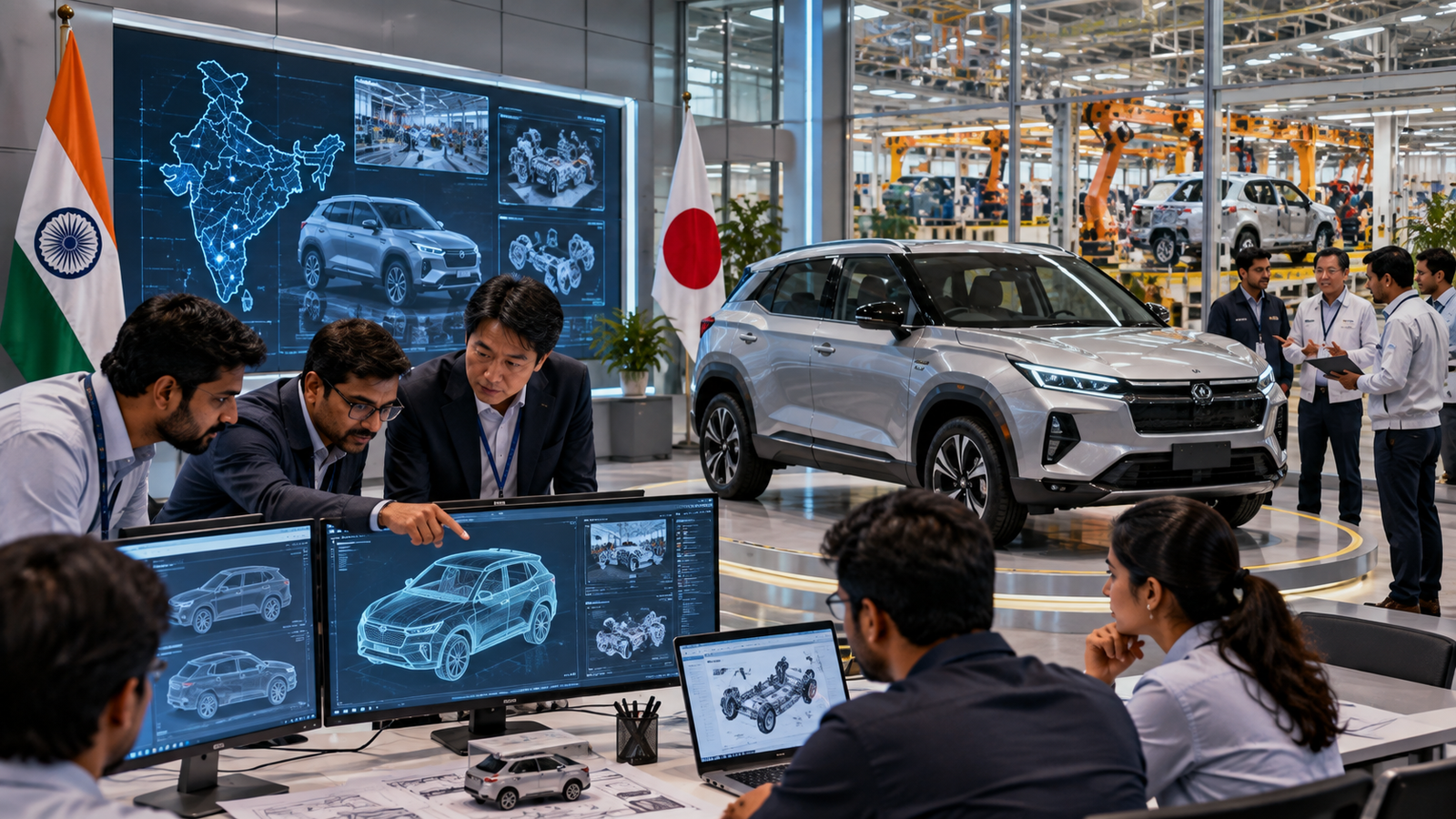
Honda Motor is overhauling its India product-development strategy and working with Tata Technologies on new vehicles for the Indian market, according to Reuters reporting published on October 5, 2026. The Japanese automaker is targeting cost reductions of as much as 20% and wants to cut development time from roughly five years to about half that period.
Reuters identified Honda as the Japanese automaker behind a full-vehicle engineering program that Tata Technologies had previously disclosed without naming its customer. Tata Technologies said earlier in 2026 that it had secured a multi-year, multi-million-dollar full vehicle program with a leading Japanese automotive manufacturer.
The first vehicle being developed under the arrangement is expected to be a sub-4-metre SUV targeted for 2028, Reuters reported, citing people familiar with the plans. A larger mid-size SUV is expected to follow, with Honda also considering ways to rebuild its historic strength in sedans.
Honda has confirmed that it is redefining its India product offering and plans to launch vehicles in the sub-4-metre and mid-size categories from 2028 onward. However, Honda disputed Reuters’ characterization that Japanese and Indian management teams had been in disagreement over supplier selection.
What Is Changing in Honda’s India Strategy?
The central change is a move away from Honda’s traditional approach of relying heavily on internally developed global products and then adapting them for India. Reuters reported that Honda now wants more local engineering, more local sourcing and a faster development cycle tailored to Indian consumer expectations.
Under the arrangement described by Reuters, Tata Technologies will take on significant vehicle-development work for India. Honda is expected to retain control over core areas such as technology, connectivity and driver-assistance systems, while also overseeing quality standards.
The strategy is intended to solve a long-running problem for Honda in India: products designed primarily for other markets can become expensive or poorly matched to local price points once adapted for Indian buyers.
Honda said in a statement cited by Reuters that it had not been able to offer a sufficient product lineup in India that delivered the right value for money. The company said it was redefining its offerings to achieve a better balance between quality and price.
Why Tata Technologies Matters to Honda
Tata Technologies is an engineering and digital-services company with deep experience in automotive product development, embedded software, manufacturing engineering and full-vehicle programs.
In May 2026, Tata Technologies disclosed that it had won a major full-vehicle engineering program with a leading Japanese automotive manufacturer. The company did not identify the customer publicly. Reuters later reported, citing three people familiar with the matter, that the customer was Honda.
Tata Technologies’ own investor materials describe the program as a multi-year, multi-million-dollar engagement and say it strengthens the company’s presence in Asia. Its broader full-vehicle engineering model covers mechanical, electrical, embedded and digital domains.
For Honda, one attraction is Tata Technologies’ access to India’s supplier ecosystem. Reuters reported that Honda managers believed Tata could help identify local suppliers and design vehicles around Indian spending preferences while reducing time to market.
Honda Is Targeting Up to 20% Lower Costs
Reuters reported that Honda expects the partnership to deliver cost reductions of up to 20%. The target has not been announced as a guaranteed saving, and the final result will depend on sourcing, engineering execution and the vehicles that eventually reach production.
Cost is a major issue because India is highly price-sensitive and intensely competitive. Local manufacturers and multinational brands compete across compact SUVs, sedans and increasingly electrified vehicles, often with long feature lists at aggressive price points.
Honda’s challenge is to reduce costs without weakening the reliability, safety and engineering standards associated with its brand. Reuters reported that Honda will continue to oversee the development process and maintain control over major technical areas.
If Honda succeeds, the company could improve pricing flexibility, increase margins or use some of the savings to add features that Indian buyers expect. If the savings fall short, Honda may still face the same value-for-money challenge it has acknowledged publicly.
Development Time Could Be Cut Roughly in Half
The second major target is speed. Reuters reported that Honda wants to halve development times from around five years at present.
That matters because India’s car market is changing quickly. Consumer preferences have shifted strongly toward SUVs, while connected features, advanced driver-assistance systems, hybrid technology and electric vehicles are changing what buyers expect from new models.
A five-year product cycle can leave an automaker responding to trends that have already moved on. A shorter cycle could allow Honda to react more quickly to changes in body style, features, powertrain demand and pricing.
Tata Technologies has positioned its full-vehicle engineering business around faster development and deeper integration across engineering functions. Honda’s use of an external engineering partner therefore represents not just a cost decision, but a change in how quickly the company wants to create India-specific products.
Why Honda Needs a Reset in India
Honda was once a much larger passenger-car player in India. Reuters reported that its market share has fallen to about 1.3% from a peak of 7.3% more than a decade ago.
The company’s current portfolio is small compared with leading competitors, and Honda has had limited presence in the compact SUV categories that account for a large share of Indian demand.
That weakness is especially important because SUVs have become central to the Indian passenger-vehicle market. Competitors including Tata Motors and Mahindra have expanded aggressively with products positioned across different SUV price bands.
Honda still has strong brand recognition in India through models such as the City and Amaze, while the Elevate has given the company a stronger position in the mid-size SUV segment. But Reuters reported that Honda’s overall lineup remains too narrow to compete at the scale it once did.
The First Tata-Developed Honda Is Expected to Be a Small SUV
Reuters reported that the first vehicle under development with Tata Technologies is a small SUV measuring less than four metres in length. It is targeted for launch in 2028.
The sub-4-metre category is particularly important in India because it includes some of the country’s highest-volume vehicles and benefits from tax structures that have historically favoured smaller cars meeting certain dimensional and engine requirements.
Honda already sells the Amaze compact sedan in the sub-4-metre space, but it has limited direct presence in the compact SUV segment compared with rivals.
A successful new compact SUV could therefore fill one of the biggest gaps in Honda’s India lineup. Reuters also reported that a mid-size SUV is expected to follow, with additional sedan activity possible later.
Honda Denies an Internal Supplier Dispute
One of the most sensitive parts of the Reuters report concerns internal decision-making. Two sources told Reuters that Honda’s Japanese and Indian management teams had disagreed over which suppliers should be used for upcoming products.
According to those sources, Japanese managers preferred established suppliers to protect consistency and quality, while the India team wanted greater use of local suppliers to cut costs and speed development.
Honda rejected that characterization. The company said there had not been disagreements between its Japanese and Indian teams over supplier selection. Honda Cars India separately said product development involved close collaboration among teams and that describing those discussions as disagreements was inaccurate.
For editorial accuracy, that distinction is important: the supplier deadlock is a Reuters source-based account that Honda has denied, not a confirmed admission by the company.
How Honda’s EV Losses Fit Into the Strategy
The India overhaul is taking place during a broader period of cost pressure at Honda. Reuters reported that the automaker expects electric-vehicle-related losses to exceed $12 billion and is seeking more than $9 billion in cost reductions over the next four years.
Honda has been shifting emphasis toward gasoline-electric hybrids while reassessing the pace and economics of some battery-electric vehicle investments.
That does not mean the India strategy is simply an EV story. The immediate plan reported by Reuters is about how Honda develops and sources vehicles for the local market. But the global financial pressure increases the importance of making India more efficient.
India is also strategically valuable because it remains one of the world’s largest and fastest-growing car markets, while Chinese electric-vehicle makers face market-access constraints that have limited their expansion there.
What It Could Mean for Indian Car Buyers
For consumers, the strategy could eventually produce Honda vehicles that are designed more closely around Indian price points, road conditions and feature expectations.
More local engineering can also make it easier to tailor cabin space, ground clearance, infotainment, connectivity and powertrain choices to local preferences rather than modifying a product conceived for a different market.
The important word is eventually. The first vehicle reported under the partnership is not expected until 2028, so buyers should not treat the current development targets as specifications or promises for a model already on sale.
Pricing, engines, hybrid options, safety equipment and final feature lists remain unknown and should not be assumed before Honda announces them.
Business Impact for Honda and Tata Technologies
For Honda, the potential upside is straightforward: lower engineering and sourcing costs, faster model launches and a better chance of rebuilding sales volume in India.
For Tata Technologies, the program strengthens its position as an engineering partner capable of handling full-vehicle development for global automakers. The company has been expanding beyond traditional project-based engineering into larger, multi-year programs that give it responsibility across multiple vehicle systems.
The program may also deepen Tata Technologies’ supplier and engineering relationships across Asia. Its own investor materials describe the Japanese OEM win as a meaningful expansion of its regional footprint.
However, commercial success will depend on the actual performance of the resulting vehicles. Engineering efficiency alone will not guarantee market share if pricing, design, dealer reach or customer perception fail to improve.
South Asia Relevance and Pakistan Angle
The story has strong South Asia relevance because India is the region’s largest automotive market and one of the world’s most important centres for low-cost vehicle engineering and component sourcing.
For Pakistan, the impact is indirect. Honda has a long-standing manufacturing and sales presence in Pakistan through Honda Atlas Cars, but Reuters’ report concerns Honda’s India product-development operation and does not say that the Tata Technologies program will be used for Pakistan.
Still, a more competitive India engineering base could matter over time if Honda develops platforms, components or sourcing systems that are later adapted for other markets. That possibility should be treated as a future business scenario, not a confirmed Pakistan plan.
Could India Become an Export Base for Honda?
Reuters reported that Honda sees possible export opportunities if the first Tata Technologies-developed product succeeds on quality, sales and profitability.
That would fit a broader industry pattern in which automakers use India not only as a domestic market but also as an engineering and manufacturing base for emerging markets.
Honda already exports vehicles from India, and Honda Cars India reported exports alongside domestic sales in its 2026 monthly results.
Whether the new 2028 products become major export models will depend on cost competitiveness, production capacity and how well the vehicles match regulations and consumer preferences in overseas markets.
What Happens Next?
The next major milestone is product development for the planned sub-4-metre SUV. Reuters says the model is targeted for 2028, while Honda has separately confirmed that it plans vehicles in the sub-4-metre and mid-size categories from 2028 onward.
Industry attention will also focus on how much localization Honda uses, whether development times actually fall, and whether the company can bring pricing closer to high-volume Indian rivals.
Another question is how Honda balances local engineering with global technology standards. The company is expected to retain control over connectivity, driver-assistance and other key technology areas while Tata Technologies handles substantial engineering work.
The most meaningful test will come when the first new vehicle reaches showrooms. Cost targets and faster development matter internally, but Honda’s India reset will ultimately be judged by product competitiveness, sales and profitability.
Important Questions Still Unanswered
Honda has not publicly confirmed the 20% cost-reduction target or the exact development-time target outside the details reported by Reuters’ unnamed sources.
The companies have also not publicly disclosed the commercial value of the Honda-specific program, the complete engineering scope, or final specifications for the 2028 compact SUV.
It is also unknown how much of the new vehicle will be sourced locally, what powertrains will be offered and whether hybrid technology will play a central role from launch.
Those unanswered questions matter because they will determine whether this is primarily an outsourcing efficiency program or a deeper transformation of Honda’s India business.
FAQs
Is Honda working with Tata Technologies in India?
Reuters reported on October 5, 2026 that Tata Technologies is developing vehicles for Honda’s Indian market. Tata Technologies had earlier disclosed a major full-vehicle program with an unnamed leading Japanese automaker. Honda has confirmed it is redefining its India product strategy, although the companies have not publicly issued a joint announcement naming every detail of the arrangement.
How much does Honda want to cut costs in India?
Reuters reported that Honda is targeting cost reductions of up to 20% under the new development approach. The figure is a target reported from sources familiar with the plan, not a guaranteed saving announced by Honda.
How much faster could Honda develop cars?
According to Reuters, Honda wants to cut development time from roughly five years to about half that period for India-focused vehicles.
What is the first new Honda vehicle under the program?
Reuters reported that the first vehicle is a sub-4-metre SUV targeted for launch in 2028. Honda has confirmed plans to enter the sub-4-metre category from 2028 onward, but final model specifications have not been announced.
Why is Honda changing its India strategy?
Honda’s India market share has fallen sharply from its historical peak, and the company says its product lineup has not delivered enough value for money. It is trying to reduce costs, speed development and create vehicles better matched to Indian buyers.
Did Honda confirm an internal dispute over suppliers?
No. Reuters cited sources who described disagreement between Japanese and Indian managers over supplier strategy, but Honda denied that characterization and said its teams collaborate closely during product development.
Will the new Honda vehicles be sold in Pakistan?
There is no confirmed plan in the Reuters report or Honda’s public statements to bring these India-developed vehicles to Pakistan. Any Pakistan relevance is currently indirect.
Could Honda export the new India-developed vehicles?
Reuters reported that successful quality, sales and profitability could open export opportunities. Honda has not yet announced specific export markets for the planned 2028 vehicles.
About The Author