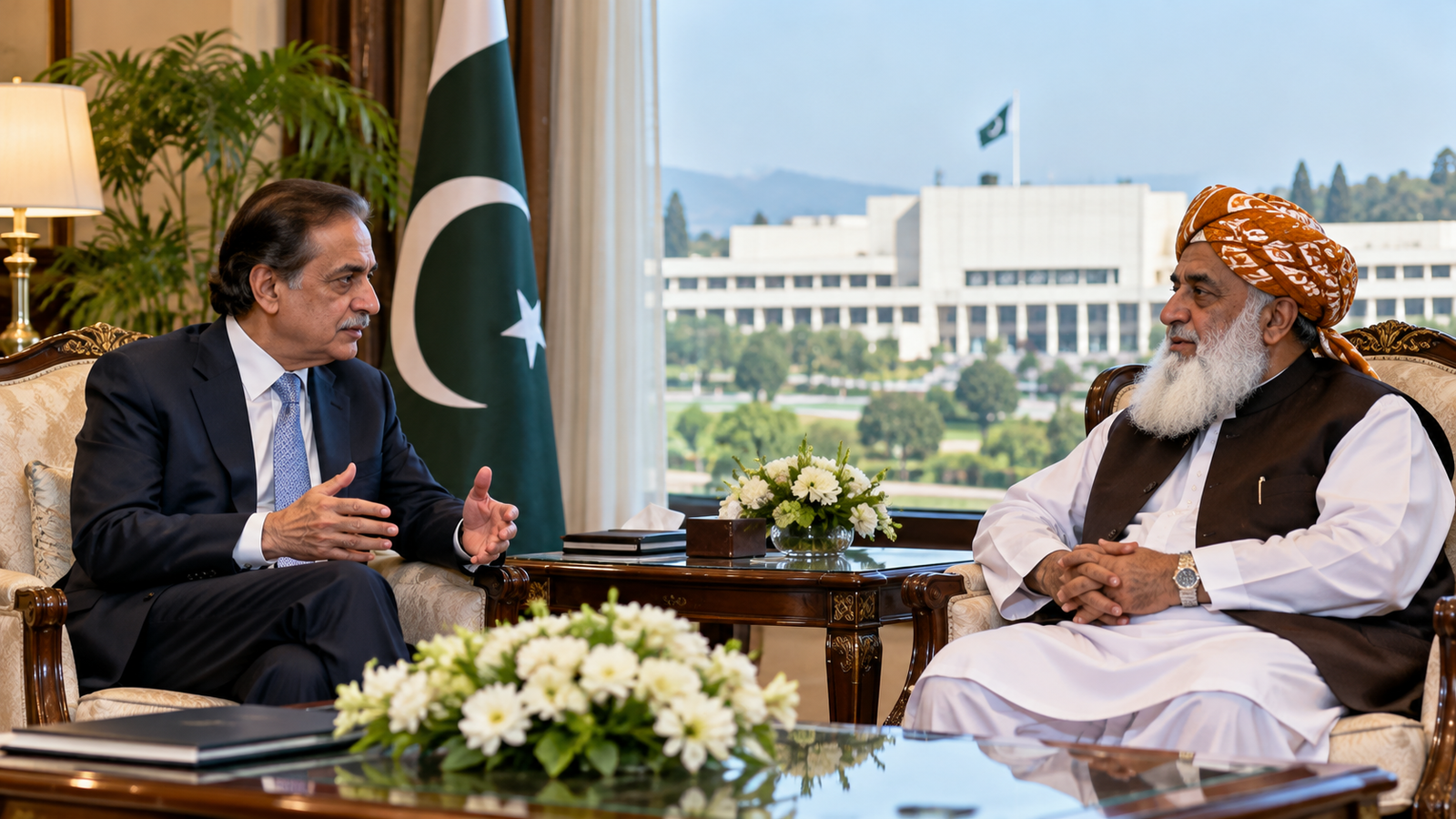
National Assembly Speaker Sardar Ayaz Sadiq met Jamiat Ulema-e-Islam-Fazl chief Maulana Fazlur Rehman in Islamabad as political dialogue efforts continued amid a tense national environment. The meeting was officially described as a courtesy call in which Sadiq congratulated Fazlur Rehman on performing Umrah, but the speaker also told reporters that political contacts, consultations and back-channel discussions were continuing.
The meeting took place on October 7 and was reported by both official and independent Pakistani media. Radio Pakistan said the speaker conveyed his best wishes to Fazlur Rehman and highlighted their longstanding personal relationship. Separately, Dunya News reported that Sadiq said talks and back-channel contacts were under way and expressed hope for political reconciliation.
The development is significant because it places dialogue, parliamentary consultation and political de-escalation at the centre of the current political conversation. Rather than framing the meeting as a confrontation between parties, the public remarks from Sadiq focused on communication, national interest and the possibility of finding a political way forward.
No formal agreement, political settlement or new negotiation framework was announced after the meeting. The available reporting instead points to continuing consultations and informal contacts. That distinction is important because the story is about an ongoing political process rather than a completed deal.
What Happened in the Meeting?
According to Radio Pakistan, Ayaz Sadiq visited Maulana Fazlur Rehman in Islamabad and congratulated him on performing Umrah. The state broadcaster said Sadiq described his relationship with the JUI-F chief as longstanding and above political affiliations.
Independent reporting added a broader political dimension. Dunya News reported that Sadiq, while speaking to journalists after the meeting, said he remained hopeful about political reconciliation and that negotiations, back-channel contacts, phone calls and consultations with members of the National Assembly were continuing.
The Express Tribune also reported that the timing of the meeting drew political attention because it came while government-opposition relations remained difficult. However, the meeting itself was not officially presented as a new round of formal negotiations. The most cautious interpretation is that the speaker used the visit to maintain communication with a senior political figure while wider dialogue efforts continued in parallel.
Ayaz Sadiq’s Message: Dialogue and Reconciliation
Sadiq’s public comments after the meeting placed strong emphasis on hope, reconciliation and continued communication. He said he believed political avenues could still emerge and indicated that he remained engaged with lawmakers through direct conversations and consultations.
This is consistent with the role Sadiq has played in recent political discussions. Earlier in October, government and opposition representatives met at Parliament House under his chairmanship, with the speaker publicly stressing that dialogue was the proper way to resolve political differences. Radio Pakistan reported on October 2 that the first round of talks between government and opposition had taken place in the Speaker’s Chamber, with a second round planned for the following day.
Sadiq’s position is important because the National Assembly speaker can serve as a neutral parliamentary facilitator even when political parties disagree strongly. His office does not replace formal party-to-party negotiations, but it can provide a channel for communication when direct political contact becomes difficult.
Why Maulana Fazlur Rehman Matters in the Political Process
Maulana Fazlur Rehman remains one of Pakistan’s most experienced political leaders and heads JUI-F, a party with a long record of parliamentary participation and coalition politics. His position can matter during periods of political deadlock because he maintains relationships across several political camps.
Sadiq also acknowledged Fazlur Rehman’s political importance in his comments after the meeting. Dunya News reported that the speaker referred to Fazlur Rehman as a brother and said it would be incorrect to suggest that he had been forgotten after the formation of the current government.
The public emphasis on personal and political ties suggests that both leaders see continued contact as useful even when formal political negotiations are difficult. That does not automatically mean JUI-F will support every government position, nor does it mean a broader political settlement is imminent. It does, however, show that channels of communication remain open.
Political Dialogue Remains the Main Story
The most important part of this development is not the courtesy element of the meeting but the broader message that political communication has not stopped. Pakistan has faced repeated periods of confrontation between government and opposition, and the willingness of senior political figures to remain in contact can reduce the risk of complete institutional deadlock.
Dialogue does not guarantee agreement. Political parties may continue to disagree over protests, elections, legal cases, parliamentary procedure, governance and other national issues. But the existence of formal and informal channels gives political actors a way to communicate demands and test possible compromises without relying only on public confrontation.
For readers, it is important to separate confirmed facts from interpretation. The confirmed facts are that Sadiq met Fazlur Rehman, congratulated him on Umrah, discussed political matters, and publicly said talks and back-channel contacts were continuing. Reports that the meeting could contribute to a wider political settlement remain an interpretation of the broader context unless a formal agreement is announced.
Role of Parliament in Political Reconciliation
Parliament can become especially important when political disputes move beyond party offices and into questions of national governance. The National Assembly provides a formal institutional space where government and opposition lawmakers can debate legislation, raise concerns and negotiate procedural matters.
Sadiq’s recent comments reflect that institutional approach. By keeping his office open to members from different political sides, the speaker can help preserve communication even when party leaderships are under pressure from supporters or internal factions.
This does not mean Parliament can resolve every dispute. Some political disagreements involve courts, election bodies, provincial governments or issues outside the legislature’s direct authority. Still, parliamentary dialogue can help reduce misunderstandings and create a record of political engagement.
Why a Neutral Political Angle Matters
Political reporting can become risky when news coverage presents allegations, party claims or speculation as established fact. In this case, the safest and most accurate framing is to focus on what was publicly confirmed: the meeting happened, political affairs were discussed, and Sadiq said dialogue and back-channel contacts were continuing.
There is no need to describe one side as responsible for the wider political deadlock unless such a claim is clearly attributed. Similarly, any report about future negotiations, protest plans or possible political deals should be treated as developing information and verified against official statements before publication.
This neutral approach is also more useful for readers because it explains the political process without turning the story into partisan commentary. For Mukhbir, that means the emphasis should remain on institutions, dialogue, verified statements and what could happen next.
What Could Happen Next?
The next important development would be any formal confirmation of a new round of government-opposition talks or a structured political dialogue process. If such talks are announced, key details would include who is participating, what issues are on the agenda, whether the speaker continues to act as facilitator and whether a timetable is set.
Another point to watch is whether Maulana Fazlur Rehman takes a more active mediation role. Public reporting so far does not confirm that he has been formally appointed as a mediator. However, his meetings with senior government figures and his relationships across the political spectrum mean his position will continue to attract attention.
It will also be important to monitor official statements from the National Assembly, JUI-F, government representatives and opposition parties. Those sources can confirm whether informal contacts are developing into formal negotiations or remain limited to consultations.
Public and Governance Impact
For the public, prolonged political instability can affect confidence in governance, parliamentary productivity and the government’s ability to focus on economic and administrative priorities. A functioning dialogue process does not remove political competition, but it can help reduce uncertainty and keep disputes within constitutional and parliamentary channels.
Business and investor confidence can also be influenced by political stability. Companies and investors generally prefer predictable policymaking and institutional continuity. While this single meeting will not by itself change economic conditions, any broader move toward political de-escalation could improve perceptions of stability if it leads to practical outcomes.
At the same time, the political system must balance dialogue with accountability, legal processes and the right of parties to maintain distinct political positions. Reconciliation is meaningful only when it is based on agreed constitutional and institutional frameworks.
Pakistan Relevance and Public Interest
This is a high-relevance Pakistan political story because it concerns senior national political figures, parliamentary dialogue and the possibility of reducing political tensions through communication rather than confrontation. It also has strong public-interest value because developments in government-opposition relations can influence legislation, governance and national stability.
Its social-media potential is moderate rather than sensational. The strongest angle is not conflict but the possibility of dialogue. That makes it suitable for a factual headline focused on reconciliation efforts rather than a provocative or partisan formulation.
What Remains Unclear?
Several questions remain unanswered. It is not yet clear whether the current back-channel contacts will lead to a formal political agreement, what specific issues are being discussed privately, or whether all major political actors are willing to participate in a structured process.
It is also unclear whether Fazlur Rehman will play a formal role in future talks or whether his meeting with Sadiq will remain part of a broader network of consultations. Until official announcements are made, claims about a political deal or mediation framework should be treated cautiously.
FAQs
Why did Ayaz Sadiq meet Maulana Fazlur Rehman?
The meeting was officially described as a courtesy call in which Sadiq congratulated Fazlur Rehman on performing Umrah. Political matters and wider dialogue efforts were also discussed.
Did the meeting produce a political agreement?
No formal agreement was announced. The available reporting says consultations and back-channel contacts are continuing.
What did Ayaz Sadiq say about political dialogue?
He said he remained hopeful about reconciliation and indicated that negotiations, back-channel contacts and consultations with lawmakers were continuing.
Is Maulana Fazlur Rehman acting as an official mediator?
There is no confirmed public announcement appointing him as a formal mediator. He remains an influential political figure with contacts across different political groups.
Why is the National Assembly speaker involved in political talks?
The speaker can facilitate communication between lawmakers and political groups through Parliament, while maintaining an institutional role above day-to-day party competition.
Are government-opposition talks formally under way?
Recent rounds of political discussions have taken place, and Sadiq says contacts are continuing. However, the scope and status of any new formal round should be confirmed through official announcements.
Why is this story important?
It indicates that political communication remains open and that senior figures are still exploring dialogue as a way to address differences.
What should readers watch next?
Watch for official announcements about new talks, participants, agendas, timelines and whether informal contacts develop into a formal reconciliation process.
About The Author