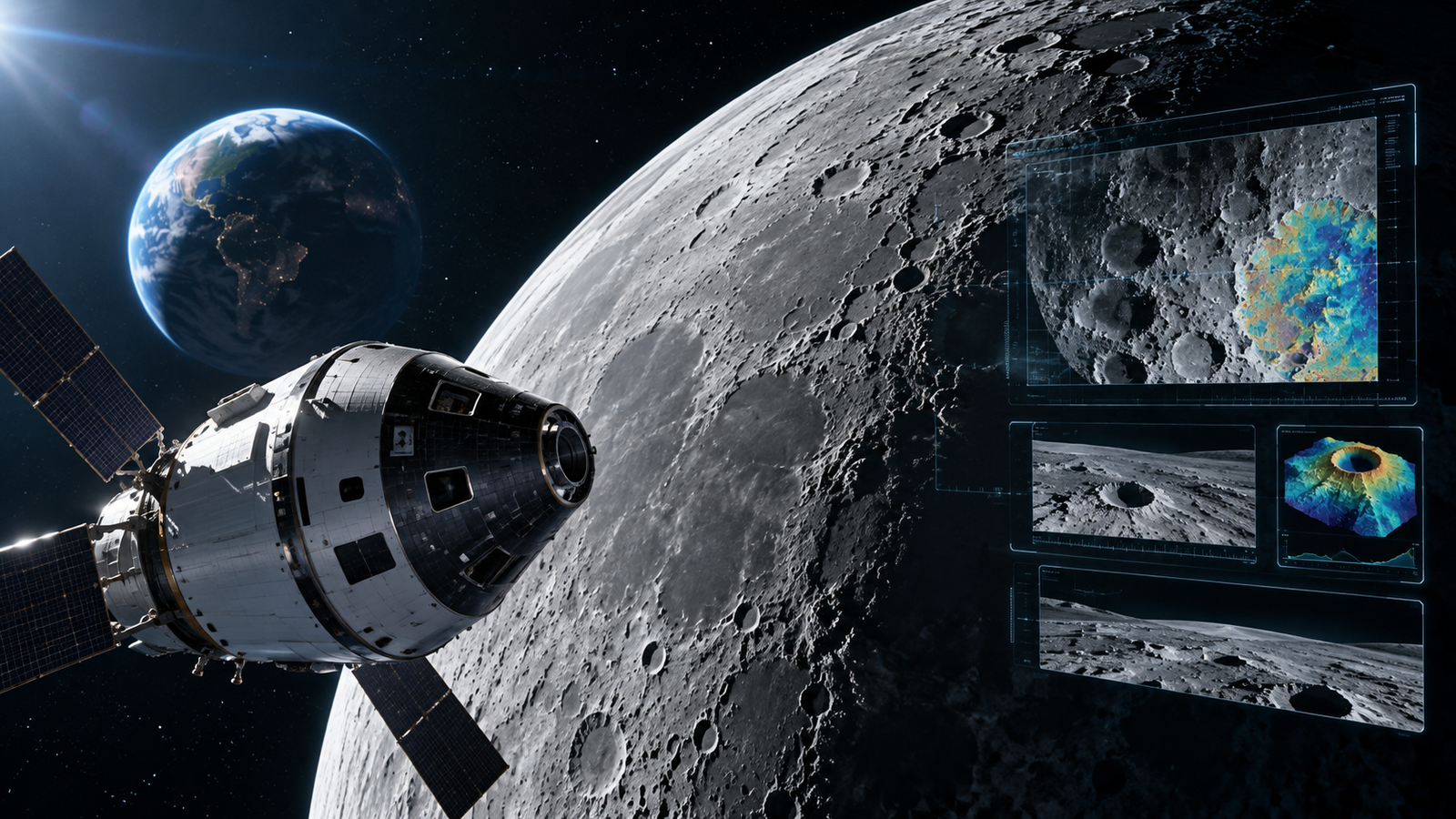
NASA has released more than 800 gigabytes of lunar science data collected during the Artemis II mission, making imagery, audio, crew observations and supporting reports available to researchers and the public. The data comes from the crewed Artemis II journey around the Moon in April 2026 and includes material that had not previously been released.
The agency published the dataset through NASA’s Planetary Data System, its public archive for planetary mission data. Alongside the raw and processed material, NASA released a preliminary lunar science report, a lunar science operations report and a data user guide designed to help researchers understand how the observations were collected and how the dataset can be used.
The release is significant because Artemis II was not a landing mission. Instead, the four-person crew traveled around the Moon aboard Orion, using the flyby to gather scientific observations while testing systems needed for future Artemis missions. NASA says the resulting dataset is already helping inform planning for Artemis III and later missions.
What NASA Released
The new package includes more than 800GB of lunar science data from the mission, including photographs, spoken observations, annotations and supporting documentation. NASA says some of this material had not been made public before the October release.
The agency also released three major documents: the Artemis II Preliminary Lunar Science Report, the Artemis II Lunar Science Operations Report and the Artemis II Data User Guide. Together, they explain the science goals, observation procedures, mission timeline and technical context behind the data.
The release also includes access to crew audio recordings from the lunar flyby. Those recordings capture astronauts describing what they could see through Orion’s windows in real time, offering context that photographs alone cannot provide.
What the Artemis II Crew Observed
During the lunar flyby, the crew documented the Moon through a combination of images, verbal descriptions, drawings and digital annotations. NASA says this created a scientific record shaped not only by spacecraft instruments but also by direct human observation.
One of the most unusual observations involved faint flashes of light seen on the darkened lunar surface. NASA says crew members reported five extremely faint “pinprick” flashes while Orion was about 46,000 miles from the Moon. These flashes were interpreted as likely impacts from rocky fragments striking the lunar surface.
NASA astronauts Reid Wiseman and Victor Glover, together with Canadian Space Agency astronaut Jeremy Hansen, marked some of the suspected impact locations on a visualization using handwritten digital annotations. The annotated image has now been released as part of the science record.
A More Colorful Moon Than Expected
The crew also described subtle differences in lunar color. According to NASA’s preliminary science material, astronauts reported seeing shades of gray, black, brown, tan, white, green and blue across different parts of the Moon.
These observations do not mean the lunar surface is brightly colored in the way Earth landscapes can be. Instead, the subtle color differences may help scientists compare surface materials, lighting conditions and geological features. Human vision can sometimes identify variations that complement data from cameras and other instruments.
The astronauts also observed major lunar features such as impact basins, crater fields and regions near the lunar terminator, where sunlight meets darkness and shadows can reveal topography in dramatic detail.
Why Human Observation Still Matters
Modern lunar science relies heavily on robotic orbiters, cameras, spectroscopy and remote sensing, but Artemis II demonstrated that trained human observers can still add useful context. Astronauts can decide what looks unusual, describe features in real time and adapt their attention as a scene changes.
That flexibility becomes especially valuable during short observation windows. During Artemis II, the crew rotated responsibilities at Orion’s windows while photographing the Moon and providing verbal descriptions. Their notes and recordings now give researchers a second layer of information alongside the imagery.
For future surface missions, this kind of human observation could become even more important. Astronauts working on the Moon will need to identify geological targets, select samples and respond to unexpected features while operating under time constraints.
How the Data Could Help Artemis III
NASA says the newly released information is already helping inform exploration plans for Artemis III and beyond. Artemis III is expected to build on lessons from Artemis II by moving closer to sustained human exploration of the lunar environment.
The data release can support mission planners in several ways. Images and observations can help scientists refine geological priorities, while operations reports can show what worked well during crewed lunar observation. The user guide also gives outside researchers a clearer framework for using the material in independent studies.
By making the dataset public, NASA is extending the scientific value of Artemis II beyond the mission team. Universities, planetary scientists and research groups can now analyze the same core material and potentially identify features or patterns that were not the focus of the initial report.
Why More Than 800GB Matters
The size of the release reflects the scale of modern space science. High-resolution images, audio files, metadata, annotations and technical documentation quickly create large datasets, especially when observations are preserved in forms suitable for long-term scientific use.
More than 800GB does not automatically mean every file contains a major discovery. The value comes from having a broad, well-documented archive that researchers can revisit. Planetary science often benefits from reanalysis years later as new tools, software and research questions emerge.
NASA’s Planetary Data System is designed for exactly that purpose. By placing the Artemis II material there, the agency is treating the mission’s lunar observations as part of a long-term scientific record rather than only as mission-day imagery.
Open Science and Public Access
The release also fits NASA’s broader open-science approach. The agency has made the dataset available not only to professional scientists but also to educators, students and members of the public who want to explore the mission.
Public access can increase the scientific reach of a mission because researchers outside NASA can test new methods, compare Artemis II observations with earlier lunar datasets or use the material for training and education.
The release includes a dedicated image collection and an audio library, making the mission easier to study from different angles. For science communicators and teachers, the combination of visual and spoken observations provides a useful way to explain how astronauts conduct science while in flight.
Scientific Importance Beyond the Moon
Artemis II’s science release is also relevant to the broader question of how humans and machines will work together in deep-space exploration. Future missions to Mars and other destinations will involve large amounts of instrument data, but crews will also need to make judgments locally when communication delays or operational limits make Earth-based decision-making slower.
Artemis therefore serves as a test bed not only for rockets and spacecraft but also for the practical science of exploration. The mission shows how crew observations, digital tools and archival systems can be combined into a research workflow that continues after the spacecraft returns home.
Global Importance
The Artemis II release has global scientific importance because the Moon remains a major target for multiple national and commercial space programmes. Better lunar maps, geological observations and operational lessons can contribute to the wider scientific understanding of the Moon even when the data originate from a U.S.-led mission.
The mission also involved international participation, including Canadian Space Agency astronaut Jeremy Hansen. That reflects the broader multinational structure surrounding Artemis and the growing role of international partnerships in lunar exploration.
Pakistan and South Asia Relevance
For Pakistan and South Asia, the story is relevant mainly through science, education and the region’s growing interest in space technology. Publicly available Artemis data can be used by university researchers, students and educators without requiring direct participation in the mission.
As regional space programmes expand their work in remote sensing, satellite engineering and planetary science, open datasets from major missions can help train students in image analysis, geospatial methods and scientific data interpretation.
The release also offers a useful reminder that space science increasingly depends on open digital infrastructure. Countries without crewed lunar programmes can still participate in research by analyzing data made available through international scientific archives.
What Happens Next
NASA expects scientists to continue studying the Artemis II dataset while planning for later Artemis missions. Some observations highlighted in the preliminary report may become the subject of deeper analysis as researchers compare them with existing lunar maps and spacecraft records.
The agency also says accessible versions of some full-length report documents are still being prepared. Additional interpretation of the mission data is therefore likely to continue even though the main dataset has now been released.
For the public, the most immediate next step is exploration: the images, audio and reports are now available for study. For NASA, the larger task is converting the lessons of Artemis II into better planning for the next phase of crewed lunar exploration.
FAQs
What did NASA release from Artemis II?
NASA released more than 800GB of lunar science data, including images, audio, crew observations, annotations and supporting reports from the Artemis II lunar flyby.
Where is the Artemis II data available?
The dataset has been uploaded to NASA’s Planetary Data System, the agency’s public archive for planetary mission science data.
When did Artemis II fly around the Moon?
The crewed mission traveled to the Moon and back in April 2026, with the lunar flyby taking place on April 6.
What unusual observations did the crew report?
The astronauts reported several extremely faint flashes on the dark lunar surface, believed to be associated with small impact events, and documented subtle color differences across lunar terrain.
How much data did NASA release?
NASA says the release contains more than 800 gigabytes of Artemis II lunar science data.
Why is the data important for Artemis III?
The observations and operations reports can help NASA refine science priorities, crew procedures and mission planning for future lunar exploration.
Can the public access the data?
Yes. NASA has made the dataset, reports, imagery and selected audio publicly available for research, education and further study.
Did Artemis II land on the Moon?
No. Artemis II was a crewed lunar flyby mission. The crew traveled around the Moon aboard Orion and returned to Earth without landing.
About The Author