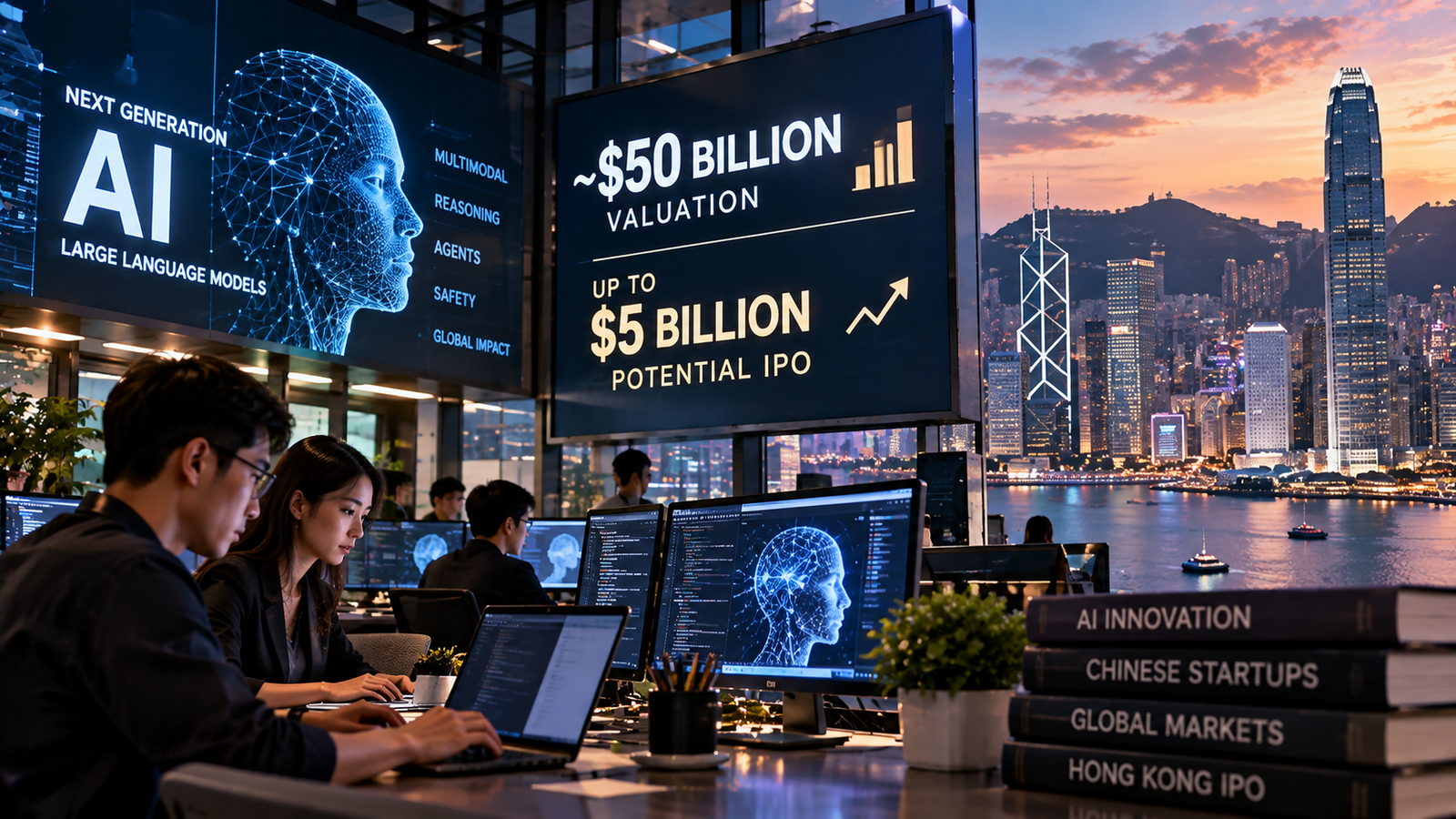
Chinese artificial intelligence startup Moonshot AI has reportedly completed its latest private fundraising at a valuation of about $50 billion and is preparing for a possible initial public offering in Hong Kong in the first quarter of 2027, according to people familiar with the matter cited by Bloomberg.
The Beijing-based company is considering raising up to $5 billion in the IPO and has begun laying the groundwork for early investor meetings, the report said. Moonshot has already filed confidentially for the transaction, according to people familiar with the plans, although the timetable and final deal size could still change.
Moonshot’s valuation has climbed rapidly during 2026 as investor interest in Chinese AI companies accelerated. Bloomberg reported that an earlier financing round this summer valued the company at $31.5 billion, while a separate July report put a later round at roughly $35 billion. The latest reported $50 billion valuation marks another sharp step up in a matter of months.
The company has not publicly confirmed the IPO timetable or the $5 billion fundraising target. For that reason, the offering should be described as a reported plan rather than a final, company-announced listing schedule.
What Is Moonshot AI Planning?
Moonshot AI is reportedly aiming for a Hong Kong listing in the first quarter of 2027. Bloomberg says the company has begun preparing early-look meetings with potential investors and has lined up major banks for the transaction, including Bank of America as overall coordinator alongside China International Capital, Deutsche Bank and Goldman Sachs. The company is considering raising up to $5 billion, which would make the offering one of the largest technology listings in Hong Kong in recent years. However, the amount is still under discussion and could change depending on investor demand, market conditions and regulatory approvals.
Why the $50 Billion Valuation Matters
A $50 billion private valuation would place Moonshot among the most valuable AI startups in China and make the company a major test of investor appetite for publicly listed artificial-intelligence businesses outside the United States. Private valuations are not the same as public-market valuations. They reflect the price investors agree to pay in financing rounds and can rise or fall sharply when a company goes public. If Moonshot lists, investors will compare the IPO price with its revenue growth, cash requirements, model performance and the valuations of other Chinese and global AI companies.
Moonshot’s Valuation Has Risen Quickly
Moonshot’s valuation has increased rapidly during 2026. Bloomberg reported that the company reached around $35 billion in July after raising more capital than initially planned, while the latest fundraising reportedly values it at about $50 billion. That pace of appreciation reflects intense competition among investors for exposure to leading Chinese AI developers. It also creates pressure on Moonshot to prove that commercial growth can keep pace with the valuation.
Kimi K3 Put Moonshot on the Global AI Map
Moonshot’s Kimi product has become one of the best-known Chinese AI platforms, and the company’s latest model, Kimi K3, has strengthened its international profile. Moonshot’s official website describes K3 as a 2.8-trillion-parameter native multimodal model with a one-million-token context window designed for long-form coding, knowledge work and complex reasoning. The company has positioned K3 as an open model and has emphasised capabilities across multimodal tasks, agents and long-context use cases.
Why Investors Are Paying Attention to Kimi
Moonshot is benefiting from a broader shift in the AI market toward models that offer strong performance at lower cost. Chinese developers have increasingly challenged the assumption that the most capable AI systems must come from U.S. companies with the largest infrastructure budgets. For investors, the appeal is not only model quality. A successful AI company needs distribution, recurring revenue, developer adoption and a path to monetisation. Moonshot’s Kimi ecosystem gives the company a consumer-facing product, enterprise opportunities and a platform for future AI services.
Revenue Growth Is a Key Part of the IPO Story
Bloomberg reported that Moonshot’s annual recurring revenue, a forward-looking measure often used by subscription and software businesses, is expected to reach about $2 billion by December, up from around $1 billion currently. The company had reportedly reached about $300 million of ARR in June. Those figures have not been independently confirmed by Moonshot in a public filing. They are important because public investors will want evidence that commercial growth is accelerating fast enough to support a valuation in the tens of billions of dollars.
What Annual Recurring Revenue Means
Annual recurring revenue, or ARR, estimates the yearly value of recurring subscriptions or contracted revenue at a given point in time. It is commonly used by software companies because it provides a snapshot of predictable revenue growth. ARR is not the same as audited annual revenue, profit or cash flow. A company can report strong ARR growth while still spending heavily on computing, research, salaries and customer acquisition. If Moonshot proceeds with an IPO, audited financial statements will provide a clearer picture of actual revenue, losses and cash requirements.
Moonshot Has Powerful Backers
Moonshot’s investor base includes some of China’s largest technology and venture-capital groups. Bloomberg says Alibaba, Tencent and 5Y Capital are among its backers. Support from large strategic investors can provide more than capital. It can also offer distribution, cloud infrastructure, commercial relationships and credibility with future investors. At the same time, public-market investors will examine whether large shareholders have special rights and how much control founders and strategic backers retain after listing.
Founder Yang Zhilin Remains Central to the Company
Moonshot was founded in 2023 by Yang Zhilin, a former Tsinghua University professor who previously worked at Meta and Google. His research background and technical profile have helped Moonshot position itself as a research-driven AI lab rather than only a consumer-software company. Founder-led AI companies can move quickly because decision-making is concentrated, but they also face governance questions as they scale. An IPO would bring more disclosure requirements and greater scrutiny of ownership, voting rights and board structure.
Why Hong Kong Is Becoming Important for AI Listings
Hong Kong has become an increasingly important venue for Chinese technology and AI companies seeking public capital. A successful Moonshot IPO would add to a growing pipeline of AI-related listings and could encourage more private Chinese labs to consider the market. For Hong Kong, large technology IPOs are strategically important because they increase trading activity, attract international investors and reinforce the exchange’s role as a financing hub for Chinese companies.
The IPO Could Raise Up to $5 Billion
People familiar with Moonshot’s plans have said the company is considering raising as much as $5 billion. That figure would be significant even by global technology IPO standards and would give Moonshot substantial capital for computing infrastructure, research and international expansion. However, the final amount could be smaller. IPO proceeds depend on market demand, valuation discussions, regulatory approvals and the number of shares ultimately sold. Until Moonshot publishes formal offering documents, the $5 billion figure should be treated as a reported target rather than a confirmed fundraising amount.
Regulatory Scrutiny Is a Major Risk
Moonshot’s IPO preparations come as Chinese authorities increase oversight of the AI sector. Bloomberg reported that it remains unclear how the listing timetable could be affected by tighter regulation following reports of a data-security probe involving Moonshot and DeepSeek. Data governance is especially important for AI companies because models may process large amounts of user information, business data and potentially sensitive content. Any regulatory investigation could affect product development, investor confidence or the timing of a public offering.
Competition With DeepSeek Is Intensifying
Moonshot is not the only Chinese AI company attracting large amounts of capital. DeepSeek is also reportedly preparing for a major financing round and eventual IPO, while other domestic developers are competing on model capability, open-source adoption and enterprise use. That competition could help accelerate innovation, but it also raises spending requirements. Leading AI companies need continuous investment in chips, data centres, researchers and training runs, making capital efficiency a critical part of the investment case.
How Moonshot Compares With U.S. AI Startups
Moonshot is developing in a market where U.S. companies such as OpenAI and Anthropic are also raising enormous amounts of capital and considering public listings. The global AI sector is therefore moving toward a period in which private labs increasingly need access to public markets to fund infrastructure and expansion. The valuations are different, but the core question is similar: can rapid model improvement and user growth produce enough revenue and profit to justify massive capital requirements?
Technology Impact: Open Models Could Expand Adoption
Moonshot’s emphasis on open models could help it gain international developer adoption. Open or openly available models allow companies and researchers to inspect, customise and deploy AI systems more flexibly than closed services. That approach can accelerate adoption but may make monetisation more complex. Moonshot will need to balance open distribution with paid products, enterprise services, APIs and other commercial offerings if it wants to convert technical popularity into sustainable revenue.
Business Impact for China’s AI Sector
A successful Moonshot IPO could establish a public-market valuation benchmark for other Chinese AI startups. That would matter for venture-capital portfolios, employee stock options and future fundraising across the sector. It could also encourage investors to distinguish between AI companies based on revenue, model economics and commercial traction rather than treating the entire sector as one broad technology theme. In that sense, the IPO could increase both capital availability and financial discipline.
Why Investors Should Treat the Valuation Carefully
A $50 billion valuation is impressive, but it should not be treated as proof that Moonshot is worth that amount in every market environment. Private fundraising rounds can involve negotiated terms, strategic investors and share structures that differ from ordinary public-market transactions. When the company lists, investors will focus on revenue growth, losses, cash burn, compute spending, customer concentration and governance. The eventual IPO price may be higher or lower than the latest private valuation.
South Asia and Pakistan Relevance
There is no direct Pakistan-specific element in Moonshot’s reported IPO plan. The broader relevance is technological and financial: Chinese AI companies are becoming increasingly important global competitors, and South Asian developers and businesses may use their models, APIs or open-source tools. For Pakistan, greater availability of lower-cost AI models could reduce dependence on expensive proprietary platforms. The IPO itself is mainly a China and Hong Kong capital-markets story, but the technology developed by Moonshot could have wider regional impact if adoption expands.
What Happens Next?
The next step is likely to be investor marketing and regulatory progress ahead of the reported first-quarter 2027 listing window. Moonshot is expected to continue preparing its financial disclosures, ownership structure and offering documents. Investors will also watch the company’s revenue trajectory, Kimi adoption and any regulatory developments. If market conditions weaken or oversight increases, the timetable could move. If demand remains strong, Moonshot could become one of the most closely watched Asian technology IPOs of 2027.
Important Questions Still Unanswered
Moonshot has not publicly confirmed the reported $50 billion valuation, the early-2027 IPO schedule or the plan to raise up to $5 billion. The company also has not published detailed audited financial statements for public-market investors. Key unanswered questions include the size of Moonshot’s operating losses, its annual compute spending, the economics of Kimi’s open-model strategy and how much equity existing investors may sell in the IPO. Those details will be critical to judging whether the reported valuation is sustainable.
FAQs
1. What is Moonshot AI’s reported valuation?
Bloomberg reported that Moonshot AI completed private fundraising at a valuation of about $50 billion. The company has not publicly confirmed the figure.
2. When could Moonshot AI go public?
The company is reportedly targeting a Hong Kong IPO in the first quarter of 2027, although the timetable could still change.
3. How much could Moonshot raise in the IPO?
People familiar with the plans have said Moonshot is considering raising up to $5 billion. The final amount has not been confirmed.
4. What is Moonshot AI best known for?
Moonshot is best known for its Kimi AI platform and Kimi K3 model, which the company describes as a large multimodal model designed for coding, knowledge work and long-context reasoning.
5. Who founded Moonshot AI?
Moonshot was founded in 2023 by Yang Zhilin, a former Tsinghua University professor who previously worked at Meta and Google.
6. Who invests in Moonshot AI?
Reported backers include Alibaba, Tencent and 5Y Capital, along with other investors that have participated in the company’s fundraising rounds.
7. Is Moonshot’s $50 billion valuation guaranteed at IPO?
No. Private valuations can differ from public-market valuations. The final IPO valuation will depend on investor demand, market conditions and Moonshot’s disclosed financial performance.
8. Does Moonshot’s IPO directly affect Pakistan?
There is no direct Pakistan-specific transaction impact. The broader relevance comes from the growing global availability of Chinese AI models and the possibility of lower-cost AI tools for developers and businesses.
About The Author