NASA has selected a new lunar science investigation called GIMLI to determine whether the Marius Hills Pit on the Moon opens into a large underground lava tube. The project, led by the Planetary Science Institute, was announced as part of NASA’s latest Payloads and Research Investigations on the Surface of the Moon, or PRISM, selections.
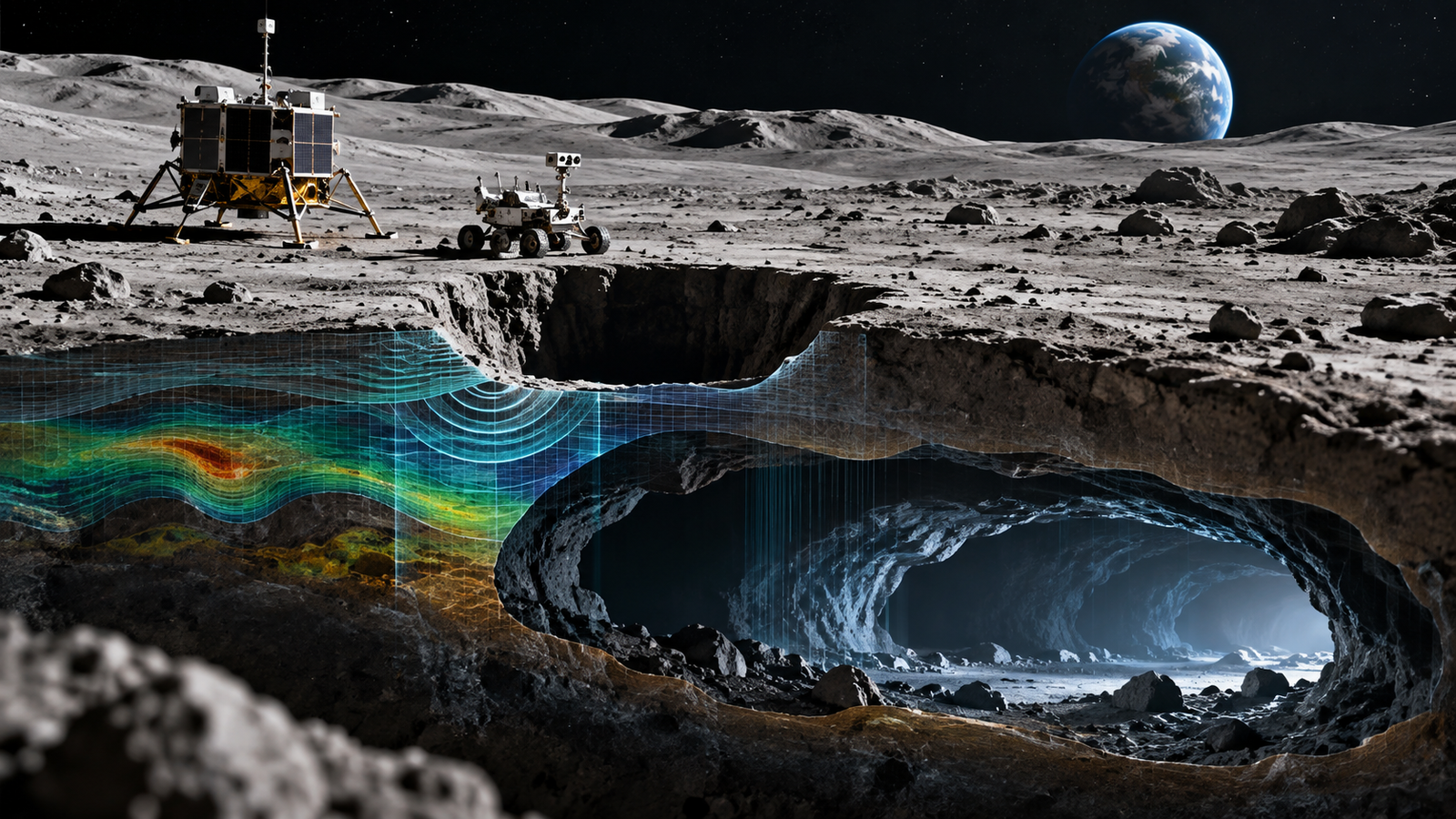
The investigation will deploy instruments at the Marius Hills Pit, a striking opening in one of the Moon’s most volcanically diverse regions. Researchers plan to use ground-penetrating radar, active-source seismic measurements, gravity data and cameras to map the subsurface and estimate the size of any hidden void.
The central question is simple but scientifically important: does the pit end beneath the visible opening, or is it a skylight into a much larger tunnel created by ancient lava flows? NASA and the Planetary Science Institute say confirming a substantial lava tube could improve understanding of lunar volcanism and identify natural underground spaces that may protect future astronauts from radiation and extreme temperature swings.
NASA selected GIMLI alongside two other lunar investigations in late September 2026. The agency says the payloads will be delivered through its Commercial Lunar Payload Services initiative as part of a broader effort to expand science on the lunar surface and support long-term human exploration.
What Is the NASA GIMLI Lunar Cave Mission?
GIMLI stands for Geophysical Instruments for Marius Lunar pit Investigation. The project is led by Planetary Science Institute Associate Director and Senior Scientist Than Putzig, with Honeybee Robotics serving as a commercial partner and the Norwegian Space Agency providing the ground-penetrating radar.
The mission is designed to investigate the Marius Hills Pit directly from the lunar surface. Rather than sending astronauts or a robot deep into the opening, the team plans to combine several geophysical techniques to infer the structure below ground.
That approach is important because a lava tube can be difficult to identify from orbital images alone. A surface opening may reveal only a small part of a much larger underground system. Radar, seismic waves and gravity measurements can probe beyond what cameras can see.
Why the Marius Hills Pit Matters
The Marius Hills Pit has attracted scientific interest for years because it sits in a region shaped by extensive volcanic activity. NASA’s Lunar Reconnaissance Orbiter has imaged the pit in detail, and previous observations have shown an overhang and a void extending beneath part of the rim.
NASA has described the pit as roughly 65 by 90 meters across and about 34 meters deep in some imaging studies. Earlier oblique observations also showed layered volcanic rock in the pit walls, giving researchers a direct look at material that is normally buried beneath the lunar surface.
The most important unanswered question is whether the visible cavity connects to a long lava tube. Orbital radar and gravity studies have produced evidence consistent with subsurface voids in the broader Marius Hills region, but GIMLI is intended to test the idea from the surface with a purpose-built instrument package.
How Lava Tubes Form on the Moon
Lava tubes form when the outer surface of a lava flow cools and solidifies while molten rock continues moving underneath. When the eruption ends and the remaining lava drains away, it can leave a hollow tunnel behind.
Similar structures exist on Earth in volcanic regions. On the Moon, lower gravity and the absence of weathering may allow some lava tubes to survive on very large scales for billions of years.
Scientists are interested in lunar lava tubes for two reasons. First, their walls and floors may preserve evidence of ancient volcanic processes. Second, an intact underground cavity could provide natural shielding from conditions that make long-term surface operations difficult.
How GIMLI Will Search Beneath the Lunar Surface
GIMLI will combine multiple instruments instead of relying on a single measurement. The Planetary Science Institute says the payload will include ground-penetrating radar, seismic sensors, a gravimeter and cameras.
The radar will send electromagnetic signals into the ground and measure reflections from changes in subsurface structure. A large void can produce a distinctive radar response, although interpretation depends on the properties of the surrounding rock and regolith.
The seismic system will use active-source methods. In simple terms, the team will create controlled vibrations and measure how the resulting waves travel through the ground. Differences in wave speed and reflection can reveal boundaries, fractures and empty spaces below the surface.
Gravity measurements provide another independent test. A large underground cavity contains less mass than solid rock, creating a small local gravity anomaly. Cameras will document the surface, pit walls and surrounding terrain so scientists can connect subsurface measurements with visible geology.
Using several techniques together should reduce uncertainty. If radar, seismic and gravity data all point to a void in the same location, confidence in the interpretation would be much stronger than if only one instrument detected an anomaly.
Why GIMLI Revives an Apollo-Era Technique
One of the most notable parts of GIMLI is its use of intentional active-source seismic measurements. Putzig said he has long wanted to bring that approach back to planetary science because similar methods have seen little use on the Moon since the Apollo era.
Apollo astronauts deployed seismic experiments that helped scientists study the lunar interior and surface layers. GIMLI will apply modern instruments and analysis to a much more focused problem: mapping the structure around a specific lunar pit.
The combination of active seismology with radar and gravity measurements is what makes the mission scientifically distinctive. Each method is sensitive to different physical properties, giving the team multiple ways to test whether a substantial cave exists.
What Scientists Can Learn Even If No Cave Is Found
GIMLI does not depend on finding a dramatic underground tunnel to produce useful science. If the data show that the Marius Hills Pit does not connect to a large lava tube, the measurements can still help explain how the pit formed and how volcanic materials are arranged beneath the surface.
The pit walls expose layers of regolith and ancient lava flows. Researchers hope those layers will reveal how lava moved across the region and whether long intervals separated different eruptions.
That information can improve models of lunar volcanic history. It could also help scientists interpret other pits and suspected lava tubes identified from orbit, making GIMLI valuable even if its main hypothesis is not confirmed.
Could a Moon Cave Protect Future Astronauts?
A confirmed lava tube would immediately attract attention for human exploration because the lunar surface is a harsh environment. Astronauts must contend with radiation, micrometeoroids and large temperature swings.
An underground space could provide natural shielding from some of those hazards. NASA has said that large lunar caves may offer future crews ready-made protection that would otherwise require heavy construction or substantial shielding material.
That does not mean GIMLI has identified a future lunar base. A cave would still need to be assessed for structural stability, access, lighting, communications, dust, navigation and many other operational risks before it could be considered for human use.
For now, the shelter idea is a potential long-term benefit. The mission’s primary role is scientific: determine what lies beneath the Marius Hills Pit and understand the volcanic processes that created the region.
Who Is Building the GIMLI Instruments?
The Planetary Science Institute is leading the scientific investigation. Honeybee Robotics, a Blue Origin company, will provide project management services and build much of the instrumentation for the active seismic system, gravimeter and cameras.
Honeybee Robotics will also support integration of the instruments onto the lander and rover and, with PSI, help operate them on the lunar surface. The Norwegian Space Agency is supplying the ground-penetrating radar.
The wider science team includes researchers from Boise State University, Johns Hopkins University, the Lunar and Planetary Institute and the University of Oslo. The international and commercial partnerships reflect NASA’s broader model of combining agency science goals with outside institutions and private lunar delivery services.
How GIMLI Fits Into NASA’s CLPS and Moon Science Strategy
GIMLI was selected through NASA’s PRISM program and is expected to reach the Moon using a spacecraft provided through the Commercial Lunar Payload Services initiative, known as CLPS.
CLPS allows NASA to buy lunar delivery services from commercial companies rather than develop every lander itself. NASA has repeatedly said the model carries risk because landing on the Moon remains difficult, but the agency uses it to increase the pace and variety of science missions.
GIMLI is one of three new investigations NASA selected in the latest PRISM round. The agency says the new payloads are intended to improve knowledge of the lunar environment, support future exploration and contribute to planning for sustained human activity on the Moon.
NASA has not announced a specific GIMLI launch date in the material released with the selection. That means the project is still at the mission-development stage, and hardware integration, delivery planning and the eventual CLPS provider assignment will be important milestones to watch.
Science and Technology Impact
Scientifically, a confirmed lava tube would provide direct evidence about how volcanic flows behaved in the Moon’s past. Comparing a lunar tube with similar structures on Earth could help researchers reconstruct eruption styles and the physical conditions under which ancient lunar lava moved.
Technologically, GIMLI will demonstrate how different geophysical instruments can work together on another world. Ground-penetrating radar, active seismology and precision gravity measurements could be useful in future missions searching for ice, buried structures or safe construction zones.
The mission also has value for robotic exploration. Mapping an underground target from the surface is less risky than immediately sending a rover into an unknown cave, and the same strategy could help future teams decide whether a subsurface site is worth exploring directly.
Pakistan and South Asia Relevance
GIMLI has no direct Pakistan-specific operational role, so its relevance to Pakistan and South Asia is mainly scientific and educational rather than immediate.
The mission could still interest universities, astronomy communities and engineering students in the region because it combines planetary geology, robotics, radar, seismology and gravity science in a single lunar project.
For South Asian space programs, GIMLI also illustrates how relatively specialized instruments can contribute to larger international exploration efforts. The wider lesson is that lunar science does not depend only on launch vehicles; sensors, data analysis and geophysical expertise can also become important parts of future missions.
What Happens Next for the GIMLI Mission?
The next phase will involve instrument development, integration planning and preparation for a future CLPS delivery to the Moon. NASA and the project partners will need to finalize mission hardware and coordinate how the lander and rover will operate at the Marius Hills site.
Once on the lunar surface, the most important result will be whether the radar, seismic and gravity data reveal a consistent underground void extending from the pit. If they do, scientists will then try to estimate its dimensions and understand how it formed.
If no large cave is detected, GIMLI will still return valuable information about the pit’s origin, subsurface layering and the volcanic history of Marius Hills.
The project therefore has a useful scientific outcome either way: it can confirm one of the Moon’s most intriguing suspected caves, or explain why the Marius Hills Pit looks like an opening into something larger when viewed from orbit.
Important Questions Still Unanswered
Several details remain open. NASA has not announced a specific launch date or CLPS delivery mission for GIMLI in the selection announcement. The final operating timeline on the lunar surface also remains to be detailed publicly.
Scientists also do not yet know whether the suspected lava tube is continuous, how far it might extend, or whether its geometry would make it accessible to future robots or astronauts.
Those questions are exactly what make the mission compelling. GIMLI is moving a long-standing lunar mystery from orbital observation toward direct geophysical testing on the Moon.
FAQs
What is NASA’s GIMLI mission?
GIMLI is the Geophysical Instruments for Marius Lunar pit Investigation. NASA selected the project to study whether the Marius Hills Pit connects to a large underground lava tube.
Where is the Marius Hills Pit?
The Marius Hills Pit is in a volcanically active region on the Moon’s near side called Marius Hills. It has been observed repeatedly by lunar orbiters, including NASA’s Lunar Reconnaissance Orbiter.
What instruments will GIMLI use?
The mission will use ground-penetrating radar, active-source seismic sensors, a gravimeter and cameras to study the pit and the surrounding subsurface.
Why are lunar lava tubes important?
Lava tubes can preserve evidence of ancient volcanic activity. If large and stable, they may also provide natural shielding from radiation, extreme temperatures and micrometeoroids for future explorers.
Who is leading the GIMLI mission?
The Planetary Science Institute is leading the project under principal investigator Than Putzig. Honeybee Robotics is a major commercial partner, and the Norwegian Space Agency is providing the ground-penetrating radar.
Has NASA confirmed that a large Moon cave exists at Marius Hills?
No. Orbital observations suggest that an underground void may exist, but GIMLI is specifically designed to test whether the pit connects to a substantial lava tube and to estimate its size if one is found.
When will GIMLI launch to the Moon?
NASA has selected the mission for a future CLPS delivery, but the selection announcement did not provide a specific launch date.
Could astronauts live inside the Marius Hills cave?
Possibly in the long term, but that has not been established. Any underground space would first need to be confirmed, mapped and assessed for safety, access and operational suitability.
About The Author