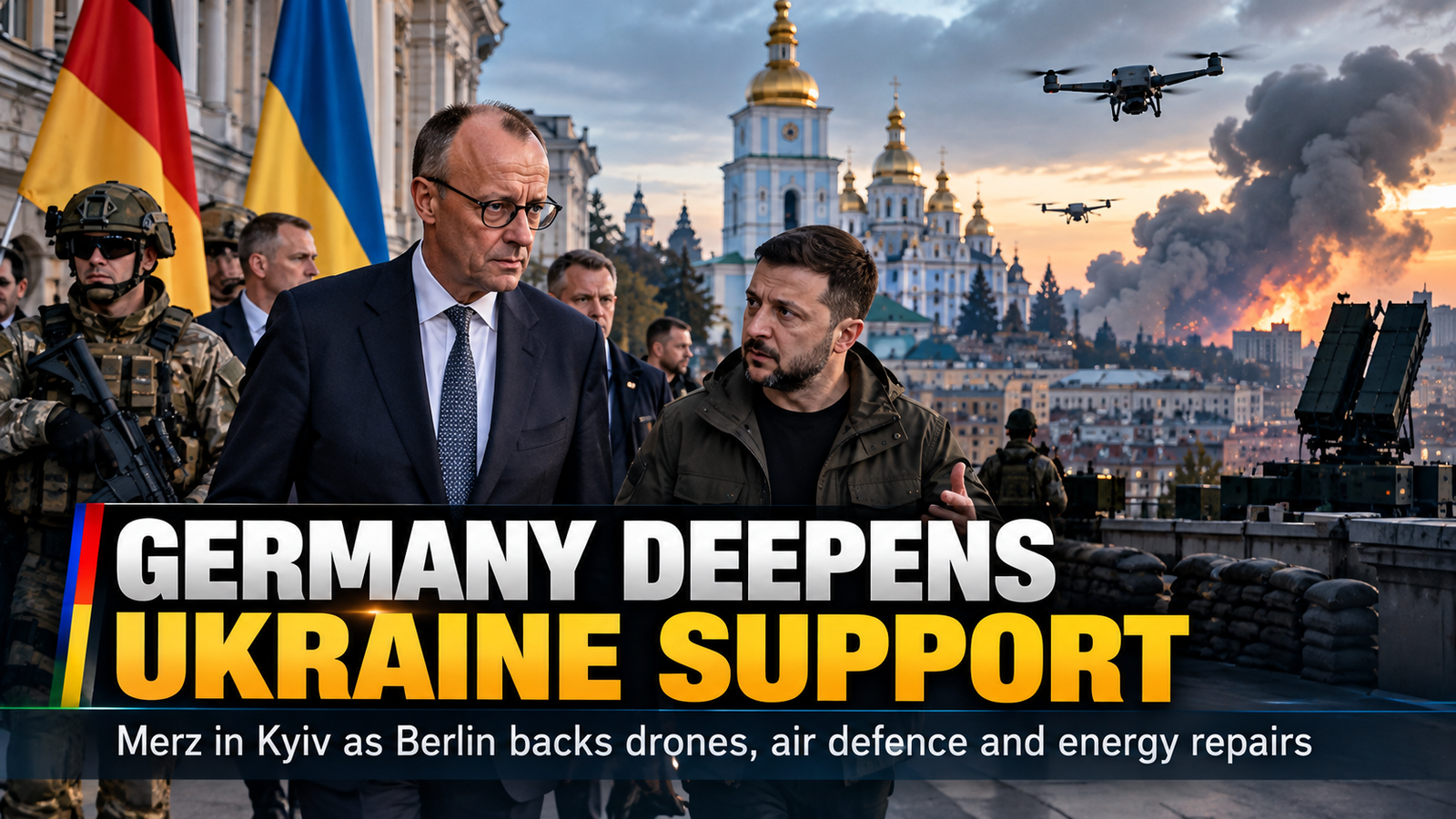
German Chancellor Friedrich Merz arrived in Kyiv on October 4, 2026, as Germany moved to deepen military, industrial and energy cooperation with Ukraine while Russian attacks on the capital intensified.
Reuters reported that Merz reached Kyiv amid air-raid sirens and explosions and was expected to announce a €1 billion military aid package, €350 million for energy infrastructure repairs and progress on a joint drone-production arrangement between German and Ukrainian companies.
The visit comes at a sensitive moment for Ukraine. Russian strikes have increasingly targeted bridges, transport links and energy infrastructure around Kyiv, while Ukrainian leaders are pushing European partners for more air-defence systems, long-range capabilities and financial support before winter.
For Germany, the trip is also about more than another aid package. Berlin is trying to build a longer-term defence relationship with Ukraine, including joint production, industrial cooperation and support for Ukraine’s path toward the European Union.
What Happened in Kyiv?
Merz arrived in Kyiv for talks with Ukrainian President Volodymyr Zelenskyy and other officials.
The visit took place under active wartime conditions, with air-raid sirens and explosions heard in the capital.
Reuters said the German chancellor was expected to use the trip to reaffirm Berlin’s political support and announce additional assistance.
The planned package includes military aid as well as funding to help repair Ukraine’s damaged energy infrastructure.
That combination reflects the two major pressures facing Kyiv: sustaining battlefield capabilities while also keeping civilian infrastructure functioning through winter.
Why Germany Is Increasing Support Now
Germany has become one of Ukraine’s most important European backers.
The country has supplied air-defence systems, ammunition and other military equipment while also supporting reconstruction and humanitarian needs.
The latest visit comes as German officials warn that Russia’s war is no longer only a Ukrainian security issue.
Merz has repeatedly argued that continued Russian aggression could create wider risks for Europe.
That view has pushed Berlin toward a more active defence policy and a larger role in European security planning.
The €1 Billion Military Aid Package
Reuters reported that Merz was expected to announce a €1 billion military aid package during the visit.
Details of every component were not immediately public.
However, German support for Ukraine has increasingly focused on air defence, ammunition, drones and other equipment needed for sustained operations.
The package is significant because Ukraine continues to face heavy pressure on its air-defence stocks.
Russian missile and drone attacks force Ukraine to use large numbers of interceptors, which are expensive and difficult to replace quickly.
Air Defence Remains a Priority
Air defence is one of Kyiv’s most urgent military needs.
Reuters has reported that Russian forces are increasingly using large combined waves of drones and missiles, a pattern Ukrainian officials say is intended to strain air-defence systems.
Germany has already played a major role in providing systems such as IRIS-T and supporting Patriot-related capabilities.
The German government’s April 2026 strategic partnership declaration with Ukraine included priorities covering additional IRIS-T launchers and Patriot-related support.
That broader framework helps explain why Merz’s October visit is not an isolated event.
It is part of a longer plan to strengthen Ukraine’s ability to defend cities, critical infrastructure and military positions.
Germany and Ukraine Are Expanding Drone Cooperation
One of the most important parts of the visit is the expansion of joint drone production.
Reuters said Germany and Ukraine were working on a deal expected to focus on the rapid production of interceptor drones designed to counter faster jet-powered drones.
The partnership reportedly involves German company Quantum Systems and Ukrainian manufacturer WIY Drones.
Drone warfare has become central to the conflict.
Both sides use large numbers of unmanned systems for reconnaissance, targeting, electronic warfare and direct attacks.
That has created demand not only for offensive drones but also for cheaper systems capable of intercepting incoming unmanned aircraft.
Why Joint Production Matters
Joint production can solve several problems at once.
Ukraine has extensive battlefield experience and fast product-development cycles.
German companies bring industrial capacity, financing and access to European supply chains.
Combining those strengths could help produce systems faster than relying entirely on traditional procurement.
It could also help Ukraine build a defence industry that remains viable even after the war.
For Germany, the partnership provides direct exposure to technologies shaped by real combat conditions.
The German-Ukrainian Strategic Partnership
Germany and Ukraine had already set out a broader framework for defence-industry cooperation earlier in 2026.
An April declaration from the German government listed cooperation on long-range and mid-range strike drones, air defence and a joint working group on defence industry issues.
It also included support for Ukraine’s EU accession process and reconstruction.
That means the October visit is best understood as implementation of an existing strategic direction rather than a sudden change in German policy.
€350 Million for Energy Infrastructure Repairs
Merz was also expected to announce €350 million to help repair Ukraine’s energy infrastructure.
That support is especially important as winter approaches.
Russia has repeatedly targeted power generation, heating systems, substations and other infrastructure.
Damage to these systems can disrupt electricity, heating and water services for millions of people.
Energy repairs therefore have both humanitarian and strategic importance.
Why Energy Infrastructure Is a Political Issue
Energy infrastructure is not only a technical issue.
When power and heating systems fail in winter, public pressure increases quickly.
Large-scale outages can disrupt hospitals, businesses, transport and communications.
Zelenskyy told Reuters that Ukraine believes Russia’s intensified attacks on civilian infrastructure are intended to pressure residents of Kyiv and other cities to leave. That is a Ukrainian assessment of Moscow’s aims, not an independently established motive.
Russia says it targets military-related infrastructure and denies deliberately attacking civilians.
Whatever the legal and political arguments, the practical effect is that Ukraine needs large amounts of money, equipment and technical support to repair systems repeatedly damaged by attacks.
Russian Attacks Are Increasing Pressure on Kyiv
Merz’s arrival came while Kyiv was under renewed attack.
Reuters reported strikes on infrastructure including the Northern Bridge and heating-related facilities.
Reuters reported that earlier Russian strikes had also hit bridges and other sites around the capital.
The pressure on transport links matters because bridges across the Dnipro River are critical for moving people, goods and military supplies.
Reuters reported that Russia has been striking Kyiv bridges in an effort to disrupt links between the capital’s two banks and logistics routes connecting central and eastern Ukraine.
Zelenskyy Says Ukraine Will Strike Russian Refineries
The visit also comes as Ukraine signals a harder response to Russian attacks.
Zelenskyy said Ukraine would continue or intensify strikes on Russian oil refineries in response to what he described as a broader Russian campaign against civilian infrastructure.
Oil facilities are strategically important because Russia relies heavily on energy exports and refinery capacity.
Ukraine argues that attacks on these sites reduce Russia’s ability to finance and support military operations.
The strikes are controversial because they can also affect global fuel markets.
That tension has created disagreement between Kyiv and some of its partners over how far Ukraine should go.
Germany’s Broader Security Argument
Merz has increasingly framed support for Ukraine as part of Germany’s own national security.
He has warned that Russian military pressure, cyber activity, sabotage and drone incidents could threaten European countries more directly.
That argument is important politically inside Germany.
Support for Ukraine requires large public spending and remains controversial among parts of the electorate.
By linking Ukraine’s defence to German and European security, Merz is trying to justify long-term support rather than treating it as temporary emergency assistance.
Domestic Political Pressure in Germany
Germany’s Ukraine policy remains a significant subject of domestic political debate.
Some political parties support continued or expanded military assistance to Kyiv.
Others favor reducing military support, placing greater emphasis on negotiations or pursuing a different approach to relations with Russia.
The Alternative for Germany (AfD), among other critics of the government’s policy, has opposed parts of Berlin’s military support for Ukraine and argued for a different approach toward Russia.
Merz therefore faces both international commitments and competing views within Germany over the scale and direction of support for Ukraine.
His Kyiv visit reinforces the government’s position that Germany should remain a major supporter of Ukraine.
The Economic Side of the Visit
The German delegation included business figures as well as political officials.
That matters because Germany’s relationship with Ukraine is increasingly moving beyond emergency aid.
German companies are interested in defence manufacturing, energy reconstruction, infrastructure and future commercial opportunities.
Ukraine will require very large amounts of investment to rebuild damaged cities, transport networks and energy systems.
German industry wants to be positioned for that process.
This gives the relationship a long-term economic dimension alongside the immediate military one.
Ukraine’s EU Reform Commitments
German support also comes with expectations.
Berlin has repeatedly pushed Ukraine to strengthen anti-corruption institutions and continue reforms required for closer integration with the European Union.
These issues are politically sensitive in Kyiv.
Ukraine argues that wartime conditions make reform more difficult.
European governments respond that large financial aid packages require strong oversight and transparent institutions.
Germany’s strategic partnership with Ukraine explicitly links cooperation with reform and EU accession.
Why Anti-Corruption Reform Matters
Ukraine receives large amounts of military and financial assistance.
Donor governments need to demonstrate to their own taxpayers that funds are being used responsibly.
Strong anti-corruption institutions can help protect public support for continued assistance.
They are also central to Ukraine’s longer-term goal of joining the European Union.
This is why reform discussions often appear alongside military aid announcements.
Business Impact
Germany’s deeper defence partnership with Ukraine could have significant effects on European industry.
Demand is rising for drones, air-defence systems, sensors, ammunition and electronic-warfare technology.
German companies with expertise in these areas may receive more contracts.
Ukrainian defence firms could also gain access to European capital, manufacturing and export networks.
The shift toward joint production may become more important than traditional one-way aid because it creates industrial capacity inside Europe and Ukraine.
Technology Impact
The war has accelerated development of military drone technology.
Systems are being redesigned quickly in response to battlefield experience.
Anti-drone systems are also becoming a major technology market.
The German-Ukrainian cooperation reported by Reuters shows how defence technology is moving toward faster development cycles.
That could influence military procurement across Europe.
Traditional defence programs often take years.
Drone systems can evolve in months or even weeks.
Pakistan Relevance
The story has no direct Pakistan role, but it has limited relevance through defence markets and energy prices.
The Ukraine war is reshaping demand for air-defence systems, drones and military electronics, which can affect global defence supply chains.
For Pakistan, the clearest economic link is energy: sustained disruption to Russian oil infrastructure can add pressure to global fuel markets.
As an oil-importing economy, Pakistan can be affected when international energy prices rise.
South Asia Relevance
India and other South Asian countries also monitor the Ukraine conflict closely because it affects defence procurement, energy imports and relations with Russia, Europe and the United States.
The expansion of European defence production could gradually reshape global arms markets.
That may influence future procurement choices across the region.
Why This Visit Matters
Merz’s Kyiv visit is important because it combines immediate support with long-term strategy.
Germany is not only sending money and equipment.
It is building deeper industrial ties, supporting energy reconstruction and linking Ukraine more closely with European institutions.
The drone cooperation is particularly significant because it shows how military assistance is shifting toward joint manufacturing.
That model could become increasingly common as European countries try to increase defence production.
What Happens Next?
The next steps will include finalizing drone-production arrangements and, once formally announced and released, implementing the military and energy-support measures reported ahead of the visit.
Ukraine will continue pressing Germany and other European countries for more air-defence systems.
Berlin will also watch Ukraine’s progress on governance and reform.
On the battlefield, the intensity of Russian attacks on Kyiv and other cities will remain a major test of how quickly new equipment and energy support can make a difference.
The broader political question is whether Europe can maintain this level of support over the long term.
Frequently Asked Questions
Why did Friedrich Merz travel to Kyiv?
Merz traveled to Kyiv to reaffirm German support for Ukraine, discuss military and economic cooperation and advance new aid and drone-production plans.
How much military aid is Germany announcing?
Reuters reported that Merz was expected to announce a €1 billion military aid package.
How much support is planned for Ukraine’s energy infrastructure?
Germany was expected to provide €350 million for energy infrastructure repairs.
What is the Germany-Ukraine drone deal?
Germany and Ukraine are working on joint drone development and production, including anti-jet drone systems involving German and Ukrainian companies.
Why is Germany supporting Ukraine so heavily?
Berlin argues that Ukraine’s security is closely linked to the wider security of Germany and Europe.
Does the story have direct Pakistan relevance?
There is no direct Pakistan involvement, but the conflict affects global defence technology, energy markets and military supply chains that matter to Pakistan.
About The Author