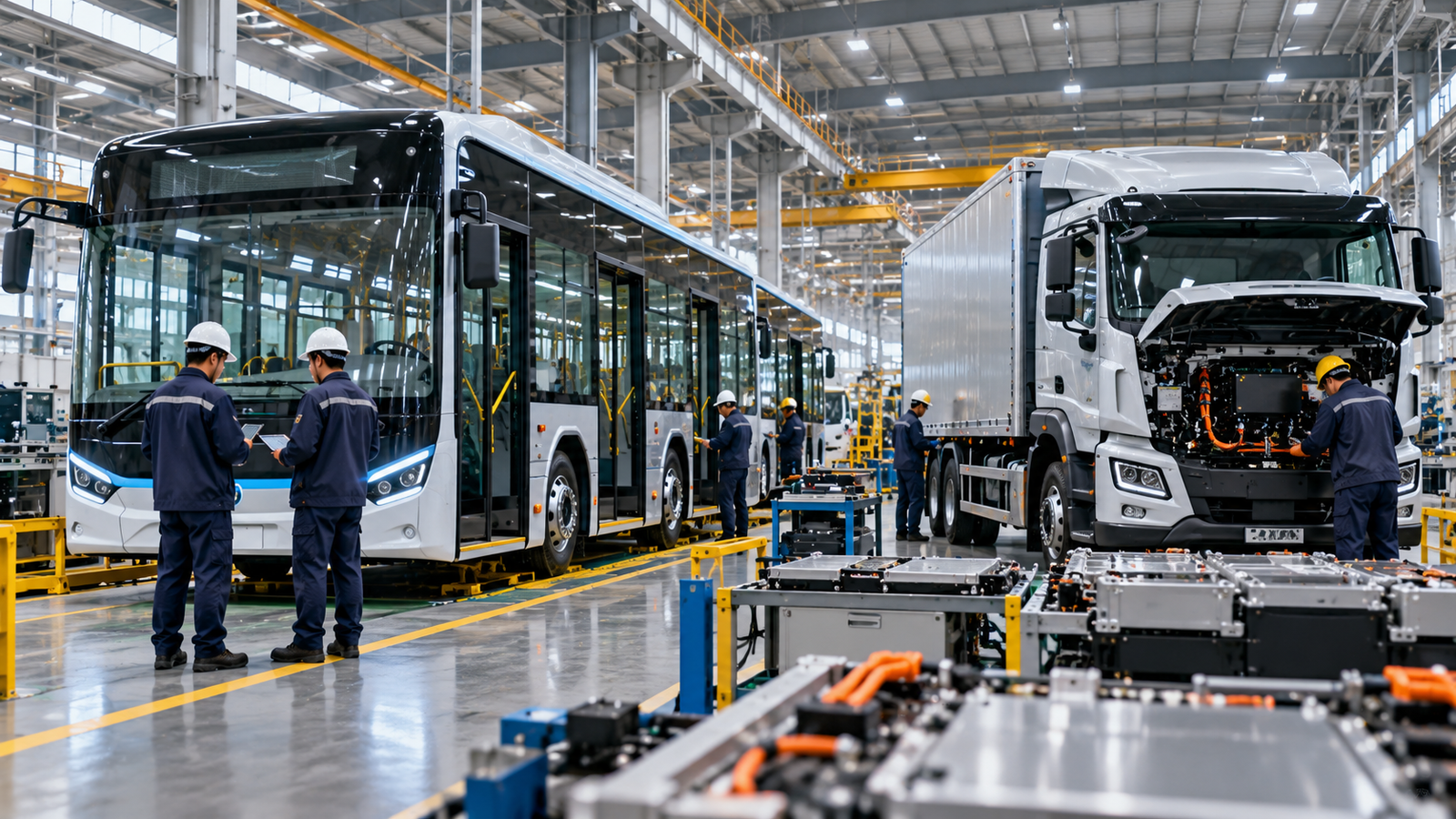
LAHORE, October 17, 2026 – Chinese investors are exploring plans to assemble and manufacture electric buses and trucks in Punjab, Pakistan. A 20-member delegation of the Pakistan-China Business Forum met Punjab Industries and Commerce Minister Chaudhry Shafay Hussain in Lahore on October 16 to discuss possible investment in electric vehicles and other industries.
The Chinese EV investment in Punjab story was reported by Business Recorder, The News and Express Tribune on October 17. Pakistan Observer also covered the meeting on October 16. The discussions included electric vehicle factories, information technology, tourism, agriculture and a planned China Pavilion to display Chinese products.
For readers, one point is especially important: these are investment discussions and proposed projects. The reports do not confirm that a new electric bus or truck factory has begun construction, that a production line is already running or that a final factory investment amount has been agreed.
Chinese EV Investment in Punjab: Key Facts
Meeting date: October 16, 2026.
Location: Lahore, Punjab, Pakistan.
Delegation: 20 members linked to the Pakistan-China Business Forum.
Pakistani official: Punjab Industries and Commerce Minister Chaudhry Shafay Hussain.
Main auto-sector proposal: Electric bus and truck assembly and manufacturing facilities.
Other areas discussed: Information technology, tourism and agriculture.
Additional proposal: A China Pavilion on about 100 kanals of land.
Current project status: Investment interest and discussion; factory completion not confirmed.
Reporting: Business Recorder, The News, Express Tribune and Pakistan Observer.
These details are based on the dated news reports and should not be confused with a signed, funded manufacturing project.
What Happened at the Lahore Meeting?
The Chinese delegation met the Punjab minister to discuss opportunities for businesses interested in working in Pakistan. Representatives came from industries including electric vehicles, IT, tourism and agriculture.
Wei Linzhui, director of the forum’s Beijing office, discussed establishing a China Pavilion in Punjab. The proposed site would cover around 100 kanals and provide a place to showcase Chinese products.
The delegation also expressed interest in assembly and manufacturing plants for electric buses and trucks. These vehicles could eventually be used for public transport, cargo services or commercial fleets if the plans move ahead.
Minister Chaudhry Shafay Hussain welcomed the interest and highlighted industrial infrastructure and business opportunities in Punjab.
What Could the New Electric Vehicle Plants Produce?
The discussions focused on two main types of vehicles: electric buses and electric trucks.
Electric buses run on battery power instead of using a traditional diesel engine. They can be used on city routes and other passenger services, depending on battery range, road conditions and access to chargers.
Electric trucks are designed to carry goods. Their suitability depends on how far they need to travel, how much cargo they carry and whether charging points are available along their routes.
A local assembly operation may initially bring together imported components, while a more developed manufacturing facility could produce an increasing share of parts in Pakistan.
The news reports do not provide a final list of models, planned factory capacity, battery specifications or commercial launch dates.
Why Chinese Investors Are Interested in Punjab
Punjab has a large population, important industrial areas and demand for transport and logistics services. Electric vehicles are becoming more visible in Pakistan as governments and businesses consider ways to reduce reliance on petroleum.
A manufacturing project may offer investors access to local customers while allowing them to develop suppliers and service networks.
Punjab’s special economic zones and industrial estates were highlighted during the meeting as places where manufacturing investment could take place.
However, investors still need to study market demand, costs, regulations, available sites and commercial feasibility before starting a factory.
The meeting shows interest in these opportunities. It does not prove that every proposed investment will become a completed business.
Could Electric Buses Become More Affordable in Pakistan?
Local assembly has the potential to lower some transport and import-related costs, especially if more components eventually come from local suppliers.
But a lower vehicle price is not guaranteed. Batteries, motors, electronics, taxes, power costs and the size of production all affect the final selling price.
Electric buses also need charging depots, maintenance teams and spare parts. Transport operators compare the purchase price with operating costs over several years.
No official retail price or government purchase price for buses from the newly discussed factories has been announced.
For consumers and transport passengers, the practical benefits would become clearer only after actual models, prices, routes and services are confirmed.
Electric Trucks Could Change Commercial Transport
Trucks play an important role in moving goods between factories, warehouses, markets and ports.
Electric trucks may be useful on planned routes where drivers can charge at a depot before returning to work. Their economics depend on battery size, load, daily distance and the price of electricity.
For long-distance routes, reliable charging infrastructure becomes particularly important.
A local factory could eventually support vehicle sales, repair services and training, but the October meeting does not confirm production numbers or contracts with logistics operators.
Businesses considering electric fleets should wait for technical specifications and operating-cost evidence rather than relying on early investment headlines.
What Is the Proposed 100-Kanal China Pavilion?
The investors also discussed a China Pavilion that would showcase Chinese products in Punjab.
Wei Linzhui was reported as saying that the forum planned to use around 100 kanals of land for the project. Punjab’s industries minister offered government support regarding land availability.
A product exhibition or business pavilion could give Pakistani companies a place to explore partnerships and compare products from Chinese suppliers.
However, the pavilion is a separate proposal from electric bus and truck manufacturing. An exhibition site does not automatically mean a vehicle factory has been approved there.
The sources reviewed do not establish a completed building, opening date or signed land transfer for the proposed pavilion.
What Did Punjab’s Industries Minister Say?
Chaudhry Shafay Hussain said several Chinese companies had invested in Punjab during recent years and invited more businesses to consider opportunities in the province.
He discussed industrial estates, special economic zones and government efforts to attract investors. Business Recorder also reported his comments on lower plot prices in industrial areas.
The minister encouraged interest in electric vehicle charging infrastructure, which would be important if electric transport expands.
He also mentioned other industrial initiatives, including a planned exhibition centre in Faisalabad and developments in electronics manufacturing.
These statements provide background on Punjab’s investment approach; they should not be presented as confirmation that the proposed electric truck factory is already operational.
Why EV Charging Infrastructure Matters
An electric vehicle needs reliable charging. A bus may need a depot charger, while commercial trucks may require larger charging equipment because of their higher energy use.
Charging infrastructure includes electricity connections, suitable equipment, maintenance and safe operating procedures.
If a fleet cannot charge vehicles at the right times, a lower running cost on paper may not translate into a reliable transport service.
That is why factories and charging networks often need to develop together.
The Punjab minister’s invitation for charging-infrastructure investment is relevant, but no specific number of new charging stations was confirmed in the October 16 meeting report.
Can These Projects Create Jobs?
If electric bus and truck facilities are eventually built, they could require workers in assembly, quality checks, engineering, logistics, sales and maintenance.
Local suppliers might also gain orders for parts, metalwork, seats, wiring and other materials.
However, job creation depends on the size of the investment and the extent of local manufacturing. A plant assembling imported kits may create a different number of jobs from a factory making major components domestically.
No verified employment figure for the proposed projects was announced.
Mukhbir therefore treats job creation as a potential benefit, not an already confirmed outcome.
Technology Transfer and Local Manufacturing
Technology transfer means sharing technical skills, production methods or designs so that a business can develop its own capabilities.
For Pakistan’s automotive industry, this could involve training local engineers, improving quality control or gradually making more components at home.
The benefits would depend on the actual terms of any future agreements and the investments made in equipment and skills.
A meeting about manufacturing does not by itself prove that patented battery technology or other sensitive expertise has already been transferred.
Readers should look for later agreements that clearly explain the responsibilities of the companies involved.
How Does This Compare With Other China–Pakistan EV Deals?
Other recent news has described cooperation in Pakistan’s electric vehicle industry.
ProPakistani reported on October 15 that Millat Industrial Products Limited had signed a cooperation agreement with China’s XDAO concerning electric motorcycle localisation and technology.
Business Recorder separately reported a memorandum of understanding between GUGO Motors and China’s Shengtang Group to explore electric bus manufacturing.
These are different developments involving different participants and stages of planning.
The 20-member delegation’s October 16 meeting should not be described as the completion of either earlier project. Each announcement needs its own timeline and supporting documents.
Could Pakistan Reduce Fuel Imports With Electric Vehicles?
Electric vehicles do not consume petrol or diesel while driving. If adopted at scale, they could reduce demand for imported transport fuels.
But the overall benefit depends on how electricity is produced, the cost of batteries and the number and type of vehicles replaced.
Charging from electricity generated by imported fuels may produce different economic results from charging using domestic renewable power.
The October 16 reports do not include a verified calculation of fuel-import savings from the proposed bus and truck factories.
It would be misleading to announce a fixed dollar saving before production, vehicle adoption and operating patterns are known.
Challenges Before Factories Can Open
Investment interest is only the first stage of a large industrial project.
Investors may need suitable land, regulatory approvals, financing, construction permits, production equipment and reliable electricity supplies.
They must also decide whether local buyers will purchase enough buses and trucks to support production.
Vehicle certification, battery safety, repair networks and long-term after-sales services are important too.
Delays are possible even when businesses express strong interest. That is why readers should distinguish a proposal from an investment contract, factory groundbreaking or commercial production announcement.
What Does This Mean for Pakistan’s Auto Industry?
A successful electric vehicle manufacturing project could bring new competition and offer more options for public transport and commercial fleet buyers.
It might also encourage local parts suppliers and technical training providers to enter new areas of automotive production.
At the same time, established vehicle manufacturers would need to respond to changes in cost, charging availability and customer demand.
No one can confirm the effect on vehicle prices, market share or employment from the October meeting alone.
The important news is that Chinese firms are exploring the opportunity and Punjab is publicly encouraging investment.
What Happens Next?
The next useful updates would be a formal agreement identifying the investing companies, the exact factory site, project value, manufacturing capacity and expected launch schedule.
Government approvals, construction announcements and confirmed purchase contracts would offer stronger evidence that an investment is progressing.
Until then, the October 16 meeting should be described as a discussion of possible investment rather than an already completed factory development.
Chinese EV investment in Punjab is a promising story for Pakistan’s auto industry, but its real impact will depend on whether the proposed bus and truck plants move from plans to production.
Frequently Asked Questions
What is the Chinese EV investment in Punjab news?
A 20-member Chinese business delegation discussed possible electric bus and truck manufacturing plants with Punjab’s industries minister on October 16, 2026.
Have the electric bus and truck factories opened?
No. The reviewed reports describe proposals and investment interest, not operational factories.
Who met the Chinese investors in Lahore?
Punjab Industries and Commerce Minister Chaudhry Shafay Hussain.
What types of vehicles are being considered?
Electric buses and electric trucks, including possible assembly and manufacturing facilities.
What is the 100-kanal China Pavilion?
It is a proposed exhibition and business space to display Chinese products in Punjab. It is separate from the planned vehicle factories.
Will the projects create jobs?
They could create jobs if built, but no confirmed job total has been announced.
Could local EV manufacturing lower prices?
It might reduce some costs over time, but no new vehicle prices or guaranteed reductions have been reported.
When will the factories start production?
No verified construction or production start date was announced in the reporting reviewed.
About The Author