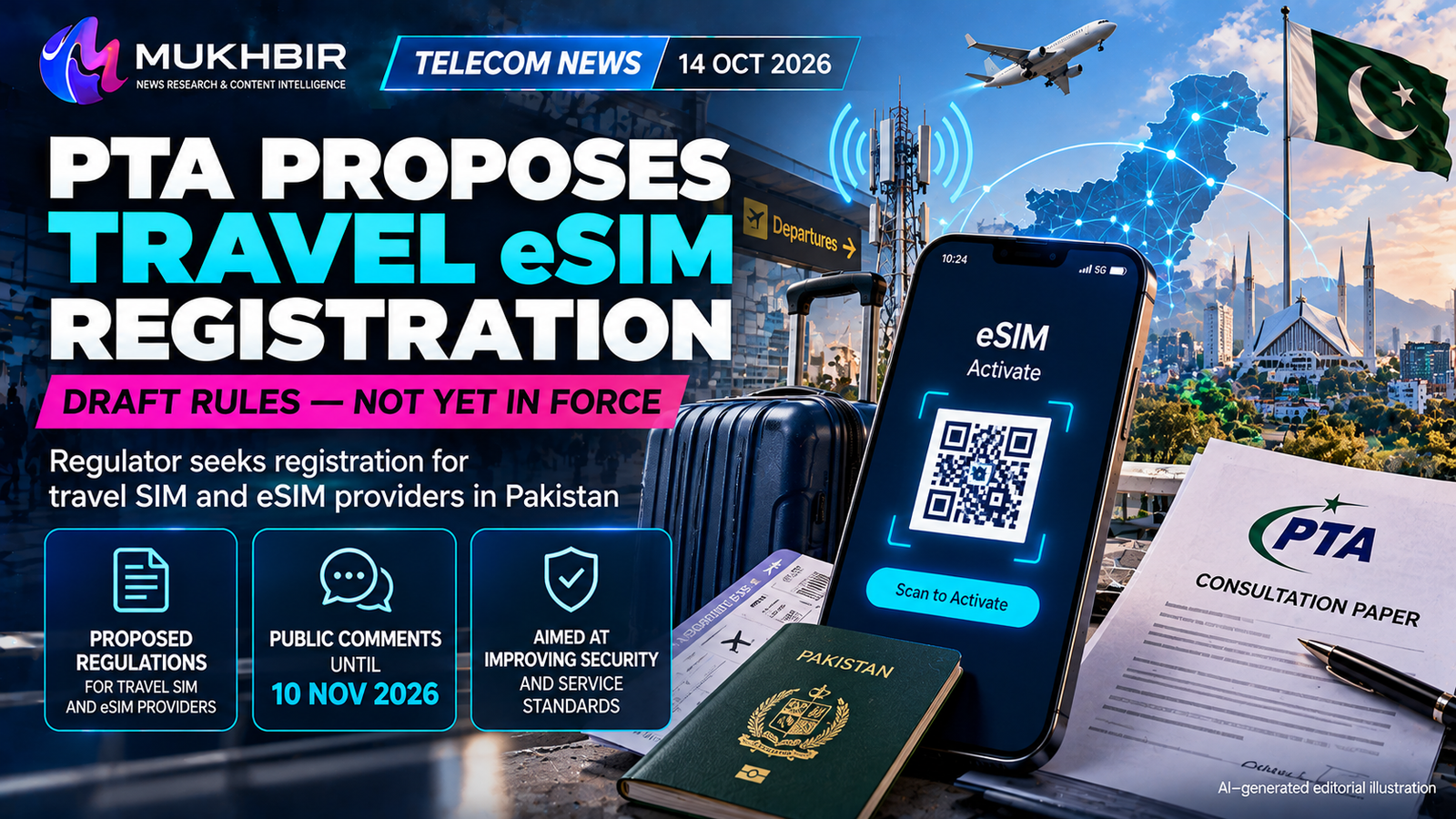
ISLAMABAD – October 14, 2026: The Pakistan Telecommunication Authority (PTA) has proposed a registration framework for travel SIM and eSIM aggregators under draft rules intended to regulate international roaming connections operating on Pakistani mobile networks. The proposed measures would require businesses offering travel SIM and eSIM services to register with the telecom regulator and disclose information about their operator partnerships, distribution channels and local points of contact.
The PTA travel eSIM registration 2026 development was covered by ProPakistani, Feature Pakistan and Raised by Numbers on October 13. Business Recorder and PhoneWorld published earlier coverage of the wider draft International Roaming (Inbound) Regulations, 2026. This article examines the proposal as part of Mukhbir’s October 14 daily Telecom coverage; the proposal itself was not newly announced on October 14.
The distinction between a proposed regulation and a rule already in force is essential. PTA’s consultation period remains open until November 10, 2026, according to published coverage. The draft can change, and any final requirements would take effect only after the formal legal notification process.
What Is PTA Proposing for Travel SIM and eSIM Providers?
Under the draft International Roaming (Inbound) Regulations, 2026, businesses operating as travel SIM or eSIM aggregators in Pakistan would need prior PTA registration. The framework covers firms that distribute or facilitate the activation of travel connectivity products allowing customers to roam on Pakistani networks.
ProPakistani reported that applicants would submit specified registration forms, prescribed fees and documentary evidence about their operations. They would also identify foreign mobile operators, network or IMSI partners, channels used to distribute services and a responsible local contact.
PTA would gain a regulatory mechanism to supervise which providers are offering international roaming products in the domestic market. The purpose is to make customer activations more traceable and clarify the relationship between the retailer, foreign operator and licensed Pakistani mobile network.
The requirements remain proposed. The reviewed articles do not establish that every travel eSIM seller must pay a particular newly enacted registration charge today.
Why Is PTA Considering These Regulations?
Travel eSIM services allow a user to install a mobile profile digitally, frequently without purchasing a physical SIM after arriving in a country. This can be convenient for tourists, business travellers and overseas Pakistanis visiting home.
The regulator’s concern is that an incoming roaming connection may operate without the same local customer verification procedures applied to domestic SIM registrations. PTA has linked this gap to challenges investigating spoofed calls, phishing, extortion, e-commerce fraud and other alleged misuse.
An international roaming SIM is not inherently suspicious or illegal. The draft addresses the identity and monitoring framework around services, not a blanket prohibition on ordinary travellers using foreign mobile subscriptions.
Policymakers will need to balance traceability, privacy, ease of travel and the practical capabilities of foreign operators. The consultation period offers an opportunity to examine those trade-offs.
What Details Would Providers Have to Disclose?
Published summaries of the proposed framework describe business-registration details, supporting documents, associated foreign operators or network suppliers and the channels through which a provider offers its services.
A company may also have to designate a Pakistan-based representative or local contact to communicate with PTA. Such a requirement could help the regulator serve notices, request compliance information and coordinate with businesses whose technical operations extend across borders.
The proposal contemplates prescribed annual fees, security deposits and renewal procedures. The amounts and detailed eligibility terms should be checked in the final regulatory text; the available reporting does not establish a universally applicable finalized fee schedule.
For customers, this would primarily regulate service providers rather than require each traveller to register as a telecom business.
How Would Travel eSIM Activation Be Monitored?
The draft framework would require registered providers to offer or activate eSIM profiles through valid commercial arrangements with licensed operators or foreign home operators. Providers may need to report issued or activated profiles and related customer-verification information.
PTA could direct providers to connect their systems to a designated portal or application programming interface, enabling periodic or near-real-time reporting about activations. Such technical integration would be part of regulatory oversight rather than proof that the authority automatically reads the contents of personal phones.
Providers may also need data-sharing arrangements and records sufficient for authorized investigations. Exact technical specifications and security controls would need to be reviewed once final requirements are published.
The public should distinguish subscriber-identification records from the content of private conversations or files. No unrestricted access to every user’s phone is established by the cited proposal.
What Is an eSIM and How Is It Different From a Physical SIM?
An eSIM is a digital subscriber identity profile supported by compatible hardware. A customer can often install a profile by scanning a QR code or following instructions in an app, instead of inserting a removable plastic SIM card.
Some travel providers resell access arranged through international roaming partners. Customers can purchase a data package before arriving abroad and activate connectivity on a local partner network.
A physical foreign SIM can also roam in Pakistan through agreements between the home network and a licensed Pakistani operator. The regulator’s draft concerns inbound roaming more broadly, including relevant physical SIMs and digital eSIM profiles.
Not every digital eSIM is a travel eSIM. Locally issued Pakistani eSIM subscriptions follow the applicable domestic telecom registration framework.
Proposed Customer Identity Checks for Inbound Roaming
The wider draft regulations would introduce Know Your Customer, or KYC, checks for people using foreign SIMs or eSIMs on Pakistani mobile networks. ProPakistani and Business Recorder reported that proposed information fields include passport or travel-document details, nationality, the home operator and the expected length of stay.
Some proposed verification methods involve a welcome-SMS link, a PTA-approved digital portal, coordination with immigration information or assistance from registered aggregators.
A verification requirement is not the same as a present-day instruction for everyone to upload passport scans to an unfamiliar website. Travellers should use official operator or regulator channels and avoid phishing links.
Implementation details, acceptable documents, privacy protections and any exemptions may change after stakeholder comments are considered.
Would Foreign SIMs Face a 90-Day Roaming Limit?
Business Recorder, PhoneWorld and Pakistan Era reported that the draft introduces a permanent-roaming threshold when a foreign SIM is used in Pakistan for 90 days or more within a rolling 180-day period.
The proposed mechanism would allow a local network to seek confirmation through the foreign home operator about whether the user is a genuine traveller. If an explanation is not available or a connection is linked to abuse, further action could follow under the rules.
This is not confirmation that all overseas Pakistanis currently lose service on the 90th day. The proposal is in consultation and has not been shown by the reviewed reports to be in force.
Long family visits and repeated cross-border travel are among the practical circumstances that deserve close consideration during the consultation process.
Can PTA Suspend or Cancel Provider Registrations?
The draft gives PTA proposed powers to suspend or cancel registrations where providers do not comply with applicable requirements. This could include shortcomings in required reporting, unauthorized service arrangements or failures to meet regulatory obligations.
The final conditions and appeal procedures should be established from the notified legal instrument rather than assumed from a summary of an early draft.
Enforcement powers need clear definitions so compliant businesses understand their obligations and customers are not unexpectedly disconnected without adequate notice or lawful process.
The existence of a proposed power does not imply that a particular travel eSIM company has already been found in violation or banned.
What This Could Mean for Overseas Pakistanis
Many overseas Pakistanis visit Pakistan using SIM cards issued in the Gulf, United Kingdom, United States and other countries. Travel eSIMs may also serve people who want data immediately on arrival while maintaining their home-country phone number.
If implemented, the framework could affect how travel eSIM plans are sold and how customer details are checked, particularly for long or repeated visits. It may also change the responsibilities of travel connectivity retailers.
However, the draft does not mean the services are banned today. Overseas Pakistanis should verify the current rules with PTA and their mobile provider rather than making travel decisions based solely on an unfinished proposal.
The government may also need to clarify how this framework interacts with separate device-registration arrangements.
Does This Replace PTA’s 120-Day Mobile Phone Registration Facility?
No direct replacement has been established in the reviewed reporting. Device registration and inbound roaming subscriber verification address different regulatory questions.
PTA’s temporary mobile phone registration facility allows eligible overseas visitors to register a personal device for a limited stay under relevant rules. Inbound roaming regulations, by contrast, deal with foreign network subscriptions and the entities distributing those services.
Travellers should not assume that compliance with one scheme automatically satisfies every requirement under the other. The final regulatory guidance should specify any interactions or exemptions.
Because the draft has not taken effect, users should rely on currently operating official services rather than hypothetical future forms.
Privacy and Data Protection Questions
Subscriber traceability can help authorities examine fraud and telecom misuse, but collecting additional identity records also creates privacy and cybersecurity obligations.
Providers may need to protect passport details, travel dates and activation data against unauthorized disclosure. The rules should establish appropriate access controls, retention periods, reporting safeguards and accountability.
ProPakistani’s coverage of the wider regulations mentioned a proposal for operators to retain customer verification records for at least 12 months after roaming use ends, unless PTA specifies otherwise.
This is a reported draft retention requirement, not evidence that private communications would be retained or opened to public access. Precise distinctions matter when explaining regulatory changes to travellers.
Impact on Travel eSIM Businesses and Telecom Operators
Businesses selling travel connectivity may face new paperwork, registration costs, technical reporting obligations and the need to maintain compliant relationships with partner networks.
For established providers, clear rules could reduce uncertainty about market access. Smaller sellers may need additional resources to meet reporting and security requirements.
Local mobile network operators may also need to coordinate identity verification, roaming monitoring and responses to suspected misuse. Operational changes could require investments in software, staff training and compliance processes.
The effects on retail prices, choice and competition remain uncertain. No credible figure in the reviewed coverage establishes an immediate increase in travel eSIM package charges.
What Happens Before the Rules Take Effect?
PTA has invited written comments on the draft by November 10, 2026, according to ProPakistani and other published sources. Stakeholders may submit concerns or propose changes to the framework.
After reviewing feedback, the regulator could revise the draft and proceed through formal notification requirements. A final version may differ from the rules described in initial news reports.
A business or traveller should not present draft conditions as currently binding unless an official notification shows they have entered into force.
Mukhbir will need to update this article once PTA publishes the final text, including effective dates, fee levels, exemptions and approved verification procedures.
Why This Story Matters to Pakistan’s Digital Economy
Travel SIMs and eSIMs are part of the wider shift toward digital connectivity. They support tourism, business travel, cross-border work and the ability to access communications without buying a new physical card for every journey.
Clear rules may help reduce misuse and improve regulatory accountability, but complicated procedures could also create inconvenience or barriers for legitimate visitors. The final balance will depend on implementation.
The regulatory debate is directly relevant to Pakistan’s telecom market and also to overseas Pakistanis and international travellers. Its relevance is practical rather than speculative.
At present, the verified development is a proposed registration and monitoring framework—not a completed ban on foreign eSIM services or proof that every traveller must undergo new checks immediately.
Frequently Asked Questions
Is PTA travel eSIM registration mandatory now?
The reviewed reports describe draft regulations under consultation, not a fully implemented registration requirement.
What is the PTA travel eSIM registration 2026 proposal?
It would require travel SIM and eSIM aggregators operating in Pakistan to register with PTA and meet specified disclosure and reporting obligations.
What is the public consultation deadline?
Published coverage states that comments on the draft can be submitted until November 10, 2026.
Will foreign SIM cards be banned in Pakistan?
The proposal does not establish a blanket ban on foreign SIMs. It seeks verification and controls for incoming roaming services.
What is the proposed 90-day roaming threshold?
Reports say foreign subscriptions used for 90 days within 180 days could be treated as permanent roaming, potentially triggering additional checks.
Do travellers have to register as eSIM providers?
No. The proposed provider registration targets businesses operating as travel SIM or eSIM aggregators; user KYC is a separate matter.
Does PTA gain access to the contents of every smartphone?
No such unrestricted access is established by the cited draft coverage. It concerns registration, identity checks and service-related reporting.
Will these rules affect overseas Pakistanis?
They could affect some inbound roaming and travel eSIM users if finalized, but exact obligations, exemptions and timing remain to be confirmed.
About The Author