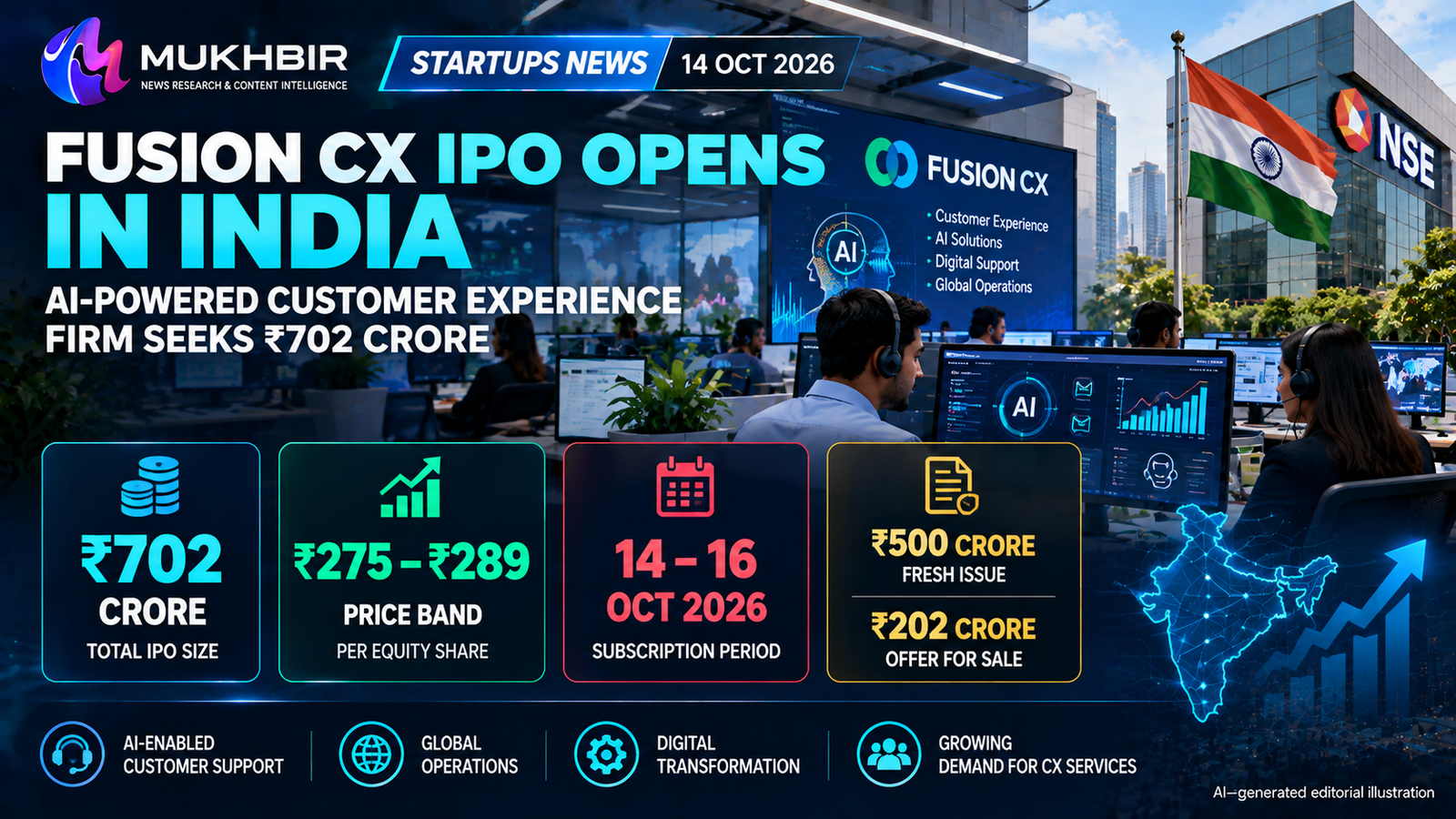
MUMBAI, October 14, 2026 – The initial public offering of Fusion CX, an India-based customer experience and technology-enabled outsourcing company, opened for subscription on Wednesday, bringing a ₹702 crore share sale to India’s primary market. The offering is priced at ₹275 to ₹289 per equity share and is scheduled to remain open until October 16, according to IPO details published by Moneycontrol, Financial Express, NDTV Profit and the Economic Times.
The Fusion CX IPO 2026 is attracting interest because it combines a traditional customer-service outsourcing business with investments in technology and artificial intelligence. The proposed public listing also offers a test of investor demand for companies that promise to combine human-led customer support with automation, data systems and digital customer experience services.
The ₹702 crore figure represents the maximum reported offering size at the upper end of the price band; it does not mean the company has already received that amount from public subscribers. Moneycontrol reported 5% subscription as of 10:25 a.m. India time on the opening day, an early snapshot that is not a final demand figure.
Fusion CX IPO 2026: Key Details
Company: Fusion CX Limited. Sector: Customer experience management, business process outsourcing and technology-enabled services. IPO subscription: October 14–16, 2026. Price band: ₹275–₹289 per share. Total issue size: approximately ₹702 crore at the upper price band. Fresh issue: approximately ₹500 crore. Offer for sale by existing shareholders: approximately ₹202 crore. Lot size: 51 shares. Expected stock exchanges: NSE and BSE. Expected listing date: October 22, subject to the offering timetable and completion of formalities.
Sources include Financial Express, NDTV Profit, Business Standard and Moneycontrol. These are the issue terms and planned timetable available on the morning of October 14; the final allotment and exchange debut have yet to take place.
What Is Fusion CX and What Does It Do?
Fusion CX operates in the customer experience and business process services industry. Businesses outsource customer conversations and related operations to providers that offer trained employees, workflow systems and technology-enabled support across different communication channels.
Such work can include customer service, sales assistance, support operations and business processes. As clients introduce artificial intelligence into service workflows, outsourcing providers face pressure to adapt how agents retrieve information, classify requests, automate routine work and monitor quality.
Fusion CX is described in its market materials as a technology-enabled customer experience provider. That characterization should not be confused with a claim that it develops foundational AI models or sells only software. Its business involves services and customer operations, with technology forming part of its delivery strategy.
Why Is the Company Launching an IPO?
The offering has two components serving different purposes. The fresh issue of ₹500 crore involves new shares sold by the company, generating proceeds for uses outlined in the prospectus. The ₹202 crore offer for sale allows existing shareholders to sell some of their holdings.
Moneycontrol and Financial Express reported that the company intends to use significant fresh-issue proceeds to repay or prepay debt, support subsidiaries, upgrade information technology systems and meet other permitted purposes.
Debt repayment may reduce financing costs and improve balance-sheet flexibility. Investment in technology could support its operational strategy, but no specific future revenue or profit uplift is guaranteed by the IPO announcement.
It is essential to distinguish proceeds flowing into the company from proceeds received by selling shareholders. The full ₹702 crore is not automatically available to management for expansion.
How Much Will Investors Pay Per Lot?
The stated lot size is 51 shares. At the lower end of the price band, a 51-share lot costs ₹14,025, while at ₹289 per share it costs ₹14,739 before any applicable transaction charges.
The price band is a range for the offering, not a forecast of where shares will trade after listing. Investors using a broker must check the final applicable rules, allocation process and offer documents.
Subscription itself does not guarantee allotment. Demand may exceed shares available in some categories, and the final process follows the allocation rules described in the offering materials.
How Did Anchor Investors Respond?
Ahead of the public opening, Fusion CX secured approximately ₹315.9 crore through an anchor investor allocation, according to reporting by Financial Express and Economic Times. Investors described in the coverage included established domestic institutions and investment participants.
Anchor subscriptions can signal institutional interest, but they are not proof that a public offering will perform well after listing. Such investors may follow different strategies, holding restrictions or portfolio mandates than retail applicants.
The anchor allocation occurred before the main public subscription period and should be reported separately from day-one retail and noninstitutional bidding figures.
What Happened on the First Day of Subscription?
Moneycontrol reported that the IPO had received bids for 638,673 shares against approximately 14,040,000 shares on offer by 10:25 a.m. Indian time on October 14, corresponding to about 5% subscription at that point.
The same snapshot showed approximately 19% subscription in the retail portion and 4% in the noninstitutional category. These were opening-hour numbers; subscription can change substantially during the three-day bidding window.
Mukhbir does not present the early subscription reading as a final verdict on market appetite. The complete subscription data and final allotment should be checked after the relevant stages close.
Why AI Matters to Customer Experience Companies
Artificial intelligence is reshaping customer support by enabling automated responses, assistance to human representatives, faster information retrieval and analysis of large volumes of requests. For business process outsourcing companies, these technologies offer possible productivity gains as well as new competition.
Technology can help service teams resolve routine questions, but more complex or sensitive interactions may still require people who can understand context and take responsibility for decisions.
Companies adopting AI must also address accuracy, privacy, quality assurance and the risk of automated systems giving customers incorrect information. Investors evaluating Fusion CX should distinguish planned technological investment from proven operating results.
An IPO linked to AI can attract attention without demonstrating that a company will receive a particular share of future AI industry revenues. Its competitive position depends on client relationships, service quality, pricing and execution.
What Are the Main Business Risks?
The first consideration is competition. Customer support outsourcing is a global industry, and service providers compete on cost, domain expertise, language capability, operational reliability and technology. Clients may switch providers or change the amount of work handled externally.
A second issue is technological disruption. AI can help an outsourcing operator become more efficient, yet clients may also automate parts of the work themselves. The net effect on staffing, contract pricing and margins varies by service type.
A third issue is financial performance. Investors need to review audited financial statements, debt obligations, cash generation, margins and the use of proceeds rather than relying on company descriptions or grey-market chatter.
Finally, postlisting share prices are influenced by broader market conditions and the valuation investors ultimately assign to the business. The offer price is not a promise of capital gains.
How Reliable Is the Grey Market Premium?
Some financial websites publish a grey market premium, or GMP, as an informal indication of unofficial trading interest before the listing. These figures can change rapidly and do not represent an official exchange quotation.
The practice may be useful for understanding speculative market conversation, but it is not a validated predictor of the actual listing price. A stock can list below its offer price even when early unofficial indications are positive.
For that reason, this article does not suggest a guaranteed percentage return or recommend subscribing solely because of a reported premium.
What Happens on October 16 and October 22?
The public subscription period is scheduled to end on October 16. Allotment procedures and related settlement steps are expected to follow, with market reporting pointing to an October 22 debut on Indian exchanges.
These dates are planned milestones and are subject to applicable exchange, regulatory and company processes. Until trading officially begins, the listing should not be described as completed.
The next independently newsworthy updates will include final subscription demand, allotment results, any change to the timetable and verified opening trading data.
Why This IPO Matters to the Indian Startup Ecosystem
India’s startup and growth-company ecosystem includes businesses that serve global customers from domestic operations. Public offerings can give such firms wider access to investors, establish market valuations and offer liquidity to some early backers.
However, Fusion CX should not be equated with an early-stage startup in the funding-round sense. Its proposed IPO is a more mature capital-market transaction and should be analyzed on the basis of its existing operations and disclosures.
The offering also illustrates the overlap between business services and artificial intelligence. Investors increasingly expect traditional service businesses to explain whether technology creates measurable efficiencies and durable customer demand.
What Is the Relevance for Pakistan and South Asia?
The transaction is centered on India, but customer support outsourcing, technology-enabled services and AI adoption are relevant business themes across South Asia. Firms in Pakistan, Bangladesh and other regional markets also compete for international digital-service contracts.
The IPO does not establish a direct Fusion CX investment, new office or employment announcement in Pakistan. Such claims would require a specific company disclosure.
For Pakistani startup founders and service businesses, the general lesson concerns building predictable revenue, using technology responsibly and understanding the distinction between private funding and a public-market share sale.
What Should Readers Watch Next?
The most useful data points will be the final subscription multiple on October 16, detailed allotment disclosures and the first verified exchange trading prices after the planned listing.
Investors may also examine how Fusion CX allocates the fresh issue proceeds, whether debt repayment improves its financing position and how its technology investments affect customer operations over time.
As of the October 14 opening, the supported development is a ₹702 crore IPO at a ₹275–₹289 price band, backed by an earlier anchor allocation, with public bidding underway. Its commercial outcome and market performance are still unknown.
Frequently Asked Questions
When did the Fusion CX IPO 2026 open?
Public subscription opened on October 14, 2026, and is scheduled to close on October 16.
What is the IPO size?
The offering is reported at approximately ₹702 crore at the top end of the price band, combining fresh shares and an offer for sale.
What is the Fusion CX IPO price band?
The stated band is ₹275 to ₹289 per equity share.
How much is the fresh issue?
Approximately ₹500 crore of the offering comprises fresh shares issued by the company.
What is the offer-for-sale portion?
Existing shareholders are offering approximately ₹202 crore worth of shares, subject to the offering terms.
How many shares are in one retail lot?
The reported lot size is 51 shares, costing ₹14,739 at the upper price band before charges.
When are the shares expected to list?
Market coverage points to October 22, 2026, for a planned NSE and BSE listing, subject to confirmation.
Is an IPO investment guaranteed to make money?
No. Share prices can rise or fall after listing, and neither anchor demand nor unofficial grey-market premiums guarantee a return.
About The Author