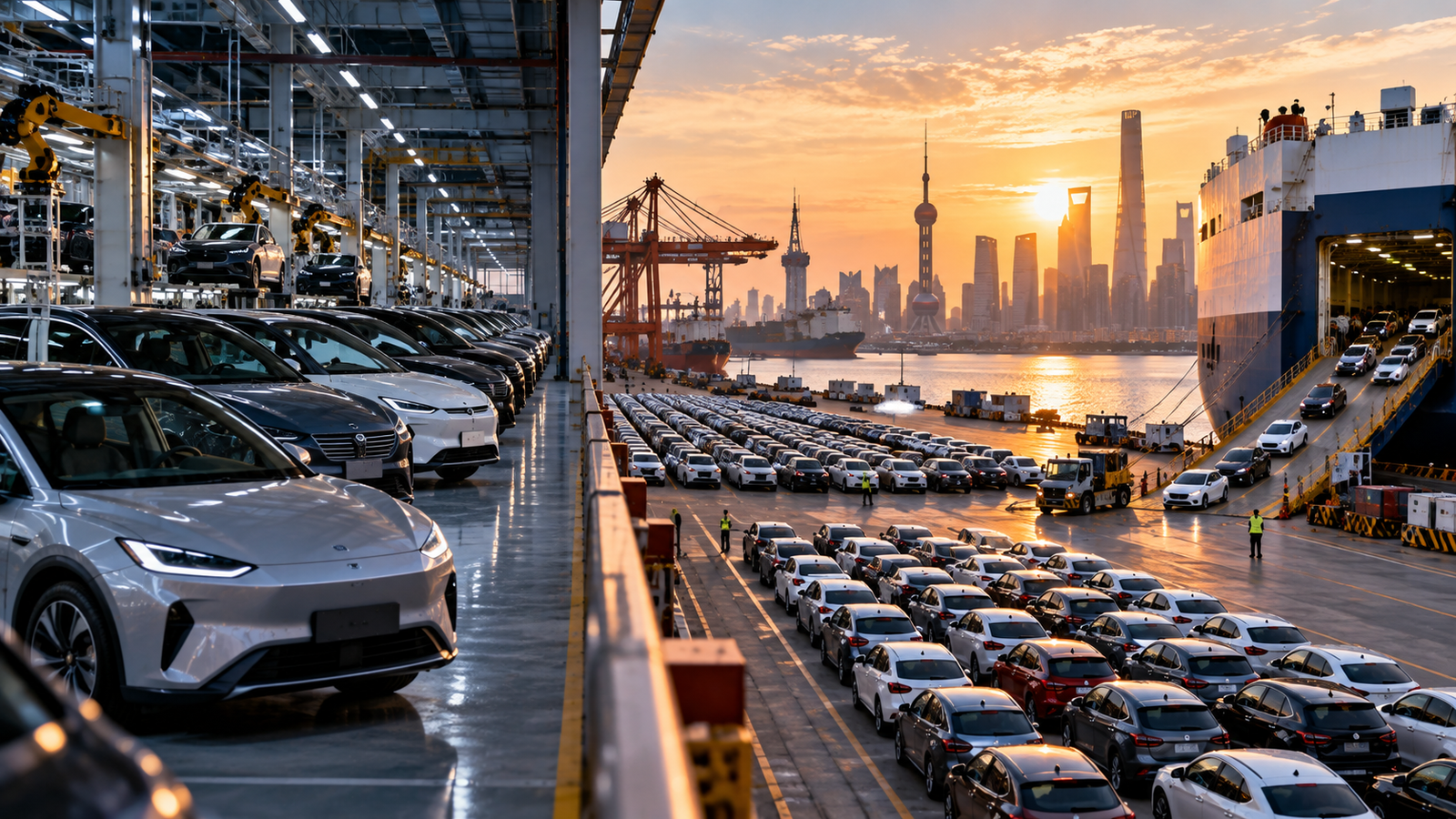
China car sales 2026 continued to weaken in September even as Chinese automakers shipped sharply more vehicles overseas. Domestic passenger car sales fell 28.1% from a year earlier to about 1.63 million vehicles, while exports rose 73.2% to approximately 923,000, according to industry figures cited by Reuters on October 12. The contrasting trends reveal a major challenge for the world’s largest auto manufacturing base.
Domestic demand has now reportedly declined for 12 consecutive months. September’s 28.1% drop was steeper than August’s 23.7% fall in the same Reuters data series. Exports, by contrast, continued growing strongly after a 77.5% annual increase in August. The figures underscore how much more important foreign buyers have become for manufacturers facing weaker conditions at home.
These measurements should be read carefully. China has several automotive statistical series covering domestic sales, retail registrations, wholesales and exports. Numbers published by different associations may differ because they include different vehicles, reporting populations or sales channels. The September figures above are from the series described in Reuters’ October 12 report and should not be casually combined with a different dataset.
For international buyers, the story raises questions about affordability, competition and the future of electric vehicles. For carmakers and investors, it highlights the financial pressures created when factories must depend more heavily on export markets to maintain production volumes.
What happened to China’s car market in September?
According to Reuters’ October 12 report based on industry data, China’s domestic passenger vehicle sales dropped 28.1% year on year to 1.63 million units in September. That was the twelfth consecutive month of annual contraction, showing that the downturn has persisted beyond a single weak sales period.
At the same time, September exports grew 73.2% compared with a year earlier, reaching 923,000 vehicles. This was another strong month after exports rose 77.5% in August. Export growth and domestic contraction therefore occurred simultaneously, rather than representing an overall increase in consumer demand inside China.
September comparisons can be influenced by promotions, policy incentives, stock availability and the strength of sales in the prior-year period. The monthly percentage change alone cannot establish the contribution of each factor. A complete assessment requires looking at year-to-date results, inventory conditions and changes in government support.
Why are domestic vehicle sales falling?
Weak consumer demand is part of the explanation. Buying a car is a major household expense, and consumers may postpone purchases when income expectations, property-related finances or economic confidence are uncertain. A crowded marketplace can also encourage shoppers to wait for discounts or newer models.
The broader industry has faced adjustments to subsidies and tax incentives for new-energy vehicles. Changes to purchase support can move demand between periods: buyers may bring forward purchases before a benefit expires, leaving a weaker comparison later. Manufacturers then face pressure to increase discounts to maintain volumes.
Competition has intensified across both combustion-engine and electrified models. Numerous brands are trying to attract buyers through pricing, range, software features and design. Price cuts can support unit sales but weaken earnings if production costs do not fall at the same pace.
A prolonged sales decline may also reflect the exceptionally high baseline in previous periods. Analysts need to separate genuine weakness in underlying demand from statistical effects. The September result clearly signals contraction in the reported series, but no single month identifies every cause.
Why are Chinese auto exports growing so fast?
Overseas demand gives automakers another route to scale. Chinese manufacturers have invested heavily in modern production facilities, battery technology and broader vehicle lineups. When home-market sales slow, international orders can help sustain production and make greater use of existing capacity.
Competitive pricing has been a major element of Chinese exporters’ appeal. Some brands offer relatively generous equipment, modern interiors and electric powertrains at prices that challenge established international manufacturers. Their success varies by destination because exchange rates, tariffs, brand recognition and after-sales networks differ.
Exports also include a mix of propulsion technologies. Battery-electric vehicles and plug-in hybrids attract considerable attention, but not every exported vehicle is fully electric. Statistics covering passenger-car exports should not be treated as a direct measure of electric-car exports unless the source specifically defines them that way.
September’s 73.2% growth represents a year-on-year comparison, not an assertion that exports accounted for 73.2% of all vehicles sold. Understanding the distinction helps readers avoid a common error when evaluating dramatic headline percentages.
China’s overseas expansion changes the global industry
Strong exports can pressure competitors in Europe, Latin America, Asia, Africa and other destinations. Established manufacturers may need to reduce costs, refresh products and offer more electrified options in response. Some may pursue partnerships, local assembly arrangements or changes in their own supply chains.
International expansion also comes with challenges. Selling vehicles in a new country requires spare parts, warranty systems, service centres, financing and customer support. A brand that exports large volumes initially still needs a sustainable local business to retain buyers over time.
Shipping capacity matters, too. Transporting hundreds of thousands of vehicles involves specialized car carriers, ports, customs procedures and delivery networks. Logistics costs and delays can materially affect the competitiveness of an imported vehicle.
Export growth is positive for producers with competitive models, but it does not guarantee profitability. Overseas distribution, marketing and compliance costs can offset part of the revenue benefit. Investors should assess margins and cash flow alongside shipment totals.
Electric vehicles and China’s changing competitive landscape
China’s auto industry plays a central role in the global transition to electric mobility. Domestic manufacturers have developed significant battery, software and manufacturing capabilities, while foreign brands also produce vehicles in China for both local buyers and export markets.
Demand for new-energy vehicles is not insulated from wider market conditions. A slowing domestic auto sector can still affect electric models through pricing pressure, inventory adjustments and changes in subsidies. The direction of total car sales and the market share of EVs are different indicators and may move in opposite directions.
Companies such as BYD, Geely and other exporters compete against traditional global manufacturers on price, technology and design. Their competitive positions differ across countries, and one manufacturer’s performance should not be assumed to represent the entire Chinese industry.
The wider shift may help consumers gain access to more vehicle choices. Yet the result will depend on local regulations, charging availability, duties and the ability of brands to establish reliable service networks.
How the figures compare with other industry reports
Different releases around September 2026 describe China’s market using distinct metrics. A Bloomberg report citing the China Passenger Car Association put September passenger vehicle retail sales at approximately 1.702 million, down 24% year on year. Reuters’ October 12 article cited a different domestic measure of around 1.63 million and a 28.1% decline.
The figures are not necessarily contradictory: retail deliveries, domestic wholesale volumes and association classifications can produce different results. However, without matching definitions and data tables, editors should not calculate new combined totals or select one figure as universally representative.
For Mukhbir, this article consistently attributes the headline’s 28.1% and 73.2% percentages to the Reuters-reported series. The alternative retail estimate is included to clarify why readers may see different numbers in other coverage.
The most robust conclusion across reports is that China’s home car market weakened while external shipments remained a major source of growth. Precise comparisons over time should use one consistent statistical series.
Trade tensions and tariffs are growing risks
As exports rise, receiving markets may scrutinize pricing, subsidies, supply chains and the effect on domestic manufacturing jobs. Governments can respond through tariffs, import investigations, technical requirements or negotiations with exporting countries.
Such policies can increase the landed cost of a vehicle, potentially limiting the price advantage of Chinese brands. They may also encourage companies to manufacture closer to end markets rather than rely entirely on shipments from China.
The European Union and China have already been engaged in automotive trade discussions. Any new agreement should be interpreted according to the precise vehicles and trade measures it covers, rather than presented as a blanket settlement of all electric-vehicle disputes.
For the auto industry, regulatory uncertainty complicates investment decisions. A company planning a factory or distribution network must estimate future demand under changing duties, product rules and political conditions.
What does this mean for Chinese automakers and investors?
A company can sell more cars abroad while experiencing lower sales and margins at home. Shareholders therefore need to consider geographic mix, currency exposure, operating profit and the cost of building an overseas network. Unit growth is only one part of the financial picture.
When domestic competition is intense, companies may accept lower vehicle margins to protect factory utilization. If export volumes grow, those sales can spread fixed manufacturing costs over more units. Whether this produces higher profits depends on the prices and expenses of international operations.
Investors also watch inventory. If factories produce vehicles faster than customers and distributors can absorb them, unsold stock creates working-capital pressure. Export figures may reflect completed shipments before the vehicles are delivered to final buyers in destination markets.
The longer-term test will be whether Chinese carmakers build durable international brands. Reliable after-sales support, customer satisfaction, product safety and resale value can matter as much as a competitive initial price.
Potential impact on Pakistan and South Asia
The global rise in Chinese automotive exports is relevant to Pakistan because Chinese brands and vehicle technology are already part of the regional auto market. Wider international availability may influence future model selection, pricing and partnerships, although September’s China-wide export growth does not establish a particular increase in shipments to Pakistan.
Local prices depend on duties, exchange rates, freight, assembly arrangements and financing costs. A vehicle that is competitively priced in China may still be expensive in Pakistan after import-related charges and dealer expenses. Consumers should compare official local specifications and warranties rather than relying solely on foreign-market prices.
In South Asia, governments and manufacturers must balance affordability with industrial development and safety requirements. Imports can introduce new technologies, while sustainable local assembly and parts manufacturing require a predictable regulatory environment and sufficient market demand.
No September 2026 Pakistan-specific shipment figure is confirmed by the broad China export data used in this report. That distinction prevents the global story from being turned into an unsupported local claim.
What happens next in China’s auto market?
The next monthly releases will show whether domestic sales continue to fall and whether exports maintain their rapid expansion. Analysts will also watch vehicle pricing, discount campaigns, policy incentives, inventories and trade measures in importing countries.
The October data may be influenced by holiday-related purchases and the timing of industry promotions. For a meaningful trend, it is better to follow several consecutive months than to make a definitive forecast from one release.
Manufacturers will need to address two challenges simultaneously: winning buyers at home and competing successfully overseas. Strong exports offer an opportunity, but the domestic downturn remains a warning about the pressure facing one of the world’s most important car markets.
As of October 12, 2026, the verified central finding is clear: China’s reported September domestic passenger car sales fell sharply, while exports jumped. The lasting business impact will depend on profitability, regulations and consumer demand in both home and overseas markets.
Frequently Asked Questions
How much did China car sales fall in September 2026?
Reuters reported a 28.1% year-on-year fall in domestic passenger vehicle sales, to about 1.63 million units, in the data series used for this article.
How much did Chinese car exports grow?
Exports rose 73.2% from September 2025 to approximately 923,000 vehicles, according to the October 12 Reuters report.
How many months have domestic sales declined?
Reuters reported twelve consecutive months of year-on-year contraction in the domestic car sales series.
Why are exports rising while domestic demand is falling?
Manufacturers are expanding overseas sales while local buyers face economic uncertainty, intense competition and shifting purchase incentives.
Are all exported Chinese cars electric?
No. Total passenger vehicle exports include different powertrains; they should not be confused with purely battery-electric vehicle exports.
Why do other reports show different China sales numbers?
Data providers may use retail, wholesale or other market definitions. Figures must be compared within consistent reporting series.
Will rising Chinese exports make cars cheaper in Pakistan?
Not necessarily. Local prices depend on duties, exchange rates, shipping, product specifications and dealer arrangements.
What should the global auto industry watch next?
Watch domestic demand, export profitability, inventories, price competition and tariffs in major overseas markets.
About The Author