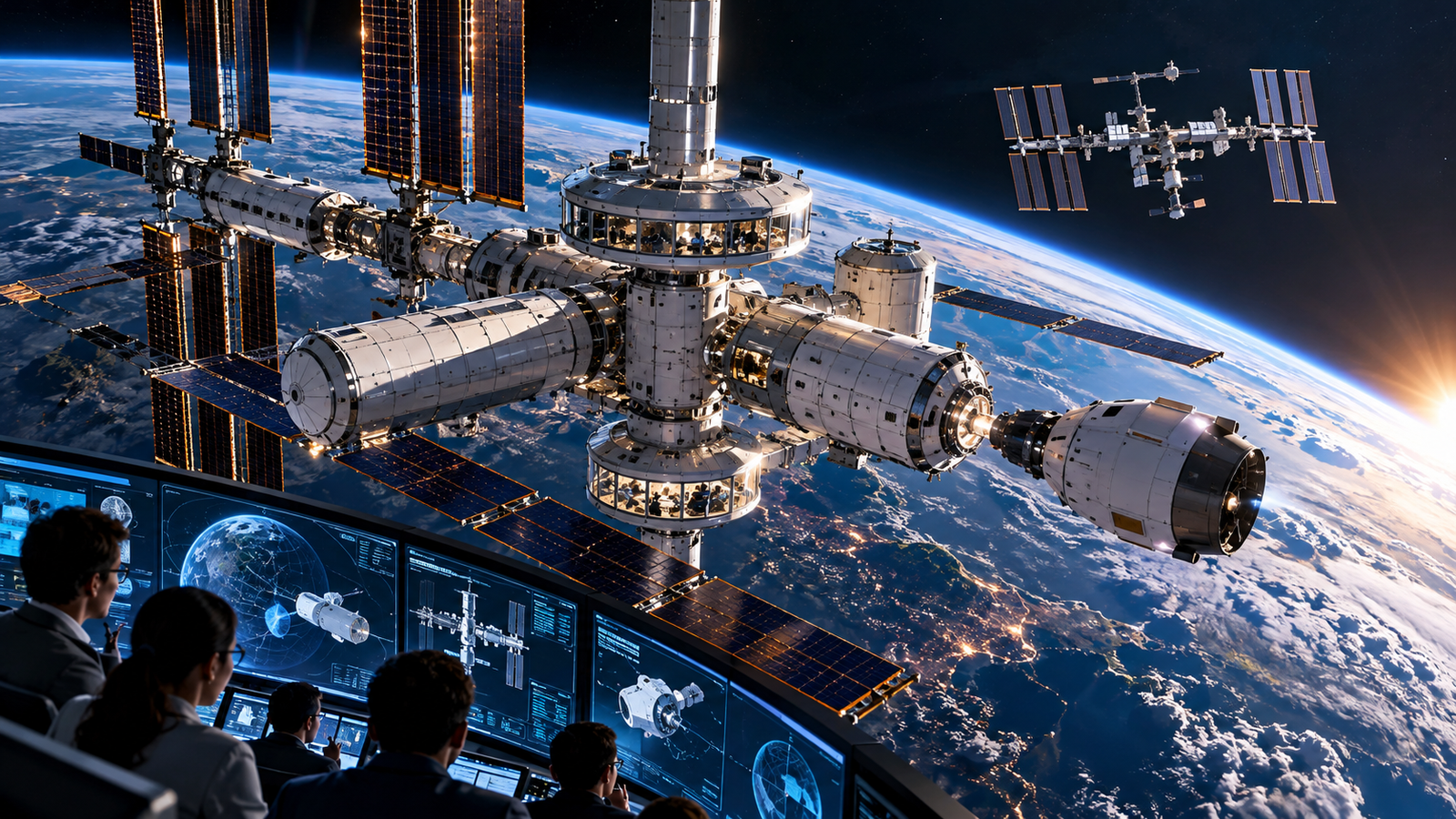
NASA has issued a final request for proposals inviting U.S. companies to submit plans for the next generation of commercial space stations in low Earth orbit, marking a major step in the agency’s transition away from the International Space Station.
The October 9 announcement is part of NASA’s strategy to maintain a continuous human presence in low Earth orbit after the ISS reaches the end of its operational life around 2030. Rather than owning and operating the next station itself, NASA wants to buy services from privately owned platforms that also serve commercial and international customers.
NASA Administrator Jared Isaacman said the agency still needs low-Earth-orbit facilities for research, technology development, crew training and preparation for missions to the Moon and Mars. The commercial model is intended to preserve those capabilities while allowing NASA to direct more resources toward deep-space exploration.
The final request for proposals follows months of industry consultation, including a draft released in July 2026. NASA says the new procurement approach is designed to support multiple commercial providers, reduce the risk of a gap after the ISS retires and encourage a broader marketplace in orbit.
Why NASA Is Moving Toward Commercial Space Stations
The International Space Station has been central to human spaceflight for more than two decades. It supports microgravity research, technology testing, astronaut training and international cooperation, but the platform is aging and is not intended to operate indefinitely.
NASA’s long-term plan is to transition those activities to commercially owned and operated stations. Under this model, NASA would become one customer among several instead of being the primary owner and operator.
This approach is similar to the agency’s commercial crew strategy, which helped shift astronaut transportation to private companies such as SpaceX. NASA hopes a similar market can emerge for orbital destinations.
The model could reduce government costs over time if station operators are able to earn revenue from other customers including private companies, research institutions, sovereign governments and space tourists.
What the Final Request for Proposals Means
NASA’s final request for proposals is a formal procurement step. It allows U.S. companies to submit detailed plans explaining how they would design, demonstrate, certify and operate future commercial stations.
The agency has said it intends to use Federal Acquisition Regulation-based contracts awarded through full and open competition. NASA’s earlier draft outlined a multi-award structure designed to support more than one provider during development before narrowing the field for later certification and service purchases.
That competitive approach is important because NASA wants to avoid dependence on a single platform. Multiple viable stations could improve resilience, encourage price competition and reduce the risk that a single technical delay creates a gap in U.S. human spaceflight capability.
NASA Wants a Continuous U.S. Presence in Low Earth Orbit
A central goal of the programme is avoiding a period in which the United States no longer has regular access to a crew-capable orbital station after the ISS is retired.
NASA has repeatedly described a seamless transition as a strategic priority. Low Earth orbit remains an important environment for testing life-support systems, operating spacecraft, studying the human body and preparing crews for longer missions.
These activities are directly relevant to Artemis and future Mars missions because engineers and astronauts can validate technologies relatively close to Earth before relying on them deeper in space.
A commercial station network could preserve that training ground while reducing the amount of government infrastructure NASA must directly manage.
What Companies Are Already Working on Commercial Stations
Several companies have been developing commercial station concepts under earlier NASA partnerships. These include Axiom Space, Blue Origin and its Orbital Reef partners, Starlab, Vast and other companies involved in commercial low-Earth-orbit development.
NASA has previously supported design and technology milestones through Space Act Agreements and related commercial programmes. The new procurement phase is intended to move the industry closer to actual certified services.
Each proposed station has a different business model and architecture. Some are designed around modular expansion, while others aim for smaller initial stations that can grow over time.
The strongest projects will need to demonstrate not only technical feasibility but also a credible commercial market beyond NASA.
Commercial Demand Will Be Critical
NASA does not want future stations to depend entirely on government spending. The agency’s strategy assumes operators can attract additional customers for research, manufacturing, media, tourism, sovereign missions and technology testing.
That is one of the biggest uncertainties in the programme. Technical development can be supported by NASA, but long-term commercial success will depend on whether enough customers are willing to pay for orbital services.
Investors will therefore watch not only engineering milestones but also contracts, reservations and partnerships that show real demand.
If commercial revenue remains weak, private stations may still depend heavily on NASA purchases, reducing some of the economic benefits of the new model.
ISS Retirement Creates a Tight Timeline
The timing matters because the ISS is expected to remain operational through around 2030. Commercial stations must be ready early enough to prevent a long interruption in U.S. access to low Earth orbit.
Space-station development is complex. Companies need to build modules, launch them, assemble systems, certify life support, demonstrate docking and prove that crews can operate safely for extended periods.
Any major delay could increase the risk of a gap. That is why NASA is moving now to formalise its next phase of procurement.
The agency has said industry believes the timeline is achievable, but actual delivery will depend on funding, technical progress and launch availability.
Why Certification and Safety Matter
Human spaceflight requires much stricter standards than uncrewed satellite operations. NASA will need confidence that commercial stations can safely support astronauts, handle emergencies and maintain reliable life-support systems.
Future operators will also need robust docking systems, power, communications, environmental controls and procedures for crew rescue or evacuation.
NASA’s final procurement phase is expected to include formal design acceptance and certification before the agency begins buying services at scale.
This means commercial stations will need to satisfy both business requirements and demanding government safety standards.
Research and Manufacturing Could Be Major Markets
Microgravity research is one of the most important commercial opportunities in low Earth orbit. Pharmaceutical companies, materials researchers and advanced-manufacturing firms can study processes that behave differently without normal gravity.
Some companies also see potential in producing specialised materials, biological products or optical fibres in orbit.
Whether these markets become large enough to support commercial stations remains uncertain, but the ISS has already demonstrated scientific value in many of these areas.
A commercial platform could make access more flexible and potentially create new pricing models for private researchers.
Private Astronaut Missions Could Expand
Commercial space stations could also support more private astronaut missions. Axiom Space has already flown private crews to the ISS, showing that there is demand for missions involving private individuals, national astronauts and research teams.
Independent commercial stations may be able to offer more frequent missions and more tailored schedules than the ISS.
That could create a broader market for astronaut training, tourism and national space programmes that do not operate their own orbital platforms.
Business Impact
The request for proposals could unlock major contracts for aerospace companies, launch providers, life-support suppliers, robotics firms and space-infrastructure startups.
A successful commercial-station market would create a new layer of economic activity in orbit, with private operators purchasing launches, cargo services, communications and maintenance.
It could also increase competition among station developers and reduce costs for customers over time.
However, the sector remains capital intensive and technically risky, so companies may require substantial private investment before recurring revenue becomes predictable.
Technology Impact
Commercial stations will drive demand for new technologies in life support, autonomous operations, power systems, docking, robotics and in-space manufacturing.
Operators will need systems that can function with smaller crews and lower operating costs than the ISS.
Automation may therefore become increasingly important, especially for monitoring systems, maintenance and logistics.
Advances developed for commercial stations could later support lunar habitats and Mars missions.
Global Importance
The shift from government-owned stations to commercial platforms could reshape the global space economy. Countries without their own space stations may be able to purchase access from private operators.
That could make human spaceflight more accessible to smaller national programmes while also increasing competition among U.S., Chinese and other orbital infrastructure providers.
China currently operates the Tiangong space station, giving it a long-term national platform in low Earth orbit. NASA’s commercial strategy is partly about ensuring the United States maintains a strong presence after the ISS era ends.
Pakistan and South Asia Relevance
The direct impact on Pakistan is limited, but commercial stations could eventually create new opportunities for universities, research institutions and national space agencies across South Asia.
If access becomes cheaper and more flexible, countries without independent crewed-spaceflight programmes may be able to send experiments, researchers or technology demonstrations to orbit through commercial partnerships.
For Pakistan, such opportunities would depend on funding, international partnerships and the growth of domestic space research capabilities.
The broader trend is important because commercialisation can lower barriers to participating in space science without requiring a country to build an entire orbital platform itself.
What Happens Next
U.S. companies will now prepare and submit proposals under NASA’s final solicitation. NASA will evaluate those plans based on technical capability, business credibility, safety and the ability to support the agency’s future needs.
The next major milestone will be the selection of contractors and the beginning of formal development work under the new procurement structure.
NASA will also continue monitoring whether the commercial marketplace is strong enough to support multiple stations.
The ultimate test will be whether one or more commercial platforms are operating and certified before the ISS reaches retirement.
FAQs
What did NASA announce?
NASA released a final request for proposals inviting U.S. companies to submit plans for next-generation commercial space stations.
Why does NASA need commercial stations?
The International Space Station is nearing the end of its operational life, and NASA wants to maintain a continuous U.S. presence in low Earth orbit after its retirement.
When is the ISS expected to retire?
NASA plans to transition away from the ISS around 2030.
Will NASA own the new stations?
No. The strategy is based on commercially owned and operated stations from which NASA can purchase services.
Which companies are developing commercial stations?
Companies involved in NASA-supported station development have included Axiom Space, Blue Origin, Starlab, Vast and other commercial partners.
What will NASA use commercial stations for?
NASA expects to use them for research, technology development, crew training and preparation for Moon and Mars missions.
Why is competition important?
Multiple providers could reduce costs, improve resilience and lower the risk of relying on a single station.
Why does this matter globally?
Commercial stations could expand access to human spaceflight and research for countries and companies that do not operate their own orbital platforms.
About The Author