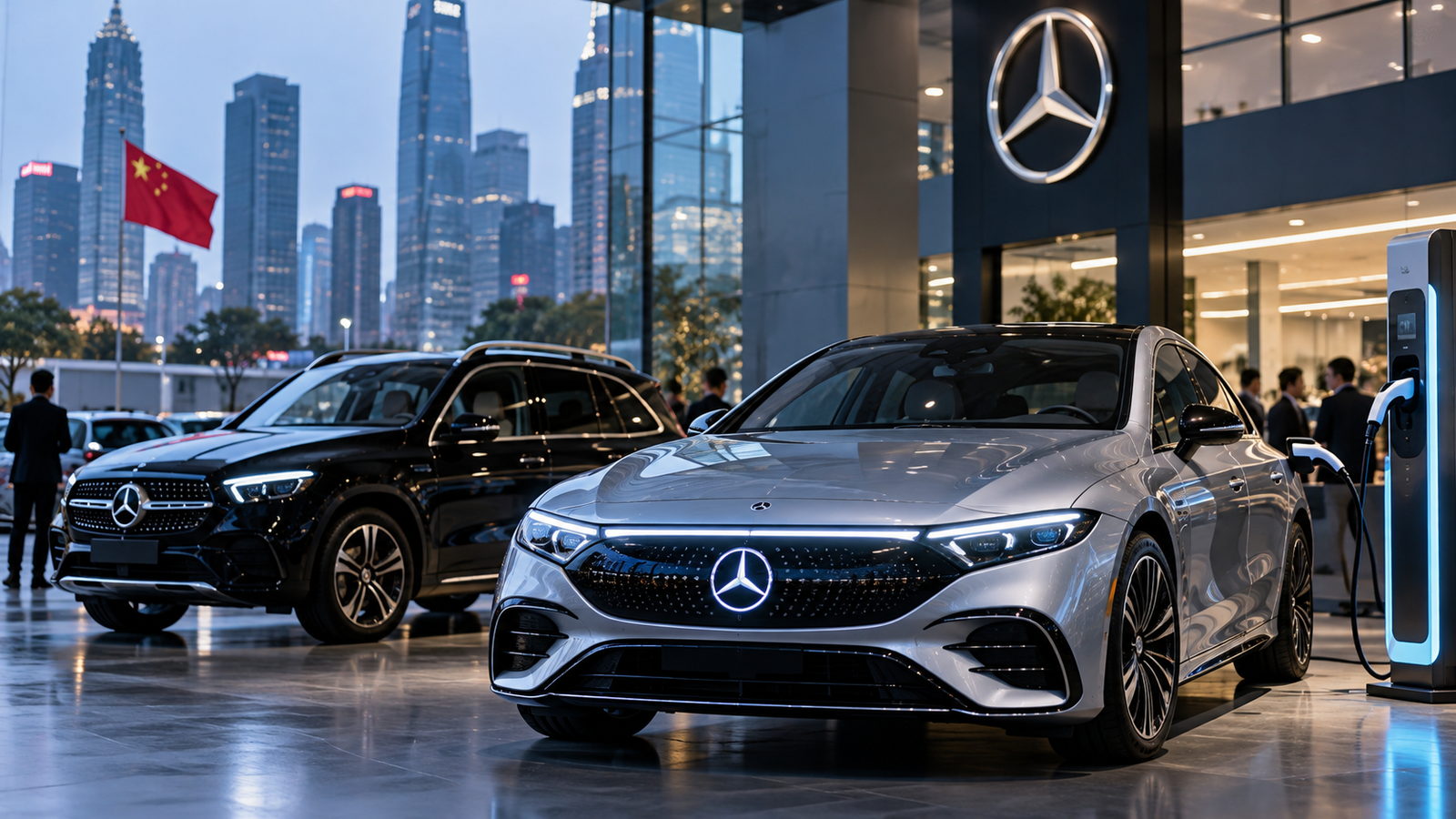
Mercedes-Benz reported a mixed third quarter in 2026, with deliveries in its core passenger-car business falling 8% year on year while battery-electric vehicle sales across cars and vans climbed 52%. The results show how the German luxury carmaker is gaining momentum in electric vehicles even as weak demand in China continues to weigh on its broader business.
Mercedes-Benz Cars delivered 407,200 vehicles worldwide in the July-to-September quarter, according to company figures reported by Reuters. The decline was driven largely by a sharp drop in China, where car deliveries fell 31% to 86,800 units compared with the same period a year earlier.
At the same time, group sales of battery-electric vehicles, including both passenger cars and vans, rose to 78,100 units, up 52% year on year. That contrast is one of the clearest signals in the company’s latest sales update: the overall market remains difficult, but demand for Mercedes’ newer electric products is growing rapidly.
Mercedes-Benz has not yet published its full third-quarter financial results. Those are scheduled for October 28, meaning the current sales figures provide an early look at volume trends rather than a complete picture of revenue, margins or profitability.
China Remains the Biggest Pressure Point
China was the main weakness in the third quarter. Mercedes-Benz said deliveries in the market fell 31% to 86,800 vehicles, continuing a difficult period for foreign premium brands in the world’s largest auto market.
Competition in China has intensified as domestic manufacturers launch new electric and plug-in hybrid vehicles at a rapid pace. Chinese brands increasingly compete not only on price but also on software, in-car technology, charging capability and advanced driver-assistance features.
For Mercedes-Benz and other European premium manufacturers, that has made the market much more difficult. Traditional brand strength remains valuable, but buyers now have a wider choice of locally developed luxury EVs and intelligent vehicles.
The company had already warned earlier in 2026 that China would remain challenging. In July, Mercedes-Benz adjusted its full-year outlook and said car sales were expected to come in slightly below the previous year, citing the difficult market environment in China.
U.S. and European Sales Moved in the Opposite Direction
The weakness in China was partly offset by growth in other major markets. Mercedes-Benz car sales rose 6% in the United States and 5% in Europe during the third quarter.
This regional split matters because it shows the company’s global performance is not uniformly weak. The United States and Europe are currently providing more support, while China remains the largest drag on total deliveries.
Europe has also become an increasingly important market for the company’s electric models. Mercedes-Benz reported earlier in the year that battery-electric car sales had risen strongly in Europe, supported by newer models entering showrooms.
That trend appears to be continuing as the company expands its electric lineup and customers gain access to more recent products built around new EV platforms.
EV Sales Rose 52% to 78,100 Units
The most positive figure in the third-quarter update was the 52% rise in battery-electric vehicle sales across Mercedes-Benz cars and vans. Deliveries reached 78,100 units during the quarter.
This increase follows strong electric growth earlier in the year. In the second quarter, Mercedes-Benz Cars reported a 51% year-on-year increase in battery-electric car sales, with Europe playing a major role in that expansion.
The company is in the middle of a broad product launch programme that includes new electric versions across several segments. New models are intended to improve range, efficiency, software integration and charging performance while giving customers more body styles and price points.
For Mercedes-Benz, sustaining this growth will be important because electric vehicles are becoming a larger part of the company’s long-term product strategy even as adoption varies sharply between regions.
Why the EV Growth Matters
The 52% growth rate suggests Mercedes-Benz is gaining traction with its latest generation of electric products despite a difficult global auto environment. That is strategically important because legacy carmakers are under pressure to prove they can compete with both Tesla and fast-growing Chinese EV manufacturers.
Electric vehicle adoption is no longer moving at the same pace everywhere. Europe has seen strong growth supported by emissions rules, model availability and high fuel prices, while the U.S. market has weakened after policy changes reduced incentives for some buyers.
China remains the largest EV market globally, but it is also one of the most competitive. Local manufacturers have built strong positions and often launch new models faster than established Western brands.
Mercedes-Benz therefore has to manage a complex transition: expanding electric sales while protecting profitability in premium combustion-engine and hybrid vehicles that still account for a large share of its business.
Top-End Vehicle Sales Fell 21%
Another weak point in the quarter was Mercedes-Benz’s Top-End segment, which includes some of the company’s most expensive vehicles. Sales in this category fell 21% year on year to 53,900 units.
Reuters reported that the decline reflected both the weaker market environment in China and ongoing model changeovers. Product transitions can temporarily reduce sales when an older model is phased out before a new version reaches full availability.
The Top-End segment is particularly important because high-end vehicles typically contribute disproportionately to margins. Lower volumes in this category can therefore matter more financially than a similar decline in lower-priced models.
Investors will likely look closely at the October 28 earnings report for signs of how the sales mix affected profitability.
Mercedes Is in the Middle of a Major Product Offensive
Mercedes-Benz has described its current launch cycle as its largest-ever product offensive. The company has planned more than 40 new models between 2025 and 2027, covering electric vehicles, combustion-engine models and hybrids.
Earlier in 2026, the company highlighted new models including the electric CLA, GLB and GLC as important contributors to future demand. The goal is to refresh large parts of the portfolio while improving both software and electrification.
A broad product offensive can strengthen sales over time, but it also creates temporary disruption. Model changeovers can reduce availability, complicate inventory management and create uneven quarterly comparisons.
That context helps explain why some of the third-quarter weakness may be operational rather than purely demand-driven.
The Luxury Car Market Is Changing Quickly
Mercedes-Benz’s results also reflect a broader shift in the global premium-car market. Luxury brands are facing slower demand in China, higher technology investment requirements and growing competition from new EV manufacturers.
Traditional premium features such as interior materials, engine performance and brand heritage are now being evaluated alongside software quality, battery range, charging speed and digital services.
This is especially visible in China, where technology-focused local automakers have made advanced infotainment and connected features central to the buying experience.
European luxury brands are responding by increasing software investment and developing more advanced electric platforms, but the competitive landscape is moving quickly.
Business Impact
For Mercedes-Benz, the central business question is whether rapid EV growth can offset weaker demand in China and pressure on high-margin vehicles. Volume alone will not answer that question because electric vehicles can have different cost structures and profit margins from combustion-engine models.
The company has been working to improve efficiency and reduce costs while funding new technology. Management will need to balance investment in electric platforms, batteries, software and manufacturing with the need to protect cash flow.
China will remain particularly important. Even with lower current sales, it is still a major market for luxury vehicles, and a sustained decline could have significant implications for the company’s global strategy.
Technology Impact
The growth in electric sales shows that vehicle technology is becoming increasingly central to competition in the premium market. Battery efficiency, software architecture, digital interfaces and charging systems now influence purchase decisions alongside traditional vehicle attributes.
Mercedes-Benz is investing heavily in electric platforms and software as it tries to compete with both established automakers and newer technology-focused brands.
The company’s ability to integrate these systems reliably will matter as vehicles become more dependent on over-the-air updates, driver-assistance software and connected services.
What This Means for EV Competition
A 52% increase in Mercedes-Benz battery-electric sales adds to evidence that established automakers can still grow quickly in EVs when they introduce competitive products.
However, the global market remains fragmented. Europe is expanding, China is intensely competitive and the United States has become more uncertain after changes to federal EV policy.
This means manufacturers may increasingly tailor products and pricing by region rather than follow a single global electrification strategy.
For Mercedes-Benz, Europe may become especially important as a market where regulatory pressure and customer demand support continued electric growth.
Pakistan and South Asia Relevance
The direct impact on Pakistan is limited because Mercedes-Benz operates mainly in the premium imported-vehicle segment. However, the broader trend has relevance for South Asia as global manufacturers accelerate electric product development.
More EV models in international markets can eventually increase the supply of new and used electric vehicles available for import into countries such as Pakistan.
Technology improvements in batteries, charging and efficiency can also spread across the wider auto industry over time, helping lower costs and improve vehicle range.
For Pakistan, the pace of local EV adoption will still depend heavily on taxes, import policy, charging infrastructure, electricity costs and local assembly.
SEO and Social-Media Potential
The story has strong search potential because it combines Mercedes-Benz, China, electric vehicles and global auto sales. The contrast between an 8% fall in overall car deliveries and a 52% rise in EV sales creates a clear and easily understandable headline.
For social media, the strongest framing is not that Mercedes-Benz is “failing,” but that the company is experiencing two different trends at once: weakness in China and rapid electric growth.
That distinction is important for accuracy. The sales decline is real, but so is the strong expansion in battery-electric deliveries.
What Happens Next
The next major update will come on October 28 when Mercedes-Benz publishes its full third-quarter financial results. Investors will be looking for information on margins, cash flow, China performance and the profitability of the company’s growing EV business.
The company’s full-year guidance will also be closely watched. Mercedes-Benz has already said overall car sales are expected to finish slightly below the previous year.
Beyond the next earnings report, the main strategic question is whether new electric models can continue growing fast enough to improve the company’s position while demand in China remains difficult.
FAQs
How many cars did Mercedes-Benz sell in Q3 2026?
Mercedes-Benz Cars delivered 407,200 vehicles in the July-to-September quarter, down 8% year on year.
How much did Mercedes-Benz sales fall in China?
Car deliveries in China fell 31% to 86,800 units compared with the same quarter a year earlier.
How fast did Mercedes-Benz EV sales grow?
Group battery-electric vehicle sales, including cars and vans, rose 52% to 78,100 units.
Did Mercedes-Benz sales grow anywhere?
Yes. Car sales rose 6% in the United States and 5% in Europe during the quarter.
What happened to Mercedes-Benz Top-End sales?
Top-End vehicle sales fell 21% to 53,900 units, affected by China weakness and model changeovers.
Why is China difficult for Mercedes-Benz?
The market is facing weaker luxury demand and intense competition from domestic manufacturers, especially in electric and technology-focused vehicles.
When will Mercedes-Benz publish full Q3 results?
The company’s third-quarter financial report and analyst call are scheduled for October 28, 2026.
Why does this matter for Pakistan?
The direct effect is limited, but faster global EV development can influence imported vehicle availability, technology costs and future electric-car adoption in Pakistan.
About The Author