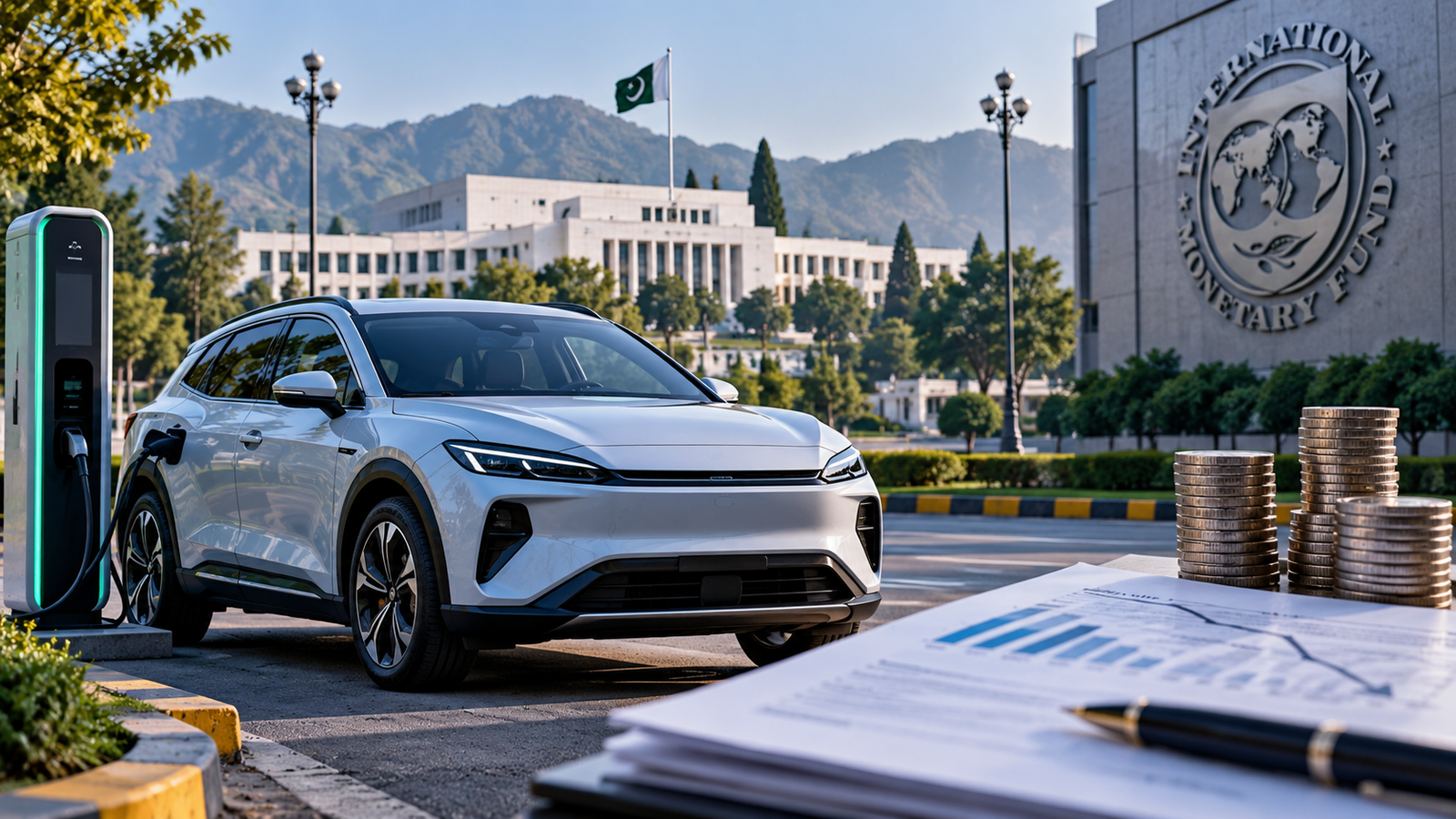
Pakistan’s proposed electric-vehicle tax incentives have come under fresh scrutiny after reports said the International Monetary Fund has objected to a concessional sales-tax rate for EVs in the country’s draft Auto and Auto Parts Manufacturing Policy 2026–31. PakWheels reported on October 6 that the lender has sought withdrawal of the proposed concession, a move that could push the sales-tax rate on electric vehicles from 1% to the standard 18% if the government accepts the demand.
The development comes while Pakistan is still finalising its new auto policy. Government consultations on the 2026–31 framework have continued through September and October, and official material from the Ministry of Industries and Production shows that the new policy had not yet been formally notified as of early October. That distinction is important: the reported 1% EV sales-tax proposal is part of a draft framework, while the reported IMF objection has not yet translated into a final, legally effective tax change.
If the concession is removed, the immediate impact would be higher tax costs on EVs, with consequences for vehicle prices, demand, local assembly plans and investment decisions. PakWheels illustrated the scale by noting that a 1% tax on a Rs10 million vehicle would be around Rs100,000, whereas an 18% tax would be about Rs1.8 million before considering other duties, levies or pricing factors.
The issue also highlights a broader policy tension. Pakistan wants to increase adoption of cleaner vehicles, reduce fuel dependence and encourage local production, but it is simultaneously under pressure to protect tax revenue and avoid creating costly exemptions. How the government resolves that conflict could shape the local EV market for years.
What Has Been Reported
According to PakWheels, the IMF has reportedly objected to the concessional sales tax being considered for electric vehicles under Pakistan’s proposed Auto Policy 2026–31. The report said discussions between Pakistan and the IMF were continuing and that the policy draft was being revised in light of concerns raised during those talks.
The reported proposal under discussion would have allowed a 1% sales-tax rate for certain new-energy vehicles. Earlier reporting on the draft also indicated that electric vehicles, plug-in hybrids and range-extended electric vehicles could receive preferential treatment, although different versions of the draft have circulated and not every reported provision has been officially confirmed.
That means buyers and automakers should not treat the reported tax rates as final. Pakistan’s new auto policy is still moving through consultation and approval stages, and tax changes only become effective after the government formally approves and notifies them through the relevant legal and regulatory instruments.
How Big Could the Tax Difference Be?
The possible difference between a 1% and 18% sales-tax rate is substantial. On a vehicle with a taxable value of Rs10 million, a 1% levy would equal roughly Rs100,000. At 18%, the same tax component would rise to about Rs1.8 million. The final retail price would also depend on customs duties, federal excise treatment, dealer margins, registration costs, localisation levels and other taxes.
For consumers, that gap could determine whether some EVs remain competitive with petrol, hybrid or plug-in-hybrid models. Pakistan’s EV market is still developing, so even a relatively small increase in the upfront purchase price can matter because many buyers compare total acquisition cost before factoring in lower running and maintenance expenses.
The effect would not be identical across all models. Lower-priced compact EVs could face a smaller absolute increase, while premium imported vehicles could see a much larger rupee impact. Locally assembled models may also be affected differently depending on the final structure of duties on parts, kits and finished vehicles.
Why the IMF May Be Concerned About Concessions
The IMF has repeatedly focused on tax-base broadening, revenue mobilisation and reduction of distortive exemptions in countries operating under Fund-supported programmes. In Pakistan’s case, a deeply reduced EV sales-tax rate could be viewed through that fiscal lens because it would reduce near-term tax collection relative to the standard rate.
From the government’s perspective, however, concessions can be used as industrial-policy tools. Lower taxes can help a new technology reach scale, encourage local assembly and attract investment in charging infrastructure, batteries and components. The policy question is therefore not simply whether an exemption costs revenue, but whether it produces enough economic, industrial and environmental benefits to justify that cost.
The government will have to balance those competing objectives carefully. A concession that is too generous may create a large revenue gap or favour imports. A tax burden that is too high could slow EV adoption before the local ecosystem is mature enough to compete without support.
Pakistan’s New Auto Policy Is Still Not Final
Official sources show that the Auto and Auto Parts Manufacturing Policy 2026–31 was still under consultation in September. The Associated Press of Pakistan reported on September 17 that a government committee was reviewing the draft clause by clause and considering concerns raised by ministries and other organisations.
The Ministry of Industries and Production said in September that a new auto policy was on the cards, while its policies page in early October continued to list the previous Auto Industry Development and Export Policy 2021–26 and the New Energy Vehicles Policy 2025–30 among existing policy documents. The absence of a notified 2026–31 auto policy reinforces the need to treat current tax numbers as proposals rather than settled law.
The new framework is expected to address more than EV taxes. Reported areas of discussion include localisation, import duties, new-energy vehicles, safety standards, exports, technology transfer and the long-term competitiveness of Pakistan’s automotive sector.
What the Existing NEV Policy Says About Pakistan’s Direction
Pakistan already has a New Energy Vehicles Policy 2025–30, showing that electrification is part of the government’s longer-term industrial and transport strategy. The policy direction reflects concerns about oil imports, urban pollution, energy efficiency and the need to modernise the automotive supply chain.
EV adoption can reduce direct petrol and diesel consumption, but the overall economic benefit depends on how vehicles are manufactured, how electricity is generated and whether local component production grows. If most EVs are imported as complete units, some of the savings on fuel imports can be offset by higher vehicle and battery import costs.
That is why the design of tax incentives matters. Policymakers may prefer concessions that reward local value addition, domestic battery-pack assembly, charging investment or export capability rather than applying the same benefit to every vehicle regardless of how much economic activity is created inside Pakistan.
Potential Impact on EV Buyers
For buyers, the main risk is higher upfront pricing. EVs often carry a higher purchase price than comparable internal-combustion models, even though electricity and maintenance costs can be lower over time. A sharp increase in sales tax would widen that initial price gap and could make monthly financing costs less affordable.
That matters particularly in Pakistan, where high interest rates, currency volatility and vehicle-price inflation have already made new-car purchases difficult for many households. If incentives are reduced before EV volumes scale up, the market could become concentrated among wealthier buyers rather than broadening into the mass market.
On the other hand, a more neutral tax structure could encourage manufacturers to reduce costs, improve localisation and compete on efficiency rather than relying heavily on government concessions. The outcome would depend on how quickly the local industry can adapt.
Potential Impact on Automakers and Investors
Automakers need tax certainty because vehicle programmes require long lead times. Companies deciding whether to assemble EVs locally must estimate demand, parts costs, duty structures and expected retail prices several years ahead. A sudden shift from a deeply concessional tax rate to the standard rate could alter business cases that were developed around the draft policy.
Some companies may delay model launches or investment decisions until the final framework is notified. Others could shift toward hybrids or plug-in hybrids if those categories receive more favourable treatment. Much will depend on whether the final policy differentiates between fully electric vehicles, PHEVs, REEVs and conventional hybrids.
Charging companies could also feel the effect indirectly. Slower EV sales would mean slower utilisation growth for public chargers, while faster adoption would improve the economics of expanding charging networks in major cities and along highways.
Could EV Prices Rise Immediately?
No immediate price increase should be assumed solely from the reports. The reported IMF position concerns a draft policy discussion, not a notified tax amendment. Existing vehicle prices remain subject to the current tax framework until the government issues formal changes.
That said, the report can still influence market expectations. Dealers, importers and prospective buyers may delay decisions while waiting for clarity, especially if they believe the final policy could materially change taxes on imported or locally assembled EVs.
For consumers, the most reliable signal will be a formal notification from the federal government, Federal Board of Revenue or another competent authority. Until then, claims about exact future tax rates should be treated as provisional.
Why This Matters for Pakistan’s Auto Industry
The EV tax debate is part of a much larger question about the direction of Pakistan’s auto sector. The government has said the country needs to move beyond simple vehicle assembly toward engineering, innovation and exports. Prime Minister’s Adviser on Industries and Production Haroon Akhtar Khan said on October 3 that Pakistan must progress from assembly to manufacturing, then engineering and innovation, describing modern vehicles as increasingly technology-driven products.
A successful auto policy therefore needs to do more than lower or raise taxes. It has to create incentives for local engineering, components, software, batteries, safety compliance and export capability. EVs could be a major part of that transition because they rely on different supply chains and electronic systems than conventional vehicles.
If the policy focuses only on short-term tax concessions without building a local industrial base, Pakistan could remain dependent on imported technology. If it removes incentives too early, however, it could slow the transition before domestic capabilities have had time to develop.
Business and Economic Impact
The final decision could affect government revenue, foreign exchange demand, energy imports and private investment. Higher EV taxes may support short-term revenue collection but could reduce vehicle sales and investment. Lower taxes may stimulate adoption but create a fiscal cost that the government would need to justify.
The foreign-exchange impact is also complex. More EVs can reduce petrol and diesel consumption over time, potentially lowering oil imports. But imported EVs, batteries and components also require foreign currency. The net effect depends heavily on localisation and the speed at which Pakistan develops domestic supply chains.
For investors, policy consistency may matter as much as the precise tax rate. Companies can plan around higher or lower taxes if they know the rules will remain stable. Repeated changes and prolonged uncertainty make investment decisions harder and can discourage long-term commitments.
What Happens Next?
The next major step is finalisation of the Auto and Auto Parts Manufacturing Policy 2026–31 and clarity on its tax provisions. The government will need to reconcile IMF concerns, revenue objectives, industry demands and its own EV and industrial-development goals.
Any final package is expected to move through the relevant government approval process before formal notification. Until that happens, the reported 1% and 18% figures should be described as part of the ongoing policy debate rather than as a confirmed tax change.
Buyers, automakers and investors will be watching closely because the final structure could determine which vehicle technologies become most competitive in Pakistan over the next five years.
FAQs
Has Pakistan already increased EV sales tax from 1% to 18%?
No. The 18% figure is being discussed in reports about the IMF’s reported objection to a proposed 1% concession. A final change would require formal government approval and notification.
What has the IMF reportedly asked Pakistan to do?
PakWheels reported that the IMF has sought withdrawal of the concessional sales-tax treatment being considered for electric vehicles in the draft Auto Policy 2026–31.
How much difference could the tax make on a Rs10 million EV?
A 1% sales tax would be about Rs100,000, while an 18% rate would be about Rs1.8 million, before other taxes, duties and charges.
Is Pakistan’s Auto Policy 2026–31 final?
No. Official reporting shows consultations and clause-by-clause review were still underway, and the policy had not yet been formally notified in early October.
Could EV prices rise if the concession is removed?
Yes. A higher sales-tax rate could increase retail prices, although the final impact would vary by model, taxable value, localisation and other duties.
Why does Pakistan offer EV incentives?
EV incentives can support adoption, reduce fuel dependence, encourage cleaner transport and attract investment in local assembly and charging infrastructure.
What should buyers do now?
Buyers should wait for official tax notifications before assuming that reported draft rates will become law, especially if a purchase decision depends on future tax treatment.
Why is this important for Pakistan’s auto industry?
The final tax structure will influence EV demand, local assembly, investment planning, charging infrastructure and the country’s broader transition toward technology-driven vehicle manufacturing.
About The Author