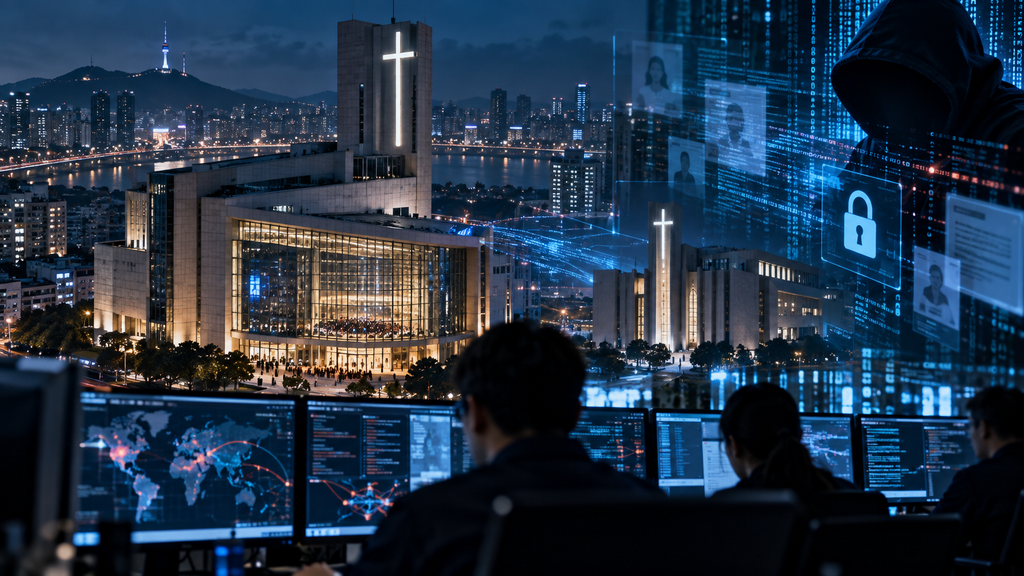
Two of South Korea’s best-known megachurches are investigating suspected cyberattacks that may have exposed the personal information of hundreds of thousands of congregants. Reuters reported on October 7 that the incidents involve Seoul’s Yoido Full Gospel Church and Sarang Church, while cybersecurity company Oasis Security said evidence found on an overseas server suggests artificial intelligence tools may have been used during the intrusions. Yoido Full Gospel Church said its initial analysis indicates data linked to 850,000 members may have been compromised.
The developments come at a time of growing concern in South Korea over AI-linked cyber threats. Just a day earlier, President Lee Jae Myung said signs had emerged that AI may have been used in recent cyberattacks on commercial banks, prompting a full-scale police investigation and emergency coordination across the financial sector.
At this stage, the affected churches and South Korean authorities have not publicly identified the attackers or fully explained the precise tools allegedly used. The available evidence points to suspected AI-assisted activity, not a completed public finding naming a perpetrator or confirming every technical detail of the intrusions.
What is already clear is that the case has become much bigger than an ordinary data-security story. Large churches can hold extensive membership records, family details, donation information and contact data. If such information is accessed or copied, the consequences can include identity-theft risk, targeted scams, reputational damage and a broader loss of trust in how major institutions protect sensitive data.
What Happened
Reuters reported that Oasis Security found data, attack records and account information on an overseas server containing information linked to Yoido Full Gospel Church and Sarang Church. The firm said records of the alleged attacks showed signs that AI tools may have been used, including references to “sub-agents” and extensive attack reports that appeared automated.
That does not necessarily mean a fully autonomous AI system carried out the breaches on its own. The available description suggests investigators saw patterns consistent with AI-assisted workflow automation during the intrusion process. Attackers may have used AI-based systems to help map targets, generate structured reports, coordinate steps or accelerate repetitive tasks that previously required more manual effort.
Yoido Full Gospel Church said its initial analysis showed data relating to 850,000 members may have been compromised. Reuters said the information included names and dates of birth, while a smaller number of records also contained changes to national identification numbers, addresses and telephone numbers. The church said it was notifying affected members, blocking external access and changing server passwords.
Sarang Church, in Seoul’s Seocho district, said it had formed an emergency task force, reported the suspected incident to relevant authorities and was taking steps to determine what happened and prevent further harm.
Why This Story Matters
This is an important technology story for several reasons. First, it is not limited to a corporate database or a small website. It involves two large and socially prominent institutions that manage extensive personal data. Second, the case comes amid a wider rise in concern over AI-assisted hacking, making it part of a broader shift in cybersecurity risk.
Third, faith-based organisations are not always discussed in the same way as banks, telecom providers or healthcare systems when cyber resilience is debated, even though many of them manage large volumes of sensitive information. The incidents show that cyber risk is no longer confined to the most obvious high-value digital targets.
What Data May Have Been Exposed
Based on Reuters’ reporting, the data linked to Yoido Full Gospel Church may have included names and dates of birth, with a smaller number of records also involving changes to national identification numbers, addresses and telephone numbers. Even where bank details or passwords are not publicly listed among exposed information, such personal data can still be highly sensitive.
It can be used for phishing, impersonation, account-recovery abuse, social engineering or the construction of more complex fraud attempts. The risk becomes more serious when attackers hold multiple pieces of information about the same person. A name, date of birth, phone number and address together can help criminals create convincing scam messages or pass basic identity checks used by some services.
Because the full scope is still being assessed, the final impact may change as the investigation progresses. The current figures and data categories should therefore be treated as preliminary findings rather than the final official record of everything affected.
Why Investigators Suspect AI Tools
One of the most striking details in the story is the reference to “sub-agents” and apparently automated attack reporting. Oasis Security said those signs suggested AI tools may have been used during the intrusion. Reuters did not publish a full technical forensic report, so the exact role of AI remains under investigation.
In practical terms, AI can help attackers rapidly summarise reconnaissance, propose attack paths, generate scripts, evaluate exposed services and produce structured logs or reports. It can also lower the skill barrier for some threat actors by making certain technical steps easier to automate. That does not mean AI replaces human attackers, but it can make them faster and potentially more efficient.
South Korea’s recent banking incidents provide important context. President Lee Jae Myung said on October 6 that AI models were believed to have been used in some recent hacking incidents against banks and called for cybersecurity methods suited to the AI era. Authorities have not yet publicly disclosed the precise AI tools used in those bank attacks.
The Wider South Korea Cybersecurity Context
The megachurch investigations did not emerge in isolation. Reuters reported that the church story follows hacking attacks against South Korean commercial banks that led to exposure of customers’ personal information. Police launched a full-scale investigation, while the Financial Services Commission and Financial Supervisory Service intensified their response.
The Financial Supervisory Service and Financial Security Institute shared information on 28 unique suspect IP addresses with the financial sector. That response shows authorities already see AI-era cyber incidents as a national-level challenge rather than a narrow IT issue.
Viewed together, the bank and church cases suggest South Korea is facing broader data-security pressure across multiple sectors. The targets are different, but the core themes are similar: sensitive personal information, suspected AI-assisted intrusion methods and an urgent need for stronger institutional cybersecurity.
How the Churches Are Responding
Yoido Full Gospel Church said it was notifying affected members, blocking external access and changing server passwords. Those are immediate containment measures designed to limit further exposure while investigators assess the damage. Notification is especially important because potentially affected people need to know they may face follow-on fraud attempts or impersonation risks.
Sarang Church said it had formed an emergency task force, notified relevant authorities and was working to determine the details of the suspected breach and prevent further harm. Such a response typically involves forensic investigation, legal review, communication planning and additional security hardening.
Immediate response, however, is only the first stage. Institutions that suffer data incidents often later face questions about cybersecurity governance, third-party vendor management, access controls, password practices, network segmentation, logging and breach-detection capability.
Technology Impact
From a technology perspective, this story reinforces the argument that cybersecurity strategies built for older threat environments may no longer be enough. If attackers are using AI-assisted methods, defenders may need more automated detection, faster incident triage and stronger anomaly monitoring to respond effectively.
The issue is no longer only whether an organisation can block a known threat. It is whether it can identify adaptive, increasingly automated attacker behaviour quickly enough. This is especially relevant for institutions that have digital transformation goals but do not always invest in security at the same pace.
Churches, nonprofits and large member-based organisations may modernise databases, online donation tools and integrated member systems without always receiving the same level of security attention as banks or large listed companies. The South Korean cases may therefore become a warning to similar organisations around the world.
Consumer and Public Impact
For ordinary congregants, the story is ultimately about personal information. If someone’s name, date of birth, address or phone number has been compromised, that person may become more vulnerable to fraud, phishing calls or impersonation attempts.
In some cases, criminals do not need financial-account passwords immediately. They first use leaked identity details to build trust and launch secondary scams. There is also a social-trust dimension because religious institutions are community anchors, not merely service providers. A major data incident can therefore damage relationships between institutions and members in ways that go beyond a typical corporate breach.
Global Relevance and Pakistan Relevance
The story has clear global importance because it reflects a wider concern about AI-enhanced cyber risk. Governments and companies worldwide are increasingly confronting the possibility that AI agents and automation tools can be used not only for legitimate security testing but also to accelerate malicious activity.
For Pakistan, the relevance is indirect but genuine. Large religious organisations, schools, hospitals, NGOs and community networks in Pakistan also manage substantial amounts of personal data, often with uneven cybersecurity maturity. The South Korean case is a reminder that cyber hygiene is no longer only a big-bank or big-tech issue.
Any institution with a large member database can become a target, especially if attackers can use AI tools to automate parts of reconnaissance, exploitation or reporting. Strong access controls, regular patching, multi-factor authentication, network monitoring and incident-response planning are therefore becoming essential across sectors.
What Happens Next
The next phase will depend on findings from forensic investigators, the churches’ internal reviews and any action by South Korean authorities. Key questions include whether attackers merely accessed data or also exfiltrated it, how long systems may have been exposed, whether additional institutions were affected and whether law enforcement can identify the responsible actors.
Investigators will also need to clarify the AI aspect more precisely. Public reporting currently points to signs of AI-tool use, but not a complete official technical disclosure of which models, agents or systems may have been involved. That distinction matters because the policy and security response may differ depending on whether AI was used for reconnaissance, scripting, reporting, exploitation or some combination of those functions.
Important Unanswered Questions
Several important questions remain unresolved. It is still unclear who carried out the attacks, whether the same actor targeted both churches, whether the incidents are connected to the recent banking breaches and how much data was definitively extracted rather than simply found on an overseas server.
Another major unanswered question is whether the evidence pointing to AI use will stand up to deeper forensic review. Early indicators can be valuable, but final technical findings often take time. It would therefore be premature to make broader claims beyond what the churches, the cybersecurity firm and Reuters have reported.
FAQs
What happened in the South Korean megachurch cyberattack case?
Two major South Korean churches – Yoido Full Gospel Church and Sarang Church – are investigating suspected cyberattacks. Evidence described by cybersecurity company Oasis Security suggests AI tools may have been used during the intrusions.
Which churches are involved?
The churches named in the reporting are Yoido Full Gospel Church and Sarang Church in Seoul.
How many people may have been affected?
Yoido Full Gospel Church said its initial analysis indicated data relating to 850,000 members may have been compromised. A public figure for Sarang Church’s potentially affected records was not specified in Reuters’ report.
What kind of information may have been exposed?
The potentially compromised data included names and dates of birth, while a smaller number of records also contained changes to national identification numbers, addresses and telephone numbers.
Why do investigators think AI tools may have been used?
Oasis Security said attack records included references to “sub-agents” and extensive reports that appeared automated, leading the firm to say AI tools may have been involved.
Is this linked to South Korea’s recent bank cyberattacks?
There is no public confirmation that the same attackers were involved. However, the church incidents follow separate bank breaches in which President Lee Jae Myung said signs had emerged that AI may have been used.
What have the churches done in response?
Yoido Full Gospel Church said it was notifying affected members, blocking external access and changing server passwords. Sarang Church said it had created an emergency task force and reported the suspected incident to relevant authorities.
Why does this matter outside South Korea?
The case highlights a growing global concern that AI tools may make some cyber intrusions faster and more scalable, affecting any organisation that stores large volumes of personal data.
About The Author