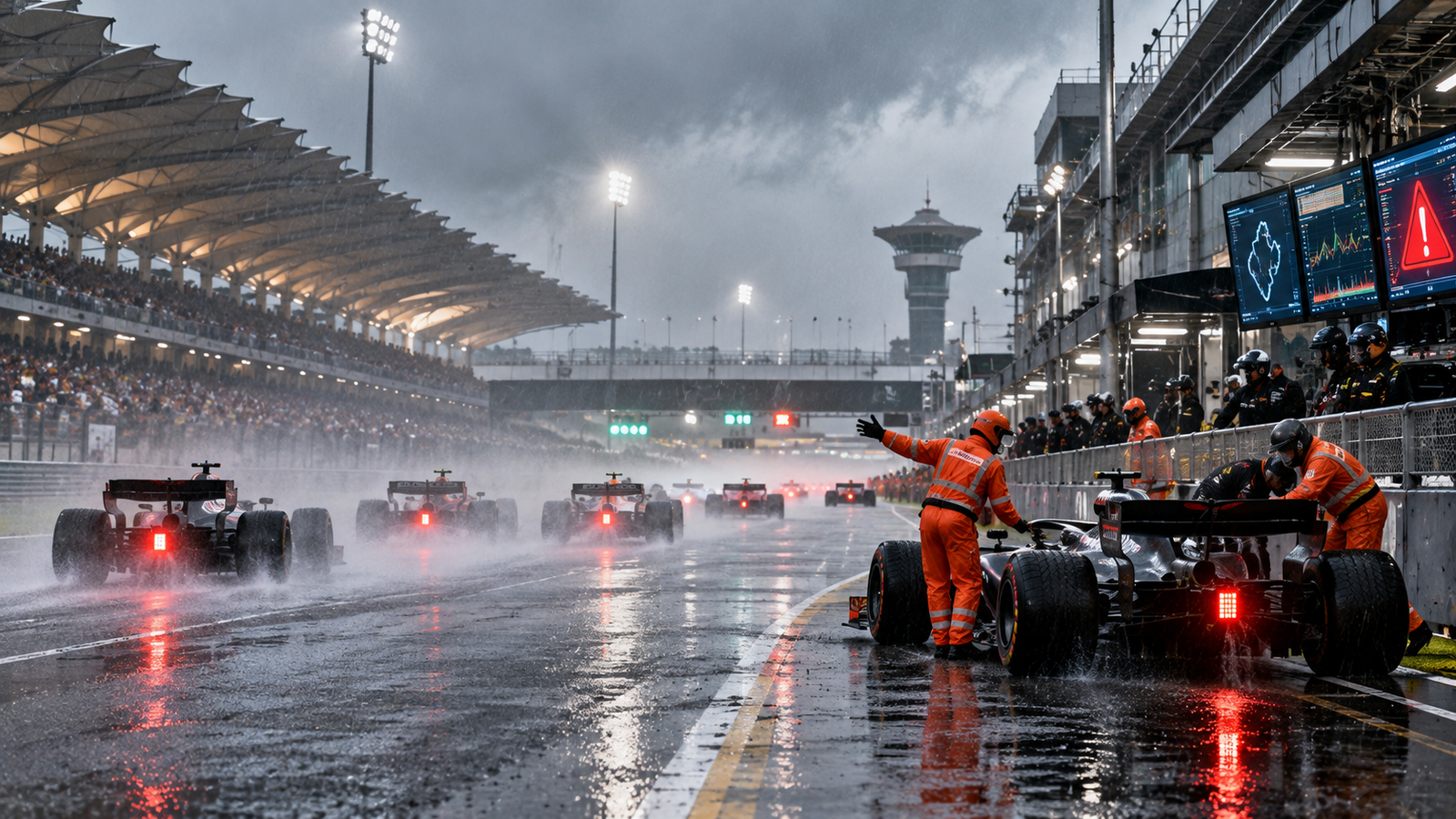
Formula 1’s governing body, the FIA, has opened a full investigation into a software problem that caused several cars to lose power during the formation lap at the Bahrain Grand Prix in Malaysia on October 4, 2026, forcing race officials to abort the start at a rain-soaked Sepang International Circuit.
The problem affected multiple drivers, including Lewis Hamilton and eventual race winner Max Verstappen, after heavy rain delayed the event and created unusually low-speed running behind the safety car. Drivers reported cars suddenly losing drive or crawling at very low speed as electrical energy limits interacted with the wet-weather conditions.
The FIA introduced a software update during the delay before restarting the race. Nikolas Tombazis, the FIA’s single-seater director, said the combination of low engine revs, poor grip and wet-weather operation had not been adequately reproduced in testing and that the governing body would review the incident with teams and power-unit manufacturers.
Once the race finally got underway, Verstappen won for Red Bull ahead of Mercedes driver Kimi Antonelli and Ferrari’s Hamilton. The chaotic start, however, became one of the biggest talking points of the weekend and raised fresh questions about the complexity of Formula 1’s new-generation hybrid power units.
What Happened During the Bahrain Grand Prix in Malaysia?
The race was already under pressure before the software issue appeared. Heavy rain at Sepang delayed the planned start and left standing water across parts of the circuit.
During the formation procedure, cars were running much more slowly than they would in normal dry conditions. That combination of low speed, reduced engine revs and wet-weather energy settings created a situation the control software did not handle as expected.
Formula 1’s official race report says Hamilton stopped on the start-finish straight and was told by Ferrari that the team was dealing with a software issue. Other cars also experienced problems, and Race Control suspended the starting procedure.
The field returned to the pit lane, the original grid order was restored and officials prepared a second start attempt after the FIA changed the software configuration.
Why Did Some F1 Cars Lose Power?
Reuters reported that the fault was linked to a complex interaction between low engine speeds, poor grip and software-controlled energy use in the new hybrid power units.
Modern Formula 1 engines combine an internal combustion engine with powerful electrical systems. The software must manage when energy is harvested, stored and deployed while staying within technical regulations.
In the Sepang conditions, cars were circulating slowly enough that the expected energy flow did not behave as it would during normal racing. The result was that some cars ran into power limitations and slowed dramatically.
The FIA’s explanation so far is preliminary. The governing body has said it will carry out a deeper investigation before establishing the full technical chain that caused the problem.
Why Wet Conditions Exposed the Bug
Wet-weather driving changes almost every operating parameter in a Formula 1 car.
Drivers use less throttle, brake earlier and accelerate more gently because grip is lower. Behind a safety car or during a formation lap, speeds can fall even further.
Those conditions reduce engine revs and alter how the hybrid system charges and releases electrical energy. Reuters reported that this combination had not been sufficiently tested before the race.
Tombazis acknowledged that the sport had limited wet-weather running with the new generation of cars before Sepang. That meant a rare but realistic operating scenario reached a Grand Prix before the software had been fully validated under those conditions.
What Software Fix Did the FIA Apply?
The FIA changed the relevant software settings during the delay before the race restarted.
Reuters reported that the update removed energy constraints in the affected operating areas, allowing the cars to run without triggering the same loss-of-power problem during the second start procedure.
Formula 1’s own coverage says the software update formed part of the reason for the long delay while officials worked through the issue.
The emergency change got the race moving, but it was a short-term operational fix rather than a complete explanation of why the bug appeared. That is why the FIA has committed to a post-race technical review.
Hamilton and Verstappen Were Among the Drivers Affected
Lewis Hamilton and Max Verstappen were two of the most prominent drivers caught by the issue.
Hamilton said he had to stop on track and restart the car, something he described as a first in his Formula 1 career. Verstappen also experienced the loss of performance during the formation lap.
In the FIA’s post-race press conference, Verstappen criticised the complexity of the current engines and compared the bizarre low-speed running to a toy-like racing situation.
The reactions matter because both drivers have extensive experience across different generations of Formula 1 cars. Their frustration reflects a wider debate about whether increasingly complex hybrid systems are creating problems that are difficult for teams, officials and fans to understand.
Why the Race Was Called the Bahrain Grand Prix in Malaysia
The event itself was unusual before any cars reached the grid.
Formula 1 and the FIA moved the 2026 Bahrain Grand Prix to Malaysia because the original Bahrain event could not take place amid regional security concerns.
The race was therefore officially staged as the Formula 1 Gulf Air Bahrain Grand Prix in Malaysia at Sepang International Circuit from October 2 to October 4.
Sepang last hosted Formula 1 regularly in 2017 and is known for heat, humidity and sudden tropical rain. The circuit’s return gave Formula 1 a replacement venue capable of hosting a full Grand Prix on relatively short notice.
How the Race Eventually Finished
After the delayed and aborted start procedure, the Grand Prix eventually developed into a competitive wet-to-dry race.
Max Verstappen converted pole position into victory, finishing 2.307 seconds ahead of Kimi Antonelli after 55 laps, according to the FIA’s official classification.
Lewis Hamilton recovered to finish third for Ferrari, 4.919 seconds behind the winner, while Charles Leclerc finished fourth.
The win was Verstappen’s first of the 2026 season and the first Formula 1 victory for Red Bull Ford Powertrains.
George Russell’s Late Retirement Added to the Drama
Mercedes driver George Russell was also hit by a major technical problem late in the race, although Reuters reported his retirement as a power-unit failure rather than the same formation-lap software bug.
Russell was running third with five laps remaining when his car stopped, costing him a likely podium finish.
The retirement increased the gap between Russell and championship leader Kimi Antonelli from 66 points to 84 points, according to Reuters.
It is important not to merge the two issues. The FIA’s investigation concerns the software problem that disrupted the start, while Russell’s late failure was reported separately as a power-unit problem.
Why the Incident Matters for the 2026 F1 Regulations
The Sepang problem has intensified scrutiny of Formula 1’s 2026 technical rules.
The current-generation power units rely heavily on electrical energy alongside the internal combustion engine, making software control central to performance and reliability.
More software does not automatically make a system unsafe or unreliable, but it creates more interactions that must be tested across different speeds, temperatures, grip levels and race conditions.
The fact that the issue appeared during Formula 1’s first major wet-weather test of the new system suggests teams and regulators may need broader validation before future rule changes are introduced.
Technology Impact: F1 Cars Are Increasingly Software-Defined
Modern Formula 1 cars are often described primarily in terms of aerodynamics, engines and tyres, but software now controls a large part of how those systems operate together.
Energy deployment, battery charging, torque delivery, brake-by-wire systems and multiple fail-safe functions all depend on software logic.
The Sepang incident shows how a software problem can affect the entire sporting event rather than only one team. When the same regulatory logic applies across the grid, a problem in the operating framework can appear in multiple cars at once.
For engineers, the lesson is similar to software-intensive industries outside motorsport: edge cases matter, and systems must be tested under conditions that may initially appear unlikely.

Could the FIA Change the Rules After the Investigation?
The FIA has not announced a specific regulation change as a direct result of the bug.
The immediate commitment is to investigate the incident with the teams and power-unit manufacturers and understand why the existing software controls behaved as they did.
Any future change could involve software parameters, testing requirements, operational procedures or technical regulations, but those possibilities remain speculative until the FIA publishes findings.
Formula 1 is already expected to continue refining the new power-unit rules, so the Sepang review could feed into a wider technical development process.
What Teams Will Want From the FIA Review
Teams will want a clear explanation of the trigger conditions and assurance that the same situation cannot easily return in Singapore or another wet race.
They will also want to know whether any software change affects performance, reliability or energy management in normal conditions.
Because manufacturers develop different power units, the FIA must separate problems caused by common regulatory software assumptions from issues specific to individual engines.
A transparent review will be important because teams need confidence that technical fixes are applied consistently across the grid.
Why the Incident Matters for Fans and Race Operations
For fans, the biggest impact was delay and confusion.
Spectators had already waited through heavy rain when cars then began slowing or stopping during the formation procedure. The aborted start extended the uncertainty before racing could begin.
Complex technical explanations can also make Formula 1 harder to follow if viewers cannot understand why a car suddenly loses drive despite appearing mechanically intact.
That gives the FIA and Formula 1 an incentive to explain the issue clearly once the investigation is complete, not only to teams but also to the public.
Business and Commercial Impact
Formula 1 depends on predictable event operations for broadcasters, sponsors, promoters and fans, so long delays can create commercial pressure even when a race eventually produces strong on-track action.
The Malaysia event was particularly important because Sepang had been brought back as a replacement venue for Bahrain. Delivering the event successfully was therefore part of a broader effort to keep the 2026 calendar intact.
The race ultimately finished and produced a full classification, limiting the immediate commercial damage.
However, repeated technical disruptions of this type would be more serious because they could affect scheduling, broadcast windows and confidence in the reliability of the sport’s technical rules.
South Asia and Pakistan Relevance
There is no direct Pakistan-specific sporting connection to the incident.
The broader relevance for South Asian audiences comes from Formula 1’s strong regional fan base and the fact that the race took place in Malaysia, making it geographically closer to South Asia than many European or American rounds.
Pakistan relevance should therefore not be overstated. This is primarily a global motorsport and technology story.
What Happens Next?
The FIA will now review the software problem with Formula 1 teams and engine manufacturers.
Officials will examine why the bug was not identified earlier, how the emergency software change solved the immediate problem and whether additional testing is required before another wet-weather race.
Formula 1 moves next to the Singapore Grand Prix on October 11, giving the sport only a short turnaround before another demanding event.
The key question is whether the FIA can confirm the Sepang issue has been fully contained before similar conditions appear again.
Important Questions Still Unanswered
The FIA has not yet published a complete technical report explaining the software bug.
It is not yet clear whether the problem originated mainly from regulation-defined energy limits, shared control logic, manufacturer-specific implementation or a combination of those factors.
Another unanswered question is whether the emergency software change used at Sepang will remain in place for future races.
The investigation will also need to explain why wet-weather testing did not expose the problem before a Grand Prix weekend.
FAQs
What caused the F1 software bug in Malaysia?
Reuters reported that the problem involved a combination of low engine speeds, poor grip and wet-weather energy-management settings. The FIA is still investigating the full technical cause.
Which race was affected?
The issue occurred at the 2026 Bahrain Grand Prix, which was held at Malaysia’s Sepang International Circuit after the event was relocated from Bahrain.
Which drivers were affected by the software problem?
Lewis Hamilton and Max Verstappen were among several drivers affected during the formation lap, according to Reuters and Formula 1’s official race coverage.
Why was the race start aborted?
Race Control suspended the start after multiple cars lost power or slowed dramatically during the formation procedure, creating confusion and an unsafe operating situation.
How did the FIA fix the problem during the race?
The FIA applied a software update during the delay that changed the energy constraints affecting the cars before the second start attempt.
Who won the Bahrain Grand Prix in Malaysia?
Max Verstappen won the 55-lap race for Red Bull, finishing 2.307 seconds ahead of Kimi Antonelli. Lewis Hamilton finished third.
Was George Russell’s retirement caused by the same software bug?
Reuters reported Russell’s late retirement as a separate power-unit failure. It should not be treated as confirmed evidence of the same formation-lap software problem.
What will the FIA do next?
The FIA has promised a full investigation with teams and power-unit manufacturers to understand the cause and prevent a repeat.
About The Author