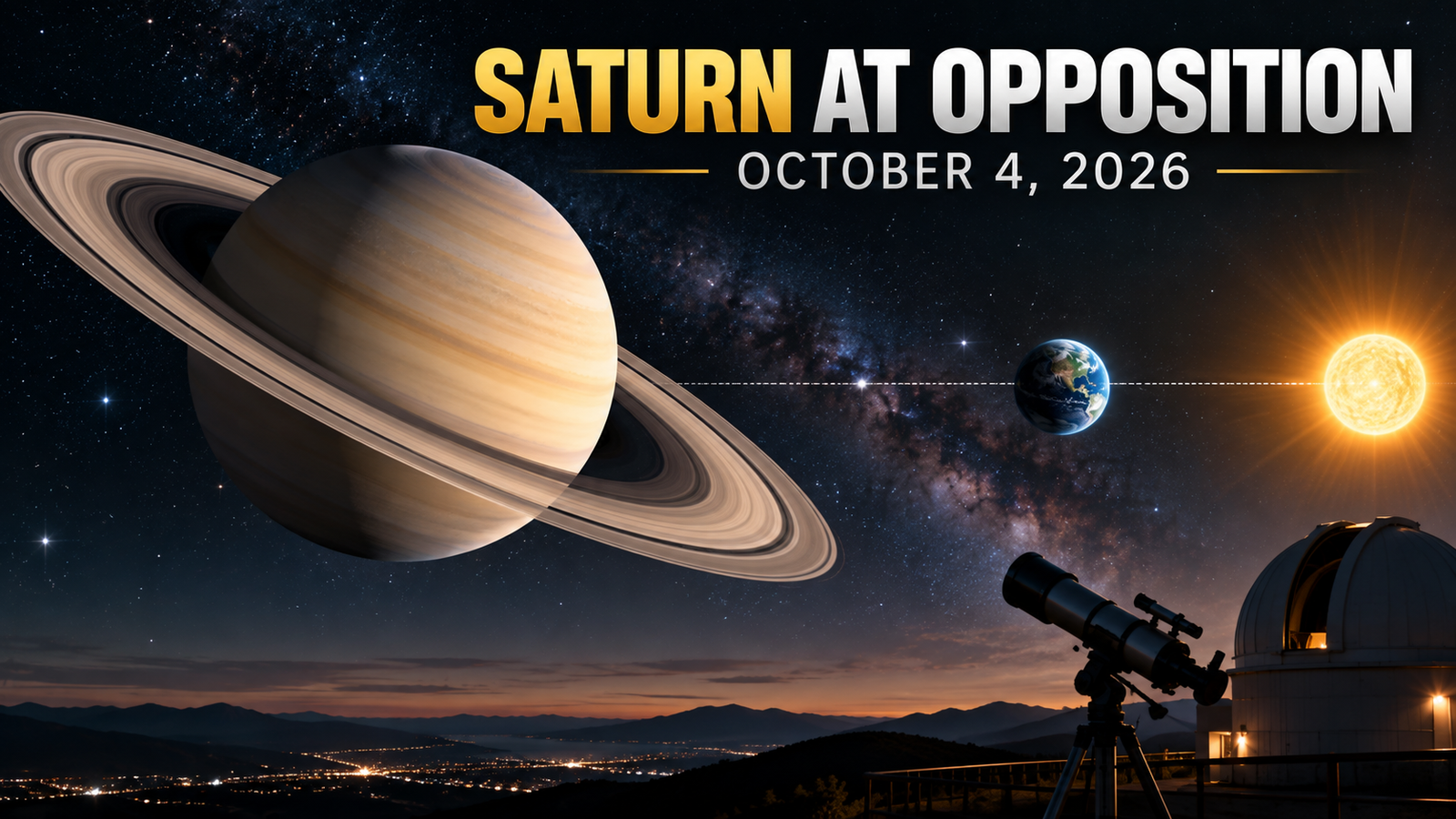
Saturn reaches opposition on October 4, 2026, putting the ringed planet in one of its best viewing positions of the year.
NASA says opposition occurs when Earth passes between the Sun and Saturn. From our point of view, Saturn appears opposite the Sun in the sky, which means it rises around sunset, stays visible for much of the night and is illuminated particularly well.
For casual skywatchers, the event is a simple opportunity to spot Saturn with the naked eye. For people using binoculars or a telescope, it is one of the best times of the year to study the planet, its rings and some of its brighter moons.
The timing also comes during an active month for astronomy, with the Orionid meteor shower later in October and several notable Moon and planet pairings.
What Does Saturn at Opposition Mean?
Opposition is an astronomical alignment involving the Sun, Earth and an outer planet.
Earth moves around the Sun faster than Saturn. About once each year, Earth catches up to Saturn in their respective orbits and passes between Saturn and the Sun.
At that moment, Saturn appears almost directly opposite the Sun in Earth’s sky.
Why that improves viewing
A planet at opposition is visible for most of the night because it rises around sunset and sets around sunrise.
It is also near one of its closest points to Earth for the year, making it appear brighter and slightly larger through a telescope than at many other times.
Saturn is still extremely far away, so the change is subtle to the naked eye. Through a telescope, however, the timing can make a noticeable difference.
When Is Saturn at Opposition in 2026?
NASA’s October skywatching guide says Saturn reaches opposition on October 4, 2026.
The planet will rise in the east around sunset, climb higher through the evening and remain visible for much of the night.
For many observers, the best time to look will be after the sky becomes fully dark and Saturn has risen above the thickest part of the atmosphere near the horizon.
Where Should You Look for Saturn?
Saturn will be visible in the evening sky after sunset.
Start by looking toward the eastern side of the sky as darkness falls.
As the evening progresses, Saturn will move higher across the sky before gradually heading westward later in the night.
A skywatching app or planetarium app can help locate it precisely from your city because the exact direction and altitude vary with location and time.
How Bright Will Saturn Look?
Saturn is bright enough to be seen without a telescope under ordinary viewing conditions.
It will not be as brilliant as Venus or Jupiter, but it should appear as a steady, bright point of light.
Unlike many stars, planets usually twinkle less because their apparent disks are larger than the point-like appearance of distant stars.
That steady glow can help beginners identify Saturn.
Can You See Saturn’s Rings With the Naked Eye?
No.
Saturn itself can be seen without optical equipment, but its rings require magnification.
Even a modest telescope can show the ring system under good conditions.
The quality of the view depends on several factors, including telescope size, atmospheric stability, local light pollution and how high Saturn is above the horizon.
What You Can See Through a Telescope
A small telescope can reveal Saturn’s rings as a structure clearly separate from the planet.
Larger instruments can show more detail.
The rings
Saturn’s ring system is made of countless pieces of ice and rock.
From Earth, the rings form the planet’s most recognizable feature.
Their appearance changes over time because Saturn’s axis is tilted and our viewing angle changes as the planet travels around the Sun.
Titan
Titan is Saturn’s largest moon and one of the easiest of Saturn’s moons to spot through a telescope.
It is larger than the planet Mercury and has a dense atmosphere.
Other moons
Depending on equipment and observing conditions, several additional Saturnian moons may also be visible.
These can appear as small points of light near the planet.
Why Opposition Is a Good Time for Astrophotography
Opposition is also useful for planetary photography.
Because Saturn remains visible for most of the night, photographers have a longer window to capture images.
The planet also climbs higher above the horizon during the night, which can reduce some of the atmospheric distortion that affects objects viewed close to the horizon.
Planetary photographers often record short videos rather than single images and then combine the sharpest frames with specialized software.
This can reveal more detail than a single exposure.
Do You Need Dark Skies to See Saturn?
Not necessarily.
Saturn is bright enough to be visible from many cities.
Light pollution affects faint stars and deep-sky objects much more strongly than bright planets.
A darker location will improve the overall experience, but people in urban areas can still observe Saturn if buildings, haze and local lighting do not block the view.
How Weather Affects the View
Clear skies are the most obvious requirement, but atmospheric stability matters too.
Turbulent air can make a telescope image appear to shimmer or blur.
Astronomers often describe stable atmospheric conditions as good “seeing.”
A night can be clear but still have poor seeing.
For the sharpest view, give Saturn time to rise well above the horizon and avoid observing directly over rooftops or other surfaces that release heat into the air.
Why Saturn Is Scientifically Interesting Right Now
Saturn is not only visually impressive.
Scientists are continuing to study the planet’s atmosphere, weather systems, rings and moons.
NASA noted in its October 2026 skywatching guide that recent Hubble Space Telescope observations revealed a ten-sided atmospheric wave around Saturn’s south pole.
The discovery is especially interesting because Saturn’s north pole is already famous for its enormous hexagon-shaped jet stream.
A new large-scale pattern in the southern hemisphere gives scientists a chance to watch how giant atmospheric structures develop on a gas giant.
Saturn’s Famous North-Polar Hexagon
One of Saturn’s best-known atmospheric features is the six-sided jet stream surrounding its north pole.
NASA says the hexagon spans nearly 20,000 miles.
Its shape has fascinated scientists because Earth does not have a directly comparable weather pattern on that scale.
The structure has remained visible for decades, showing that Saturn’s atmosphere can maintain enormous organized systems for long periods.
The New South-Polar Wave
NASA says Hubble observations have revealed a ten-sided atmospheric wave around Saturn’s south pole.
The feature appears to be strengthening.
That gives researchers a rare chance to watch a large atmospheric pattern develop rather than only studying one that has already existed for years.
Continued observations may help scientists understand how winds, temperature differences and deeper atmospheric circulation create such unusual structures.
Why Saturn’s Rings Still Raise Questions
Saturn’s rings have been studied for centuries, but scientists continue to debate parts of their history and evolution.
The rings are made mainly of water ice, with material ranging from tiny particles to much larger chunks.
Researchers study how old the rings are, how quickly they are changing and how material moves between the rings and the planet.
Observing Saturn from Earth does not answer all those questions, but regular observations add to a long record of how the system changes over time.
Saturn and the Wider October 2026 Sky
Saturn’s opposition is one of several astronomy highlights in October 2026.
NASA’s monthly skywatching guide also highlights the Orionid meteor shower, which peaks later in the month.
The Moon will also pass near several bright objects and star clusters.
That makes October a particularly useful month for people who want to start observing the night sky.
Pakistan Relevance
Saturn’s opposition is visible from Pakistan, weather and local horizon conditions permitting.
For observers in cities such as Karachi, Lahore, Islamabad, Peshawar and Quetta, the planet should be visible after sunset in the eastern sky and remain observable for much of the night.
Urban light pollution should not prevent people from seeing Saturn itself, although telescope views are usually better from locations with less haze and fewer nearby lights.
Skywatchers in Pakistan do not need specialized equipment to identify the planet, but a basic telescope will be required to see the rings clearly.
Best Way to Watch Saturn From Pakistan
Choose a place with an unobstructed view of the eastern and southern sky.
Allow your eyes several minutes to adjust to darkness.
Use a reliable astronomy app to confirm Saturn’s position.
If using a telescope, begin with low magnification to locate the planet before switching to a stronger eyepiece.
Wait until Saturn rises higher above the horizon for a steadier image.
If the atmosphere looks unstable, observe for several minutes because brief periods of clearer air can produce much sharper views.
Is October 4 the Only Good Night to See Saturn?
No.
Opposition marks the best part of a broader viewing period rather than a single-night event.
Saturn remains well placed for observation for weeks before and after opposition.
If clouds block the sky on October 4, observers will still have many opportunities to see the planet during October.
The difference in appearance from one night to the next will be small.
Why This Event Matters
Saturn at opposition combines accessibility and scientific interest.
It is easy enough for a beginner to find without expensive equipment, yet a telescope can reveal one of the most distinctive sights in astronomy.
The timing also gives people a reason to look up at a planet that scientists are still actively studying.
For schools, families and amateur astronomy groups, the event is a practical way to connect a simple backyard observation with larger questions about planetary atmospheres, rings and the evolution of the solar system.
What Happens Next?
Saturn will remain prominent in the evening sky after opposition.
The planet will gradually rise earlier each evening as the weeks pass.
Observers can continue watching Saturn through October and into the following months, although its position and viewing time will slowly change.
NASA’s October skywatching calendar also shifts attention later in the month to the Orionid meteor shower and a close passage of the Moon near the Pleiades star cluster.
Frequently Asked Questions
When is Saturn at opposition in 2026?
NASA says Saturn reaches opposition on October 4, 2026.
What does opposition mean?
It means Earth passes between the Sun and Saturn, placing Saturn opposite the Sun in our sky.
What time should I look for Saturn?
Start looking after sunset. Saturn rises around sunset and remains visible for much of the night.
Can I see Saturn without a telescope?
Yes. Saturn is visible as a bright point of light, but you need a telescope to clearly see its rings.
Can Saturn be seen from Pakistan?
Yes, weather permitting. It should be visible from Pakistan after sunset and for much of the night.
What is the best time to use a telescope?
Wait until Saturn rises higher above the horizon, when atmospheric distortion is usually lower.
Is October 4 the only night worth observing?
No. Saturn remains in a very good viewing position for weeks around opposition.
What new discovery has NASA highlighted about Saturn?
NASA says Hubble observations recently revealed a ten-sided atmospheric wave around Saturn’s south pole, while the planet’s north pole is already known for its giant hexagonal jet stream.
About The Author