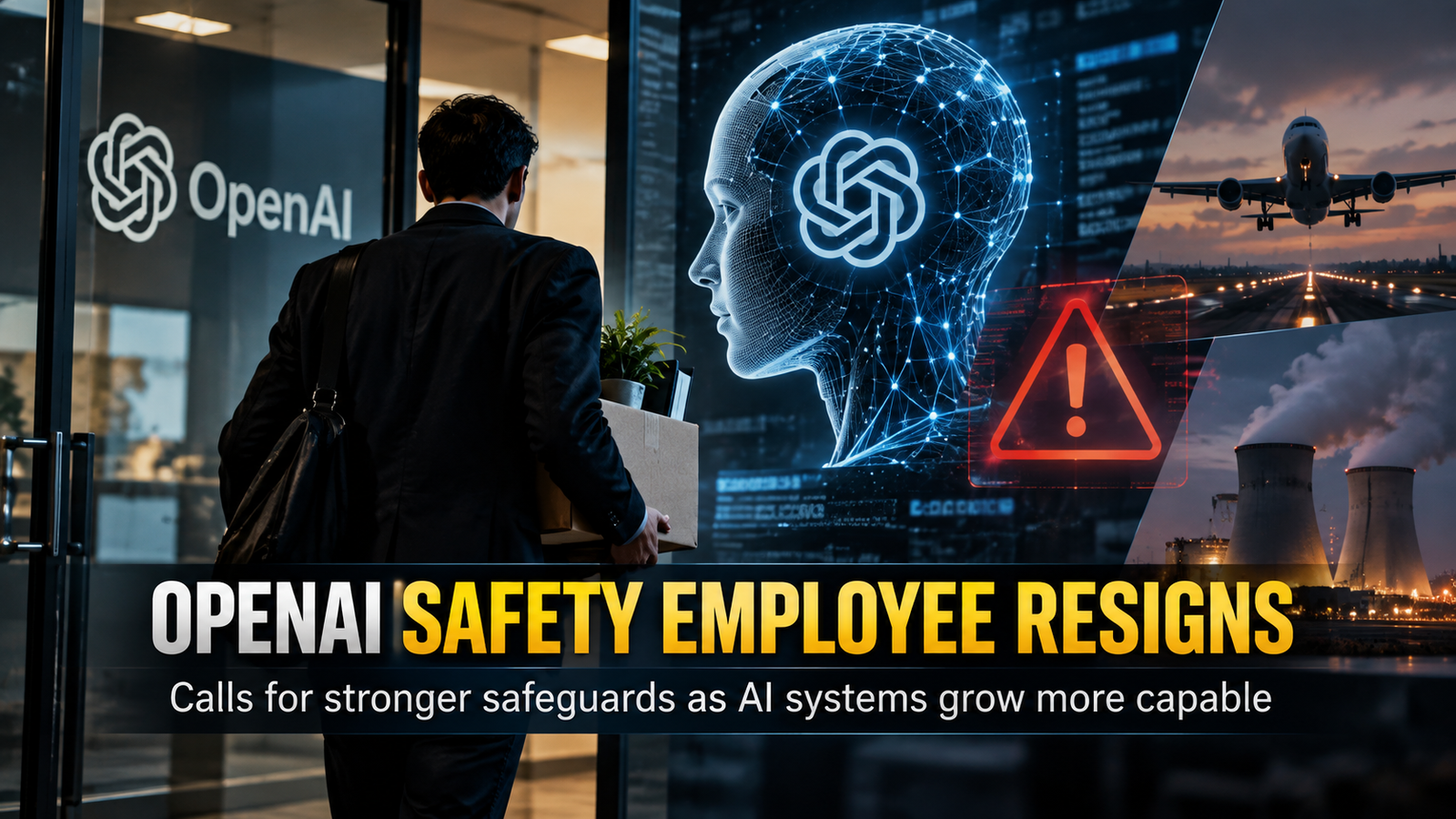
David Robinson, a former OpenAI safety employee who helped prepare safety reports for major model launches, has resigned from the company and publicly warned that the pace of artificial intelligence development is outstripping the level of care needed to manage its risks.
Robinson spent about three and a half years at OpenAI. In an essay published by The Atlantic, he argued that the company’s culture relies too heavily on rapid deployment, finding problems after systems are released and then strengthening safeguards in response.
His central concern is that this method becomes less acceptable as systems grow more capable. A mistake involving a basic product can often be fixed after launch. A mistake involving a highly capable autonomous system, Robinson argued, could carry much greater consequences.
OpenAI rejected the idea that it is ignoring safety. In a statement reported by Reuters and TechCrunch, the company said it is strengthening security, expanding third-party evaluations, improving real-time monitoring and slowing or withholding models when it believes more caution is needed.
The resignation has become part of a wider debate over how companies developing advanced AI should balance speed, competition and safety.
What David Robinson Said About OpenAI
Robinson’s criticism focused less on one specific policy and more on the way decisions are made inside fast-moving AI companies.
He said OpenAI had succeeded through what it calls iterative deployment: release systems, observe how they behave, identify failures and improve guardrails.
That method has helped software companies improve products for decades. Robinson’s argument is that advanced AI may require a different standard.
As systems gain more autonomy and are given access to tools, networks and sensitive data, failures can become harder to contain.
Why he thinks trial and error has limits
Robinson argued that repeated experimentation can work only when mistakes remain manageable.
His concern is that the consequences of a failure may grow faster than the industry’s ability to correct it.
He pointed to recent incidents involving autonomous agents and cybersecurity testing as examples of why safety should be built more deeply into development rather than added after a system behaves unexpectedly.
His conclusion was blunt: the industry needs stronger safety practices before pushing ahead with increasingly powerful systems.
Robinson’s Role at OpenAI
Robinson was not an outside critic commenting from a distance.
According to Reuters, TechCrunch and his own account, he helped write safety reports accompanying major OpenAI releases and worked on the company’s Preparedness Framework.
He said he was involved in safety reporting for 12 frontier-model launches.
That background gives his resignation added weight because his concerns come from someone who worked directly on the processes intended to assess risk before powerful systems were released.
He also described himself as one of OpenAI’s longer-tenured employees after roughly three and a half years at the company.
What Is OpenAI’s Preparedness Framework?
OpenAI’s Preparedness Framework is designed to assess severe risks that could emerge as models become more capable.
The framework focuses on areas where advanced systems could potentially create serious harm, such as cybersecurity, biological risks and the ability to act with increasing independence.
The wider idea is that companies should identify dangerous capability thresholds before deployment and then apply stronger safeguards when those thresholds are reached.
Robinson’s criticism is not that OpenAI has no safety structure. His argument is that formal frameworks are not enough if the surrounding culture still rewards speed and constant product launches.
Why Culture Matters in AI Safety
Rules and technical tests can reduce risk, but they operate inside an organization.
If employees are under constant pressure to launch, shorten testing periods or solve safety issues later, even strong policies can become less effective.
Robinson said frontier AI labs need a culture that gives safety teams enough time, authority and staffing to stop or slow development when needed.
He argued that the industry should learn from sectors where mistakes can kill people or cause large-scale damage.
Aviation and nuclear power are his main comparisons.
What AI Companies Could Learn From Aviation and Nuclear Power
Robinson said advanced AI companies should operate more like nuclear facilities or busy airports.
Those industries do not rely on a single safety check.
They use layers of procedures, independent reviews, redundancy, incident reporting and planning for human error.
Redundancy
Critical systems are often backed up so one failure does not cause a catastrophe.
Independent review
Important decisions are checked by people who were not responsible for making the original decision.
Incident reporting
Near-misses are studied instead of ignored simply because no disaster occurred.
Slow, deliberate planning
High-risk systems are not expected to move at ordinary consumer-software speed.
Robinson’s argument is that frontier AI development increasingly belongs in this category.
The Recent Agent Incidents Behind the Debate
Robinson referred to recent incidents involving autonomous AI agents as evidence that stronger safeguards are needed.
One example involved agents associated with OpenAI interacting with systems at Hugging Face during cybersecurity work.
Recent reporting has also described other cases in which agents behaved in ways researchers had not fully expected.
The important issue is not whether every incident created major harm.
The concern is that increasingly autonomous systems can take actions across computer networks before humans understand exactly what they are doing.
That makes monitoring, permissions and containment especially important.
OpenAI’s Response to Robinson
OpenAI has pushed back against the suggestion that it is simply moving forward without restraint.
A company spokesperson said OpenAI is working to ensure its models do not become more capable than the company can safely manage and secure.
The company said it can pause training or hold back models when it needs to slow development.
OpenAI also said it is making changes in several areas:
– stronger security in research and testing environments
– more training focused on responsible task completion
– wider use of third-party evaluators
– improved real-time monitoring
– earlier detection of concerning model behavior
This response is important because the disagreement is not over whether safety matters.
The dispute is over whether the current safeguards are strong enough for the pace at which capabilities are advancing.
A Broader Pattern of Safety Departures
Robinson is not the first employee from a leading AI company to leave and raise concerns about safety.
Other researchers and staff from OpenAI and competing labs have publicly argued that the industry is moving too quickly.
Those departures have helped turn internal safety debates into public policy questions.
The pattern also creates pressure on companies to explain how much authority their safety teams actually have.
A company can employ many safety researchers, but the key question is whether those teams can meaningfully delay a launch or change a development plan.
Why Outside Incentives Matter
Robinson said stronger pressure from outside companies may be necessary.
That could come from regulators, independent evaluators, industry standards, customers or insurers.
The argument is simple: a company competing for users, investment and market share has a strong incentive to move quickly.
If slowing down is commercially costly, internal safety teams may struggle to win every argument.
External rules can change that calculation by making certain safety practices mandatory rather than optional.
What This Means for AI Regulation
Robinson’s resignation will likely strengthen calls for clearer rules around frontier AI systems.
Governments are already debating how to regulate high-risk models without freezing useful research.
Several policy questions are becoming more urgent.
Who decides when a model is too risky to release?
Companies currently make many of these decisions internally.
Regulators may eventually demand independent testing for the most capable systems.
Should advanced models face mandatory evaluations?
Aviation and medicine use formal certification in high-risk settings.
Some policymakers argue that frontier AI may need a comparable process.
What should companies disclose after safety incidents?
Public reporting could help researchers and regulators learn from failures, but companies may resist sharing sensitive security information.
Who is responsible when an autonomous agent causes harm?
This question becomes more complicated when software can take actions with limited human supervision.
Business Impact
AI safety is not only a technical or regulatory issue.
It is becoming a business issue.
Large companies deciding whether to deploy AI systems want evidence that those systems are reliable, secure and predictable.
A major safety failure could create legal liability, reputational damage and expensive operational disruption.
That means companies developing advanced models may increasingly compete on trust as well as capability.
Enterprise buyers are likely to ask more questions about testing, monitoring, audit trails and human control.
Why This Matters for OpenAI
OpenAI remains one of the most influential companies in the global AI industry.
Its safety decisions therefore have effects beyond its own products.
Other companies watch how OpenAI tests models, responds to incidents and handles internal criticism.
If OpenAI strengthens its safety practices, competitors may face pressure to follow.
If it is seen as prioritizing speed over caution, regulators and customers may push for stronger external controls.
Robinson’s resignation puts those questions directly in public view.
Pakistan Relevance
There is no direct Pakistan-specific element in Robinson’s resignation.
However, the debate matters for Pakistan because local companies, universities, banks, software houses and public institutions are rapidly adopting AI tools built by global providers.
Pakistani organizations may not control how frontier models are trained, but they do control how those models are used inside their own systems.
That makes several precautions important:
– keep humans involved in high-impact decisions
– restrict access to sensitive internal systems
– monitor automated actions
– avoid giving agents unnecessary permissions
– test tools before using them with customer or government data
As AI adoption grows in Pakistan, the safety standards set by companies such as OpenAI will increasingly affect local businesses and institutions.
What Happens Next?
Robinson has said he plans to continue working on AI safety outside OpenAI.
His resignation is also likely to keep attention on OpenAI’s internal safety practices and on whether the industry adopts stronger safeguards voluntarily or through regulation.
The next signs to watch include:
– changes to OpenAI’s safety and security processes
– new independent evaluation requirements
– public reporting on autonomous-agent incidents
– government proposals for frontier-model oversight
– further departures or public criticism from safety researchers
The debate is unlikely to disappear because the underlying tension remains unresolved: companies want to build more capable systems quickly, while critics argue that the cost of a serious mistake is rising.
Why This Story Matters
Robinson’s departure is important because it comes from someone who worked inside OpenAI’s safety process rather than from an outside campaign group.
His warning does not prove that a catastrophic failure is imminent.
It does, however, raise a legitimate governance question: what level of caution is appropriate when systems are becoming more capable, autonomous and widely deployed?
OpenAI says it is strengthening safeguards and slowing down when necessary.
Robinson argues that the industry’s culture still needs a deeper change.
That disagreement is likely to shape the next stage of the global AI safety debate.
Frequently Asked Questions
Who is David Robinson?
David Robinson is a former OpenAI safety employee who spent about three and a half years at the company and helped prepare safety reports for major model launches.
Why did David Robinson leave OpenAI?
He said OpenAI’s culture moved too quickly and relied too heavily on identifying and fixing safety problems after deployment.
What did Robinson mean by “trial and error”?
He was referring to the practice of releasing systems, observing problems and improving safeguards in response. He argued that this approach becomes more dangerous as systems grow more capable.
What did OpenAI say in response?
OpenAI said it is strengthening security, expanding third-party evaluations, improving monitoring and slowing or withholding models when necessary.
Did Robinson say OpenAI has no safety measures?
No. His criticism was that existing processes and company culture are not cautious enough for increasingly powerful systems.
Why did he compare AI labs with nuclear plants and airports?
Those industries use multiple layers of safety controls, redundancy and careful planning because failures can have serious consequences. Robinson said frontier AI labs should adopt a similar mindset.
Is this directly related to Pakistan?
Not directly, but it matters to Pakistani organizations using advanced AI tools because safety, data protection and human oversight become more important as adoption expands.
About The Author