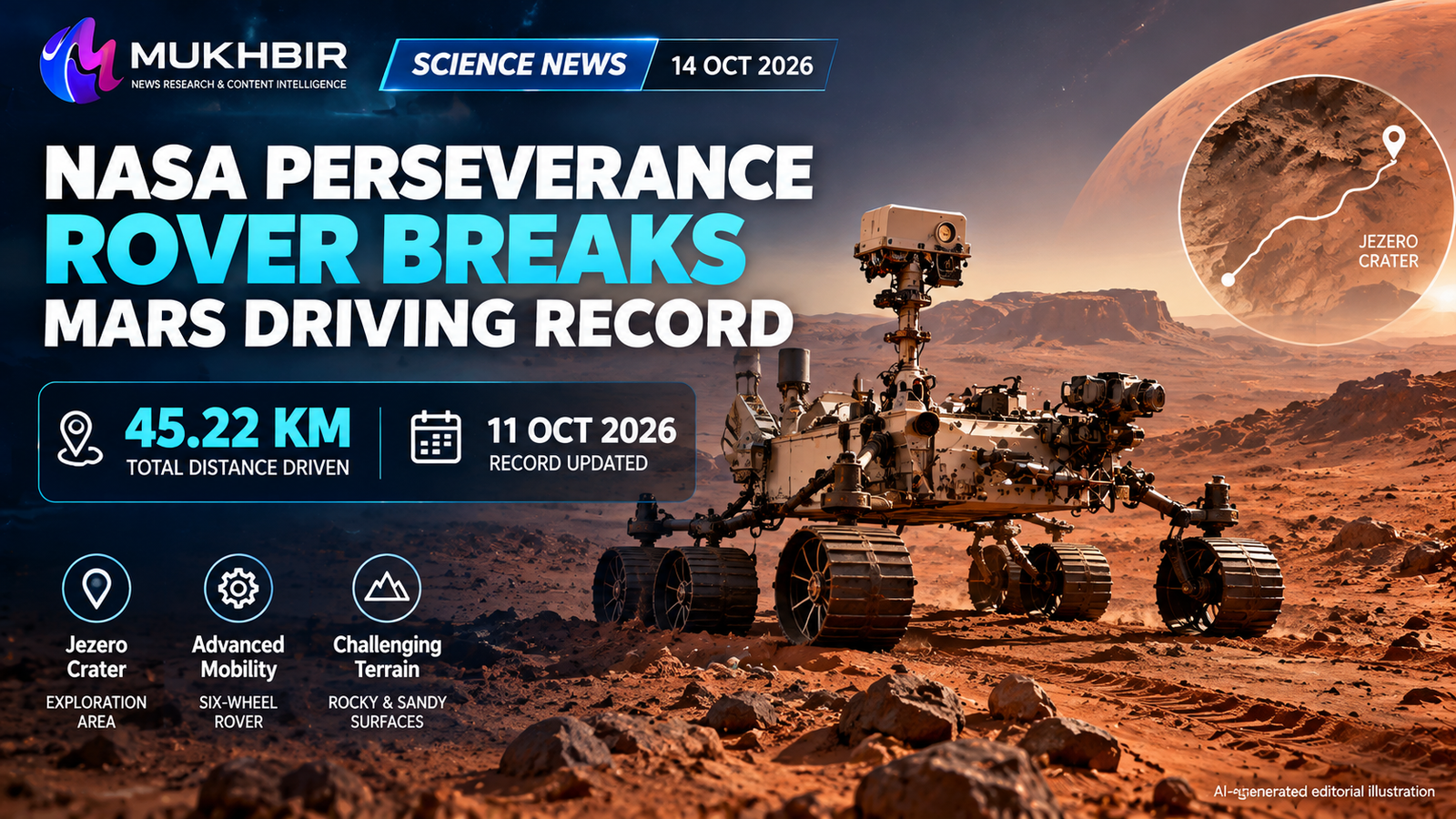
NASA’s Perseverance rover has set a new off-world driving record, covering a cumulative 45.22 kilometers (28.10 miles) on Mars by October 11, 2026. The milestone surpassed the 45.16-kilometer (28.06-mile) mark established by Opportunity, making Perseverance the farthest-traveling vehicle on the surface of another world, according to an official NASA announcement released October 12.
The NASA Perseverance rover record 2026 was also covered by Reuters and Geo News on October 13 and independently recognized by Guinness World Records. While this article is prepared for Mukhbir’s October 14 Science coverage, the record was achieved on October 11—not newly set on October 14.
The achievement highlights improvements in autonomous navigation and the rover’s long-term durability. Perseverance is now examining some of the most ancient rocks accessible near Jezero Crater, investigating environments that could reveal whether Mars once offered conditions suitable for microbial life.
NASA Perseverance Driving Record: Key Facts
Record date: October 11, 2026. Total distance driven: 45.22 km (28.10 miles). Previous record: Opportunity, 45.16 km (28.06 miles). Location: Jezero Crater region on Mars. Mission: Mars 2020 Perseverance, landed February 2021. Record-setting mission sol: 2,006. Main navigation system: AutoNav. Record-drive segment: approximately 91.31 meters (299.6 feet).
NASA’s October 12 statement provides precise odometer figures, while Reuters’ October 13 reporting explains the wider significance. Because Perseverance remains active, its lifetime distance may continue increasing after the dated record snapshot.
How Perseverance Overtook Opportunity
Opportunity, NASA’s earlier six-wheeled rover, explored Mars between 2004 and 2018 and ultimately covered about 45.16 kilometers. Its extraordinary longevity made it the previous record holder for total distance driven on a planetary surface beyond Earth.
Perseverance completed a 91.31-meter drive on October 11, bringing its odometer to 45.22 kilometers. The achievement came on the rover’s 2,006th Martian day, about five and a half years after landing, whereas Opportunity accumulated its record over nearly 15 years.
The comparison is about cumulative surface driving distance, not the fastest individual drive or maximum speed. Technological improvement and different missions made Perseverance more efficient at traversing terrain, but Opportunity’s record remains a remarkable accomplishment.
Where Was the Record Set on Mars?
The rover crossed the milestone while moving through a region informally called Lac de Charmes, west of the rim of Jezero Crater. It was traveling toward Idubi, an area whose ancient geological formations are of interest to the Mars science team.
NASA says some of the rocks in this region are so old that comparable formations on Earth have largely been altered or destroyed through tectonic activity and erosion. Exploring them may offer evidence of very early planetary history.
The mission is seeking clues about ancient environments, including regions affected by hydrothermal processes. Those settings are scientifically interesting because interactions between water, rock and heat can create conditions relevant to habitability.
The record does not demonstrate that Mars presently supports life. The rover’s work investigates geological evidence and the possibility of ancient microbial environments, which require careful interpretation.
How AutoNav Helped Break the Record
NASA attributes much of the accomplishment to Perseverance’s autonomous navigation technology, known as AutoNav. Rather than waiting for ground teams to plan every movement in detail, the rover can evaluate its immediate surroundings and choose routes between waypoints selected by operators on Earth.
Its cameras capture images as the rover moves, allowing onboard software to construct a three-dimensional understanding of obstacles and terrain. The rover can then select an appropriate path while continuing toward its scientific destination.
NASA says more than 90% of Perseverance’s distance has involved AutoNav terrain assessment. By comparison, only around 5% of the distance driven by Opportunity and its twin Spirit involved their early autonomous navigation system.
Autonomy is important because signals between Earth and Mars take time to travel. The rover cannot be driven like a remote-control car with instantaneous human reactions, so local navigation capability helps increase efficiency and reduce waiting.
How Fast Can the Rover Travel?
Perseverance is not designed for highway speeds. Its movements are deliberate because Martian terrain includes rocks, slopes and other hazards that could damage scientific instruments or mobility hardware.
NASA reported that the rover can drive as much as 412 meters in one Martian day, known as a sol. It considers hundreds of thousands of terrain measurements as it plans safe paths through complex areas.
A single fast day is less important than a sustained ability to drive safely, stop at relevant geological outcrops and collect useful measurements. The new total-distance record reflects years of successful navigation rather than one dramatic sprint.
Why the Rover Still Matters Scientifically
Perseverance landed in Jezero Crater in February 2021 to investigate ancient geology and search for potential signs of past microbial life. Scientists believe the crater once contained a lake and river delta, making it an important target for studying Mars’ wetter history.
The rover has examined multiple geological environments and collected samples of rock and regolith for potential future analysis. NASA’s October update said it had collected 29 such samples spanning the crater floor, delta and rim.
One particularly interesting rock, nicknamed Cheyava Falls, contained what scientists describe as a potential biosignature. That phrase means an observation possibly consistent with past biological activity, not proof that extraterrestrial life has been discovered.
Future investigation must distinguish biological explanations from nonbiological chemical and geological processes. The scientific value of longer driving lies in reaching more varied terrain that can help answer these questions.
A New Mission Extension Through 2028
NASA recently approved an extension of the Perseverance mission that is expected to continue exploration around Jezero’s rim through approximately the end of 2028. The extension follows favorable assessments of the rover’s major operating systems.
Mission engineers have indicated that the mobility hardware remains in strong condition. While further long-term operation is possible, no spacecraft’s future lifespan can be guaranteed given harsh temperatures, dust, mechanical wear and unexpected faults.
The rover’s route is expected to continue toward other ancient geological features, including a region known as Rainbow Falls. Each new stop will be chosen for its scientific value as well as terrain accessibility and operational safety.
NASA’s confidence in continued operation does not mean every planned discovery or sample-return activity is already assured.
How the Mars Record Compares With Lunar Rovers
NASA’s historical comparison includes robotic Mars vehicles and wheeled vehicles used on the Moon. Perseverance has exceeded not only Opportunity but also the distance covered by the Apollo 17 crew’s lunar vehicle and the Soviet Lunokhod 2 rover.
Earlier machines helped establish how surface mobility could expand planetary exploration. NASA’s Sojourner rover traveled only about 100 meters during its 1997 Mars mission, while Spirit eventually covered 7.7 kilometers before falling silent in 2010.
Curiosity, NASA’s other active Mars rover, had driven more than 38 kilometers as of the October 11 comparison. It explores a different region, Gale Crater, and carries out its own geological and environmental investigations.
Comparing these distances shows how capabilities have developed across decades, although the vehicles operated under different scientific goals and engineering constraints.
What This Means for Future Robotic Exploration
Longer autonomous drives help robotic missions reach scientifically valuable locations without requiring ground operators to specify every meter of travel. This can improve the amount of terrain studied during a spacecraft’s limited operating life.
NASA is also improving how Perseverance verifies its position against orbital maps and steers through challenging landscapes. Engineers want future rovers to continue safely even when sunlight causes glare that can interfere with navigation cameras.
The broader technology is relevant to robotic exploration beyond Mars, including lunar surface vehicles and missions to other distant destinations. Any direct commercial benefit on Earth would require separate technical evidence rather than an assumption based on the spaceflight record.
Pakistan and South Asia Relevance
This is primarily a global science achievement rather than a Pakistan-specific development. Still, students and researchers in Pakistan and South Asia can follow the mission as a concrete example of robotics, computer vision, geology and aerospace engineering working together.
Educational institutions can use NASA’s published images, maps and mission descriptions to explore autonomous navigation and planetary science. However, the cited sources do not establish any direct Pakistani institutional involvement in the record-setting drive.
Mukhbir covers the development because of its scientific importance, international public interest and strong potential for educational search traffic, not because a regional connection needs to be invented.
What Happens Next?
Perseverance is expected to continue driving and investigating ancient terrain around Jezero Crater. New odometer readings, sample findings, technical milestones and NASA announcements may warrant follow-up stories as the extended mission progresses.
The record could increase with every successful journey, but readers should distinguish the historical October 11 figure from any later total. Likewise, a promising rock finding should not be called proof of ancient Martian life without the scientific evidence to support such a conclusion.
The essential news is that Perseverance officially surpassed Opportunity’s longstanding off-world distance record and continues to use advanced autonomous navigation to extend the reach of Mars exploration.
Frequently Asked Questions
What record did NASA’s Perseverance rover break?
It became the vehicle with the greatest cumulative driving distance on a world other than Earth, according to NASA and Guinness World Records.
How far had Perseverance driven?
NASA reported 45.22 kilometers, or 28.10 miles, as of October 11, 2026.
Which rover held the previous record?
NASA’s Opportunity rover previously held the record with 45.16 kilometers, or 28.06 miles.
When was the record achieved?
The milestone was reached on October 11, 2026, and NASA announced it on October 12.
Where is Perseverance exploring?
The rover is traveling near the western rim of Jezero Crater, including the region called Lac de Charmes.
How does Perseverance navigate on Mars?
Its AutoNav system uses cameras and onboard processing to map hazards and select paths between waypoints.
Has Perseverance discovered life on Mars?
No confirmed discovery of life has been established. It has found features described as potential biosignatures that require further study.
How long is the Perseverance mission expected to continue?
NASA has approved an extension supporting exploration around the crater rim through approximately the end of 2028.
About The Author