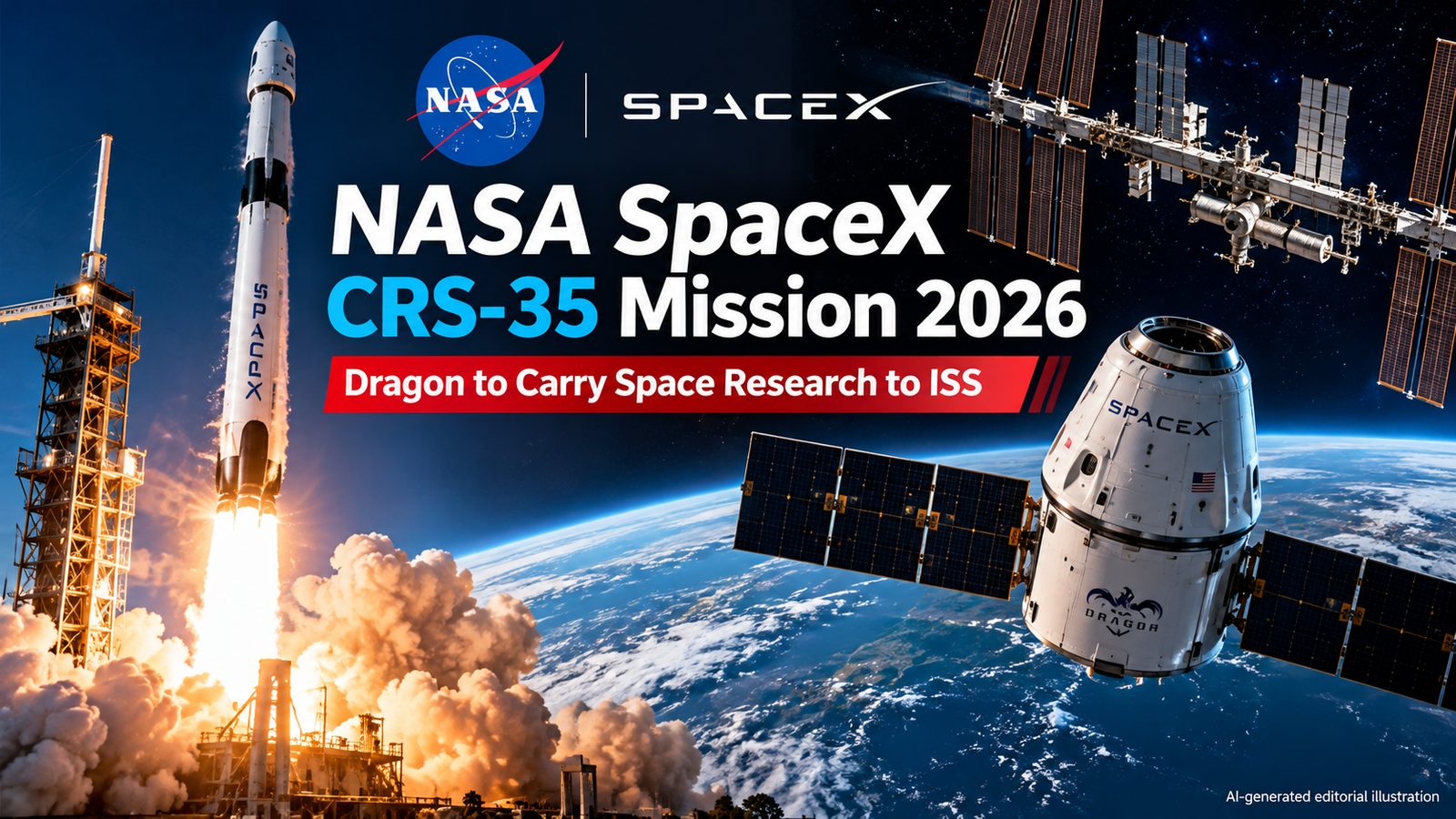
NASA and SpaceX are targeting October 13, 2026, for the launch of the 35th commercial resupply mission operated by SpaceX for the International Space Station (ISS). The Falcon 9 rocket is scheduled to send a reusable Dragon cargo spacecraft into orbit carrying scientific experiments, station supplies and equipment intended to support research in microgravity.
The NASA SpaceX CRS-35 mission 2026 is notable for its emphasis on human and plant health, including experiments involving miniature models of the human brain and antibiotic-resistant bacteria. NASA has also confirmed that the flight will carry the final set of ISS Roll-Out Solar Arrays, an upgrade intended to support power generation at the orbiting research laboratory.
NASA and SpaceX officially targeted 6:33 a.m. Eastern Daylight Time on Tuesday, October 13, from Space Launch Complex 40 at Cape Canaveral Space Force Station in Florida. That corresponds to 3:33 p.m. in Pakistan. SpaceX listed a backup opportunity for October 14 at 6:08 a.m. Eastern Time. Launch plans are subject to operational and weather conditions.
At the time of this prelaunch report, the official mission pages described a scheduled departure, not a confirmed successful launch. Publication after liftoff should include a verified postlaunch update rather than silently changing the article’s timeline.
NASA SpaceX CRS-35 Mission: Key Details
Mission: SpaceX’s 35th Commercial Resupply Services flight for NASA.
Rocket: SpaceX Falcon 9.
Spacecraft: Cargo Dragon, flying its fourth mission.
Launch location: Space Launch Complex 40, Cape Canaveral Space Force Station, Florida.
Target launch: October 13, 2026, at 6:33 a.m. EDT (3:33 p.m. PKT).
Backup launch opportunity: October 14, 2026, at 6:08 a.m. EDT.
Destination: International Space Station.
Planned arrival: October 15, approximately 11:00 a.m. EDT, subject to successful launch and orbital operations.
Cargo highlights: Scientific investigations, crew supplies, station hardware and ISS Roll-Out Solar Arrays.
These figures come from NASA’s CRS-35 mission coverage advisory and SpaceX’s mission page. Schedules may change as teams assess readiness.
Why Is NASA Launching CRS-35?
The International Space Station is both a research laboratory and a continuously operated spacecraft. Its crews rely on cargo missions for supplies, scientific equipment, hardware upgrades and material used in experiments.
Commercial resupply flights allow NASA to contract transport services from private companies rather than operating every cargo spacecraft itself. SpaceX supplies the Falcon 9 launcher and Dragon vehicle for CRS-35 under the agency’s Commercial Resupply Services program.
The Dragon spacecraft is designed to reach the station and dock autonomously after a series of carefully controlled maneuvers. Once docking and safety checks are complete, astronauts can open the hatches and begin unloading cargo.
Cargo flights also support a cycle of research: equipment and samples travel into orbit, experiments take place aboard the station, and some completed materials may later return to Earth for laboratory analysis.
What Science Is Flying on CRS-35?
NASA described four investigations from its Biological and Physical Sciences program in an October 12 mission preview. They address human brain biology, crop disease, astronaut health assessment and bacteria that show resistance to antibiotics.
Each experiment benefits from the distinct conditions aboard the ISS, where researchers can study biological systems for extended periods under microgravity. This environment can change how fluids move, how cells interact and how organisms respond to stress.
Researchers are interested in both spaceflight applications and potential lessons for life on Earth. Still, individual experiments are designed to investigate questions; their outcomes cannot be declared before samples and data have been analyzed.
Miniature Brain Models Could Reveal How Cells Respond to Space
One CRS-35 experiment will send small laboratory-grown models of the human brain to the station for approximately five weeks. Such models, sometimes called brain organoids, are simplified collections of cells used to study particular features of human tissue.
Scientists hope to understand how aspects of brain biology respond to the space environment. The work could help researchers identify processes that are relevant to astronaut health during long-duration missions.
The brain models are not complete human brains and cannot substitute for all the functions of a living person. Their value lies in enabling controlled observations of specific biological responses that would otherwise be difficult to isolate.
NASA framed the experiment as precision-health research. Scientific conclusions will require observations, comparisons and postflight analysis.
Crop Disease Research and Future Space Farming
Food production is one of the major logistical challenges for missions lasting months or years. Carrying all food from Earth becomes increasingly demanding as exploration ventures farther from the planet.
NASA says CRS-35 includes an investigation involving crop disease. Plant research in microgravity can help scientists understand the ways biological systems react to unfamiliar environments and the threats that may affect food production.
Growing crops in space is not simply about seeds and light. Plants depend on nutrients, water distribution, air movement and disease management, all of which must function inside spacecraft or specialized habitats.
The experiment may contribute knowledge useful for future exploration and terrestrial agriculture, but it would be premature to promise a commercial farming breakthrough based on the launch alone.
Faster Monitoring of Astronaut Health
A further investigation focuses on assessing astronaut health more quickly. Crews on long-duration missions cannot always rely on the same clinical infrastructure available in a hospital on Earth.
Rapid and dependable ways of examining biological indicators could allow researchers to monitor how astronauts are responding to conditions in orbit and help teams make timely decisions when medical questions arise.
This work is especially relevant to future missions that operate far from Earth, where communication delays and limited access to medical equipment may complicate care.
The CRS-35 experiment is an early research step rather than an announcement that a particular diagnostic device has already been validated for all spacecraft or patients.
Antibiotic-Resistant Bacteria on the Space Station
NASA’s science preview also identifies an investigation concerning antibiotic-resistant organisms. Researchers are interested in how bacteria behave in the station environment, including characteristics relevant to their survival or resistance.
Antibiotic resistance is a significant health challenge on Earth as well as a concern for crewed spacecraft. Studying organisms in different conditions can generate evidence about the processes that contribute to resistance.
This does not mean the mission is expected to produce an immediate treatment for resistant infections. The experiment aims to improve scientific understanding and may inform later research.
Safety protocols and controlled laboratory procedures are essential when studying organisms with potential health implications, including during sample handling and analysis.
Final ISS Roll-Out Solar Arrays Are Part of the Cargo
CRS-35 is scheduled to deliver the final set of International Space Station Roll-Out Solar Arrays, known as iROSAs. These compact solar arrays are designed to supplement the ISS’s existing power-generating infrastructure.
Electricity is essential for onboard computing, life support, communications, scientific experiments and other operations. Hardware improvements help the station make effective use of its remaining operational period.
Solar arrays cannot generate power while in Earth’s shadow, so the orbital power system also depends on storage and management systems. The upgrade should be understood as part of an integrated electrical system.
NASA announced the array delivery in its October 7 launch-coverage advisory. Installation and operation are future milestones that must be confirmed separately from successful arrival.
How the Falcon 9 and Cargo Dragon Flight Will Work
After liftoff from Florida, Falcon 9’s first and second stages will separate. The second stage is responsible for placing Dragon on an appropriate path toward orbit, after which the cargo spacecraft begins its own checks and planned maneuvers.
SpaceX says the first-stage booster assigned to this mission is on its eighth flight. It is expected to attempt a landing at Landing Zone 40 at Cape Canaveral after completing its launch duties.
Dragon will then undertake a journey of roughly 52 hours before reaching the ISS. During this time, the spacecraft will perform a sequence of orbit-adjustment burns and establish communication with the station.
When approach conditions are satisfied, Dragon is designed to execute an autonomous docking procedure. SpaceX targets approximately 11 a.m. Eastern Time on Thursday, October 15, for arrival.
All such steps remain conditional before they occur. A scheduled docking should not be presented as completed simply because the rocket reaches orbit.
Reuse of Rockets and Spacecraft
SpaceX’s use of a previously flown Falcon 9 booster and Dragon vehicle shows how reusable hardware has become part of regular space-station logistics.
The company says this Dragon previously supported CRS-26, CRS-29 and CRS-33. For CRS-35, its planned fourth flight illustrates the practice of refurbishing and reusing cargo spacecraft rather than building a new vehicle for every mission.
Reusability can affect logistics, production and operating economics, but cost savings depend on refurbishment requirements, mission frequency, hardware performance and other factors.
A successful reuse record is valuable, though every launch still requires mission-specific inspections, testing and operational readiness decisions.
Why Microgravity Matters to Researchers
On Earth, gravity influences fluid movement, sedimentation and many biological processes. Microgravity offers scientists a different environment for observing systems that are difficult to isolate under ordinary laboratory conditions.
The ISS is particularly valuable because experiments can be performed over days or weeks and can sometimes be monitored or adjusted by astronauts.
Scientists use this environment to investigate changes in living cells, materials and physical behavior. Some findings may lead to further experiments on Earth, but translating orbital observations into practical technology usually takes additional years of study.
NASA’s CRS-35 biological research is part of that longer process of discovery, measurement and validation.
Global Relevance and Possible Benefits for South Asia
Although CRS-35 is a United States-led commercial cargo mission, scientific work in space can contribute to internationally relevant research questions.
Studies of biological health, crop resilience and antibiotic resistance intersect with challenges faced by many countries, including Pakistan and other South Asian nations.
However, no direct Pakistan-specific research partnership or immediate medical benefit has been established in the official CRS-35 materials reviewed for this article. Any long-term relevance remains potential rather than guaranteed.
For students and universities, the mission offers examples of interdisciplinary scientific work combining biology, physics, engineering, robotics and aerospace systems.
When and Where Can Viewers Watch the Mission?
NASA announced that live launch coverage would begin around 6:15 a.m. Eastern Time on October 13. SpaceX also planned a launch webcast roughly 20 minutes before liftoff through its official channels.
Viewers in Pakistan can use the NASA and SpaceX websites for updates, but the target launch time may change. The availability of the rocket to the naked eye from a particular location depends on geographic conditions and trajectory.
Watching the webcast is the most dependable way for international audiences to follow countdown activities and technical updates.
Any later report claiming liftoff, booster landing or Dragon docking should rely on the official mission timeline or other verified live reporting.
What Happens After CRS-35 Launch?
The planned sequence begins with Falcon 9 liftoff, ascent and Dragon deployment. SpaceX will then monitor the cargo spacecraft as it adjusts its orbit on its way toward the ISS.
Assuming normal operations, Dragon is expected to dock on October 15, after which the crew can unload supplies and set up investigations.
Research teams will collect observations during the mission and analyze results as the studies progress. The release of scientific findings may take considerably longer than the flight itself.
Subsequent milestones should be covered as updates to the original article or as new stories only when they constitute independently newsworthy developments.
Frequently Asked Questions
What is NASA’s SpaceX CRS-35 mission?
It is SpaceX’s 35th commercial cargo resupply mission for NASA, intended to deliver research, supplies and hardware to the International Space Station.
When is the CRS-35 launch scheduled?
NASA and SpaceX targeted October 13, 2026, at 6:33 a.m. Eastern Daylight Time, equivalent to 3:33 p.m. Pakistan time.
Which rocket and spacecraft will be used?
The mission uses a SpaceX Falcon 9 rocket and a reusable Cargo Dragon spacecraft.
What science is aboard CRS-35?
NASA highlighted research involving brain models, crop disease, faster astronaut health assessment and antibiotic-resistant bacteria.
Why are brain models going to the ISS?
Researchers want to examine how simplified models of human brain tissue respond to conditions in space over an approximately five-week experiment.
What hardware will CRS-35 deliver?
Among its station hardware is the final set of ISS Roll-Out Solar Arrays, which supplement power generation on the orbiting laboratory.
When is Dragon expected to dock?
SpaceX targeted Thursday, October 15, at approximately 11 a.m. Eastern Time, assuming the mission proceeds as scheduled.
Has the CRS-35 mission already succeeded?
The official sources used for this prelaunch report described a scheduled mission. Launch, landing and docking should be marked complete only after verified updates.
About The Author