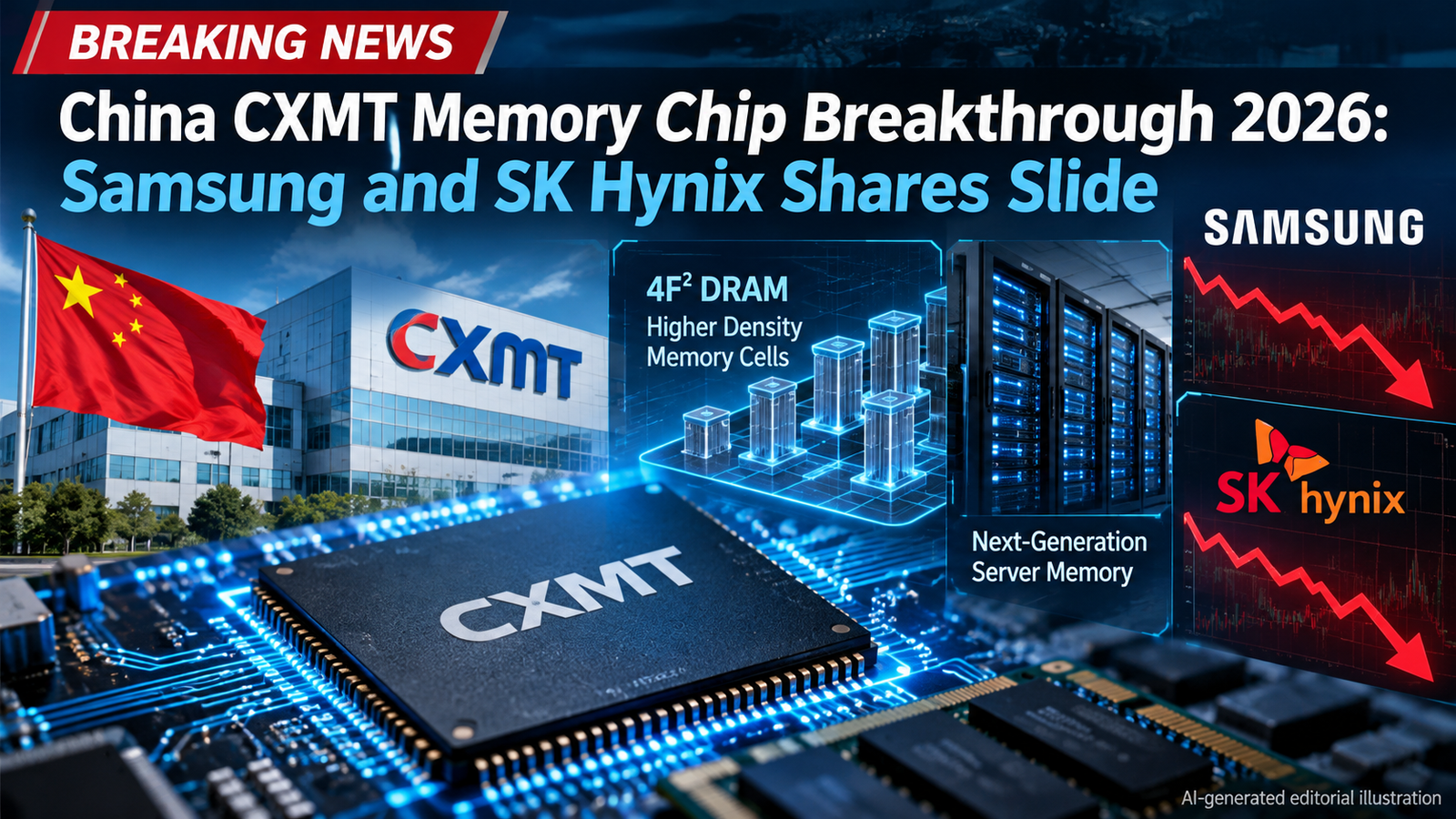
China’s ChangXin Memory Technologies (CXMT) has reported progress in a higher-density memory chip architecture and plans to introduce a new server-memory product by the end of 2026, developments that contributed to a sharp selloff in leading Asian semiconductor stocks on Tuesday, October 13. Shares of Samsung Electronics and SK Hynix fell as investors considered the possibility of stronger Chinese competition in a market central to artificial intelligence computing.
The CXMT memory chip breakthrough 2026 story is significant not because a finished new product has already displaced existing chips, but because a major Chinese supplier says it is advancing technology that could eventually alter server-memory economics. Market participants reacted before commercial performance, manufacturing scale and customers for the planned product could be independently assessed.
Reuters and Associated Press reported that South Korea’s benchmark Kospi suffered one of its steepest declines of the year as semiconductor stocks weakened. Korean technology reporting connected that pressure to CXMT’s plans for a denser memory-cell design, amid broader doubts about the cost and sustainability of the global AI investment boom.
What did CXMT announce?
CXMT, a Chinese manufacturer of dynamic random-access memory (DRAM), described technological progress involving a 4F² memory-cell architecture. Korean and international business publications reported that the company intends to release a server-memory module built around the design by the end of 2026.
The ‘4F²’ notation refers to a memory-cell area measured relative to the minimum feature size used in semiconductor manufacturing. In simplified terms, the architecture is intended to fit memory cells more densely than conventional approaches, potentially increasing how much information a chip can hold per unit of silicon.
Greater density can matter for production economics, power requirements and server capacity. However, technical claims about cell layouts do not automatically mean a company can manufacture high-yield products reliably at massive volume. This distinction is crucial when evaluating CXMT’s reported progress.
The latest public coverage does not establish a final commercial specification, independently verified manufacturing yield or confirmed shipment volume for the planned server-memory module. Mukhbir therefore treats it as a reported technology advancement and product plan, not as proof that a new chip has already reached global customers.
Why did Samsung and SK Hynix shares fall?
Semiconductor investors have spent much of 2026 pricing in demand for memory used by AI servers and cloud infrastructure. When a new competitor signals potential progress, investors may revise expectations for scarcity, pricing and future profit margins, even when the product has not yet entered full commercial production.
The Associated Press reported that South Korea’s Kospi dropped around 7.4% on October 13, while Samsung Electronics lost roughly 7.7% and SK Hynix approximately 8.8% in the reported market snapshot. Figures can change during trading and differ across reports by timestamp, so these should not be described as final closing prices without confirmation.
Reuters also described a broad Asian selloff affecting chip-related names and other technology shares. The decline reflected several pressures, including questions about AI capital expenditure, competitive technological advances in China and investor preference for less volatile assets.
A single stock-market session does not settle which company will dominate future memory markets. It does show how sensitive valuations have become to announcements that might reshape supply and pricing.
What is DRAM and why is it important for AI?
Dynamic random-access memory, or DRAM, temporarily stores information that processors need to access quickly. Modern computing systems use it across personal computers, smartphones, networking equipment and data centers. It is different from long-term storage such as solid-state drives.
AI training and inference can require large amounts of fast-moving data. Memory capacity, bandwidth, latency, energy efficiency and cost all influence how efficiently a server can run workloads. Different classes of memory have different performance characteristics and are not automatically interchangeable.
High-bandwidth memory (HBM), typically used beside advanced AI accelerators, differs from conventional server DRAM modules. A denser server-memory architecture may contribute to overall AI infrastructure efficiency without necessarily matching the specialized requirements of HBM.
Reports about CXMT should therefore avoid claiming the company has already surpassed Samsung and SK Hynix in every AI memory segment. The announced progress concerns a specific design and planned server-memory offering, with implementation details still to be tested.
How does the 4F² memory-cell design work?
Semiconductor manufacturing uses increasingly small features to pack more circuitry onto each chip. The 4F² expression describes an intended footprint of four times the square of a process-related feature dimension. It is an architectural shorthand, not by itself a promise of fourfold speed or four times the usable capacity.
Engineers must still address cell reliability, charge retention, interference, manufacturing variation and the ability to scale production economically. Novel layouts can introduce trade-offs that become visible only after extended testing and commercial deployment.
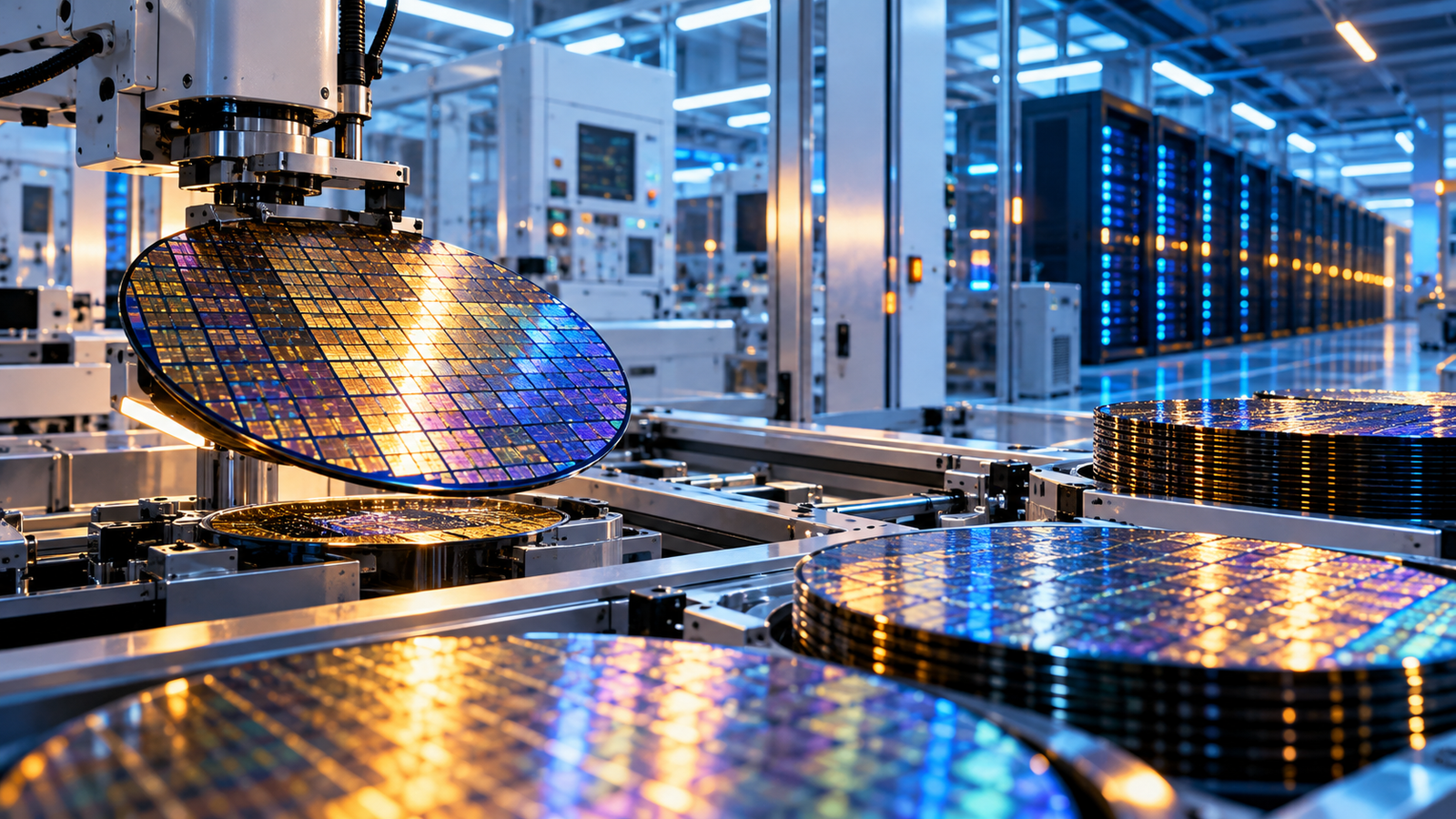
If a smaller cell architecture proves reliable, manufacturers may fit more memory onto a wafer or build higher-capacity modules at competitive cost. That could eventually increase pressure on established suppliers’ pricing, depending on yields, quality and customer acceptance.
The public reports cited here describe CXMT’s ambition but do not offer independently verified benchmark comparisons against Samsung, SK Hynix or Micron’s latest commercial memory modules. Claims of a decisive global technology lead would therefore be premature.
What does this mean for Samsung, SK Hynix and Micron?
Samsung Electronics and SK Hynix are major South Korean memory producers, while Micron Technology is a leading United States competitor. All operate in markets where profitability can change with supply, demand, technological transitions and capital spending.
The market reaction suggests investors are increasingly focused on whether a Chinese producer could close part of the technology gap in server DRAM. If production capability improves, competition may intensify in certain product segments over time.
But the incumbent companies have substantial engineering expertise, customers and established production systems. Those capabilities matter when turning a laboratory or pilot-process advance into products that meet strict reliability and performance requirements.
Micron shares also faced pressure in the United States as traders assessed possible competition from CXMT. That reaction illustrates the global scope of the story, but stock-price declines alone are not evidence of lost customers or immediate market-share changes.
China’s semiconductor strategy and CXMT’s expansion
China has sought to strengthen domestic semiconductor supply amid international technology restrictions and rising demand for AI infrastructure. Memory chips are a strategically important component because cloud servers and consumer devices require dependable, high-volume supplies.
CXMT has grown into a significant DRAM supplier. Earlier 2026 reports described a major Shanghai stock-market listing and supply arrangements with domestic technology companies, reflecting increasing investor and customer interest in Chinese-made memory.
Reuters reported in June that CXMT had secured a multiyear memory supply arrangement with Tencent valued at close to $3 billion, citing people familiar with the matter. That earlier development demonstrates domestic commercial demand, but it is separate from the October 13 announcement and should not be presented as a new deal today.
Scale, manufacturing yield and access to advanced production equipment remain important constraints. Investment and technology progress can accelerate development, but do not guarantee rapid displacement of global suppliers.
Why the AI investment boom is part of this story
The semiconductor selloff occurred amid wider investor concerns about the level of spending needed to build artificial intelligence data centers. Companies have committed substantial funding to servers, power infrastructure, networking and specialized processors.
Demand for computing may remain strong while investors worry about when infrastructure spending will generate sufficient returns. The industry can therefore experience both growing usage and volatile valuations at the same time.
Reuters reported on October 13 that the International Monetary Fund highlighted risks linked to an AI investment slowdown in its global financial stability assessment. The warning reflects financial exposure to ambitious technology spending, rather than a declaration that AI development itself has stopped.
Memory suppliers sit at the intersection of these two pressures. They may benefit from demand for data-center capacity but face competition and pricing risks if more suppliers develop viable products or if technology spending slows.
Could CXMT lower the cost of AI servers?
Potentially, stronger competition and improved memory density can influence costs. However, it is too early to calculate any savings from CXMT’s planned product, because its specifications, availability, selling price and real-world reliability have not been publicly verified in the reviewed reporting.
Server costs depend on many inputs, including processors, memory, networking, cooling, storage, power and software. Even a meaningful improvement in one component does not automatically translate into lower consumer AI subscription prices.
For cloud providers, predictable supply can be as important as headline chip density. Purchasing decisions typically account for reliability, compatibility, service agreements and long-term total cost of ownership.
The product’s future impact will therefore depend on whether data-center operators can obtain it at scale and whether independent testing establishes a useful advantage.
What is the relevance for Pakistan and South Asia?
The immediate story is global, with its center of gravity in China, South Korea and international technology markets. Pakistan’s direct exposure to the share-price movements is less established than that of semiconductor-producing economies.
Nevertheless, memory pricing and availability can eventually affect imported computers, enterprise servers and the economics of digital infrastructure used across South Asia. Universities, technology firms and data-center buyers all depend on global hardware supply chains.
These are potential indirect effects, not evidence that laptop prices or cloud bills in Pakistan changed on October 13. Such outcomes would require observed retail or procurement data before being reported as facts.
For regional audiences, the wider issue is whether growing semiconductor competition improves access to computing capacity over time, and how export controls and global investment patterns shape that access.
What should investors and technology readers watch next?
The key milestone is whether CXMT actually introduces the planned server-memory product by year-end. Subsequent questions include manufacturing yield, independent benchmarks, customer qualification, supply volume and sustained pricing.
Investors will also watch statements from Samsung, SK Hynix and Micron, together with earnings and capital expenditure updates from cloud and AI infrastructure customers.
Share prices move continuously, so market-performance figures should always carry timestamps and should not be updated selectively to create a more dramatic narrative. New claims about commercial adoption should be linked to credible documents or attributed company statements.
As of October 13, the confirmed public-interest development is that CXMT’s reported memory-cell design progress and product plan coincided with sharp pressure on major Asian chip stocks. The company has not yet been shown, through the reports reviewed, to have displaced established industry leaders in volume production.
Frequently Asked Questions
What is the CXMT memory chip breakthrough 2026?
CXMT reported progress in a higher-density 4F² DRAM memory-cell architecture and plans to introduce a related server-memory product by the end of 2026.
Why did Samsung shares fall on October 13?
Investors reacted to concerns about competition from CXMT and broader uncertainty around AI-related technology spending, according to Reuters and AP.
Did SK Hynix also decline?
Yes. AP reported a substantial decline in SK Hynix shares during the October 13 semiconductor selloff. Market figures vary by reporting time.
Does CXMT already outperform Samsung memory chips?
The reporting does not establish that conclusion. The new design and planned server-memory product still require commercial performance and production verification.
What does 4F² DRAM mean?
It refers to a memory-cell architecture whose area is described relative to a manufacturing feature dimension, aiming for greater density rather than guaranteeing higher speed.
Is server DRAM the same as HBM?
No. Conventional server DRAM and high-bandwidth memory serve different roles and have different performance characteristics.
Could the development affect AI costs?
It might influence competition and memory economics over time, but there are no verified figures showing immediate cost savings.
Does this news matter for Pakistan?
It may eventually affect global hardware availability and pricing, but an immediate Pakistan-specific price impact has not been demonstrated.
About The Author