KP emergency 2026 measures took effect after Pakistan’s President Asif Ali Zardari approved and signed a summary concerning Khyber Pakhtunkhwa on Sunday, October 11, following advice from Prime Minister Shehbaz Sharif. The President Secretariat said the decision invoked Articles 232 and 234 of Pakistan’s Constitution, relating to an emergency proclamation and Governor’s Rule.
The federal cabinet recommended the measures after reviewing the province’s security situation. The decision changes how provincial executive authority is exercised and has generated competing interpretations from the federal government and Pakistan Tehreek-e-Insaf (PTI), which had led the provincial administration.
The emergency applies to Khyber Pakhtunkhwa, not the whole of Pakistan. It should not be described as a nationwide emergency or automatically equated with martial law. The constitutional provisions, official notifications and subsequent decisions determine the actual scope of the measures.
This report uses the President Secretariat account carried by Associated Press of Pakistan, along with October 11–12 coverage from ProPakistani, Dawn and Reuters. Statements about motives or constitutional objections are attributed to those making them rather than endorsed as established findings.
Who signed the KP emergency order?
President Asif Ali Zardari approved and signed the summary on October 11, 2026. The President Secretariat’s media wing stated that the approval followed the prime minister’s advice under Articles 232 and 234. The official state news agency Associated Press of Pakistan carried that confirmation.
Prime Minister Shehbaz Sharif had chaired a federal cabinet meeting earlier the same day. Cabinet members reviewed information on law and order and recommended that the prime minister advise the president to invoke the relevant constitutional powers.
The distinction between cabinet recommendation, prime-ministerial advice and presidential approval matters. The cabinet proposed the action, the prime minister formally advised it, and President Zardari approved and signed the summary. None of these stages should be attributed to the wrong officeholder.
ProPakistani’s October 11 report independently described the same sequence. Dawn also confirmed the president’s approval of the cabinet’s recommendations and the separate application of emergency and Governor’s Rule provisions.
What happened on October 11?
The federal cabinet held an emergency meeting chaired by the prime minister after officials briefed ministers on security concerns in KP. According to the Prime Minister’s Office account reported by Dawn, cabinet members discussed what they regarded as weaknesses in cooperation on counterterrorism.
The government then sent its recommendation through the prime minister to the president. The President Secretariat announced that the summary had been approved and signed. The federal government subsequently began making administrative changes linked to the new arrangement.
Dawn reported that Dr Muhammad Fakhr Alam Irfan was appointed KP chief secretary through an official notification. Further administrative and security decisions followed, including a separate Interior Ministry order authorising military assistance to civil power.
These are related developments but not identical decisions. The signing of the emergency summary, administrative appointments and security deployment orders have different legal bases and should be reported separately.
What are Articles 232 and 234 of Pakistan’s Constitution?
Article 232 addresses an emergency proclamation where national or regional security is threatened under conditions specified by the Constitution. It sets requirements for constitutional approval and oversight, including the role of the provincial assembly or Parliament depending on how the proclamation is made.
Article 234 deals with a breakdown of constitutional machinery in a province. Under its framework, functions of the provincial government can be assumed or assigned in a manner specified by the constitutional proclamation, with limits and safeguards that require close reading of the actual order.
The provisions are distinct. Article 232 is not simply another name for Governor’s Rule, and Article 234 does not by itself mean a national emergency. Dawn’s constitutional explainer emphasizes that neither the president nor governor may assume the functions of the provincial high court.
Article 233 separately concerns possible restrictions on certain fundamental-rights enforcement during emergencies. Dawn reported that Article 233 was not cited in the summary signed by President Zardari. Therefore, the article should not claim an automatic blanket suspension of rights on the basis of the announcement.
Why did the federal government recommend the move?
The federal government said the decision followed deteriorating security and concern over militant attacks in KP, which borders Afghanistan. Cabinet statements argued that the provincial government’s cooperation on counterterrorism had been insufficient.
These are the federal government’s stated grounds for the action. They should not be converted into an independent finding that particular provincial officials deliberately supported violence or committed wrongdoing. Allegations concerning political intent or operational responsibility require evidence beyond a cabinet statement.
Prime Minister Shehbaz Sharif publicly referred to security risks for civilians and personnel, while other federal officials defended the emergency as a response to law-and-order conditions. The government’s position is that the measure is aimed at restoring effective administration and security coordination.
KP’s former PTI-led provincial administration challenged that assessment. Its representatives said federal actions and disagreements over security policy should be addressed through constitutional procedures and political consultation rather than suspension of elected provincial governance.
How did PTI and other political leaders respond?
PTI chairman Barrister Gohar Ali Khan condemned the emergency and Governor’s Rule as undemocratic and argued that weakening provincial autonomy would not resolve security problems. The party’s parliamentary representatives also criticized the decision in statements reported by Dawn.
The opposition’s interpretation differs from the federal government’s legal and security explanation. Mukhbir presents both as attributed positions and does not independently rule on constitutionality, political motive or the merits of particular parties.
Other opposition representatives raised the prospect of pursuing legal and parliamentary challenges. The precise legal standing of any challenge will depend on filed petitions, court orders and the constitutional record rather than political declarations alone.
Governor Faisal Karim Kundi called for cooperation and stability following the decision, according to local reporting. His statements reflect the governor’s official position, not proof that every resident or political group supports the arrangement.
What does Governor’s Rule mean for administration?
Governor’s Rule may allow specified provincial executive functions to be performed under a governor-led arrangement, subject to the applicable constitutional order. It does not automatically abolish courts or remove all checks on government authority.
The exact responsibilities transferred depend on official proclamations and notifications. Provincial civil servants, law-enforcement institutions and public-service departments may receive new reporting instructions while the arrangement remains in force.
Changes in top administrative appointments illustrate that the federal government has begun implementing its decisions. However, the announcement alone does not establish that every local office, hospital, school or public agency has stopped functioning.
Residents seeking services should follow announcements by the relevant provincial department. Broad claims that all government offices have closed, or that ordinary legal protections no longer apply, would go beyond the evidence available in the initial reports.
Was the army deployed after the emergency?
Dawn reported that the federal government issued a separate statutory regulatory order authorizing Pakistan Army troops and assets to assist civil authorities in KP. The stated purposes included protection of people, property and government installations.
Military support to civil power is a distinct administrative and legal matter from the president’s signature on the emergency summary. Reporting should identify which order authorizes which action, and should not imply that the army replaced every civil institution.
Security checkpoints, police deployments and road restrictions were also reported in Peshawar. Such operational measures can vary by location and time. A report of restrictions in one district should not be generalized to the entire province.
Dawn also described mobile-data disruptions in selected areas while noting there was no confirmed province-wide shutdown. Readers should check local operators and official advisories for current network availability.
What happened to the provincial leadership?
Following the order, reports emerged concerning the status of former chief minister Sohail Afridi and other PTI figures. Reuters reported on October 12 that federal officials acknowledged preventive detention of provincial leaders following the emergency measures.
The circumstances and legal basis of each person’s detention require individual attribution and updated records. Such developments should not be folded into the October 11 signing announcement as though every reported action occurred at the same time.
The change in provincial leadership is politically significant, but news coverage should avoid presenting an accusation against detainees as a conviction or assuming that a court has approved every administrative measure.
Any subsequent release, hearing or formal custody order should be reported with its own date, source and legal context.
What could change for residents and businesses?
Short-term uncertainty may affect transport, school attendance, market activity and routine government processes in places experiencing demonstrations or security restrictions. Effects are likely to vary by district, so local conditions must be confirmed rather than assumed.
Companies operating in Peshawar and other parts of KP may need to check road access, worker safety and communications availability. However, there is no basis in the initial reports for claiming a uniform shutdown of commerce throughout the province.
Public institutions remain responsible for essential functions. Citizens may need clear updates on administrative points of contact, document processing and emergency services during any changes in governance.
The wider economic consequences cannot be determined from the signature alone. They depend on the duration of the arrangement, security developments, public confidence and how normal services operate.
Does the emergency apply throughout Pakistan?
No. The reported presidential approval specifically concerned Khyber Pakhtunkhwa. Pakistan’s other provinces were not placed under the same order by this announcement.
This distinction matters for headlines, notifications and social media. A post saying simply ‘Emergency imposed in Pakistan’ could mislead readers into believing a nationwide constitutional measure was taken.
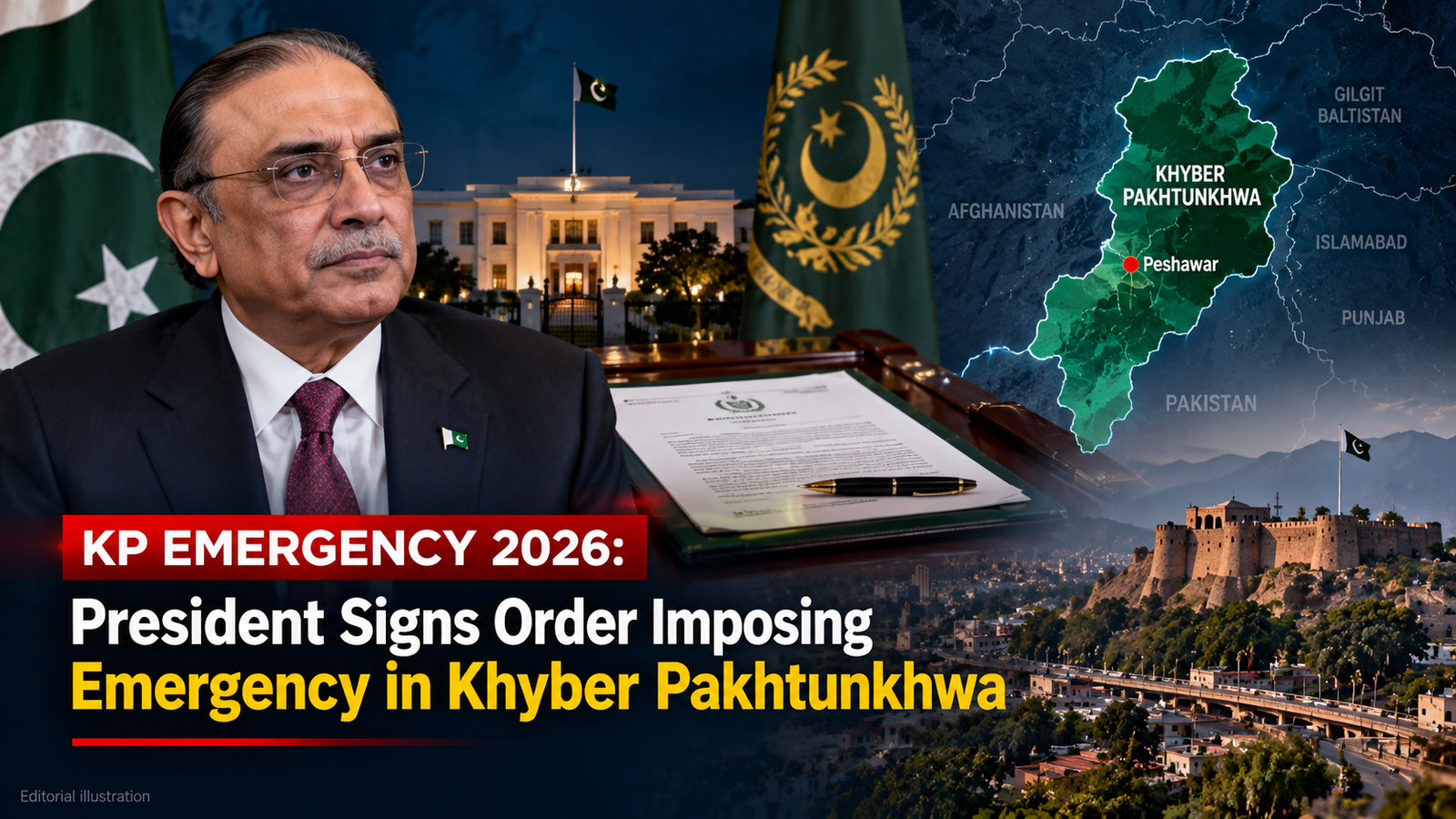
Likewise, the presidential signature should not be illustrated as a documentary signing photograph unless an authentic image of that particular moment has been independently verified. Mukhbir’s featured image is an editorial graphic, not evidence of the ceremony.
What happens next?
Attention will now turn to published notifications, constitutional procedures for review and approval, possible court challenges and practical administration under the new arrangement. The timeline and duration must be assessed against official documents and any subsequent legal decisions.
The government will continue to be questioned about security outcomes, while opposition representatives are expected to press their objections through political and potentially judicial channels. Their positions should be attributed, with no assumption that one account has been legally validated.
Any further detention, cabinet appointment, protest restriction or internet-service change must be checked as a separate development. A developing political story can change quickly, and retrospective updates should indicate when new facts became available.
As of October 12, the confirmed core fact is that President Asif Ali Zardari signed the KP emergency summary on October 11 following the prime minister’s advice under Articles 232 and 234. The broader consequences remain subject to implementation and legal scrutiny.
Frequently Asked Questions
Who signed the KP emergency order in 2026?
President Asif Ali Zardari approved and signed the summary on October 11, 2026, acting on Prime Minister Shehbaz Sharif’s advice, according to the President Secretariat.
When was emergency imposed in Khyber Pakhtunkhwa?
The presidential approval and announcement were made on Sunday, October 11, 2026.
Which constitutional articles were invoked?
The President Secretariat identified Articles 232 and 234 of Pakistan’s Constitution, covering emergency powers and Governor’s Rule.
Is the emergency nationwide?
No. This particular order concerned Khyber Pakhtunkhwa, not every province of Pakistan.
Why did the government recommend emergency?
Federal officials cited security conditions and concerns over counterterrorism coordination. PTI disputed the government’s characterization.
Who was Pakistan’s president when the order was signed?
Asif Ali Zardari was president and signed the summary, according to the official President Secretariat statement.
Did the emergency automatically suspend all fundamental rights?
The reports do not support that claim. Article 233, concerning certain rights-related measures, was not mentioned in the signed summary reported by Dawn.
What should people monitor next?
Follow official provincial and federal notifications, court proceedings, administrative changes and locally verified service or security advisories.
About The Author