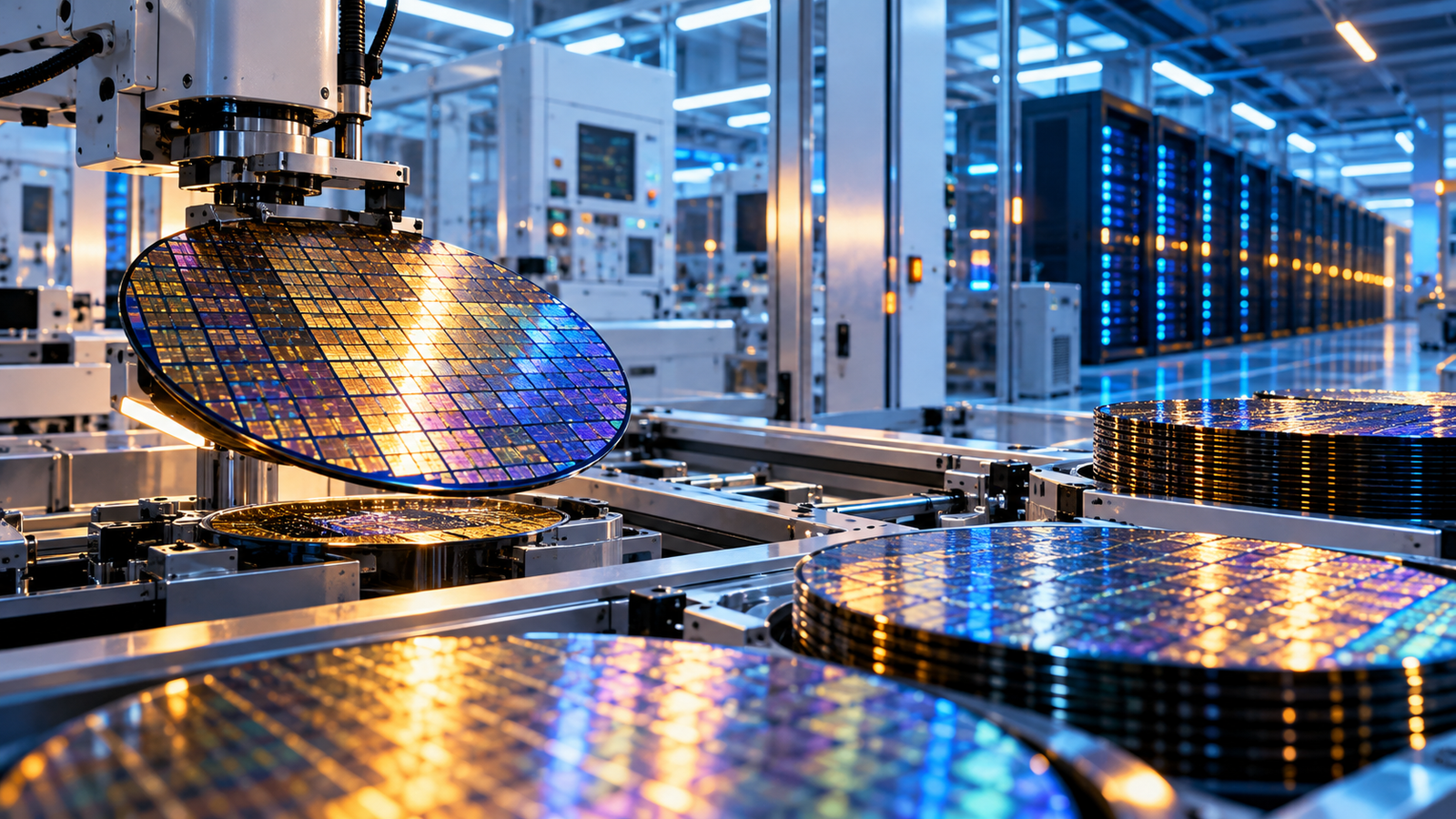
TSMC record profit 2026 expectations are rising after the Taiwanese chipmaker reported a surge in third-quarter revenue, reinforcing the scale of global demand for artificial intelligence hardware. Analysts expect Taiwan Semiconductor Manufacturing Company to report a net profit of about NT$746.3 billion ($23.4 billion) for July through September, up approximately 65% from a year earlier, according to Reuters on October 12.
The figure is an analyst forecast, not a confirmed profit result. TSMC will release its detailed third-quarter 2026 financial performance at an earnings conference on Thursday, October 15, at 2 p.m. Taiwan time. Until then, actual earnings, margins and any updated full-year guidance remain pending.
What TSMC has already confirmed is strong sales. Its October 8 revenue disclosure showed September sales of NT$511.86 billion, 54.6% higher than the same month in 2025. Reuters calculated third-quarter revenue of approximately NT$1.49 trillion, a roughly 50% annual increase and above market forecasts.
This combination of confirmed revenue and anticipated earnings has drawn attention across the semiconductor supply chain. TSMC manufactures advanced chips for technology companies and occupies a central position in the infrastructure behind AI data centers, smartphones and high-performance computing.
What is TSMC expected to report?
A Reuters survey of analysts published October 12 points to net profit of NT$746.3 billion in the third quarter, equivalent to roughly $23.4 billion at the exchange rate used in the report. That would be a 65% year-on-year gain and, if achieved, TSMC’s sixth consecutive quarter of record profit.
Reuters said such an outcome would also mark 11 successive quarters of profit growth. Expectations reflect strong spending on AI accelerators, leading-edge manufacturing processes and advanced packaging. However, a consensus estimate can differ from the actual financial results because margins, expenses, currency movements and operating conditions are not known precisely in advance.
The company has not yet published its full Q3 profit statement as of October 12. The official investor calendar sets the third-quarter earnings event for October 15, and the investor-relations page lists October 5–14 as a quiet period. News articles should therefore avoid describing the predicted profit as already earned or officially announced.
Confirmed revenue: what the latest figures show
The most concrete evidence supporting market optimism comes from TSMC’s monthly revenue reporting. On October 8, the company announced consolidated revenue of NT$511.86 billion for September 2026. That represented a 0.6% decline from August but a 54.6% increase from September 2025.
For January through September, revenue reached NT$3,898.73 billion, up 41.1% compared with the first nine months of 2025. These are company-reported figures, also filed with the U.S. Securities and Exchange Commission on Form 6-K. They provide a firmer basis for describing business momentum than analyst earnings forecasts alone.
Based on monthly disclosures, Reuters calculated Q3 revenue at around NT$1.49 trillion, or approximately $46.7 billion, an annual gain of 50%. The reported result exceeded analysts’ roughly NT$1.46 trillion expectation and was above TSMC’s previously stated U.S.-dollar guidance range of $44.6 billion to $45.8 billion.
Revenue is not interchangeable with profit. Revenue measures what the business generates from sales, while net profit reflects costs, taxes and other financial items. The forthcoming earnings release will explain how much of the sales strength translated into earnings, margins and cash generation.
Why AI demand is driving TSMC’s growth
Artificial intelligence systems increasingly depend on specialized processors that can train and run large models efficiently. As cloud providers, technology firms and enterprises build AI infrastructure, chip designers require manufacturing capacity for demanding designs. TSMC benefits by producing advanced semiconductors for customers rather than primarily selling its own branded processors.
Nvidia is among the major companies associated with TSMC’s manufacturing ecosystem, while Apple is an important customer for advanced chips used in consumer devices. Demand from multiple end markets can support utilization, although individual customer volumes and contractual terms are not fully disclosed in the October forecast.
The AI boom also creates demand for advanced packaging. Powerful computing systems often combine processors with high-bandwidth memory and complex interconnections. Packaging technologies, including TSMC’s CoWoS platform, help connect these components in ways that support the bandwidth and performance required for AI workloads.
Capacity is important because customers need large numbers of sophisticated chips with acceptable production yields. Expanding manufacturing and packaging lines involves expensive equipment, trained workers, reliable supplies and lengthy qualification processes. Revenue growth may therefore coexist with pressure to invest heavily in new factories.
What are 3-nanometre chips and why do they matter?
The term 3-nanometre refers to a generation of semiconductor process technology, not the literal measurement of every transistor feature. More advanced process generations generally aim to improve combinations of computing performance, energy efficiency and transistor density. Real-world outcomes depend on each chip’s design and manufacturing characteristics.
Reuters reported that analysts expect demand for 3-nanometre production to support a stronger outlook. High-performance computing and premium smartphones are among the areas where leading-edge processes can matter. The broader significance is that advanced foundry technology can help designers build more capable processors within practical power budgets.
Manufacturing at the leading edge is technically difficult and capital-intensive. Engineers must control tiny defects, manage heat and power requirements, and maintain high yields. Only a small number of manufacturers have the resources and experience to compete at this level, making reliable capacity strategically valuable.
The relationship between technology leadership and profits is not automatic. New processes can initially be costly, and pricing depends on capacity, customer demand and competition. Investors will watch TSMC’s commentary on utilization, process mix and yield-related economics during the upcoming earnings call.
Margins, forecasts and the October 15 earnings test
TSMC’s official Q3 guidance, available on its investor-relations website before the full results, projected gross margin of 65%–67% and operating margin of 56%–58%. Those ranges are management’s earlier expectations, not confirmed third-quarter outcomes. The earnings release will show whether the company met or exceeded them.
Gross margin measures revenue remaining after the direct cost of sales, while operating margin also reflects operating expenses. For a capital-intensive manufacturer, changes in utilization, electricity costs, process mix, overseas ramp-up expenses and currency movements can affect profitability.
Reuters reported that Morgan Stanley expected TSMC to lift its full-year 2026 revenue-growth guidance into the low-to-mid 40% range. This is the bank’s view of what management might say, not updated official company guidance. A cautious outlook could affect market sentiment even if reported earnings prove strong.
Investors will also assess capital spending and capacity expansion plans. High demand creates opportunities, but the company must decide how quickly to invest without building more capacity than customers ultimately need. That balancing act is relevant to manufacturers throughout the AI supply chain.
US manufacturing and the supply-chain question
TSMC has committed substantial resources to manufacturing in the United States, particularly in Arizona. Reuters’ October 12 report referred to $265 billion earmarked for Arizona factories and discussion of potential expansion elsewhere, including Texas. Investment figures and possible future locations should not be treated as proof that every proposed facility is built or operating.
Domestic semiconductor manufacturing has become strategically important to the United States because advanced chips are used in commerce, defense systems and digital infrastructure. For TSMC, geographically diversified production could serve customers and reduce some concentration risks, though overseas fabs can involve higher operating costs and complex implementation.
Taiwan remains central to the company’s advanced manufacturing network. Any major change in global capacity requires years of planning, equipment installation and workforce development. Investors should distinguish a proposed project from an approved investment, construction progress and commercial production.
Rising demand also affects suppliers of fabrication equipment, specialty chemicals, packaging technology and chip design tools. Yet not every supplier benefits equally, and their financial results depend on order timing, competition and customer spending decisions.
How the outlook affects Nvidia, Apple and AI companies
For firms designing advanced processors, strong foundry performance can signal that manufacturing partners are meeting substantial demand. AI accelerator makers want reliable delivery schedules and packaging capacity, while smartphone companies prioritize cost, performance and product-release timing.
TSMC’s earnings are therefore watched as an indicator of broader technology spending, even though they do not reveal the exact profitability of Nvidia, Apple or any other customer. A rise in chip production does not automatically translate into equivalent end-user demand growth or customer profit.
Cloud providers and software businesses may ultimately gain access to more AI computing resources as supply expands. Nevertheless, the economics of AI services depend on infrastructure utilization, electricity, hardware depreciation and how much customers will pay. Semiconductor revenue is one part of that larger equation.
Why this story matters for investors and the global economy
TSMC’s expected earnings arrive during a closely watched technology reporting season. Investors are assessing whether extraordinary AI infrastructure spending can continue and whether profits are growing fast enough to justify elevated valuations. A company delivering strong sales can still face stock-market volatility when expectations are extremely high.
Reuters reported that TSMC’s market value had reached around $2.1 trillion and that its shares had advanced sharply during 2026. Such figures are time-sensitive market observations, not fixed values. They help explain why an earnings surprise or a change in forward guidance could influence semiconductor shares well beyond Taiwan.
A strong chip manufacturing sector also affects trade, machinery orders, electricity demand and cross-border investment. The IMF separately noted on October 12 that AI investment was supporting economic activity in Asia, where hardware production is concentrated. The size and duration of that contribution depend on continued business demand and broader macroeconomic conditions.
The main risks include slower AI spending, export restrictions, geopolitical disruption, high factory costs and power constraints. None of those risks establishes that growth will stall. They are variables investors should examine alongside revenue, margins and confirmed capital expenditure.
Pakistan and South Asia relevance
The expected TSMC profit has no directly confirmed effect on Pakistan’s economy or a specific local investment project. Its relevance is chiefly through global technology costs, demand for AI services and the semiconductor supply chain. Businesses in Pakistan and South Asia that use cloud computing or advanced hardware may eventually be affected by shifts in chip availability and pricing.
India’s electronics and technology sectors have a more direct interest in global semiconductor investment and manufacturing diversification. However, the October earnings forecast alone does not establish a new factory, partnership or procurement agreement anywhere in South Asia.
For regional startups and software exporters, the most practical lesson is to monitor how AI infrastructure costs evolve. Better chip capacity may expand access to computing services, but actual affordability also depends on cloud-provider pricing, currency rates, electricity and connectivity.
What happens next for TSMC?
TSMC’s official third-quarter earnings conference is scheduled for October 15, 2026. The key figures will be reported net profit, gross margin, operating margin, capital spending and management’s updated assessment of customer demand. The announced results, rather than an analyst consensus, will determine whether a sixth straight record-profit quarter has actually occurred.
Markets will also focus on management’s outlook for advanced 3-nanometre manufacturing, CoWoS packaging and overseas facilities. If the figures or forecast differ materially from expectations, the reaction could extend to chip designers, equipment suppliers and broader technology indexes.
As of October 12, the most accurate summary is that TSMC has already reported exceptionally strong revenue and is widely expected to announce another record profit. The outcome remains unconfirmed until the company’s scheduled release.
Frequently Asked Questions
Has TSMC already reported record Q3 2026 profit?
No. As of October 12, detailed Q3 net profit had not been released. Analysts expect a record result, and the official earnings announcement is scheduled for October 15.
How much profit is TSMC expected to report?
Reuters reported a forecast of about NT$746.3 billion, or roughly $23.4 billion, representing an estimated 65% year-on-year increase.
What was TSMC’s September 2026 revenue?
TSMC officially reported NT$511.86 billion in September revenue, up 54.6% from September 2025.
Why is AI demand important for TSMC?
AI chip designers need advanced semiconductor manufacturing and packaging capacity. TSMC supplies foundry services that support many of these demanding products.
What is CoWoS packaging?
CoWoS is TSMC’s advanced packaging technology used to connect complex chip components in high-performance computing applications, including AI systems.
When will TSMC announce its Q3 2026 results?
The company scheduled its Q3 earnings conference for Thursday, October 15, 2026, at 2 p.m. Taiwan time.
Is a 65% profit increase guaranteed?
No. It is an analyst estimate. Actual earnings and management guidance could be higher or lower.
How is this development relevant to Pakistan?
The main connection is indirect through semiconductor supply, global AI computing costs and technology business demand. No Pakistan-specific investment was confirmed by this earnings forecast.
About The Author