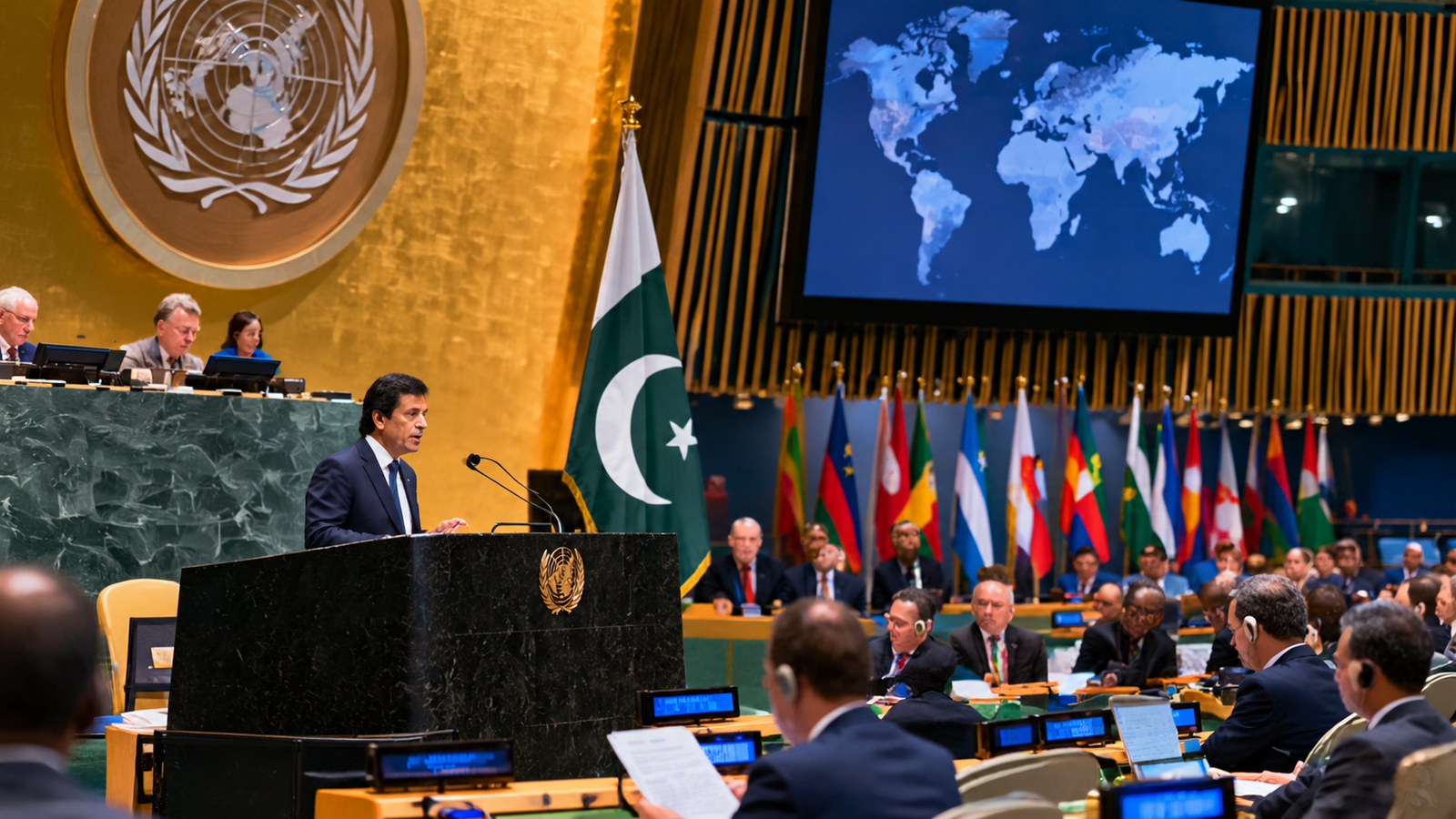
Pakistan has called for strengthening the role of the United Nations General Assembly in international peace and security, particularly when the Security Council is unable to act because of divisions or the use of veto powers.
The proposal was presented during a General Assembly plenary discussion on the implementation of UN resolutions and the revitalisation of the Assembly’s work. Pakistan also called for a dedicated mechanism to monitor how General Assembly resolutions are implemented, along with more regular reporting from the UN Secretariat and the Security Council.
The move is part of a wider debate inside the United Nations over how to improve the effectiveness of the organisation at a time when geopolitical divisions have made consensus on major crises more difficult.
Pakistan’s position focuses on institutional reform rather than a dispute with any individual country. The central argument is that resolutions adopted by the General Assembly should be followed by clearer implementation mechanisms, stronger reporting and more consistent accountability.
What Pakistan Proposed at the UN
According to reporting on Pakistan’s statement, First Secretary Ansar Shah said the General Assembly should be able to exercise its full authority under the UN Charter and play a stronger role when the Security Council is unable to respond effectively.
Pakistan proposed a dedicated mechanism to track implementation of General Assembly resolutions. It also urged regular and more detailed reporting from the UN Secretariat and the Security Council to the Assembly.
The objective, according to Pakistan’s argument, is to reduce the gap between decisions taken in New York and their implementation in practice.
This approach reflects a longstanding concern among many UN member states that resolutions can sometimes be adopted without enough follow-up, leaving governments and the public with limited visibility into whether agreed actions are actually carried out.
Why the General Assembly’s Role Is Under Debate
The General Assembly includes all UN member states and is the organisation’s most representative political body. Unlike the Security Council, where five permanent members hold veto power, every country has one vote in the Assembly.
However, many General Assembly resolutions are non-binding. That means the Assembly can shape international opinion, establish political norms and create institutional frameworks, but it does not have the same enforcement powers available to the Security Council in certain areas.
This difference becomes especially important when the Security Council is divided. In recent years, major conflicts have repeatedly exposed the difficulty of reaching consensus among the permanent members.
As a result, calls for a stronger General Assembly role have grown, particularly among countries that believe the broader UN membership should have more influence when the Security Council becomes deadlocked.
UN Leadership Is Also Pushing for Revitalisation
The debate is not being driven by Pakistan alone. The President of the 81st session of the General Assembly has also made revitalisation a major priority.
In an official statement on October 8, the General Assembly President said the organisation needs to move beyond adopting resolutions and focus more clearly on implementation, efficiency and accountability.
The President announced co-chairs for the Working Group on Strengthening and Revitalising the Work of the General Assembly and called for practical reforms to improve working methods.
Those reforms include reducing duplication, reviewing outdated mandates, improving institutional memory and making UN reporting more concise and useful.
Implementation Is Becoming a Central UN Reform Issue
One of the strongest themes in the current reform debate is implementation. UN member states adopt hundreds of resolutions covering peace, development, human rights, humanitarian issues, governance and international cooperation.
But adoption does not automatically mean action follows. Some resolutions require national implementation, others depend on UN agencies, and some require additional funding or political agreement.
Pakistan’s proposal for systematic monitoring is therefore aimed at creating a clearer picture of what happens after a resolution passes.
Such a system could help member states distinguish between resolutions that are being implemented effectively and those that remain largely symbolic.
Why Reporting From the Security Council Matters
Pakistan has also argued for stronger reporting from the Security Council to the General Assembly. The two bodies have different responsibilities, but both are central to the UN’s political system.
More detailed reporting could help the wider membership understand how the Security Council is handling major international crises, what obstacles exist and where political deadlock is preventing action.
Supporters of this approach argue that greater transparency could improve trust in the UN system. Critics may worry that stronger Assembly involvement could blur the distinction between the roles assigned to the two bodies under the Charter.
The debate is therefore likely to focus not only on whether reform is needed, but also on how to preserve institutional balance.
Pakistan’s Broader Multilateral Position
Pakistan has traditionally supported multilateral institutions and has frequently called for reforms that give developing countries greater representation in global decision-making.
The country has also argued that international institutions should be more accountable, representative and responsive to the wider UN membership.
Recent discussions between Pakistan’s foreign-policy leadership and the President of the General Assembly have also included the need to strengthen multilateralism and improve confidence in international institutions.
The latest proposal fits within that broader diplomatic approach rather than representing a sudden shift in policy.
Global Importance
The question of how the UN works when the Security Council is divided is a major global governance issue. Conflicts, humanitarian crises and geopolitical competition have placed increasing pressure on the organisation’s decision-making system.
If the General Assembly gains a more active role in monitoring implementation or responding politically to Security Council deadlock, that could influence how international legitimacy is built around future crises.
Even without binding enforcement powers, General Assembly votes can carry significant political weight because they reflect the views of the wider international community.
South Asia Relevance
The debate is also relevant to South Asia because countries in the region rely heavily on multilateral forums to advance diplomatic positions, development priorities and security concerns.
For smaller and medium-sized states, a stronger General Assembly can be attractive because it reduces the relative importance of veto power and gives every member state a formal vote.
At the same time, regional governments must balance support for broader representation with the need for an effective Security Council capable of responding quickly to crises.
Business and Economic Impact
The story does not have an immediate direct market impact, but stronger multilateral institutions can affect trade, sanctions, development finance and global economic stability over time.
When international organisations respond more effectively to conflict and instability, businesses may face lower political uncertainty and fewer disruptions to trade routes and investment flows.
Conversely, prolonged institutional deadlock can increase uncertainty, especially when conflicts affect energy markets, shipping routes or financial sanctions.
Technology and Information Impact
The UN reform debate also has a digital dimension. The General Assembly President has called for greater use of digital tools and more modern reporting systems.
Moving from static reports toward secure, multilingual digital platforms could make UN information easier to update and access.
This could improve transparency for governments, journalists, researchers and the public, while reducing duplication inside the organisation.
Political Risk and Neutral Coverage
This story is primarily institutional and diplomatic. It does not depend on allegations against a political party, leader or state, making it suitable for neutral coverage.
The key editorial requirement is to distinguish clearly between Pakistan’s proposals and decisions already adopted by the United Nations. Pakistan has called for reforms, but those proposals have not automatically become binding UN policy.
Similarly, the broader revitalisation process is ongoing and involves negotiations among many member states.
What Happens Next
The Working Group on strengthening and revitalising the General Assembly is expected to continue discussions during the 81st session.
Member states will consider proposals related to implementation, transparency, reporting and working methods before deciding which reforms have enough support to move forward.
Pakistan is likely to continue advocating for stronger implementation monitoring and a more active General Assembly role, especially in situations where Security Council divisions prevent collective action.
The most important question will be whether member states can translate broad support for UN reform into specific institutional changes that improve effectiveness without creating new duplication.
FAQs
What did Pakistan propose at the United Nations?
Pakistan called for a stronger General Assembly role, especially when the Security Council is unable to act, and proposed a mechanism to track implementation of Assembly resolutions.
Did Pakistan call for replacing the Security Council?
No. The proposal focuses on strengthening the General Assembly’s role and improving accountability, not replacing the Security Council.
Are General Assembly resolutions legally binding?
Most General Assembly resolutions are not legally binding, although they can carry significant political and diplomatic weight.
Why is implementation tracking important?
It could help member states see whether agreed resolutions are actually being followed and identify where implementation is weak.
Is the UN already considering reforms?
Yes. The 81st General Assembly session has an active revitalisation process focused on efficiency, accountability and implementation.
What role does the General Assembly play in global security?
The Assembly provides a forum for all UN member states and can adopt political resolutions, but it does not have the same enforcement powers as the Security Council.
Why is this relevant to Pakistan?
Pakistan has long supported stronger multilateral institutions and broader representation in global decision-making.
What happens next?
Member states will continue negotiating reform proposals through the General Assembly’s revitalisation process during the current session.
About The Author